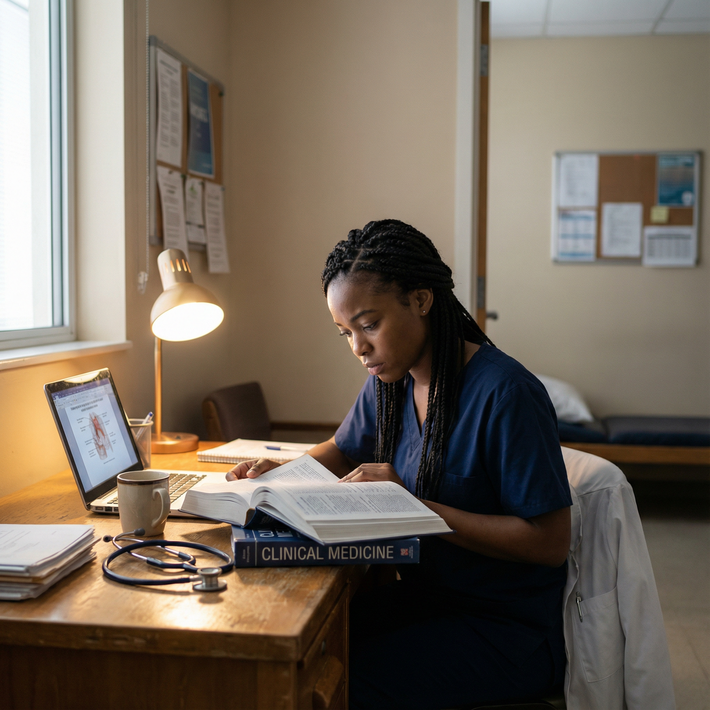
Every application season, at least one talented international graduate loses an interview, sometimes the entire cycle, to a beach, a wedding, or a "quick trip home." I've watched it happen more times than I want to count, and it never looks dramatic in the moment. It looks like a missed email. A portal you couldn't log into from a hotel lobby. A letter of recommendation that sat unuploaded while you were somewhere over the Atlantic.
This article exists to stop you from becoming that story.
Why This Mistake Happens: The Hidden Risk of "Just a Short Break"
The trap sounds reasonable. That's why it works. It's only ten days. What could possibly happen in ten days?
Everything. Everything can happen in ten days.
Here's the collision I see constantly: an international student books a trip home during what looks like a quiet stretch, and then the USMLE scheduling window opens, a transcript verification stalls, a program sends an interview invitation with a 48-hour response window, and a family obligation eats three of the "buffer" days. Add a visa appointment that runs long or a passport held for administrative processing, and your short break becomes a hostage situation.
Time zones make it worse. If you're nine to twelve hours ahead of U.S. Eastern Time, "respond by Friday" can mean Saturday morning where you're standing, after a Friday you slept through.
Understand this clearly: the vacation itself is not the danger. The danger is losing three things at once, awareness of deadlines, responsiveness to messages, and access to stable internet, a working phone, and your secure documents. Lose any one of those for 72 hours during the wrong week, and a year of work can evaporate. I've seen a strong applicant miss an interview offer because she was on a flight with no Wi-Fi. One email. That's all it took.
The Deadline Map You Cannot Afford to Ignore
Before you book anything, you need to know what you're actually protecting. International applicants juggle more moving parts than their U.S. counterparts, and each one has its own clock:
- USMLE scheduling and eligibility periods. Prometric seats in popular international testing centers disappear fast. Rescheduling from abroad isn't always possible on your timeline.
- Score release timing. Scores typically arrive weeks after your test date, on fixed release days. Programs wait on them. So does your ERAS application.
- ERAS submission windows. Programs begin downloading applications on a set date in September. Submitting after that wave puts you behind hundreds of files.
- Letters of recommendation. Your letter writers have their own schedules. An LoR that isn't uploaded before you leave may not upload itself.
- Transcript and credential verification. ECFMG and medical school verification queues move at their own pace, not yours.
- Interview response windows. Some invitations expire in 24 to 72 hours. This is the deadliest item on the list.
Now the part people get wrong: some deadlines are fixed dates, but many are soft deadlines created by processing time, time-zone differences, and program expectations. The fixed date might be mid-September. The soft deadline is the week your school needs to release your transcript, the ten days your letter writer needs, the verification queue that's already backed up in August.
The single most expensive assumption in this process is "I'll catch up when I'm back." No, you won't. By then, the verification queue is longer, the exam seats are gone, and the email that needed an answer in 48 hours got one in two weeks. The window didn't wait for your flight to land.
Short Break vs Long Vacation: What Actually Breaks First
Short breaks and long vacations fail differently, and you should know which failure mode you're buying.
A short break fails on a single point of failure. One missed message. One two-factor authentication code sent to a SIM card that doesn't work abroad. One interview invitation answered on day three instead of day one. The trip is short, but the damage is total.
A long vacation fails by compounding. Multiple milestones slide at once, a score release you didn't plan around, a document request you answered late, a letter that never got uploaded. Then there's the quieter cost: momentum. You come back to a pile of stale tasks and a brain that's still on holiday, and the ramp-back-up week eats whatever buffer you had left.
And don't kid yourself about "short." A five-day trip becomes nine days the moment a flight cancels, a visa appointment reschedules, or a family event expands. Short trips have a way of growing legs.
Cancel or postpone travel immediately if any of these red flags are present:
- Your exam registration or eligibility period isn't fully confirmed
- Any document, transcript, MSPE, photo, credential verification, is incomplete
- A letter of recommendation hasn't been uploaded yet
- Interview season is within six to eight weeks
Notice something in that chart: short breaks are not safe. They're just less catastrophically unsafe. Treat them accordingly.
Before You Leave: The Protective Checklist That Prevents Deadline Disaster
If you've decided the trip passes the risk test, you don't just pack. You build a system. Here's the checklist I make applicants complete before they go:
- Write down every deadline between now and sixty days after your return. USMLE, ERAS, LoRs, transcripts, interviews, program-specific dates. All of them.
- Submit anything due within 30 days before you leave. Not "before it's due." Before you leave. Processing delays are not your problem to fix from an airport.
- Save every portal login in a password manager that works offline. ERAS, ECFMG, Prometric, your school portal, your email.
- Set up two-factor authentication that doesn't depend on your home SIM. Use an authenticator app and print backup codes. A text message to a dead phone number is not a security method; it's a lockout waiting to happen.
- Set layered alerts. Calendar alarms adjusted to your destination's time zone, email filters that flag words like "interview," "deadline," and "action required."
Then build your coverage plan. Designate one trusted person, a classmate, a sibling, a mentor, who knows your timeline and has permission to call you, not just email you, if something urgent lands. Prepare a travel folder with digital and printed copies of your key documents. And identify exactly where you'll have stable internet at predictable times: a hotel business center, a coworking space, a relative's house with reliable broadband, a local SIM with real data.
One more warning, and I mean this: your memory is not a system. Every applicant who told me "I'll remember, it's important" remembered eventually. Eventually is not a deadline strategy. Deadlines get written down, cross-checked against the official calendar, and buffered. No exceptions.

If You're Already Away: Damage Control Without Panic
Maybe you're reading this from a relative's living room twelve time zones away. Fine. Don't panic, but don't relax either. Do this:
- Check your email and every portal daily, at a fixed time aligned to U.S. business hours. Morning in New York is evening in Lahore. Set your check-in for their morning, not yours.
- Guard your connectivity like it's oxygen. Local SIM with data, charged power bank, devices never below 40%.
- Answer time-sensitive messages immediately. Interview slots are often first-come, first-served. "I'll reply tonight" is how people end up waitlisted.
If connectivity fails or a delay blindsides you, move fast: contact the program or school early, not after the deadline passes. Document everything, screenshots, timestamps, evidence of the outage or delay. Ask respectfully for clarification or an accommodation.
And here's the hard truth nobody wants to hear: if you've already missed a deadline, do not hide it. Do not wait and hope nobody noticed. They noticed. Respond quickly, state the facts plainly, take responsibility, and ask what options remain. Programs forgive honest, prompt communication far more often than they forgive silence. Silence reads as indifference, and indifference is fatal.
How to Decide: Is This Trip Safe or a Scheduling Trap?
Run every proposed trip through one filter: does it overlap with any submission, verification, interview, or score-release window? If yes, it's high risk. Full stop. Overlap doesn't mean the deadline falls during your trip, it means the response window does.
My conservative rule for international applicants: travel only when there's a clear buffer of at least one week before and after every critical deadline, two weeks during interview season. If you can't draw that buffer on a calendar, the trip is a trap wearing a vacation costume.
Protecting your timeline is worth more than protecting a vacation date. The vacation can move. Match day can't.
Summary: The Safe Way to Take Time Off Without Losing Your Spot
Short breaks are only safe when three things are fully controlled: your deadlines, your access, and your responsiveness. All three. Not two.
The practical rule is blunt: if you can't check email, submit documents, or respond inside the deadline window from wherever you're going, you don't go yet.
Plan the break around the application. Never the application around the break. One of those is flexible, and it isn't the one that decides your career.
Key Takeaways
- Never assume a short vacation is harmless. One missed email or one delayed document can cost you a USMLE seat or an ERAS opportunity.
- Build buffer time before every critical deadline, and treat travel as unsafe whenever response speed, internet access, or document control is uncertain.