
The biggest mistake international students make with USMLE is pretending their school calendar and the US exam calendar are compatible. They are not.
If you’re an IMG, you live in two worlds: your local curriculum and the U.S. licensing schedule. They do not line up automatically. You have to force them to line up. On purpose. Early.
I’ll walk you through a concrete, time-stamped plan: from premed / early med school up to graduation, month by month and then tightening into “at this point you should…” checkpoints for Step 1 and Step 2 CK.
Big Picture: Where USMLE Fits in an IMG Timeline
Before we zoom into months and weeks, you need the overall skeleton.
For most IMGs who want a U.S. residency:
- Step 1:
- Ideally: Late basic sciences / end of preclinical years
- Realistically: Anywhere from 3rd–5th year, depending on your school’s structure
- Step 2 CK:
- Ideally: Within 6–18 months after Step 1, during/after strong clinical exposure
- Needs to be done: Before ERAS submission for your target Match year (by July–August of application year for most specialties)
Here’s how those anchor points line up if you’re aiming to apply for residency in September 2029 (for a July 2030 start), just as an example:
| Milestone | Target Timing (for Sept 2029 apps) |
|---|---|
| Step 1 | Jan–Aug 2027 |
| Step 2 CK | Feb–Aug 2028 |
| ERAS Application Open | June 2029 |
| ERAS Submission | Sept 2029 |
| Match Day | March 2030 |
Your school will not arrange this for you. You back-plan from your target Match year and squeeze Step 1 and Step 2 CK into the cracks of your local curriculum.
Year-by-Year: From Premed to Final Year
Premed / Before Matriculating to an International Medical School
At this point you should:
- Decide if U.S. residency is a real goal, not a vague “maybe”
- Choose a school that is:
- Listed in the World Directory of Medical Schools
- Eligible for ECFMG certification
- Known to produce successful USMLE takers (ask older students for actual numbers, not glossy brochure nonsense)
Your concrete tasks:
Research USMLE basics (1–2 weeks)
- Understand: Step 1, Step 2 CK, ECFMG, ERAS, NRMP, “Match year”
- Check if your school has an official USMLE prep track or just marketing fluff
Draft a rough 6–8 year arc
- If your med school is 6 years:
- Basic sciences: Years 1–3
- Clinical years: Years 4–6
- Pencil in:
- Step 1 near end of basic sciences
- Step 2 CK during middle of clinical years
- This will change later, but you need a starting hypothesis.
- If your med school is 6 years:
Year 1 of Medical School: Foundations and Positioning
This is where almost everyone wastes a year “getting used to medical school.” You cannot afford that if you’re US-bound.
At this point you should:
- Confirm that your basic science curriculum covers USMLE content (physiology, pathology, biochem, micro, pharm) in a way that can be supplemented, not totally rebuilt.
- Start light USMLE exposure—not heavy prep, but alignment.
Month 1–3:
- Get access to:
- First Aid for the USMLE Step 1 (latest edition)
- A question bank you can pause later (Amboss, UWorld later, but Amboss/USMLE-Rx early is fine)
- Compare your current classes to First Aid:
- Missing physiology depth? Weak on biochemistry? Write that down. You’ll need extra time for those later.
Month 4–12:
- For each basic science block, at this point you should:
- After finishing a unit (e.g., cardio, renal), do:
- 20–30 USMLE-style questions on that system
- Briefly skim the related First Aid pages
- This is not hardcore prep; it’s calibration.
- After finishing a unit (e.g., cardio, renal), do:
Reality check by end of Year 1:
- If you’re struggling just to pass local exams, pushing Step 1 early may be a fantasy. Adjust expectations now, not in Year 4.
- If you’re cruising through content but never touching USMLE-style questions, you’re wasting a big strategic advantage.
Year 2: Turning Your Curriculum Into Step 1 Prep
By now, you know your school rhythm. You also know whether professors actually teach like USMLE (some do, most don’t).
At this point you should:
- Start shaping Year 2 around an eventual Step 1 window at the end of Year 3 (for a 6-year program) or end of Year 2 (for a 4-year Caribbean-style program).
Month-by-month (Year 2):
Months 1–3
- Choose your Step 1 exam quarter (not exact date yet, but something like “June–August next year”).
- Map your local exam periods, big projects, and holidays.
You’re looking for a 6–10 week gap where:
- You will not fail local exams
- You can study ~40+ hours/week
- Travel to a Prometric center is realistic
Months 4–6
- Start more systematic Step 1 work:
- Pick a primary resource set:
- Pathoma or Boards & Beyond or similar
- Anki (if you’ll actually use it daily)
- Start a low-volume QBank habit:
- 10–15 questions on weekdays, system-based matching current coursework
- Pick a primary resource set:
- At this point you should:
- Have a draft Step 1 target window on your calendar
- Know where your nearest Prometric center is and how far in advance it fills
Months 7–12
- Intensify content integration:
- For any system you finish in school, aim to have:
- Watched key Step 1 videos
- Done 50–100 questions on that system
- For any system you finish in school, aim to have:
- Talk to seniors who actually took USMLE, not just talk about it:
- Ask:
- When did you take Step 1?
- Clash with local exams?
- Regrets about timing?
- Ask:
Year 3: Locking In Step 1 – Month-by-Month, Then Week-by-Week
Assume a typical 6-year program with basic sciences in Years 1–3. Adjust the year numbers if your structure is different—the logic is the same.
Month 1–2 of Year 3: Commit to a Step 1 Testing Block
At this point you should:
- Select a 3-month testing window (e.g., June–August 2027)
- Check:
- Local end-of-year exams
- Required clinical observerships
- Visa/travel issues if Prometric center is in another country
Your goal: create a 6–8 week dedicated period just before your Step 1 date.
Example:
- Local exams: April–May
- Break: June–August
- Plan:
- May: finish local exams
- June–July: dedicated Step 1 study (6–7 weeks)
- Late July: take Step 1
- August: rest / light clinical intro
Month 3–6: Pre-Dedicated Prep
By this stage, you’re in serious territory.
At this point you should:
- Be doing 40+ QBank questions 4–5 days/week
- Have done at least:
- One NBME self-assessment (offline or online) by Month 6
If your first NBME predicted score is way below competitive range, you do not cancel USMLE plans yet. You adjust:
- Identify weakest systems (often neuro, renal, biochem)
- Allocate extra time in your dedicated block accordingly
Month 7–9: Dedicated Step 1 Study Block (6–8 Weeks)
Here’s where “aligning curricula” stops being theoretical. You’re either protected from local obligations or you’re fighting fires from both sides.
During dedicated, a typical IMG schedule:
- 6 days/week, 10–12 hours/day (including breaks)
- 1 day/week lighter or off
Weekly structure:
- 5 days: 2 blocks of 40 timed QBank questions (UWorld, timed, random or system-based early weeks)
- Daily review of missed questions
- 2–3 hours content review (Anki + key videos + First Aid)
At this point you should (by week):
Week 1–2 of Dedicated
- Take a baseline NBME early in week 1, uncomfortable as that feels
- Adjust your plan based on:
- Score
- Question breakdown by system
Week 3–4
- Increase QBank volume to 80 questions/day if your review quality stays high
- Take another NBME at the end of week 4
Decision checkpoint (end of Week 4)
- If NBME is still catastrophically low and not improving:
- You may need to move the exam within the same eligibility period or push to the next, if allowed and if it doesn’t blow up your school schedule
- If trending upward and within 10–15 points of your target:
- Stay the course
Week 5–6
- Shift more to mixed random blocks
- Focus on high-yield weak areas
- Take 1 NBME per week
Last 3–4 days before exam
- Scale back to:
- 40–60 questions/day
- High-yield review (tables, formulas, biostat, ethics)
- Sleep. Non-negotiable.
Slotting Step 2 CK into an International Curriculum
Once Step 1 is done, most IMGs either relax too much or panic about clinical exposure. You need neither.
Step 2 CK is where clinical years and USMLE planning smash together.
Aligning Clinical Years with Step 2 CK
At this point (right after Step 1), you should:
- Take 1–2 weeks off, then:
- Start preparing a Step 2 CK timing plan based on:
- When your core rotations occur (IM, surgery, peds, OB/GYN, psych, family)
- Your target residency application year
Core principle:
You want Step 2 CK after you’ve completed most core rotations but before your ERAS submission for your desired Match.
For a target ERAS submission in September 2029, ideal Step 2 CK date range:
- February–August 2028 (so your score is back and on your application)
Year-by-Year / Month-by-Month for Step 2 CK
Assume:
- Year 4–6: clinical years
- You took Step 1 at the end of Year 3
Year 4: Early Clinical Exposure
At this point you should:
- Focus on doing one clerkship at a time really well
- Start noting which rotations match Step 2 CK weighting:
- Internal medicine, pediatrics, OB/GYN, surgery, psych are all core
Month 1–12 of Year 4:
- For each rotation:
- Study with a U.S.-oriented resource (e.g., OnlineMedEd, UWorld Step 2 CK questions for that rotation, internal medicine handbooks)
- Do 10–20 Step 2-style questions per day during lighter rotations
You’re not in “dedicated” yet, but you’re quietly building a base.
Year 5: Locking the Step 2 CK Window
By early Year 5 at the latest, you decide your Step 2 CK quarter.
At this point you should:
- Map:
- Remaining rotations
- National/local exams
- Any planned U.S. electives or observerships
Your target:
- Finish most core rotations at least 2–3 months before Step 2 CK
- Carve out 4–6 weeks of semi-dedicated or dedicated study
Example:
- Finish cores by December 2027
- Light local duties Jan–Feb 2028
- Step 2 CK in March 2028
Dedicated Study for Step 2 CK (4–6 Weeks)
Step 2 CK dedicated is more compressed but just as intense.
At this point you should:
- Have:
- UWorld Step 2 CK QBank (ideally 50–70% completed before dedicated)
- At least one NBME/CCSSA baseline before dedicated
Weekly plan during dedicated:
- 2 blocks of 40 questions per day (timed, random, mixed)
- Aggressive review of explanations and wrong answers
- Systematic review of weak areas (OB complications, psych meds, infectious disease, etc.)
Timeline within dedicated:
Week 1
- NBME/CCSSA at the start
- Identify 3 worst domains (e.g., OB, neuro, renal)
Week 2–3
- Heavy focus on weak areas with:
- Extra questions
- Targeted video review
Week 4
- Two self-assessments spaced 5–7 days apart (e.g., NBME + UWSA)
- If numbers are reasonably aligned and in target zone: keep your test date
If your Step 1 performance was mediocre, Step 2 CK becomes your redemption shot. I’ve seen IMGs drag themselves from a poor pass on Step 1 to a strong Step 2 CK and still land good internal medicine positions. But only because they scheduled Step 2 CK early enough that they had time to regroup if needed.
Matching Your Exams to Application Deadlines
Here’s where many IMGs miscalculate: they align their exams with their graduation, not with ERAS deadlines.
You don’t time Step 2 CK to “when I’m finally done with rotations.” You time it to “when I need a score on my ERAS.”
At this point (two years before your planned application), you should:
- Choose your Match year definitively
- Backward-plan:
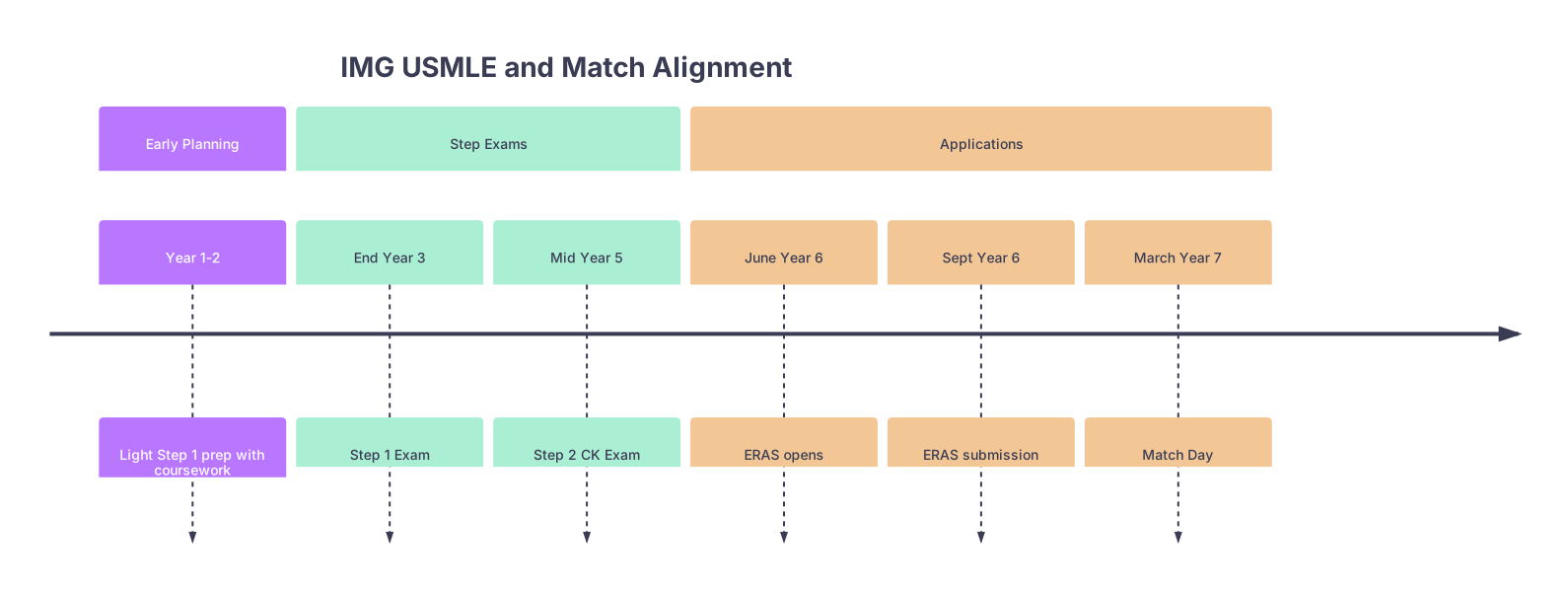
| Period | Event |
|---|---|
| Early Planning - Year 1-2 | Light Step 1 prep with coursework |
| Step Exams - End Year 3 | Step 1 Exam |
| Step Exams - Mid Year 5 | Step 2 CK Exam |
| Applications - June Year 6 | ERAS opens |
| Applications - Sept Year 6 | ERAS submission |
| Applications - March Year 7 | Match Day |
Your non-negotiable checkpoints:
- Step 1: Done at least 1.5–2 years before ERAS open
- Step 2 CK: Done no later than July–August of your application year, earlier for competitive specialties
The further from ERAS your exams are, the more time you have to remediate, repeat (if absolute disaster), or re-strategize.
Typical IMG Timing Patterns (and What Actually Works)
Let me be blunt. I’ve seen several patterns:
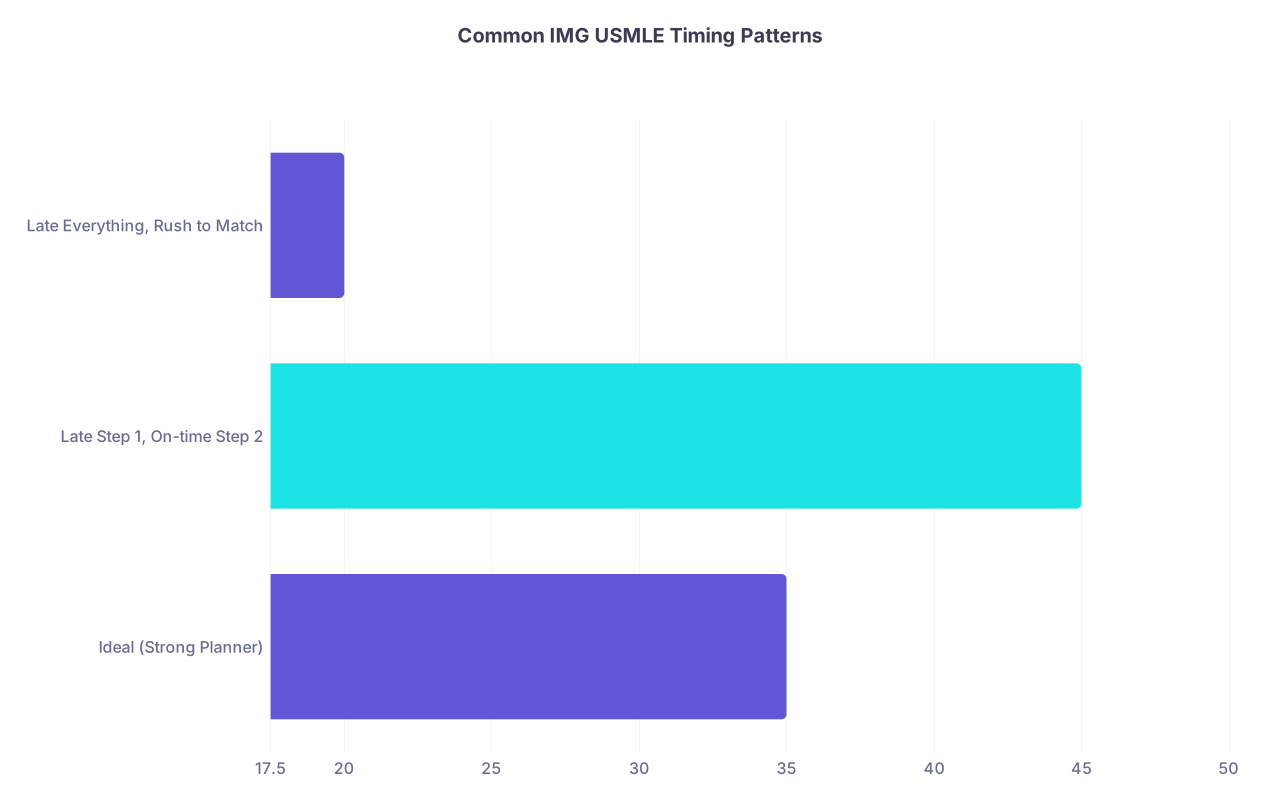
| Category | Value |
|---|---|
| Ideal (Strong Planner) | 35 |
| Late Step 1, On-time Step 2 | 45 |
| Late Everything, Rush to Match | 20 |
Ideal (Strong Planner)
- Step 1 near end of basic sciences
- Step 2 CK after solid clinical exposure, 12–18 months later
- Exams done well before ERAS season
- These people sleep better and match more reliably.
Late Step 1, On-time Step 2
- Step 1 pushed into early clinical years
- Step 2 CK timed okay but under pressure
- Possible to match, but usually with more stress and fewer specialty options.
Late Everything, Rush to Match
- Step 1 and Step 2 CK both crammed close to graduation
- Scores come back late, some not in time for applications
- These are the students asking in September, “Can I still upload Step 2 after submitting?” Technically yes, strategically ugly.
Your goal is to live in the first group. Maybe the second. Never the third.
Today: Your Next Concrete Step
Do this right now:
- Open a calendar spanning the next 5–7 years (yes, years).
- Mark:
- Your expected med school start and end dates
- Basic science years
- Clinical years
- A provisional 3-month window for Step 1
- A provisional 3–4 month window for Step 2 CK
- Your target ERAS submission year and month
Then, email or message one senior at your school who has already taken USMLE and ask them one question:
“Looking back, would you move your Step 1 or Step 2 CK dates earlier, later, or keep them the same—and why?”
That one answer, combined with your draft calendar, will tell you exactly where to adjust your own timeline.