

The biggest mistake IMGs make with U.S. clinical rotations is starting to plan them the year they want to be in the hospital. By then, the best spots are gone and the paperwork clock has already beaten you.
You need to think in years, not months.
I am going to walk you through exactly when to do what—semester by semester, then zooming in to month-by-month as the rotations get close. Your job is simple: match your current stage and move forward in order.
Big-Picture Timeline: When You Should Be Doing What
Before we drill into semesters, anchor yourself to this:
- Most strong IMGs aim for U.S. clinical rotations in 4th year (and sometimes late 3rd).
- For competitive hospital-based electives and sub-internships, you usually need to apply 6–12 months in advance.
- Visa and document chaos means you should start serious planning 18–24 months before your first U.S. rotation.
Here is the helicopter view:
| Time Before Rotation | What You Should Be Doing |
|---|---|
| 24–18 months | Research options, confirm school rules |
| 18–12 months | USMLE Step 1 prep/timing, documents, short list |
| 12–9 months | Submit applications to hospital electives |
| 9–6 months | Apply to paid externships/observerships |
| 6–3 months | [Visa, housing, health forms, finalize dates](https://residencyadvisor.com/resources/international-med-schools/from-acceptance-to-departure-6-month-checklist-before-moving-overseas) |
Now let us break this down by stage in medical school.
Pre-Med / Before Matriculating Abroad: Set Up the Foundation
At this point you should not be “booking” anything. You should be strategically choosing a school and building a plan that makes U.S. rotations realistic rather than a fantasy.
Before Choosing an International Medical School (Year 0)
At this point you should:
- Check if the school has a real U.S. rotations pipeline.
- Do they have official affiliations with U.S. hospitals?
- Do they appear in VSLO/AAMC lists as a recognized sending school?
- Do recent graduates match into U.S. residencies with U.S. clinical experience listed?
If they cannot name specific partner hospitals or typical U.S. rotation sites, treat all their “U.S. exposure” marketing as air.
Confirm school policies on away rotations.
- When (which year/semester) are you allowed to go abroad?
- What is the maximum number of weeks abroad that will count for credit?
- Do they help with documents like dean’s letters, transcripts, immunization forms?
Choose language and curriculum smartly.
- English-language programs with U.S.-style clinical documentation and SOAP notes put you on better footing.
- Schools with clear exam schedules (so you can predict free months) are much easier to coordinate with U.S. rotation dates.
Early Medical School: First 2 Years (Preclinical)
You will not be applying for rotations yet, but this is when you quietly set up everything that will matter later.
MS1 (or Year 1) – Long-Range Setup (About 3–4 Years Before Rotations)
At this point you should:
Decide your target rotation window.
- For most IMGs aiming for U.S. residency:
- Plan core U.S. electives/sub-Is in 4th year, ideally 6–12 months before your ERAS application year.
- Example: If you plan to apply for residency in September 2028, prime U.S. rotations are July–December 2027.
- For most IMGs aiming for U.S. residency:
Understand U.S. residency timelines.
- That means: ERAS opens June, submit in September, interviews Oct–Jan, Match in March.
- Your U.S. rotations must be done early enough that LORs arrive before your residency application.
Start a skill and documentation folder.
- Keep a running list of:
- Procedures observed/performed
- Volunteer work, research, leadership
- Any certificates (BLS, ACLS, language certificates)
- Future you will need this when programs ask for “clinical experience summaries” or CVs.
- Keep a running list of:
MS2 (or Year 2) – Aligning Exams and Rotation Timing (About 2–3 Years Before Rotations)
At this point you should:
Map your entire remaining school timeline. On paper.
- Mark:
- Core clinical years start and end
- Exam blocks (local finals, national licensing)
- Vacation/breaks
- Any required in-country rotations
- Identify 8–12 week windows in 3rd/4th year that are realistically free enough to go to the U.S.
- Mark:
Decide when you will take USMLE Step 1.
- For many IMGs, the strongest play:
- Finish Step 1 before your first major U.S. rotation.
- Why? Some hospitals and even private externship companies require a passing Step 1.
- For many IMGs, the strongest play:
Start a short list of U.S. target cities and regions.
- Think about:
- Where you have relatives or friends (housing, local support, help with transport).
- Places with multiple hospitals (more rotation options).
- Realistic cost of living (New York vs. midwest community hospitals—very different budgets).
- Think about:
You are still 18–30 months from U.S. rotations, but the calendar is already your main tool.
Transition to Clinical: Planning 18–24 Months Before Rotations
Now we get serious. This is usually late MS2 or early MS3, depending on your program structure.
18–24 Months Before Your First Planned U.S. Rotation
At this point you should:
Clarify your U.S. clinical experience goals.
- Do you need:
- Hands-on electives/sub-internships (for strong letters)?
- Shadowing/observerships (for exposure if your school or visa limits hands-on work)?
- A mix of both?
- Competitive specialties (e.g., dermatology, radiology, ortho) demand earlier and more targeted planning.
- Do you need:
Identify your school’s documentation requirements for away rotations.
- Ask your dean’s or registrar’s office:
- How long they need to process transcripts, letters of good standing, malpractice coverage letters.
- Whether they will sign U.S. host site affiliation agreements.
- Build that delay into your planning. Many IMGs underestimate how slow their own school is.
- Ask your dean’s or registrar’s office:
Build a structured list of target hospitals and programs.
- Use:
- VSLO (if your school participates)
- Individual hospital websites, usually under “Visiting Medical Student” or “International Students”
- Create a simple tracking sheet: hospital, specialty, type (hands-on vs observership), cost, application window, requirements.
- Use:
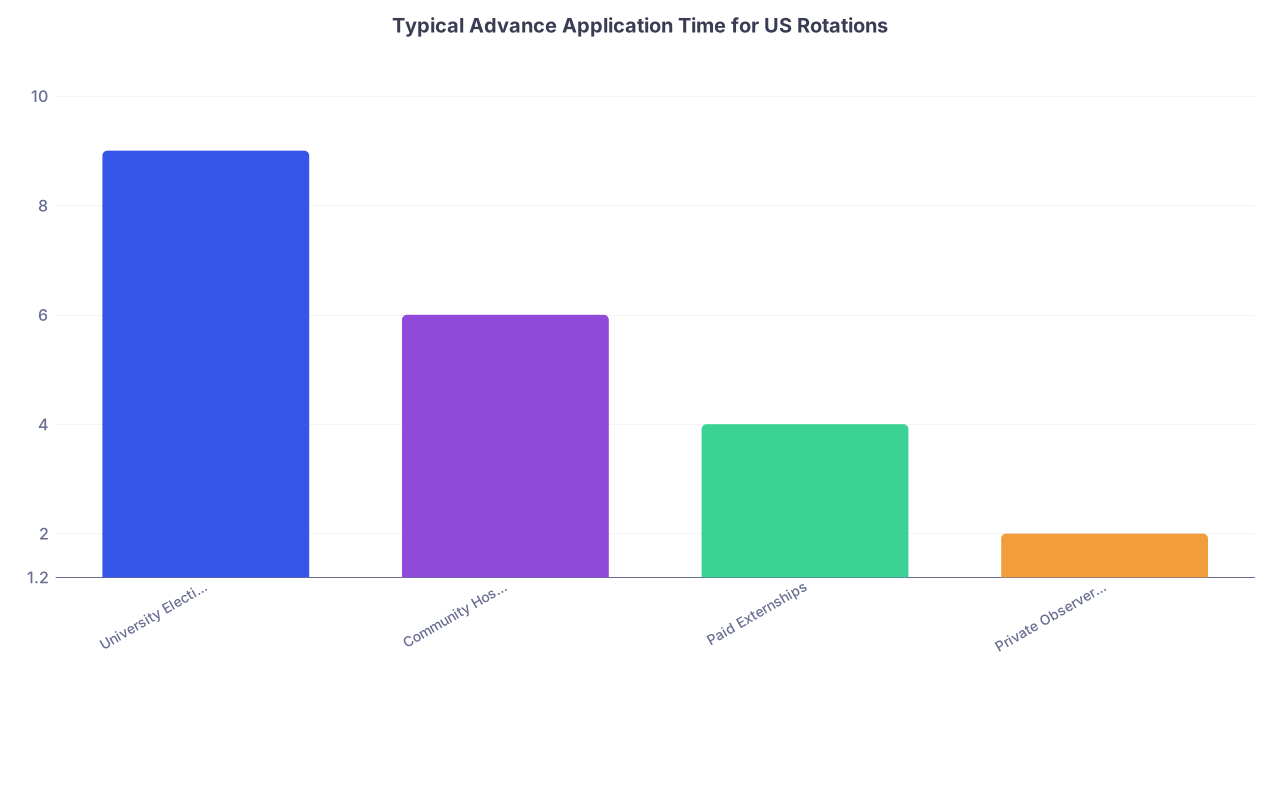
| Category | Value |
|---|---|
| University Electives | 9 |
| Community Hospital Programs | 6 |
| Paid Externships | 4 |
| Private Observerships | 2 |
Those numbers are months in advance. They are not negotiable.
12–18 Months Before: Align Tests, Documents, and Application Windows
This is where students who “start early” actually start. Which is why they are still late.
15–18 Months Before Your First U.S. Rotation
At this point you should:
Lock in your USMLE Step 1/Step 2 CK timeline.
- Ideal scenario:
- Step 1: Done before rotations or at least scheduled so your score will be back before you apply for electives that require it.
- Step 2 CK: Can be done later, but having it done before some U.S. rotations is a plus, especially for IM and surgery.
- Ideal scenario:
Confirm your passport and basic legal documents.
- Passport valid for at least 18–24 more months.
- Secure access to:
- Birth certificate
- Any name change documents
- National ID (some hospitals weirdly ask for it)
Start vaccination and health requirement review.
- U.S. hospitals often require:
- Hep B series and titer
- MMR immunity
- Varicella immunity or vaccine
- TB screening (often within last 6–12 months)
- COVID vaccines/boosters (policy varies over time)
- Some of these take months (Hep B series). You cannot fast-forward them 3 weeks before a rotation.
- U.S. hospitals often require:
12–15 Months Before Your First U.S. Rotation
At this point you should:
Narrow your rotation windows to specific months.
- Example:
- Internal Medicine: October–November 2026
- Family Medicine: January 2027
- Cross-check:
- Does your home school allow you to be away those months?
- Are you free of local exams during those times?
- Example:
Match your windows to each site’s application calendar.
- University hospitals often:
- Open applications 9–12 months before a rotation month.
- Use extremely rigid windows (e.g., apply between February 1–March 31 for the entire upcoming academic year).
- Community hospitals / private externships:
- Often open spots on a rolling basis about 4–9 months out.
- University hospitals often:
Start drafting a basic U.S.-style CV and short personal statement.
- Many sites request:
- CV (1–2 pages, concise, U.S.-friendly format)
- Short personal statement (why you want the rotation, specialty interest)
- Get at least one faculty mentor at your home institution who will be willing to write a general support letter.
- Many sites request:
9–12 Months Before: Submitting Applications for Competitive Electives
This is the prime “application season” for university-based electives and sub-internships.
10–12 Months Before Rotation Start
At this point you should:
Submit applications to your top-choice university electives.
- Especially for:
- Internal Medicine sub-I
- Surgery
- Neurology, pediatrics, OB/GYN at big-name centers
- Make sure:
- All school documents are recent (some sites require transcripts/letters dated within 6 months).
- You meet minimum USMLE / language requirements, if they exist.
- Especially for:
Apply to more places than you hope to attend.
- If you want:
- 8 weeks total of U.S. medicine rotations
- You should be applying to 12–16 weeks worth of spots.
- U.S. programs routinely reject or waitlist international applicants. You need redundancy.
- If you want:
Track responses systematically.
- Keep a log:
- Date submitted
- Date confirmed/accepted
- Fees paid
- Paperwork still outstanding (immunizations, BLS/ACLS, background check, etc.)
- Keep a log:
At this point, you are playing a calendar game. Missing a 1-month application window can push your rotation back an entire year.
6–9 Months Before: Locking in Additional Rotations and Paid Externships
University electives may be pending or partially confirmed. Now you fill the gaps.
6–9 Months Before Rotation Start
At this point you should:
Secure community hospital rotations or paid externships.
- These often:
- Open applications ~6 months before start.
- Are more flexible with dates, especially if they are paid programs.
- If you already have:
- 4 weeks at a big-name university
Fill other weeks with: - 4–8 weeks at a solid community-based IM or FM site.
- 4 weeks at a big-name university
- These often:
Balance observerships vs. hands-on.
- Hands-on U.S. clinical experience (where allowed) is best for letters.
- Observerships are often:
- Easier to arrange last-minute.
- Useful for networking and exposure if your visa or school prevents hands-on work.
- Aim for:
- At least 8–12 weeks total U.S. clinical exposure before applying to residency if possible.
Check logistical realities: costs and housing.
- Start rough budgeting:
- Program/tuition fees
- Housing (short-term rentals, student housing, relatives)
- Transport (local public transit vs renting a car)
- You do not want to “get accepted” and then decline because you realized New York rent is absurd.
- Start rough budgeting:
3–6 Months Before: Visas, Housing, Forms, and Final Details
This is where disorganized students implode.
5–6 Months Before Rotation Start
At this point you should:
Confirm all rotation dates and acceptance letters.
- Get:
- Official acceptance emails/letters with clear dates.
- Contact details for program coordinators.
- Align sequential rotations so you are not stuck with big unpaid gaps between them.
- Get:
-
- For many IMGs, U.S. clinical rotations occur on:
- B-1/B-2 visa (for observerships or short-term electives, depending on hospital policy).
- Sometimes J-1 student visa if part of an official exchange.
- Check:
- What each hosting institution states explicitly about visa type.
- How long current visa wait times are at your consulate.
- For many IMGs, U.S. clinical rotations occur on:
Finalize health and occupational requirements.
- Many U.S. hospitals will ask for:
- Drug screen (often within 30–60 days of start)
- Recent TB test (within 6–12 months)
- Updated vaccination records
- Some of these must be done close to the rotation start. Put them on the calendar.
- Many U.S. hospitals will ask for:
3–5 Months Before Rotation Start
At this point you should:
Book housing and basic local logistics.
- Identify:
- Neighborhood near the hospital that is safe and realistic.
- Commute plan (bus, train, car, walking).
- Book:
- Short-term rental (Airbnb, extended-stay hotels, student housing, or room with relatives/friends).
- Identify:
Prepare financial backup.
- Unexpected costs show up:
- Additional hospital fees
- Extra immunization titers
- Uber rides on call nights when buses have stopped
- Have a buffer; do not go to U.S. rotations with a budget that collapses if one thing goes wrong.
- Unexpected costs show up:
Clarify expectations with your home school.
- Confirm:
- That they will accept the U.S. rotation for credit.
- What paperwork you must bring back (evaluations, signed forms).
- Make sure:
- You are not accidentally delaying your graduation due to misaligned credits.
- Confirm:
1–3 Months Before: Last Checks and On-the-Ground Preparation
At this point, you are close. Now the timing is daily, not yearly.
6–8 Weeks Before Rotation Start
At this point you should:
Complete any site-specific onboarding tasks.
- Online training modules (HIPAA, EMR training)
- Background checks
- Payment of any last fees
Confirm arrival dates and reporting instructions.
- Email the program coordinator:
- Reconfirm your start date and first-day meeting time/location.
- Ask about dress code, ID badges, and any orientation sessions.
- Email the program coordinator:
Organize documents for travel.
- Keep printed and digital copies of:
- Acceptance letters
- Health records
- Insurance documents
- Passport and visa page
- U.S. border officers sometimes ask what you are doing. Having documentation readily available makes that conversation faster and less stressful.
- Keep printed and digital copies of:
2–4 Weeks Before Rotation Start
At this point you should:
Set rotation goals and template for letters.
- Decide:
- Which attendings you hope to impress enough to request LORs.
- Draft:
- A short “CV + summary of my goals” document you can share with them mid-rotation.
- This is not about content; it is about making it easy for them to remember you and write a letter quickly.
- Decide:
Prepare clinically and culturally.
- Review:
- U.S.-style documentation and note formats.
- Common phrases, abbreviations, and clinical workflows.
- Watch or read:
- Examples of U.S. SOAP notes and discharge summaries.
- You do not want to be learning basic EMR functions during precious clinical time.
- Review:
During the Rotation: Daily and Weekly Timing
This guide is about securing rotations, but you also need timing inside the rotation itself.
Week 1
At this point you should:
- Show up early. Every day.
- Identify:
- The attending or senior resident most likely to write you a serious letter.
- Clarify expectations:
- “How can I be most helpful?”
- “What do you expect from visiting students on this service?”
Week 2–3
At this point you should:
- Ask for mid-rotation feedback.
- Simple question:
- “Is there anything I can improve over the next two weeks to be more helpful to the team?”
- Adjust quickly.
- Simple question:
Final Week
At this point you should:
Ask explicitly for letters where appropriate.
- In person if possible:
- “I am applying to U.S. residency next year. Would you feel comfortable writing a strong letter of recommendation for me based on this rotation?”
- Provide:
- CV
- Personal statement draft
- Any specific instructions from ERAS
- In person if possible:
Collect all required evaluation forms for your home school.
If You Are Already Late
If you are reading this less than 6–9 months before you want to be in the U.S.:
- Focus on:
- Community hospitals and private externship/observership programs with rolling admissions.
- Short rotations that fit around your existing commitments.
- Accept that:
- Big-name university electives may be off the table for this year.
- You can still build a credible U.S. clinical experience profile with solid community-based sites and strong performance.
Visual Summary: Planning Timeline by Medical School Year
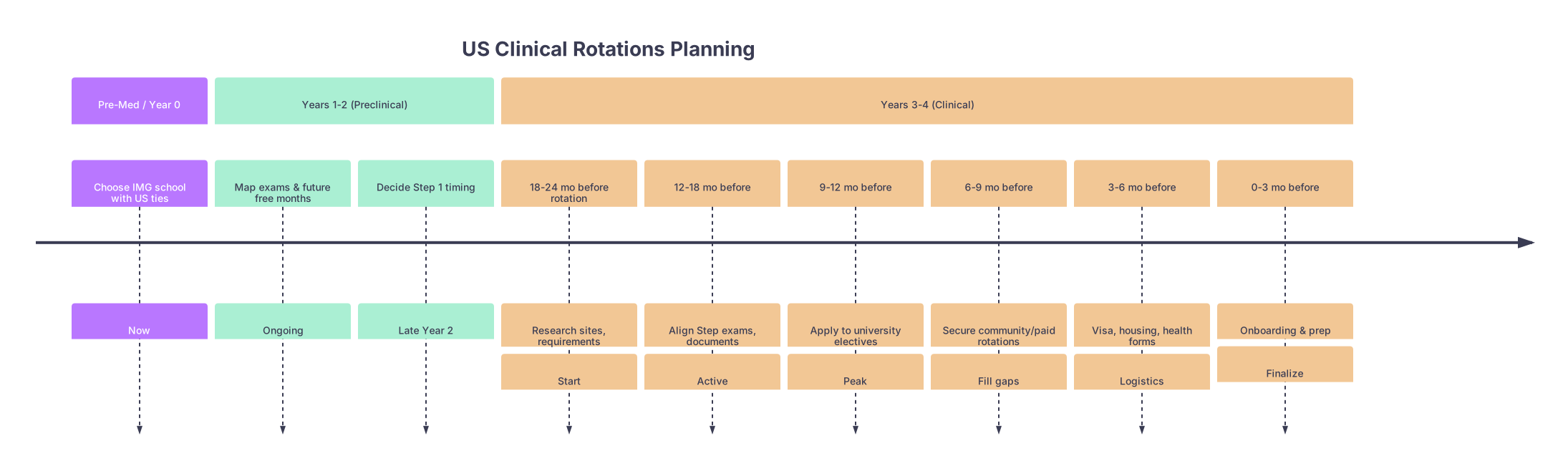
| Period | Event |
|---|---|
| Pre-Med / Year 0 - Choose IMG school with US ties | Now |
| Years 1-2 (Preclinical) - Map exams & future free months | Ongoing |
| Years 1-2 (Preclinical) - Decide Step 1 timing | Late Year 2 |
| Years 3-4 (Clinical) - 18-24 mo before rotation | Research sites, requirements |
| Years 3-4 (Clinical) - 12-18 mo before | Align Step exams, documents |
| Years 3-4 (Clinical) - 9-12 mo before | Apply to university electives |
| Years 3-4 (Clinical) - 6-9 mo before | Secure community/paid rotations |
| Years 3-4 (Clinical) - 3-6 mo before | Visa, housing, health forms |
| Years 3-4 (Clinical) - 0-3 mo before | Onboarding & prep |
Key Takeaways
- The optimal time to start planning U.S. rotations as an IMG is 18–24 months before your first desired rotation; 9–12 months before is when you actually apply to most competitive sites.
- Anchor everything—USMLE timing, home school requirements, visas, housing—to specific rotation months, not vague “sometime in 4th year” ideas.
- Over-apply, over-document, and over-prepare your calendar; the IMGs who win U.S. spots and strong letters almost always started earlier than everyone else.


