

The biggest mistake international med students make is treating their third-year abroad like any other year. If you want a U.S. residency, it is not. It is your launch window.
You do not have the luxury U.S. students have: built‑in core rotations in American hospitals, faculty who know program directors, a dean who can call on your behalf. You have one main weapon—well‑planned U.S. clinical electives and observerships—and the calendar will either work for you or against you.
Here’s the month‑by‑month, then week‑by‑week playbook for using your third year (and the months around it) to line up U.S. residency–relevant electives.
Big Picture: How Your Timeline Must Line Up With U.S. Residency
Before we get into third‑year itself, you need the framework.
For a typical U.S. residency application (ERAS) cycle:
- Applications open: mid‑September (of your final year, or post‑grad year if you apply after graduation)
- MSPE (Dean’s Letter) release: October 1
- Interviews: roughly October–January
- Rank list due: late February
- Match Day: mid‑March
If you’re at an international school with a traditional structure:
- Preclinical: Years 1–2
- Clinical: Years 3–6 (many Caribbean 4‑year schools compress this differently, but the principle is the same)
Your U.S.‑based activity needs to produce:
- Strong U.S. letters of recommendation (LORs) in your target specialty
- Recent U.S. clinical experience (ideally within 12 months of applying, absolutely within 24)
- Evidence you can function in a U.S. system (EMR, rounding structure, communication style)
So your third‑year planning is really backwards planning from your ERAS year.
Year‑by‑Year Anchor: Where Third Year Fits
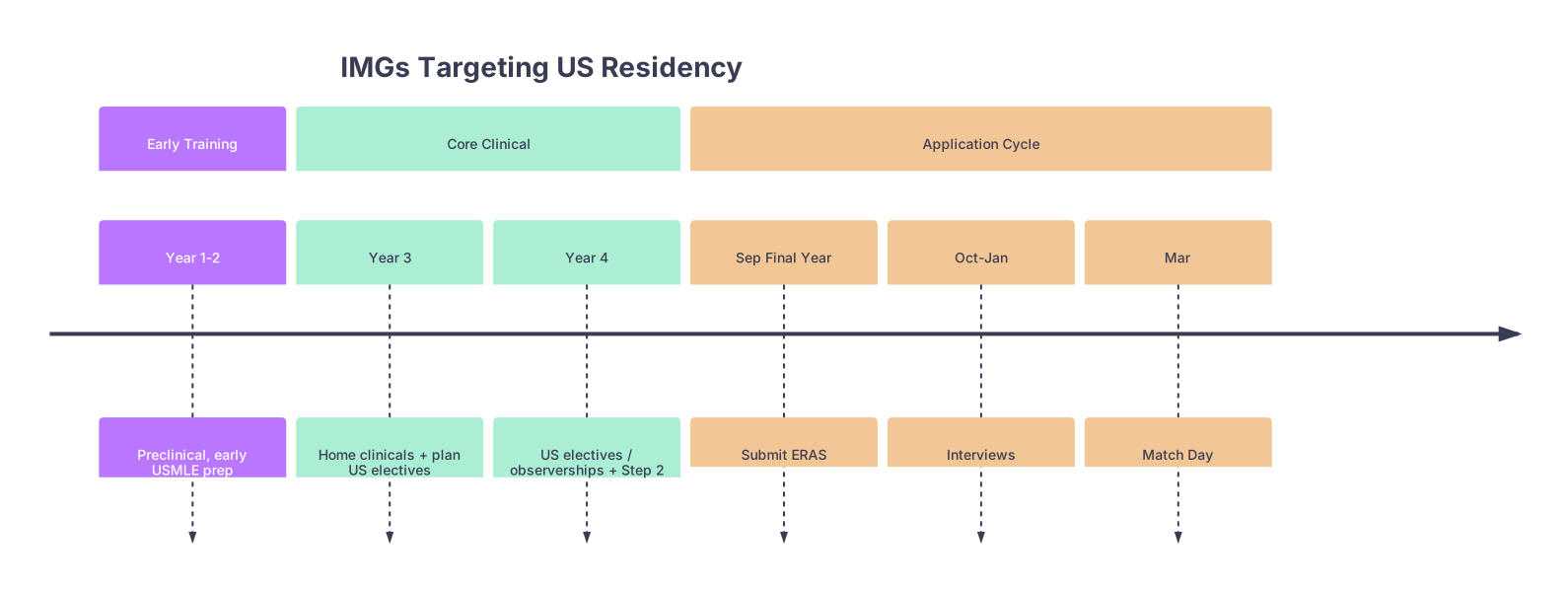
Let me lay out the critical anchors first, then zoom into third year.
| Period | Event |
|---|---|
| Early Training - Year 1-2 | Preclinical, early USMLE prep |
| Core Clinical - Year 3 | Home clinicals + plan US electives |
| Core Clinical - Year 4 | US electives / observerships + Step 2 |
| Application Cycle - Sep Final Year | Submit ERAS |
| Application Cycle - Oct-Jan | Interviews |
| Application Cycle - Mar | Match Day |
If your school is 6 years, shift the labels, but the idea holds: third year is when you lock in where, when, and how you’ll get your U.S. exposure during late 3rd and 4th year.
Third Year: Month‑by‑Month Strategy
I’ll assume a standard academic year: September–June, with some summer flexibility. Adjust by 2–3 months if your school uses a different calendar. And I’ll assume you want to start U.S. residency July after graduation.
Months 1–2 of Third Year: Information Recon and Hard Decisions
At this point you should:
- Decide your likely specialty “cluster”
- Medicine‑leaning: IM, Neuro, Psych
- Procedure‑leaning: Gen Surg, Anesthesia
- Primary care–leaning: FM, Pediatrics, OB/GYN
You do not need to declare “I will be an academic cardiologist.” You do need to know if you’re closer to internal medicine vs general surgery. Because that choice drives which U.S. electives matter.
- Map your school’s clinical calendar
- When are your core rotations (med, surg, peds, OB, psych, FM)?
- When are you actually allowed to do external electives?
- When is your official graduation date? (Residency cares about this.)
Then you start researching U.S. institutions.
At this point you should:
- Build a spreadsheet with:
- Program/hospital name
- Specialty of elective
- Accepting international med students or only U.S. LCME?
- Timing windows (some only accept in Jan–Jun, others year‑round)
- Application opening dates (many are 6–12 months in advance)
- Fees, visa/document requirements
Here’s a crude comparison to keep yourself honest:
| Site Type | Typical Lead Time | IMG-Friendly? | Common Window |
|---|---|---|---|
| Big name academic center | 9–12 months | Limited | Year-round, fills early |
| Mid-tier university hospital | 6–9 months | Variable | Sep–May |
| Community teaching hospital | 3–6 months | More likely | Flexible |
| Paid IMG clerkship agency | 1–4 months | Yes (costly) | Year-round |
| [Observership-only programs](https://residencyadvisor.com/resources/international-med-schools/no-us-shadowing-building-clinical-exposure-before-going-abroad) | 1–3 months | Yes | Year-round |
If you wait until late third year to start this, you’re already shut out of the best options. I’ve seen too many people realize this in May; by then, the brand‑name places are fully booked into next spring.
Months 3–4 of Third Year: Lock Target Months for U.S. Rotations
This is where most IMGs either become strategic—or chaotic.
You need to align three things:
- When your school lets you be away
- When U.S. programs run electives
- When you want LORs relative to ERAS opening
For a standard July residency start after graduation, ideal U.S. elective windows for LOR impact are:
- August–December of the year before you submit ERAS
- Maybe January–March of your ERAS year (but that starts getting late)
So if you’re applying ERAS September 2027, your highest‑impact U.S. electives are roughly August–December 2026.
At this point you should:
- Circle two to three 4‑week blocks in that Aug–Dec window where you can be in the U.S.
- Pick backup months (Jan–Mar) in case you do not get your first choices
- Decide rough content of electives:
- If you’re IM‑leaning: at least 1–2 inpatient internal medicine electives; maybe cardiology, nephro, or heme/onc as a bonus
- If you’re surgery‑leaning: 1–2 general surgery electives; maybe trauma or a surgical subspecialty
- If primary care: FM, outpatient IM, pediatrics, or OB as appropriate
Then start matching schools to those months based on what’s still possible when their portals open.
Key Months to Actually Be in the U.S. (For Residency Impact)
Let me be blunt. Some months are gold. Some are fine. Some are less useful for LORs and visibility.
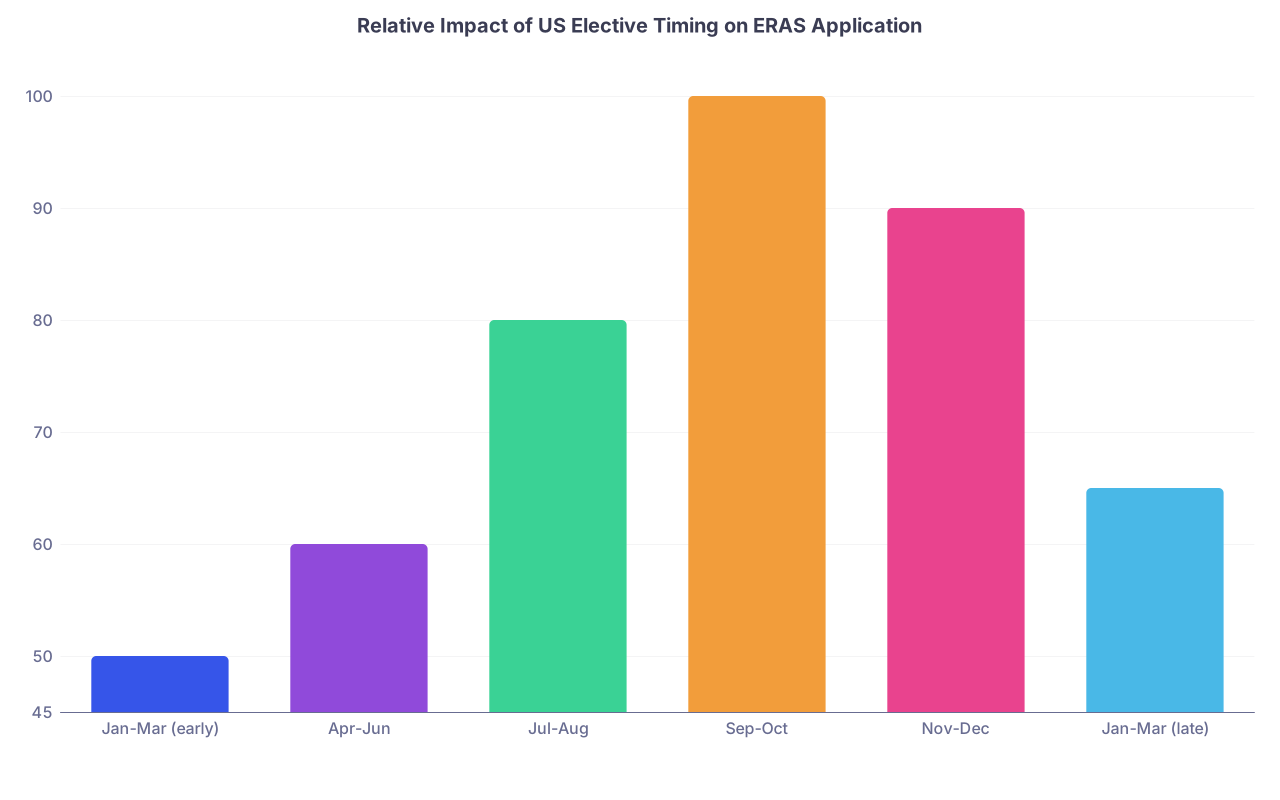
Most Valuable Months for U.S. Electives (for ERAS Impact)
Think in terms of the ERAS cycle.
| Category | Value |
|---|---|
| Jan-Mar (early) | 50 |
| Apr-Jun | 60 |
| Jul-Aug | 80 |
| Sep-Oct | 100 |
| Nov-Dec | 90 |
| Jan-Mar (late) | 65 |
September–October (year before ERAS)
- Peak visibility. Attendings remember you during the next ERAS cycle.
- Your LORs are recent but not rushed. Time to upload and be in place before programs review in bulk.
- You’re present when programs are thinking about recruitment; sometimes you overlap with their own sub‑interns.
November–December (year before ERAS)
- Still great for LORs.
- Slightly less direct overlap with their own interview‑season activity, but attendings are used to writing letters then.
July–August (year before ERAS)
- Very strong. New interns and residents, academics just getting off summer lull.
- Your letters will be ready well in time; some places treat these like “sub‑internship” months.
January–March (year before ERAS)
- Useful for experience and learning the system.
- LORs still fine, but by the time you apply they’re almost 18 months old. Program directors prefer more recent, but still acceptable.
January–March of ERAS year (same year you apply)
- Good for backup letters or updating programs, but many programs will have already made interview decisions.
- Use these months more for “if I don’t match this year, I’ll have very recent U.S. experience next cycle.”
Months That Are Less Efficient (But Sometimes Unavoidable)
April–June any year
- Many academic centers have quirky schedules and student load issues near their year‑end.
- Still fine, but the LOR freshness starts to sag if you’re 18–24 months away from ERAS.
Electives done >24 months before ERAS
- These read as ancient history. You can still list them, but letters from these rotations feel stale.
- If you must, use them to build confidence in the U.S. system and save your “prime” months for later electives.
So for third year, your primary task is not always to do the elective yet, but to reserve your spots for those high‑yield months in late third year and early fourth year.
Concrete Third-Year Calendar: What You Should Be Doing, By Month
Let’s assume:
- You’re starting third year in September 2025
- You aim to apply ERAS in September 2027
- You graduate mid‑2028 and want to start residency July 2028
Yes, that gives you a “gap” but this is a common reality for many international schools. You can also tighten this by one year if your school compresses.
September–October 3rd Year: Decide Specialty Direction + Shortlist Sites
At this point you should:
- Decide your top 2 specialty buckets
- Example: Internal Medicine vs Neurology
- Identify 10–15 U.S. hospitals that:
- Accept IMGs (directly or via visiting student programs)
- Offer electives in your specialty areas
- Check application opening dates
- Example: Some VSLO/VSAS schools open 9 months before the elective start date; some 12.
- Email your dean’s office or clinical coordinator
- Ask: “What documentation do you provide for external U.S. electives?”
- Confirm: “When can I be away for 4–12 weeks without delaying graduation?”
November–December 3rd Year: Align School Calendar With U.S. Target Months
At this point you should:
- Sketch a 12‑month block for late 3rd/early 4th year, marking:
- Required home rotations
- Exam periods
- Allowed elective months
Then, pick:
- Primary U.S. elective blocks:
- Example: July–August 4th year and October 4th year
- Backup blocks:
- Example: November, January
If your school is flexible, aim for two U.S. electives in different institutions during Sept–Dec of the year before ERAS. That gives you two separate letters and two separate network nodes.
January–March 3rd Year: Start Applications for Early Spots
This is the phase most students miss entirely.
At this point you should:
- Submit applications for U.S. electives that open 9–12 months early
- For a September elective, you might be applying in Jan–Mar
- For an August elective, some places want applications by November of the prior year
- Line up paperwork:
- Immunizations, titers
- Background checks
- BLS/ACLS certificates
- Dean’s letter or transcript extracts
You’re also juggling your home clinicals. Yes, it’s a pain. But the students who end up in solid community IM or FM programs in the U.S. are the ones who did this unpleasant administrative grind while their classmates ignored it.
April–June 3rd Year: Confirm Offers + Fill Gaps
By now, you’ll start hearing back.
At this point you should:
- Lock in your highest‑yield months (ideally Aug–Dec of the pre‑ERAS year)
- If nothing hits in Sept–Oct, aggressively pursue:
- November–December slots
- Community hospitals that accept late applications
- Paid but legitimate IMG‑oriented electives if you can’t get anything else
Also, start thinking about Step 2 CK timing. For many IMGs, Step 1 is pass/fail (or done), and Step 2 CK will carry more weight. If you’re aiming for U.S. clinicals in late third/early fourth year:
- Target Step 2 study around a block where you’re not in the U.S., so you’re not wasting precious U.S. time cramming.
Week‑by‑Week: Once You’re Actually On a U.S. Elective
The calendar got you in the door. Your behavior gets you the letter.
Let’s say your first high‑yield elective starts September 1 of the year before ERAS.
Week 0 (Before You Arrive)
At this point you should:
- Email the coordinator: confirm start date, time, where to report
- Read the hospital’s orientation packet and any clerkship handbook
- Review the basics of:
- SOAP notes in their EMR style
- Common admission orders in your specialty
- U.S. abbreviations and documentation norms (they differ from many countries)
Week 1: Prove You’re Safe and Reliable
Your only job this week: demonstrate that you won’t hurt patients and won’t disappear.
At this point you should:
- Show up 10–15 minutes early, every day
- Ask clearly: “What’s the expectation for students here—notes, presentations, follow‑ups?”
- Take 1–2 patients and follow them obsessively (labs, imaging, consults)
- Stay until the team leaves or politely ask when it’s appropriate to leave
Do not ask for letters yet. Just show you’re dependable and not a documentation hazard.
Week 2: Increase Responsibility
If week 1 goes well, week 2 is where attendings start to notice.
At this point you should:
- Offer to present new admissions on rounds
- Ask residents how you can lighten their load
- Volunteer for small but visible tasks: discharge summaries, patient education, calling families (with supervision)
You want someone on the team to say the phrase I’ve heard many times: “For an international student, you’re functioning like one of our own MS4s.” That’s the bar.
Week 3: Signal LOR Interest
By now, your attending has some sense of you.
At this point you should:
- Ask one attending (the one who has seen you most):
- “I’m planning to apply to U.S. residency in [specialty]. If you feel you can write a strong letter, I’d be very grateful for your support.”
- If they hesitate, pivot to:
- “No worries at all; I’d still really appreciate any feedback on how I can improve during the rest of this rotation.”
Better no letter than a lukewarm one. A tepid “he was fine” letter hurts you.
Week 4: Consolidate and Follow Up
At this point you should:
- Send your CV and personal statement draft to the attending who agreed to write
- Confirm how they want you to list their title and department
- Ask the coordinator how letters are submitted (ERAS portal, letter ID, etc.)
- Thank everyone—residents included—and keep their contact details
Same structure applies if your high‑yield month is October, November, etc. For each critical elective, think in 4‑week arcs: safety, growth, ask, close.
Don’t Forget Visa and Travel Timing
Some of you will get everything academically correct and then get wrecked by visa timing.
At this point in third year (while planning), you should:
- Check if you’ll need a B‑1/B‑2 or other visa for electives/observerships
- Estimate consulate wait times 3–6 months before travel
- Avoid scheduling U.S. electives too close to final exams or national holidays in your country; visa appointments get messy then
If you’re from a country with historically slow U.S. visa processing, front‑load your elective scheduling to allow for delays.
Rapid Recap: What Matters Most
You do not need a dozen U.S. electives. You need 2–3, scheduled in the right months, at places where they’ll actually see you as a potential colleague, not just a tourist with a white coat.
By the end of third year, you should have:
- Locked in months: At least 2 high‑yield U.S. elective blocks in July–December of the year before you apply to ERAS.
- Aligned your school’s calendar: Confirmed you can be away those months without wrecking graduation.
- Started and finished early applications: Hit the 6–12 month lead time many U.S. institutions require, not the 2–3 month fantasy timeline your classmates hope for.
If you get those three right, your third year abroad stops being a limitation—and becomes your advantage.


