

The biggest mistake future international MD students make is pretending visas and housing are “logistics” you can sort out later. They are not logistics. They are gatekeepers. If your visa or housing collapses, your medical school start date collapses with it.
I am going to walk you through a disciplined, time‑based plan: month‑by‑month, then week‑by‑week as you get closer, down to what you should be doing in the final days before your flight.
Use this like a checklist, not a novel.
12–9 Months Before Start: Information Reconnaissance and Constraints
At this point you should be planning programs and countries, not booking flights.
12 Months Before Matriculation (or earlier)
You start with constraints, not dreams.
Clarify country + program targets
- Shortlist 2–3 countries and 3–8 schools.
- Note:
- Program language (English vs local language)
- Program duration (4 vs 6 years)
- Typical start month (August? September? January?)
Map the visa category for each country
- Go to each country’s official government/embassy site. Not blogs. Not Reddit.
- Identify:
- Visa type (e.g., “Tier 4 Student Visa,” “D‑Type Study Visa”)
- Minimum passport validity (often course duration + 6 months)
- Financial proof rules:
- Bank balance requirements
- Minimum months funds must have been in the account
- Parent vs student account rules
- Dependents (spouse, children) rules.
- Capture every detail in one place.
Check your passport status
- You need:
- At least 6–12 months beyond the end of your first visa period.
- At least 2–4 blank pages.
- If renewal is needed: start now. Long processing times can delay everything later.
- You need:
Understand housing patterns in your destination
- For each school, determine:
- Is there university housing for international students?
- Is it guaranteed for first‑years?
- Lease start dates (often fixed to semester dates).
- Typical private rental timeline:
- Some cities: 2–3 months out.
- Some: you sign within 1–2 weeks of moving.
- Send short, specific emails to current students or the international office:
“When do incoming international students typically secure housing, and what percentage end up on‑campus vs off‑campus?”
- For each school, determine:
At this point, you are not applying for anything. You are mapping constraints so you do not get ambushed later.
9–6 Months Before Start: Admissions + Critical Lead Time Planning
At this point you should be lining up your admission and timing your visa window.
9 Months Before Start
Application + acceptance timing
- Understand:
- By what month you are likely to receive decisions.
- Whether your offer letter states:
- Start date
- Program duration
- Tuition amount
- Confirmation of full‑time study
(You will need these exact details for the visa.)
- Understand:
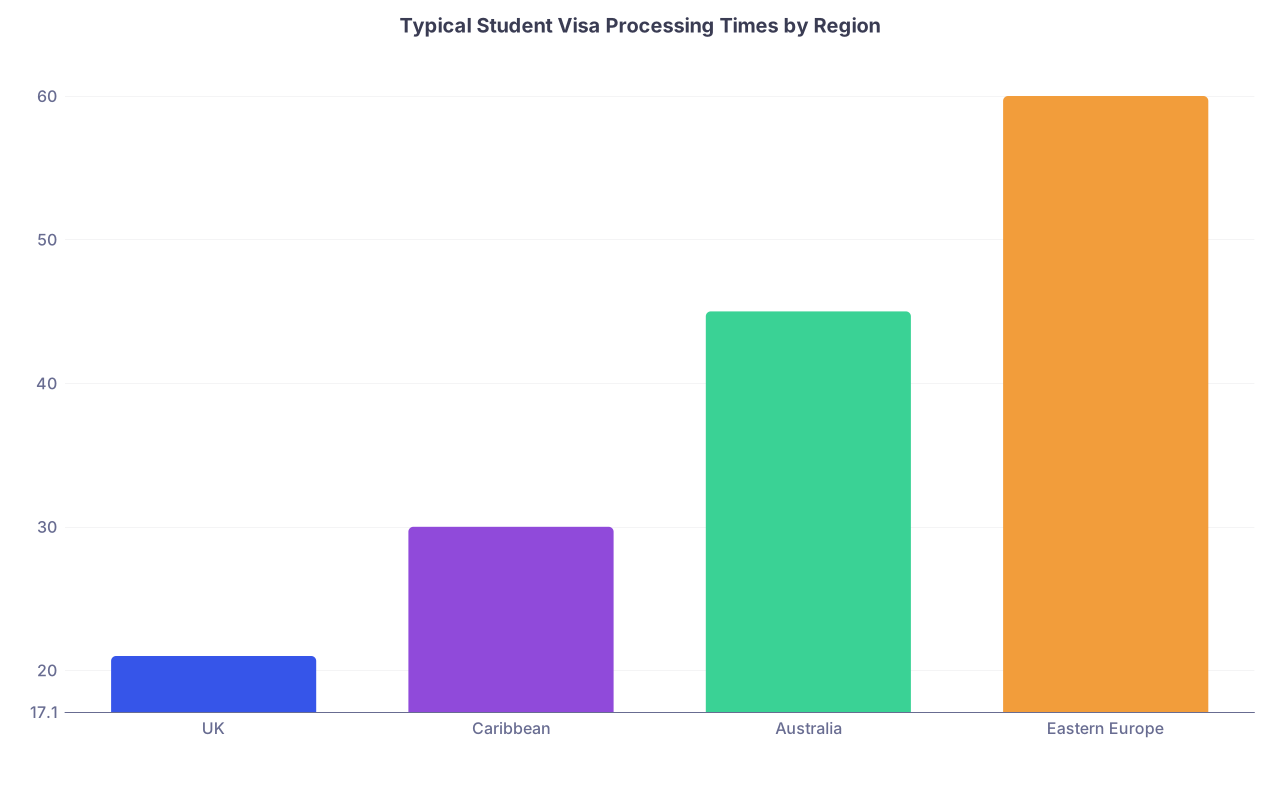
Check visa processing times and appointment bottlenecks
| Category | Value |
|---|---|
| UK | 21 |
| Caribbean | 30 |
| Australia | 45 |
| Eastern Europe | 60 |
- On official sites, note:
- “Processing time after biometrics” (e.g., 15 working days, 6 weeks).
- Typical wait time for an appointment.
- Add 3–4 extra weeks of buffer. Consulates do not care about your orientation week.
- Initial funding and banking plan
- Decide:
- Where the required balance will sit (your account vs parent vs sponsor).
- When funds must be in place. Many countries require they sit there for 28–90 days before you apply.
- If you need an education loan, you start the loan discussions now, not 8 weeks before school.
- Decide:
8–7 Months Before Start
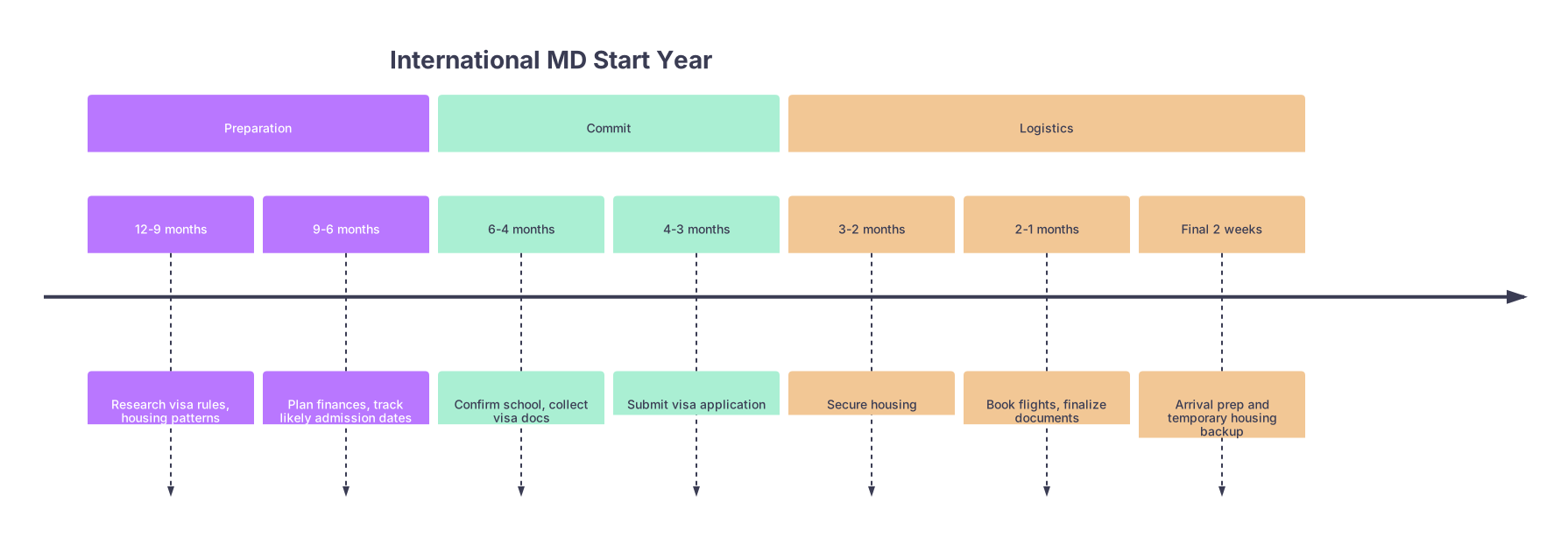
- Conditional timeline draft
You should now build a high‑level timeline:
| Period | Event |
|---|---|
| Preparation - 12-9 months | Research visa rules, housing patterns |
| Preparation - 9-6 months | Plan finances, track likely admission dates |
| Commit - 6-4 months | Confirm school, collect visa docs |
| Commit - 4-3 months | Submit visa application |
| Logistics - 3-2 months | Secure housing |
| Logistics - 2-1 months | Book flights, finalize documents |
| Logistics - Final 2 weeks | Arrival prep and temporary housing backup |
- Pick a target visa application date:
- Usually 3–4 months before classes start.
- Pick a target arrival date:
- 2–4 weeks before orientation.
- Medical + background requirements
- Check whether your destination requires:
- Chest X‑ray / TB test
- General medical exam
- Criminal background check / FBI check / police clearance
- Identify where to obtain these in your country and how long they are valid (some expire in 3–6 months; you must time them carefully).
- Check whether your destination requires:
6–4 Months Before Start: Commitment, Documents, and Proof of Funds
At this point you should have at least one acceptance in hand or be close.
6 Months Before Start
Finalize school choice
- Once you commit:
- Pay the deposit.
- Request the official documents you will need for the visa:
- Formal acceptance / offer letter
- Confirmation of Enrollment (CoE) or equivalent
- Tuition summary / fee schedule
- Any school‑issued housing options info.
- Once you commit:
Visa document checklist build
Create a hard checklist. Example:
- Valid passport (with required validity)
- Offer letter with:
- Full name matching passport
- Program name and duration
- Start date
- Financial documents:
- Bank statements (past 3–6 months)
- Loan approval letter (if applicable)
- Scholarship letters (if applicable)
- Academic records:
- Diplomas
- Transcripts
- Background check
- Medical exam report
- Passport‑sized photos (correct dimensions)
- Visa application forms (download but do not submit yet)
- Proof of language proficiency (IELTS/TOEFL if required)
- Housing plan (sometimes requested)
Print it. Tape it to your wall.
If your country requires, for example, “28 consecutive days of required funds,” this is when you:
- Move money into the chosen account.
- Stop moving it around.
- Make sure the account holder name matches what you will put on the visa forms.
5–4 Months Before Start
Start collecting “slow” documents
- Background check:
- Many police clearances take 2–8 weeks.
- Medical exam:
- If the exam must be within 6 months of arrival, you can do it now or next month.
- Certified translations:
- For any non‑English documents, line up an official translator.
- Background check:
Draft your visa forms (but do not submit)
- Fill everything out offline or in a saved online profile:
- Check for consistency:
- Names match passport exactly.
- Dates match your offer letter.
- Check for consistency:
- This lowers the chance of last‑minute errors.
- Fill everything out offline or in a saved online profile:
Pre‑research housing neighborhoods
- Make a shortlist:
- 2–4 neighborhoods you would actually live in.
- Distance to campus (public transit vs walking).
- Safety profile (ask current students; do not rely on tourist blogs).
- Start bookmarking:
- University residence pages.
- Private rental sites common in that country.
- Facebook groups / WhatsApp groups for current students.
- Make a shortlist:
3–2 Months Before Start: Visa Application + Housing Execution
This is the critical window. At this point you should execute, not research.
3 Months Before Start
- Submit your visa application
Unless your country explicitly forbids early applications, aim for:
- Online application submission: 12–14 weeks before start.
- Biometrics/appointment: As soon as you can get a slot after submission.
Steps this month:
- Double‑check:
- Bank statements meet the minimum period.
- All documents are correctly translated.
- Dates of medical exam and police check are within allowed periods.
- Submit and pay the visa fee.
- Book the embassy/biometrics appointment immediately.
If appointments are scarce, you may have to:
- Book a slot in another city.
- Use a priority service if your budget allows and rules permit.
- Begin serious housing search
This splits into two main paths.
| Option | Pros | Cons |
|---|---|---|
| On-Campus | Simpler, pre-arranged, near school | Limited availability, fixed dates |
| Private Rental | More choice, flexible long-term | Harder to arrange from abroad |
| Temporary Stay | Flexible arrival, scout in person | Extra cost, more moving |
- If university housing:
- Submit the housing application now if it is open.
- Pay deposit / reservation fee as required.
- Ask:
- Exact move‑in date.
- What furniture is included.
- If private rental:
- Prepare documents landlords may ask for:
- Proof of admission.
- Guarantor info (sometimes a domestic guarantor).
- Copy of passport.
- Reach out to reputable agencies recommended by your school or current students.
- Prepare documents landlords may ask for:
10–8 Weeks Before Start
- Visa follow‑up and contingency planning
By now, your application should be under review.
- Track the average processing time.
- If you are approaching the upper limit with no decision:
- Contact the visa center using official channels.
- Avoid multiple unnecessary inquiries. One clear, polite inquiry is enough.
You also create a mental Plan B:
- If visa is late:
- Can you attend orientation online?
- Can your program defer your start by one semester?
- Get a written statement from the school about deferral policies now, not during a panic.
- Firm housing commitments
- On‑campus:
- Receive written confirmation of room assignment.
- Check cancellation rules in case of visa denial.
- Off‑campus:
- Negotiate lease start date:
- Ideally 1–2 weeks before orientation.
- Clarify:
- Deposit amount and refund rules.
- Whether you can sign remotely.
- Whether you need a local bank account (common in some EU areas).
- Negotiate lease start date:
If landlords are hesitant to rent to someone abroad:
- Offer:
- Higher deposit (if you can afford it).
- Proof of parental guarantee.
- Documentation from school confirming enrollment.
6–4 Weeks Before Start: Flights, Overlaps, and Confirmations
At this point you should have visa decision or high confidence it will come in time, and at least a provisional housing plan.
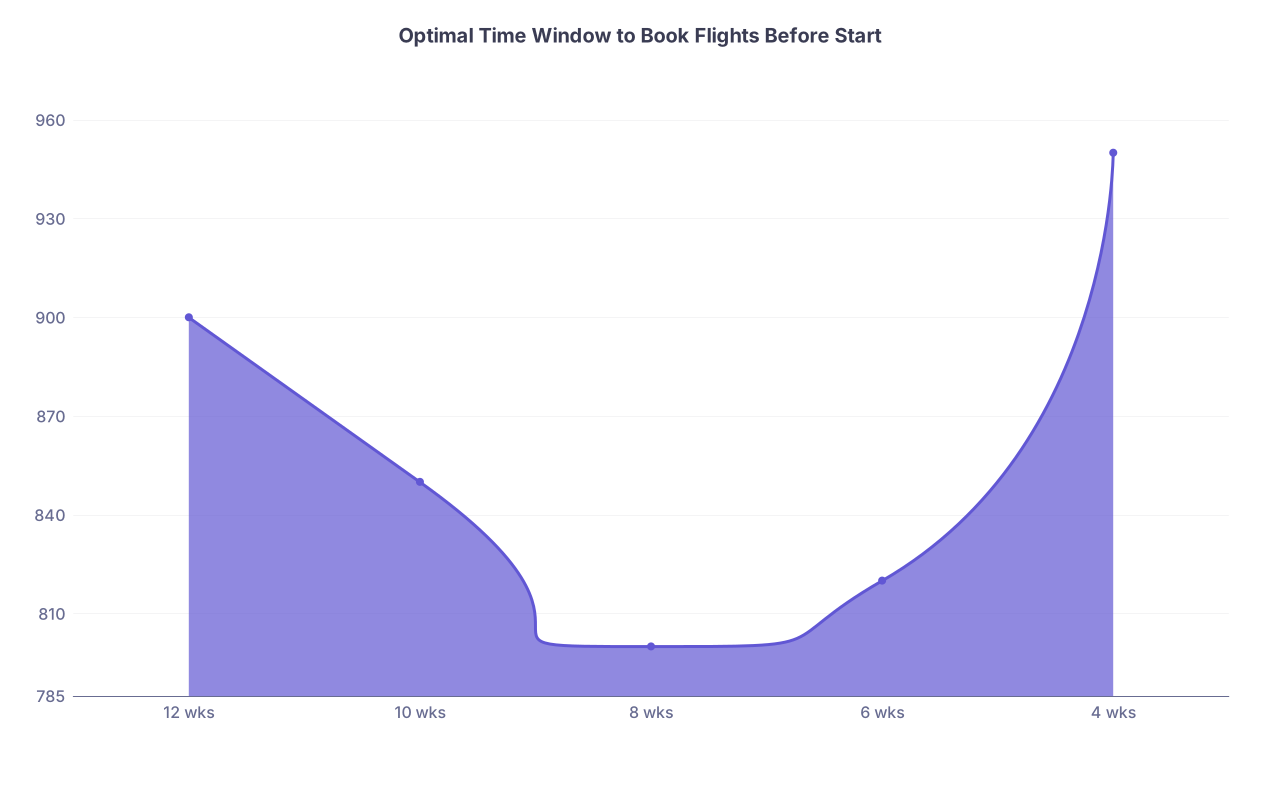
6 Weeks Before Start
- Book flights (if visa approved or virtually guaranteed)
| Category | Value |
|---|---|
| 12 wks | 900 |
| 10 wks | 850 |
| 8 wks | 800 |
| 6 wks | 820 |
| 4 wks | 950 |
- Target arrival:
- 10–14 days before orientation.
- Avoid:
- Arriving the night before orientation.
- Arriving more than a month early unless you have a solid housing plan and budget.
- Layer your housing safely
Basic structure that actually works:
- Long‑term housing:
- Lease or dorm contract starting ~7–10 days before classes.
- Short‑term fallback:
- 7–10 days of cancellable hotel/hostel/Airbnb:
- Check cancellation deadlines (usually 3–7 days before arrival).
- Keep one reservation that you can cancel without penalty once your main housing is confirmed.
- 7–10 days of cancellable hotel/hostel/Airbnb:
- Document pack preparation
Create a physical folder and a digital backup folder:
- Printed:
- Offer letter, housing confirmation, visa approval.
- Insurance documents.
- Emergency contacts (school, landlord, family).
- Digital:
- All of the above as PDFs synced offline on your phone and laptop.
4 Weeks Before Start
- Confirm everything by email
Send three short, pointed emails:
- To housing:
- Confirm move‑in date, key pick‑up procedure, office hours, and payment on arrival.
- To the international office:
- Confirm orientation date, any check‑in documents needed for residency registration.
- To yourself:
- Actually write down:
- Day 1’s address.
- Arrival transport plan (airport → housing route).
- Actually write down:
- Health and insurance
Not glamorous, but non‑optional:
- Verify:
- University insurance vs private policy.
- Visa health‑coverage requirements.
- Carry:
- A small set of medications you personally use.
- Copies of prescriptions (using generic names, not brand only).
Final 2 Weeks: Micro‑Logistics and Risk Control
This is where people either stay calm or implode. You will not implode.
14–7 Days Before Departure
- Money access
- Ensure you have:
- At least one international‑friendly debit card.
- A credit card if possible.
- Some cash in the destination currency (not just USD).
- Housing entry details
For long‑term housing:
- Screenshots of:
- Door code / call box.
- Landlord or residence assistant phone number.
- If keys must be collected during office hours:
- Align your flight arrival time.
- If not possible, arrange:
- Late‑arrival key pickup.
- Or one night at a hotel near campus, then move in next morning.
- Backup addresses
Have three:
- Primary:
- Your lease or dorm address.
- Secondary:
- Temporary stay address (hotel/Airbnb).
- Emergency:
- University address (for taxi if all else fails and you need a safe starting point).
7–3 Days Before Departure
- Print and organize
At this point you should be able to pull the following out of your bag in under 10 seconds:
- Passport with visa.
- Printed:
- Offer letter.
- Housing confirmation.
- Return or onward ticket if required.
- Proof of funds (recent statement).
- Insurance document.
- Local emergency contact list.
- Border‑crossing narrative
Border control sometimes asks direct questions. Have clean answers:
- Where are you studying? (Name + city)
- What are you studying? (Medicine, program duration)
- Where will you stay? (Exact address + type: university residence or private rental)
- How will you support yourself? (Savings, parents, loan; know the approximate amount)
Practice them once out loud. Sounds silly. It works.
Arrival Week: On‑Ground Formalities
You made it through the hard part. Do not fumble the local registration.
Days 1–3 After Arrival
At this point you should:
Secure your room
- Inspect:
- Doors, windows, locks.
- Basic utilities (water, electricity, internet).
- Document issues with photos.
- Report problems in writing.
- Inspect:
Register locally (if required)
- Many countries require:
- City registration / address registration.
- Student residence permit application after entry.
- Bring:
- Passport, visa, rental contract, enrollment proof, passport photos.
- Many countries require:
Open a local bank account (if needed)
- Ask senior students which bank is least painful.
- You may need:
- Passport.
- Proof of address (your housing contract).
- Student ID or enrollment letter.
Days 4–7 Before Orientation
Test your route to campus
- Walk or take public transit from housing to school during rush hour.
- See how long it actually takes. Adjust morning routine accordingly.
Finalize any remaining housing details
- Purchase essentials (bedding, basic kitchen items).
- Clarify rent payment schedule and method.
Summary: The Three Things You Must Not Ignore
Visa timing is backward from your start date. Work from the target start and arrival dates back to when funds must be in the account and when documents must be dated. Miss those internal deadlines and you are gambling with your seat.
Housing is layered, not singular. You want a secure long‑term option plus a flexible short‑term backup. Anything less is asking for a midnight‑arrival disaster.
Paper beats panic. A ruthless checklist and a physical folder with every key document will save you when systems go down, phones die, or an immigration officer decides to be thorough.


