
The biggest mistake Caribbean applicants make is starting late and assuming “rolling admissions” will save them. It will not.
You are trying to enter a system with aggressive marketing, variable academic standards, and very real downstream consequences for residency. The antidote is a ruthless, structured 24‑month plan. Month by month. Week by week. No guesswork.
Below is a practical, chronological guide from 24 months before matriculation to the day you show up on an island with your white coat. I will assume a target matriculation of September Year 3 and walk you backward.
24–18 Months Before Matriculation: Foundations and Reality Check
Timeframe: September Year 1 – February Year 2
Goal: Confirm this path makes sense for you, academically and personally, and get your metrics in range.
Month 24–22: Understand What You Are Signing Up For
At this point you should:
- Be brutally clear why you are considering Caribbean schools:
- GPA recovery?
- Late decision on medicine?
- MCAT below U.S./Canadian thresholds?
- Start researching match data, not marketing brochures.
Focus tasks (over 4–6 weeks):
Deep-dive specific schools
Prioritize those with:- Long track record and LCME-like structure
- Documented USMLE step performance
- Transparent residency match lists (not cherry-picked)
Look especially at:
- St. George’s University (SGU)
- Ross University
- American University of the Caribbean (AUC)
- Saba University
These are the usual “big four.” They are not perfect, but they are not fly-by-night either.
Compare outcomes, not beaches
Key Caribbean School Comparison Snapshot School Location Approx. Start Terms/Year Reported Match Rate* Typical Intake Size SGU Grenada 3 High 80–90% Very Large Ross Barbados 3 High 80–90% Large AUC St. Maarten 2 ~80–90% Medium Saba Saba 2 ~80–90% Small *Always verify current numbers and methodology.
Audit your current profile
- cGPA and sGPA trends (last 60 credits matter)
- MCAT status: taken, planned, or waiving? (yes, some programs waive; that is not automatically good)
- Clinical exposure: U.S./Canada shadowing and volunteering
- Non-clinical service and work history
If your cGPA is below ~3.0 or you have repeated course failures, you need to understand the real risk of never matching, even if you finish a Caribbean MD. Do not skip this step because it is uncomfortable.
Month 21–18: Metrics and MCAT Planning
At this point you should be locking in the MCAT plan and shoring up academics.
Over the next 3–4 months:
Decide: MCAT or MCAT-optional route
- If you can reasonably hit 505+ with 4–6 months of structured prep, take it. Higher is better, of course.
- If your diagnostics are in the low 490s and you are already several years out of school, an MCAT-optional pathway might be realistic—but understand that often correlates with weaker academic preparation and higher step exam risk.
Set a test date 12–15 months before matriculation
For a September Year 3 start, you want MCAT done by June–August Year 2. That gives you:- Time to retake if needed
- Time to apply with a complete file
Fix academic red flags now
- Retake key prereqs with C or below (especially Org Chem, Physics, Biochem)
- Aim for A or A– in these retakes to show current capability
- Avoid taking heavy science loads while studying for the MCAT unless you have already proven you can manage it
Weekly checklist (during this period):
- 10–15 hours/week MCAT pre-reading or content foundation if you have not started
- 4–6 hours/week clinical or community volunteering to keep the “story” alive
- One evening per week on school and visa research (for international students to the U.S./Canada)
18–12 Months Before Matriculation: MCAT, School List, and Timeline Choice
Timeframe: March – August Year 2
Goal: Solid MCAT performance (if taking), defined school list, clear choice of start term (January, May, or September).
Month 18–16: Commit to Start Term and School Tier
At this point you should:
- Decide which intake you are targeting:
- January
- May
- September (most common, larger cohort)
The 24‑month plan here is built around September Year 3. If you want January, compress by 8 months; if May, compress by 4.
Tasks for these 2 months:
Narrow school list (primary + backups)
Choose 2–4 primary programs to focus on, with 1–2 second-tier backups if needed. Pay attention to:- U.S. state approvals (California, New York, New Jersey, etc.)
- U.S. federal loan eligibility (if you are American and plan to use federal loans)
- Clinical rotation locations and capacity
Clarify financial reality
- Tuition plus fees (most programs are $18–25k per term)
- Living costs on island (often under-estimated)
- Travel home 1–2 times per year
- Exam fees, prep materials, etc.
I have seen smart applicants blindsided by cost inflation and exchange rates because they never did this math.
Design your MCAT study calendar
Example if you are testing in late June Year 2:
- March–April: Content review 20 hrs/week
- May–June: Full-length exams, review, targeted drilling 25–30 hrs/week
Protect this time. No new major commitments.
Month 15–12: Take MCAT and Start Pre-Application Preparation
At this point you should be in test execution mode and starting to assemble application materials.
During these 3–4 months:
Sit for the MCAT (ideally once)
- Target: 505+ as a floor for most of the better-known Caribbean programs; higher gives you more leverage and scholarship potential.
- If you score below 500:
- Decide quickly whether to retake (only if you can realistically improve by 5+ points)
- Or lean into MCAT-optional programs and compensate with a strong academic and narrative package
Start documenting your experiences
- Clinical hours: role, dates, weekly commitment, supervising physician
- Volunteering: specific responsibilities, impact, rough total hours
- Leadership or work: any sustained employment, especially in healthcare
Draft a personal statement framework You are not applying yet, but you need raw material:
- Why medicine (not “why Caribbean” yet)
- Evidence you can grind through difficult environments
- Specific stories, not vague passion
Request unofficial transcripts
- Review them for accuracy
- Note any patterns you need to explain (consistent improvement, one terrible semester, etc.)
12–9 Months Before Matriculation: Application Launch and School Communication
Timeframe: September – November Year 2
Goal: Submit early, complete applications to 2–4 targeted schools and start interview pipeline.
At this point you should shift from planning to execution.
Month 12–11: Primary Applications Ready to Send
Focus for these 6–8 weeks:
Finalize school list and intake term
Confirm:- Start term: September Year 3
- Campus (some have multiple basic science sites)
- Whether you want “conditional acceptance” pathways if offered
Draft and polish your core essays
- Main personal statement (1000–1500 words, depending on school)
- Short answers on:
- Why this school
- Handling adversity
- Gaps in education or work
Line up recommenders You will typically need some mix of:
- 1–2 science professors
- 1 non-science professor or employer
- 1 physician (ideally someone you shadowed)
At this point you should:
- Email them with your CV, draft statement, and a clear deadline (within 4–6 weeks)
- Ask explicitly for a strong letter. If they hesitate, move on.
Request official transcripts
- From every postsecondary institution you attended
- Send directly to each school or their centralized system if used
Month 10–9: Submit and Engage
This is where many applicants procrastinate because they think Caribbean schools are “less competitive.” Wrong mentality. Rolling admissions still reward early, polished submissions.
In these 1–2 months:
Submit applications to your primary 2–3 schools
- Make sure all fields are complete
- Double-check every date, GPA entry, and course list
- Pay attention to term selection (September Year 3, not the wrong intake)
Respond instantly to portal messages
- Missing documents
- Additional questions
- Invitations to interview or “information sessions”
Prepare for standard admission interviews Interview styles are usually straightforward, but you still need to be sharp:
- Why medicine?
- Why this school?
- Why are you choosing the Caribbean rather than reapplying in the U.S./Canada?
Practice honest, concise explanations. Avoid sounding like you chose the Caribbean “for the sunshine.”
Track all applications in a simple table
Caribbean Application Tracking Overview School Intake Term App Submitted Interview Date Status SGU Sep Year 3 Oct 5 Nov 2 Pending Ross Sep Year 3 Oct 12 Nov 8 Pending AUC Sep Year 3 Oct 20 Nov 15 Pending
Keep this updated weekly. If something slips by 2–3 weeks (e.g., missing letter), you catch it.
9–6 Months Before Matriculation: Offers, Decisions, and Logistics
Timeframe: December Year 2 – February Year 3
Goal: Secure an acceptance, choose carefully, and lock down finances and paperwork.
Month 9–8: Interviews and Conditional Decisions
At this point you should be actively interviewing or at least in serious conversations with admissions reps.
Over these 4–6 weeks:
Finish all interviews
Treat these like any med school interview:- Professional attire
- Stable internet if virtual
- Clear understanding of their curriculum structure:
- Basic sciences (on island)
- Pre-clinical USMLE prep
- Clinical rotations (U.S., U.K., or elsewhere)
Ask the hard questions (politely but directly):
- USMLE Step 1 first-time pass rate for the last 3 cohorts
- Residency match outcomes by specialty, not just overall percentage
- Attrition rate from matriculation to graduation
- Availability and location of core clinical rotations
Review any “conditional” or “pathway” offers
If a school offers a pre-med or extended program because your GPA/MCAT is borderline:- Clarify the extra cost and time
- Clarify the progression criteria (what GPA to move on to MD 1)
Month 8–6: Choose a School and Commit
At this point you should have at least one formal acceptance (often more) for your target term.
In these 2–3 months:
Compare final offers
Look at:
- Total estimated cost of attendance (not just tuition)
- USMLE and match outcomes
- Clinical rotation capacity and sites
- Support services: tutoring, Step prep, mental health
If one school has obviously stronger outcomes but slightly higher cost, you seriously consider paying for outcomes. I have seen people “save” $15k and then never match.
Pay seat deposit(s) wisely
- Hold one strong option
- Avoid paying multiple large non-refundable deposits unless you truly cannot decide
Begin financial aid and loan applications
- For U.S. citizens: complete FAFSA if the school participates in U.S. federal loan programs
- For Canadians: explore provincial loans and lines of credit
- Check private lenders commonly used by Caribbean students
Start basic relocation planning
- Passport valid through at least the end of basic sciences
- Review housing options: on-campus vs. off-campus
- Rough budget for setup costs (laptop, scrubs, stethoscope, flight, deposits)
6–3 Months Before Matriculation: Paperwork, Housing, and Academic Ramp-Up
Timeframe: March – May Year 3
Goal: Turn from “applicant” to “incoming student.” Every logistic box checked.
At this point you should stop thinking like a pre-med and start thinking like an M1 with a limited runway.
Month 6–5: Formal Enrollment and Immigration Steps
Over these 4–6 weeks:
Complete all enrollment forms
- Immunization records (MMR, Hep B series, varicella, TB screening, possibly COVID)
- Physical exam forms signed by a provider
- Criminal background check if required
- Final official transcripts if you are finishing a degree
Secure housing
- Decide: university housing vs. private
- Lock in:
- Lease dates aligned with orientation
- Deposit paid
- Clear move-in instructions
Handle visa/entry requirements
- Confirm whether you need a student visa vs. entry stamp on arrival
- Gather required documents:
- Letter of acceptance
- Proof of funds or financial support
- Passport photos
- Allow extra time; island bureaucracies move slowly.
Month 5–3: Academic Prep and Life Logistics
At this point you should be building habits that will survive the shock of basic sciences.
Tasks for these 2–3 months:
Light academic ramp-up
- Review:
- Basic biochemistry (metabolism, amino acids, enzymes)
- Cell biology and genetics
- Introductory anatomy and physiology
- Do not try to “pre-study” entire courses, but refresh your foundation so week 1 is not a wall.
- Review:
Technology and materials
- Reliable laptop with backup storage
- Noise-cancelling headphones (island housing can be noisy)
- Decide if you will use:
- Anki or other spaced repetition
- Specific review resources (Boards & Beyond, Sketchy, etc.)
Finalize travel
- Book flights to arrive 5–7 days before orientation
- Arrange airport pickup or know taxi/shuttle plans
- Keep digital and physical copies of:
- Acceptance letter
- Housing confirmation
- Passport and ID
Final 3 Months to Matriculation: Landing and First-Week Strategy
Timeframe: June – August Year 3
Goal: Arrive on island, settle, and hit the ground running academically.
Month 3–1: Packing, Budgets, and Exit Logistics
At this point you are closing chapters at home and opening one offshore.
Over these 8–10 weeks:
Create a realistic first-term budget
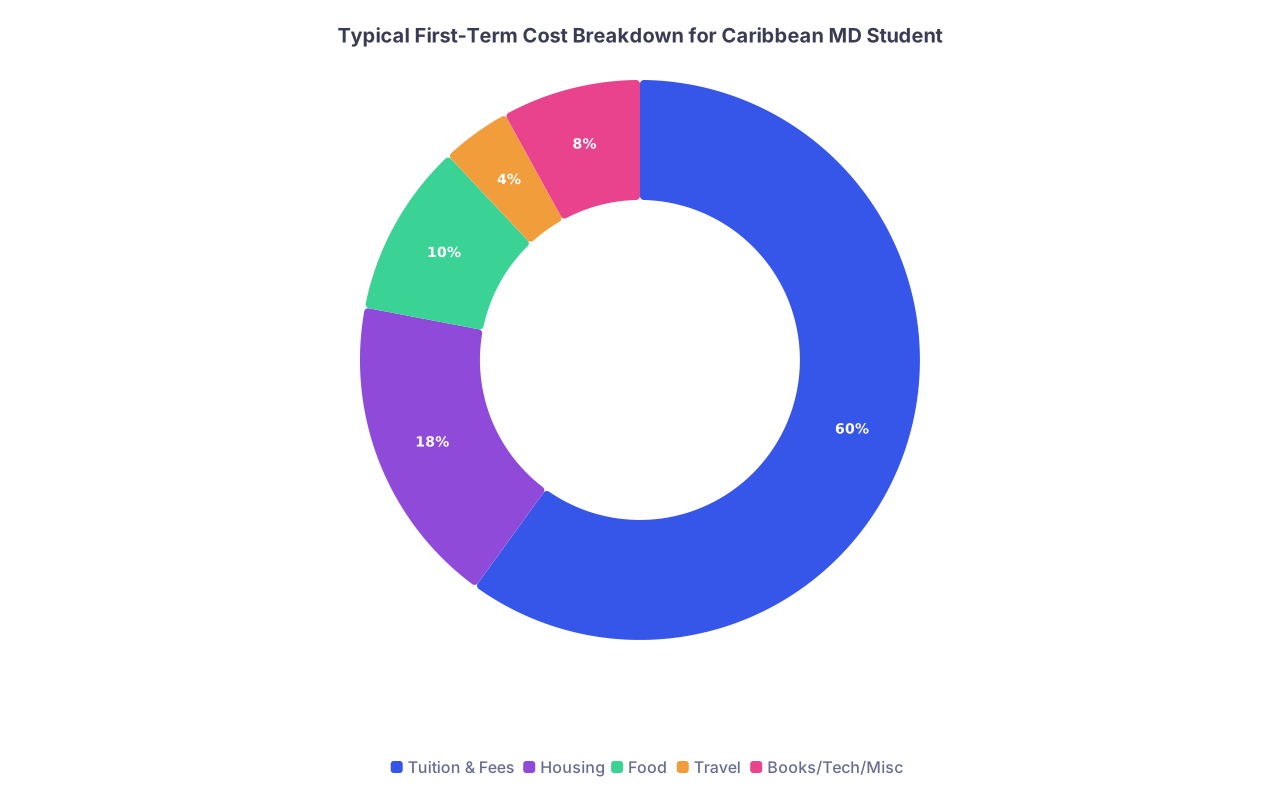
Typical First-Term Cost Breakdown for Caribbean MD Student Category Value Tuition & Fees 60 Housing 18 Food 10 Travel 4 Books/Tech/Misc 8 Percentages vary, but tuition dominates. Build in:
- Emergency fund for medical needs or last-minute flights
- Buffer for currency changes and inflation
Plan what to bring vs. buy
- Bring:
- Essential electronics and backups
- A few weeks of medications and prescriptions
- Core clothing and professional attire
- Buy there:
- Heavy household items
- Many non-essential comfort items
- Bring:
Take care of home obligations
- Pause or end leases
- Arrange storage or sale of belongings
- Update mailing address and billing info
Final 2–1 Weeks: Arrival and Orientation
At this point you should be on island, not still packing.
When you arrive:
First 72 hours
- Check into housing and do a quick safety audit (locks, lighting, neighbors)
- Get a local SIM or phone plan
- Locate:
- Campus
- Nearest grocery store
- Clinic or hospital for emergencies
Orientation week
- Attend every academic and advising session
- Walk your daily route to and from classes
- Set up:
- Library access
- Learning management systems
- Note-taking structure
Build a day-one study schedule
Use a simple time-block layout for the first month. For example:
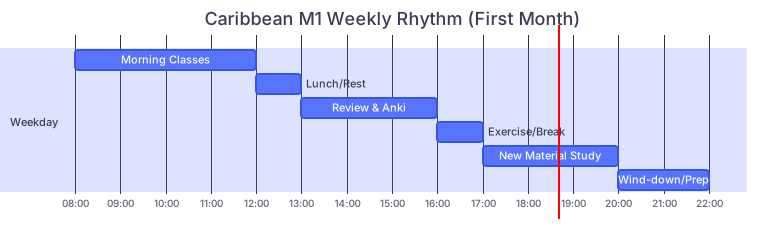
Sample First-Semester Weekly Study Structure Task Details dateFormat HH mm axisFormat %H %M Weekday: Morning Classes 08:00, 4h Weekday: Lunch/Rest 12:00, 1h Weekday: Review & Anki 13:00, 3h Weekday: Exercise/Break 16:00, 1h Weekday: New Material Study 17:00, 3h Weekday: Wind-down/Prep 20:00, 2h
You will adjust once you see the real demands, but you need a default plan on day one.
Compressed Week-by-Week Snapshot (Final 12 Weeks Before Matriculation)
To close, here is how the last 3 months should feel, week by week.
Weeks –12 to –9:
- Confirm all enrollment documents received by school
- Finalize housing and visas
- Buy or order required devices and basic supplies
- Light review of biochem and cell bio 3–4 hrs/week
Weeks –8 to –5:
- Create and test a “mock” daily study schedule at home
- Resolve any financial aid or loan issues
- Book flights and local transport
- Start packing non-essentials and organizing paperwork
Weeks –4 to –3:
- Have all documents scanned and stored in cloud + USB
- Confirm check-in details with housing
- Notify bank of international travel
- Final goodbyes and mental reset; this will be intense
Weeks –2 to –1:
- Fly to island 5–7 days before orientation
- Set up living space and test internet speeds
- Buy groceries and household basics
- Walk to campus and locate key buildings
Matriculation Week:
- Attend orientation activities
- Meet academic advisors and note any early support programs
- Finalize your time-blocked weekly study plan
- Start studying lightly before formal classes begin
Key points to remember:
- Caribbean schools are not a shortcut; they are a higher-risk path that demands earlier, stricter planning, not less.
- The 24‑month timeline is about de-risking: early MCAT, early applications, careful school choice, and ruthless logistics.
- By the time you step off the plane, every administrative decision should be behind you so all your bandwidth can go to the only thing that matters now: surviving and excelling in the basic sciences.


