

The biggest mistake international-minded premeds make is trying to prepare for everything at once. MCAT, UCAT, HPAT, local entrance exams. Result: mediocre scores across the board.
You need a sequence. Not a chaos buffet.
I am going to walk you through when to take the MCAT versus local entrance exams for international medical programs—month by month, decision by decision—so that by the time you click “register,” the timing is deliberate, not desperate.
1. First 3–6 Months: Clarify Your Target Programs Before You Touch a Practice Test
At this point you should stop thinking about exams and start thinking about countries and program types.
You have two big branching paths:
- North American–style schools (MCAT-driven)
- European/Asian/Caribbean schools (local entrance exams or none)
Step 1 (Month 0–1): Decide Your Primary “Region Strategy”
By the end of Month 1 you should have picked a primary region and a backup region. Not five equal options.
Example strategies:
Strategy A:
- Primary: U.S./Canada MD or DO (needs MCAT)
- Backup: Caribbean / Ireland / Israel programs that accept MCAT
Strategy B:
- Primary: 6-year European MD (Czech Republic, Poland, Italy, Hungary, etc.) with university-specific entrance tests
- Backup: UK / Ireland 5–6 year programs (UCAT/BMAT style)
Strategy C:
- Primary: Home country program (local exam: NEET, Gaokao, etc.)
- Backup: One or two MCAT-accepting international programs (like Sackler, Technion, Saba, St. George’s)
If you do not know which region fits, spend 2–3 weeks doing real research, not forum scrolling:
- Look at:
- Language of instruction
- Total program length (4 vs 5 vs 6 years)
- Required exams (MCAT, UCAT, school-specific, none)
- Visa and licensing path back to your desired practice country
By end of Week 4: you should have a short list of 5–15 programs, clearly grouped by exam requirement.
| Pathway / Region | Typical Exam Requirement |
|---|---|
| US / Canada MD/DO | MCAT |
| UK 5–6 year programs | UCAT / BMAT (or UCAT only) |
| Ireland / some EU (grad entry) | GAMSAT or MCAT |
| 6-year Central/Eastern Europe | University entrance exam |
| [Caribbean schools (top tier)](https://residencyadvisor.com/resources/international-med-schools/pre-med-to-matriculation-24-month-timeline-for-applying-to-caribbean-schools) | MCAT often preferred/required |
2. Months 2–3: Decide Which Exam Comes First (MCAT vs Local)
At this point you should sequence exams. One “primary” exam focus at a time.
Rule of Thumb
- If you are aiming for U.S./Canada as main goal, MCAT is your anchor. Everything else bends around it.
- If you are aiming for 6-year European or local home-country programs as main goal, the local/university exams are your anchor, and the MCAT becomes optional or secondary.
Look at Exam Calendars (Month 2)
By Week 6–8, you should have pulled:
- MCAT test dates and score release dates for the year
- UCAT/BMAT/GAMSAT / country-specific exam dates
- Application deadlines for each program
Now build a rough year plan:
- Identify a primary exam window (first major exam you will peak for)
- Identify a secondary exam window (2–4 months after primary, if you need a backup or different region)
Example time map:
- Primary exam window: June–July MCAT
- Secondary: September European school entrance exams
or
- Primary: April local entrance exam (e.g., NEET or university-specific)
- Secondary: August/September MCAT
You should not be peaking for two major exams in the same 6–8 week window. That is the fast track to burning out.
3. MCAT vs Local Exam: Content and Prep Time Reality Check
Before you commit to which comes first, you need a brutally honest content comparison.
MCAT Profile
- Long, stamina-heavy, reasoning-based
- Heavy on:
- Biochemistry
- Molecular biology
- Critical reading (CARS)
- Psych/Soc
Realistic prep for competitive scores (510+):
- 3–6 months if science base is fresh and strong
- 6–9+ months if content is rusty or you have heavy work/school schedule
Local / University Entrance Exams (Common Patterns)
Typical international entrance exams for 6-year programs (Czech, Polish, Italian, Hungarian, etc.):
- Focused mainly on:
- Biology
- Chemistry
- Sometimes Physics or Math
- Style:
- More factual recall and problem solving
- Shorter than the MCAT
- Often no CARS-equivalent
Prep time:
- 2–4 months of focused review if your high school science base is solid
- Sometimes less intense but requires precise syllabus alignment with each school
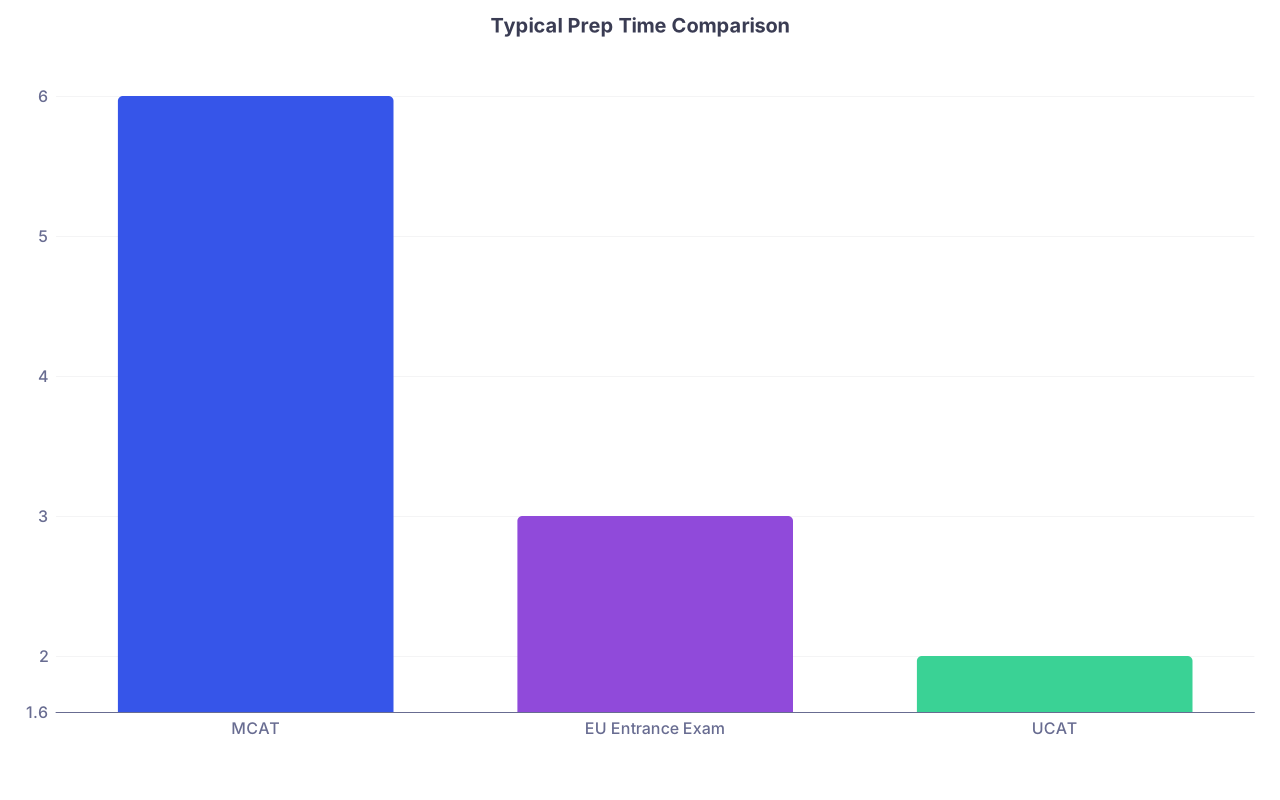
| Category | Value |
|---|---|
| MCAT | 6 |
| EU Entrance Exam | 3 |
| UCAT | 2 |
Months represent typical preparation duration for a well-prepared applicant aiming for competitive performance.
If:
- You are already deep into MCAT-level biochem and psych
- And your target European entrance exams are mostly basic science recall
…then MCAT-first is usually more efficient. You can “downshift” from MCAT to entrance exams more easily than the reverse.
If:
- Your schooling was strong in traditional biology/chemistry
- But you have zero exposure to CARS-style passages or psych/soc
…then a focused run at the local exams first may make more sense.
4. 12-Month Timeline: MCAT-First Strategy (For North America–Centric Plans)
Let us say you are 12 months out from your intended matriculation cycle and you want U.S./Canada or MCAT-accepting international programs.
Months 0–2: Foundation and Program List
At this point you should:
- Build your school list:
- U.S./Canada MD/DO
- A few MCAT-accepting international programs (e.g., Caribbean, Israel, Ireland)
- Start light content review:
- 5–10 hours/week
- Retake:
- General chemistry
- Intro biology
- Basic physics formulas
Months 3–5: Structured MCAT Prep Ramp-Up
By Month 3 you lock in:
- A specific MCAT date: usually Month 6 or 7
- A weekly schedule: 15–20 hours/week
At this point you should:
- Begin:
- Full content review (all sections)
- 30–50 practice questions per study day
- Take:
- One baseline full-length exam in Week 10–12
If your baseline is:
- <500 → consider pushing exam later or reducing other commitments
- 505–510 → June/July exam is realistic with solid effort
- >510 → you have more flexibility for local exam add-ons later
Month 6–7: MCAT Peak and Test
In the 6 weeks before MCAT:
- 2–3 full-length exams
- 200–300 questions/week
- Intense review of:
- Weak sections
- CARS timing
- Biochem pathways
At this point you do not add a second exam. Your brain is spoken for.
MCAT test in Month 6 or 7.
Score back ~4 weeks later.
Month 8–9: Decide Whether to Add Local/Entrance Exams
Once your MCAT score is in hand:
If score is strong for your goals (e.g., 512–515+ for competitive)
- You lean into MCAT-accepting programs
- Apply U.S./Canada + selected international with MCAT
- Local exams become optional or long-term backup
If score is borderline or weak
- You identify:
- International programs that are less MCAT-sensitive
- Entrance-exam-driven schools (e.g., 6-year EU)
- You schedule entrance exams 2–4 months after your MCAT date
- You identify:
During Months 8–9 you can shift to:
- Intensive biology/chem recall
- Targeted practice from each school’s sample tests
- Shorter, more specific exam prep
Month 10–12: Applications and Interviews
You should now:
- Send primary applications (AMCAS/AACOMAS or similar)
- Submit international school applications (often rolling)
- Attend:
- Online interviews
- On-site entrance exams if required
At this point, the heavy testing season is behind you. You are in the paperwork and interview phase.
5. 12-Month Timeline: Local/Entrance-Exam-First Strategy (For 6-Year or Home-Country Priority)
If your primary goal is a 6-year international program or a domestic system with its own entrance exam, reverse the order.
Months 0–2: Target School Deep Dive
At this point you should:
- Narrow to:
- 3–8 main programs
- 1–2 “reach” options
- Collect:
- Official syllabi for each entrance exam
- Past papers / sample questions
- Exact exam dates and locations
Your first calendar move: pencil in exam windows (often April–September depending on the country).
Months 3–5: Content Review for Entrance Exams
Weekly load: 10–15 hours if you are in school, 20+ if you are on a gap year.
Focus:
- Detailed review:
- High-yield biology (human, cell, genetics, physiology basics)
- General/inorganic chemistry
- Basic physics or math if required
- Practice:
- Timed sets using that school’s style
- Repeating tricky question types until automatic
You are not doing MCAT-style CARS or psych/soc yet. That is a different cognitive muscle.
Month 6–7: Entrance Exam Window
This may be:
- A single big national exam
- Or several university-specific dates over 4–8 weeks
At this point you should:
- Take 2–3 practice exams per school (if available)
- Taper content review and maintain sleep, nutrition, and travel planning
You sit your main entrance exams in this window.
Month 8: Results and Fork in the Road
Two outcomes:
You receive an acceptance / high ranking
- MCAT immediately becomes optional.
- You pivot to:
- Visa
- Financial planning
- Pre-departure logistics
- You do not cram MCAT “just in case.” That is how people sabotage a perfectly good admission.
You are waitlisted or rejected across the board
- Now MCAT becomes your lifeline for:
- Caribbean
- GEMS-style programs
- Future U.S./Canada attempts
- You schedule MCAT 6–8 months out, not 2 months. Rushed MCATs create bad transcripts.
- Now MCAT becomes your lifeline for:
Months 9–12: Transition to MCAT (If Needed)
Now:
- Use your strong biology/chem base from the entrance exam prep
- Build up:
- Biochem depth
- Psych/Soc from scratch
- CARS reading stamina
You are now on a classic 6–9 month MCAT runway.
6. Week-by-Week: How to Combine Prep Without Burning Out
Some of you will insist on keeping both paths alive at once. Fine. But you need rules.
If MCAT is First, Entrance Exam Second
Weeks 1–8:
- 90% MCAT prep
- 10% light review of local exam syllabus (just to stay familiar)
Weeks 9–14 (MCAT peak):
- 100% MCAT, no exceptions
Weeks 15–22 (post-MCAT, local exam buildup):
- 0% MCAT
- 100% entrance exam-specific content and timing
If Entrance Exam is First, MCAT Second
Weeks 1–12:
- 90% local exam prep
- 10% “MCAT-friendly” habits:
- Read 2–3 dense English-language articles/week
- Keep a small spaced-repetition deck for biochem terms
Weeks 13–18 (local exam window):
- 100% local exam focus
Weeks 19+:
- Shift to:
- MCAT structure
- Full-length practice every 2–3 weeks
- Psych/Soc read-through once
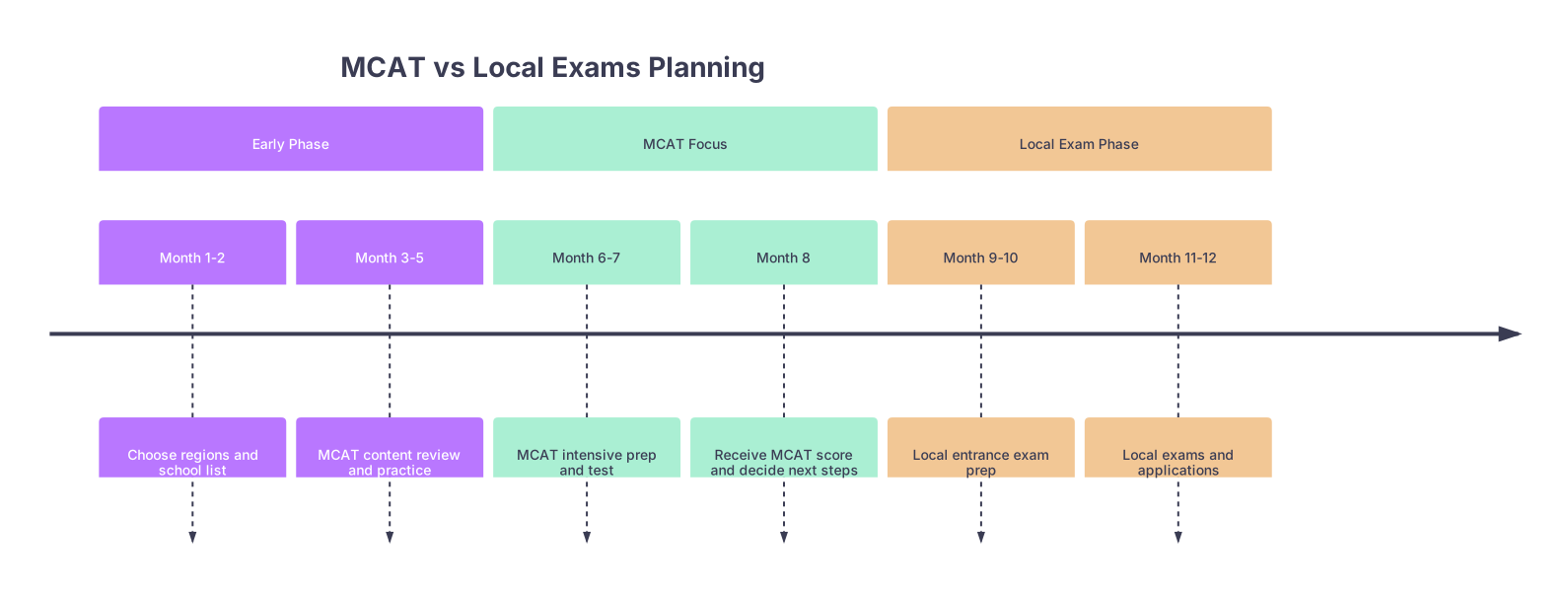
| Period | Event |
|---|---|
| Early Phase - Month 1-2 | Choose regions and school list |
| Early Phase - Month 3-5 | MCAT content review and practice |
| MCAT Focus - Month 6-7 | MCAT intensive prep and test |
| MCAT Focus - Month 8 | Receive MCAT score and decide next steps |
| Local Exam Phase - Month 9-10 | Local entrance exam prep |
| Local Exam Phase - Month 11-12 | Local exams and applications |
7. Red Flags: When Your Timeline Is Wrong
You probably need to reset if:
- You are scheduled for MCAT and a major local exam within 4 weeks of each other
- You are doing:
- Full MCAT practice exams
- And full local exam past papers
- In the same week
- Your baseline scores on both are plateaued or dropping for more than a month
- You “cannot remember” the last week you had a full day off
Fix:
- Pick one exam to postpone by 4–6 months
- Treat the other as your official primary goal
- Accept that you may need an extra year in the pipeline. Better that than a string of bad scores you cannot erase.
8. Quick Decision Checklist (Use This Today)
By the end of today, you should be able to answer:
My primary region is:
- U.S./Canada
- UK/Ireland
- EU 6-year
- Home country only
- Not sure (then your job this week is to decide)
The first major exam I will peak for in the next 12 months is:
- MCAT
- Local/university entrance exam
- UCAT/BMAT/GAMSAT
The earliest realistic date I could be ready for that exam (with 3–6 months of prep) is:
- Month: __________
- Year: __________
The exam I am willing to postpone or drop if conflict arises is:
- MCAT
- Local exam
- I refuse to drop either (then expect mediocre outcomes in both)
FAQ (Exactly 2 Questions)
1. Can I use one MCAT prep period to cover both the MCAT and European entrance exams?
Partially, but not perfectly. MCAT prep gives you excellent depth in biochem, critical reading, and data analysis, which helps with higher-level questions anywhere. However, many European and local entrance exams still test straight recall of very specific high school–level biology and chemistry facts, sometimes with weird legacy topics that the MCAT does not care about. The smart approach: use MCAT as the base, then layer on 4–6 weeks of targeted, exam-specific practice for each local test. Do not assume “MCAT high score = automatic entrance exam pass.” I have watched very bright MCAT scorers get blindsided by obscure high school physics formulas they had not seen in years.
2. If I am not sure where I want to practice medicine long-term, should I default to MCAT or to local entrance exams?
If you are truly undecided between practicing in North America and somewhere else, default to the exam that keeps more doors open with one score: usually the MCAT. A solid MCAT score can be used for U.S./Canada, some Irish grad-entry, some Caribbean, and a handful of Israel/other international programs. Local entrance exams are often single-country or even single-school tickets. The caveat: if your academic profile is much stronger in rote memorization than in reasoning, and your grades are borderline, some local systems may be more forgiving than U.S./Canada admissions even with a decent MCAT. But as a general rule for maximum international flexibility, you time your year around the MCAT first, then use local exams as targeted backups.


