
The biggest mistake students make about 6‑year European medical programs is starting to think about them in their final year of high school. That is already late.
If you want a realistic shot—at a good school, in a city you actually want to live in—you work backwards. Year by year. Semester by semester.
Here is how that looks, from early high school through your first year in Europe.
Overview Timeline: From Early High School to Med 1
At this point you should see the whole road before we zoom in.
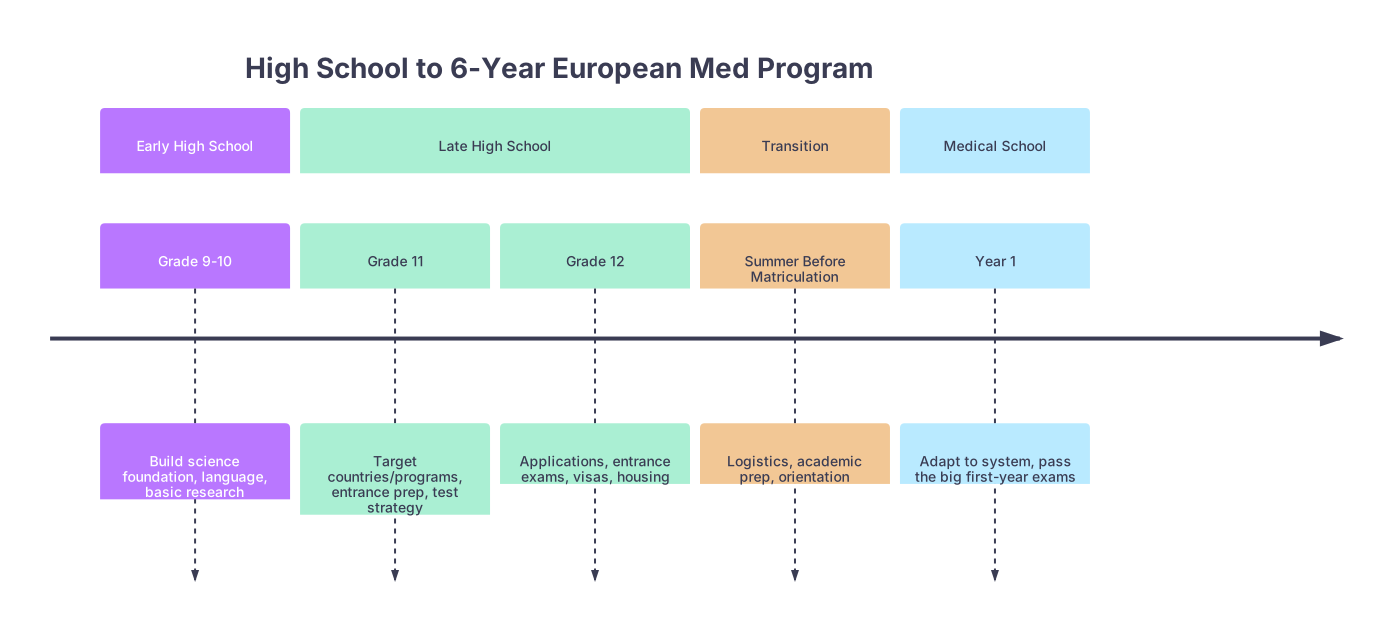
| Period | Event |
|---|---|
| Early High School - Grade 9-10 | Build science foundation, language, basic research |
| Late High School - Grade 11 | Target countries/programs, entrance prep, test strategy |
| Late High School - Grade 12 | Applications, entrance exams, visas, housing |
| Transition - Summer Before Matriculation | Logistics, academic prep, orientation |
| Medical School - Year 1 | Adapt to system, pass the big first-year exams |
Now we go year by year.
Grade 9 (Freshman Year): Quiet Setup Mode
If you are reading this in Grade 9, you are already ahead of 90% of applicants. Use that advantage.
Academics: Lay the foundation
At this point you should:
- Be in the strongest science track your school offers (or moving into it next year).
- Take:
- Biology (or life sciences)
- General chemistry if available
- Math at a solid level (aim to be on track for precalculus / higher by Grade 11–12)
Your goal is not perfection. Your goal is exposure and comfort with scientific thinking. Most 6‑year European tracks start medical content right away (anatomy, histology) and expect you not to crumble.
Languages: Pick your likely region
Decide early where you might want to study, because language prep is not last‑minute work.
Rough guide:
- UK/Ireland‑style programs (taught in English): Czech Republic, Poland, Hungary, Slovakia, Croatia, Cyprus, some Italian programs, etc.
- Local language required sooner or later: Germany, Austria, France, Spain, Italy (even if preclinical is partly in English, clinical years need local language for patients).
At this point you should:
- Commit to serious English if it is not already your strongest language (IELTS/TOEFL level later).
- Choose one additional language aligned with likely destination:
- German if you are even vaguely considering Germany/Austria.
- French for France/Belgium.
- Spanish for Spain.
- Italian for Italy.
Do not chase five languages. Pick one and build it.
Exposure: Light, low‑stakes exploration
In Grade 9 you should:
- Shadow or visit a clinic if your country’s regulations allow.
- Join a science or health club at school.
- Read one medically oriented popular science book every 2–3 months.
- Example: “The Man Who Mistook His Wife for a Hat” or “Being Mortal.”
No one in an admissions office is going to be impressed by a 14‑year‑old’s “research.” What they will notice later is consistency.
Grade 10 (Sophomore Year): Lock in Academics and Target Regions
By Grade 10 you stop “liking science” and start producing grades and test scores that prove it.
Academics: Show an upward trend
At this point you should:
- Be taking:
- Biology (ideally at higher level if your system has tracks)
- Chemistry
- Math that sets you up for higher‑level courses in Grade 11–12
- Aim for:
- Top 10–15% of your class in science and math.
- Strong internal exam results. European schools actually read transcripts, not just final exams.
If possible, move into:
- IB: aim for HL Biology and HL Chemistry.
- A‑levels: plan for Biology, Chemistry, and maybe Math/Physics.
- National systems: choose the “science” or “medical” stream if it exists.
Country and program research: Start a short list
You do not need a final list. You need a direction.
At this point you should:
- Learn the basic structure of 6‑year programs in:
- Central/Eastern Europe (Czech Republic – Charles University, Masaryk; Poland – Jagiellonian, Medical University of Warsaw, Gdańsk; Hungary – Semmelweis, Szeged, Pécs; others).
- Southern Europe: Italy, Spain, Cyprus, Croatia.
- Western/Nordic options: some English tracks in Germany (limited), Latvia (Riga Stradins), Lithuania (Vilnius), etc.
- Clarify:
- Do you want to practice medicine in Europe, the UK, the US, Canada, or elsewhere?
- Are you an EU/EEA citizen or non‑EU? This changes fees and options drastically.
To make this concrete:
| Country | Example School | Language of Instruction | Notes |
|---|---|---|---|
| Czech Republic | Charles University (First Faculty) | English | Popular among international students |
| Poland | Jagiellonian University | English | Strong reputation, Kraków location |
| Hungary | Semmelweis University | English | Long‑established English track |
| Italy | University of Pavia | English | IMAT entrance exam required |
| Latvia | Riga Stradins University | English | Common for Nordic/UK applicants |
You are not picking yet. You are learning what exists.
Languages: Level up, not dabble
At this point you should:
- Have at least B1 moving toward B2 in your chosen destination language by the end of Grade 10 if you are serious about non‑English programs.
- For English‑taught tracks, aim for:
- Consistent high marks in English.
- Early exposure to IELTS/TOEFL style tasks (reading speed, listening, academic vocabulary).
Summer after Grade 10: Light prep + early exams
In the summer you should:
- Do a focused 4–6 week block of:
- Biology/chemistry reading at a slightly higher level (intro college or A‑level style).
- One small online course (Coursera/edX) in human physiology, basic biology, or public health.
- Consider:
- Taking a standardized English test (IELTS/TOEFL) early if your level is already high; some scores last 2 years, check validity.
Do not burn out. You are still two years away.
Grade 11 (Junior Year): Commit to the Path and Entrance Exams
This is where it gets serious. The choices you make in Grade 11 will decide whether you are scrambling at the end or walking in prepared.
Early Grade 11 (September–December): Lock your target countries and exam strategy
By the end of the calendar year you should:
- Have a provisional target list of:
- 1–2 “reach” schools.
- 3–5 realistic schools.
- 1–2 safer options with higher acceptance, maybe in smaller cities.
You also need to understand entrance exam structure, because each region plays by different rules.
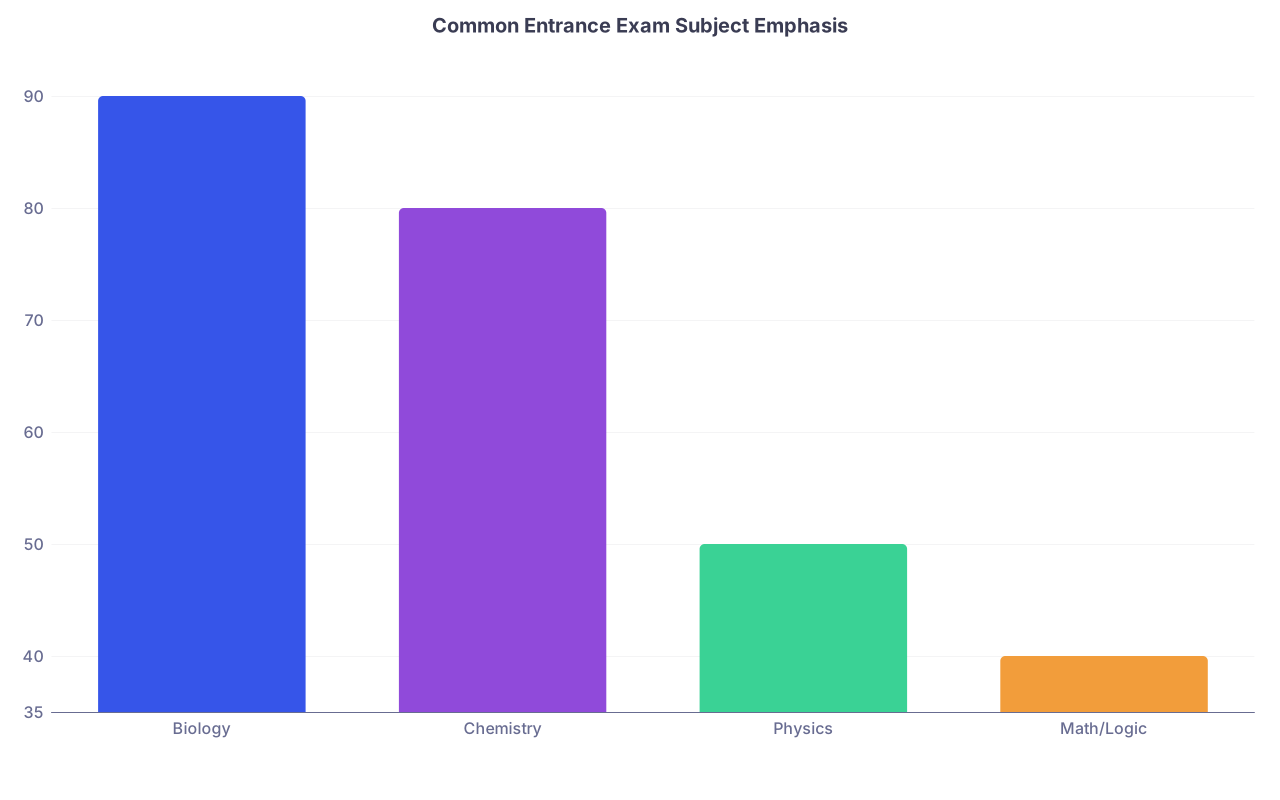
| Category | Value |
|---|---|
| Biology | 90 |
| Chemistry | 80 |
| Physics | 50 |
| Math/Logic | 40 |
Most 6‑year English‑taught programs test:
- Biology: heavy emphasis (cell biology, physiology, genetics).
- Chemistry: general and sometimes organic.
- Physics: basic mechanics, electricity, optics for some schools.
- Math/logic: less central but present in some (especially IMAT for Italian programs).
At this point you should:
- Identify each target school’s:
- Exam subjects.
- Exam dates (often spring/summer of Grade 12, sometimes earlier).
- Application deadlines.
- Whether you must travel for the exam or can test online or in test centers abroad.
Mid Grade 11 (January–June): Build exam‑oriented knowledge
This is not generic “study hard.” This is targeted.
At this point you should:
Align your school courses with exam needs
- If you are missing physics but your target schools test it, arrange:
- Extra tutoring.
- Self‑study with a structured workbook.
- Sharpen biology and chemistry to exam level (beyond what many national curricula demand).
- If you are missing physics but your target schools test it, arrange:
Start entrance exam prep properly
By spring of Grade 11 you should:- Work through at least 1–2 sets of past papers or official sample questions for:
- IMAT (for Italian programs).
- Hungarian/Czech/Polish entrance exams (many use recurring patterns).
- Keep a simple error log:
- Topic.
- Why you missed it.
- How you will fix it.
- Work through at least 1–2 sets of past papers or official sample questions for:
Language certification planning
If your program requires:- English: plan to sit IELTS/TOEFL between late Grade 11 and early Grade 12.
- Local language (e.g., German B2 for German programs): schedule a B1/B2 exam by end of Grade 11 to prove progress.
Summer after Grade 11: Heavy prep phase
This is your main runway.
By the end of this summer you should be:
- Comfortable with the full entrance exam syllabus for:
- Biology (core physiology, genetics, biochemistry basics).
- Chemistry (stoichiometry, bonding, acids/bases, organic basics).
- Scoring near your target range on practice exams.
Use the summer as follows:
Weeks 1–4: Content consolidation
- 3–5 days per week:
- 2 hours biology.
- 2 hours chemistry.
- 1 hour physics/math (if required).
- Focus on:
- Summarizing each topic in 1–2 pages.
- Solving textbook‑style problems, not just reading theory.
Weeks 5–8: Transition to timed questions
- 4–5 practice sets per week:
- Mixed questions at exam difficulty.
- Timed sections to build speed.
- Correct answers immediately. No “I will review later.” You never do.
End of summer: Reality check
At this point you should:
- Sit one full simulated exam for your most competitive target program.
- Honestly evaluate:
- Are you close to the cutoff scores reported in recent years?
- If not, do you need more time, different target schools, or tutoring?
Grade 12 (Senior Year): Applications, Exams, and Logistics
This is the most compressed year. If you did not prepare earlier, this is where the panic starts. You will avoid that.
Early Grade 12 (September–November): Application documents and reference prep
At this point you should:
- Finalize your target school list.
- Check each school’s:
- Application window (some open as early as fall, others in spring).
- Required documents:
- Transcripts (translated and notarized if necessary).
- Predicted grades or final grades.
- Copy of passport.
- Proof of language proficiency.
- CV and/or motivation letter.
Start assembling:
References:
- Ask 2 teachers (ideally biology and chemistry, or a teacher who knows you well academically).
- Give them:
- A short CV.
- A bullet list of your relevant activities.
- Ask early. Teachers write better letters when not rushed.
Motivation letter / personal statement:
By late fall you should have:- One solid core statement that explains:
- Why medicine.
- Why Europe / that region.
- Evidence you understand what a medical career actually is (not just “I like science and helping people”).
- One solid core statement that explains:
You can then adapt this letter for specific schools.
Mid Grade 12 (December–March): Entrance exams and interviews
This is when dates start to matter a lot.
| Region/Program Type | Application Opens | Entrance Exams | Notes |
|---|---|---|---|
| Italian IMAT (English programs) | Spring | September | Single centralized exam |
| Czech/Hungarian/Polish English tracks | Late fall–spring | Spring–early summer | Multiple exam dates or centers |
| Baltic (Latvia, Lithuania) | Early spring | Rolling / document-based + possible tests | Some rely heavily on grades |
At this point you should:
Register for all entrance exams as soon as registration opens.
Some centers fill fast, especially in big cities.Have a structured 3–4 month exam prep plan:
- Weekly targets for each subject.
- 1–2 full exams per month early.
- 1 full exam per week in the final 4–6 weeks.
If interviews are part of the process (MMI, traditional interviews):
- Practice:
- Ethical scenarios.
- Motivation questions (“Why medicine?”, “Why this country?”, “How will you deal with being far from home?”).
- At this point you should be able to talk concretely about:
- Your clinical exposure (even minimal shadowing or hospital volunteering).
- What you know about the school’s curriculum and structure.
Do not sound like you picked a program just because it is in Europe and in English. I have heard interviewers roll their eyes at those answers.
Late Grade 12 (April–July): Offers, backup plans, and admin
Offers and exam results will start to roll in.
At this point you should:
Sort your outcomes:
- Firm offers.
- Conditional offers (often based on final exam scores).
- Waitlists.
- Rejections.
Decide on:
- One firm acceptance as your primary plan.
- One or two realistic backups if possible (but do not hold offers past deadlines out of indecision; schools do not love that).
You also need to handle:
-
- Check:
- Which documents your target country requires (financial proof, insurance, background checks).
- Processing times (some consulates take months).
- Start the process immediately after receiving an unconditional offer.
- Check:
Housing
- University dorm vs private housing.
- Be honest about your own maturity. First‑year, new country, new language—dorms are often safer and simpler.
Final examinations in your home system
- Do not tank your final exams. Some European schools will revoke offers if you miss specified grade thresholds.
Summer Before Matriculation: Transition, Not Vacation
You will be tempted to think: “I got in. I can relax.” Relax a bit, yes. But if you do nothing, you walk into Year 1 and get hit by anatomy terms in Latin and biochemistry pathways, in a new country, new system, new language.
Use 8–10 weeks smartly.
Weeks 1–4: Logistics and mental preparation
At this point you should:
- Confirm:
- Enrollment, tuition payment schedule, and deadlines.
- Orientation dates.
- Finish:
- Visa/residence permit process.
- Housing contract.
- Do basic life prep:
- Learn how bank accounts, health insurance, and local public transport work in that country.
- Practice simple local language phrases for everyday life and basic clinical contexts (introductions, symptoms).
Weeks 5–8: Academic head‑start
Most 6‑year tracks start with:
- Anatomy.
- Histology.
- Biology/cell biology.
- General chemistry/biochemistry.
- Medical terminology.
At this point you should:
- Work through:
- A basic human anatomy overview (using something like a simplified atlas or video series).
- Introductory biochemistry (macromolecules, enzymes, metabolism basics).
- Learn:
- The most common Latin/Greek roots in anatomy (e.g., “cardio‑”, “hepato‑”, “gastro‑”).
The goal is familiarity, not mastery.
Medical School Year 1: Survive, Adapt, and Build Systems
You made it. Now the game changes. High school memorization habits will not carry you through anatomy exams where you need to label structures in three planes and explain their function.
First Month of Med 1: Set your systems
At this point you should:
Understand the exam structure for Year 1:
- Which subjects fall in each semester.
- How many “credit points” or ECTS each carries.
- Which ones are historically considered “killer” subjects at your school (ask older students; they always know).
Build a weekly routine:
- Daily:
- Review lecture notes within 24 hours. Short, focused review is how you retain.
- 30–60 minutes of anatomy or histology active recall (not passive reading).
- Weekly:
- One long session per major subject to reorganize and compress notes.
- Short quiz sessions using Anki or similar spaced‑repetition tools.
- Daily:
By Mid‑Semester: Calibrate your expectations
At this point you should:
Have taken at least one minor exam or quiz. Use it as feedback:
- If you barely passed, you are behind.
- If you failed, you need to change your study method, not just increase hours.
Be integrated with a small peer group:
- 3–5 classmates you can study with intermittently.
- Upper‑year mentors (often through student associations) who can explain how this specific school works.
Avoid the common mistakes I see every year:
- Trying to memorize slides the night before a practical exam.
- Ignoring small tests because “the big exam is what matters.”
- Treating first year as a social year because “the real stuff” starts later. Wrong. Many programs weed heavily in Year 1.
End of Year 1: Regroup for the long path
Once you finish Year 1 exams:
At this point you should:
- Review:
- What went wrong (content gaps, time management, language issues).
- What went right (subjects where your methods worked).
- Decide:
- Do you need to invest more in language, tutoring, or different study strategies for Year 2?
Remember: 6‑year programs are a marathon. You do not need perfection in Year 1. You need survival with enough margin that you are not constantly one bad exam away from repeating the year.
Final Takeaways
Keep three points in your head as you plan:
- You start in Grade 9–10, not Grade 12. Language skills and science foundations are slow to build. You cannot cram them into one year.
- Grade 11–12 are for execution, not discovery. By then you should already know your target regions, entrance exams, and language requirements.
- Getting in is the midpoint, not the finish line. Use the summer before matriculation and the first year to build systems that let you stay in, not just arrive.


