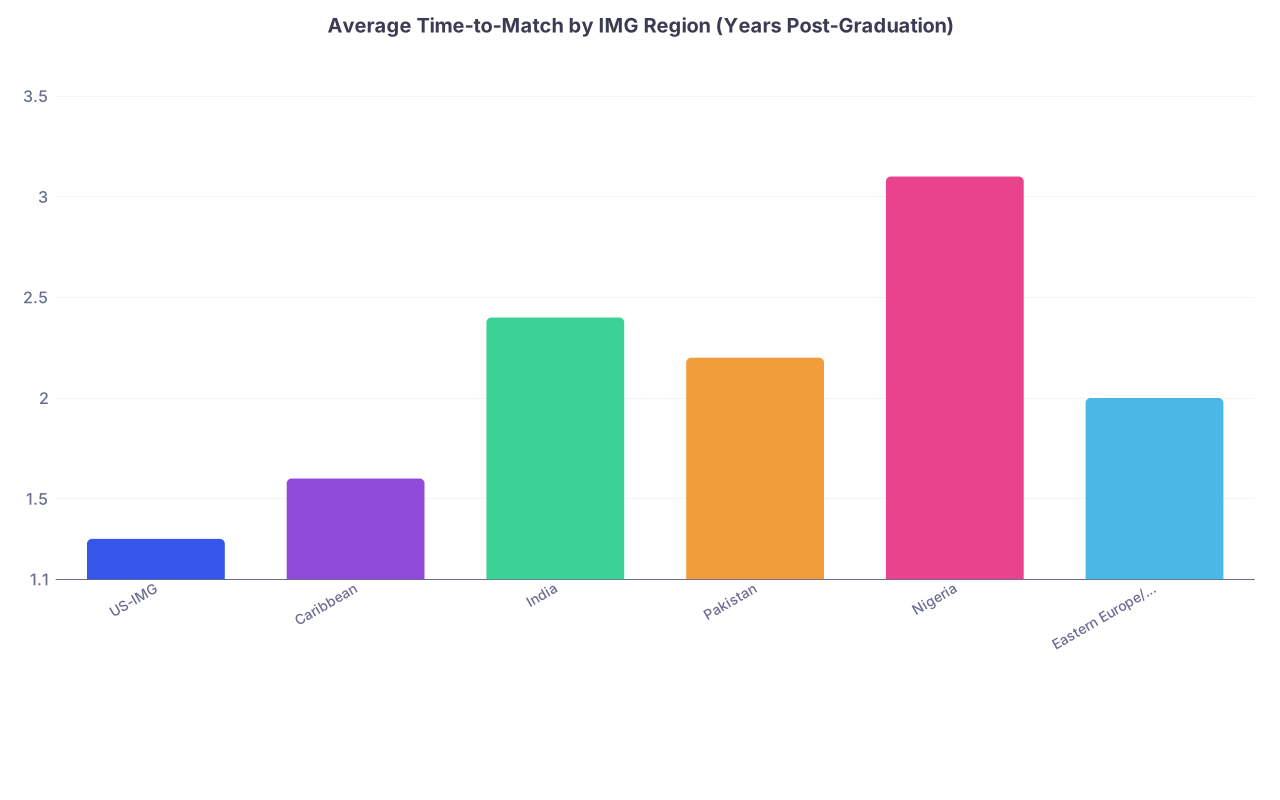
Consider this scenario: You scored a 258 on Step 2 CK. You hold a valid ECFMG certificate, possess five years of clinical practice in your home country, and speak fluent English. You hit "Submit" on ERAS, confident that your application stands out.
Three months later: total silence. Zero interview invitations. A few generic rejections.
What happened? You graduated nine years ago.
You didn't get rejected because you aren't qualified. You got rejected because human eyes never saw your application. When a residency program receives 5,000 applications for eight categorical internal medicine spots, the Program Director (PD) doesn't read 5,000 files. They open ERAS PostGrad, set a filter for Year of Graduation (YOG) ≤ 3 or YOG ≤ 5, and click "Apply."
Just like that, half the applicant pool disappears.
Programs use graduation year as a cheap, automated proxy for clinical recency. The underlying assumption is simple: older graduates have rusty bedside skills, outdated medical knowledge, and entrenched habits that make them harder to train. It's a blunt instrument, and it's unfair. But complaining about filters won't get you a residency spot. Fixing your approach will.
Here is how the filter works, how to spot it, and the exact protocol to bypass it.
Five Signs Your Graduation Year Is Already Blocking You
If you are an older IMG applying to US residency programs, you cannot afford to guess whether your graduation date is holding you back. Look for these five concrete indicators:
- High Step 2 CK, Zero Invites: You have a 245+ Step 2 CK score, but IMG-friendly community programs that regularly interview applicants with lower scores give you silence. Your numerical score got you past the Step filter, but your graduation date tripped the secondary screen.
- Instant "Screening Criteria" Rejections: You receive a rejection email within 24 to 48 hours of submitting ERAS, stating: "Thank you for your interest, but your application does not meet our initial screening criteria." That speed means an algorithm rejected you, not a faculty committee.
- The "Under Review" Black Hole: Your application sits untouched for months while recent graduates from your same medical school, with lower scores and less clinical experience, receive interview invites from those same programs.
- Coordinators Specifically Asking for Graduation Clarification: A program coordinator emails you asking to verify your exact graduation date, diploma issue date, or precise post-graduation gaps before processing your application.
- Only "Networked" Older Applicants Win: Older graduates in your network land interviews at specific programs only after an attending physician calls the PD directly, while cold applications to those same programs yield nothing.
If two or more of these sound familiar, stop sending out identical applications. Your current strategy is burning money on ERAS fees for applications that drop straight into digital trash cans.
Program Targeting: Find Residencies That Don't Auto-Reject Older IMGs
The most common mistake older IMGs make is shotgunning 200 applications across the country without checking program-specific cutoffs. You are paying ERAS to auto-reject you.
Instead, build a targeted database of programs where your application will actually be opened.
Step 1: Filter FREIDA and Residency Explorer
Start with FREIDA and Residency Explorer. Filter by specialty and IMG percentage, but do not stop at the surface data. Look at the "Graduation Year Requirement" field. Categorize programs into three buckets:
- Hard Stop: Explicitly states "Graduation within 3 years" (or 5 years). Do not apply here through cold ERAS submission.
- Soft Stop: States "Prefers graduation within 5 years." Apply only if you have a strong advocate or recent US clinical experience there.
- No Cutoff / Flexible: No mention of graduation limits, or explicitly states "No graduation year cutoff."
Step 2: Cross-Reference Official Program Websites
Database tools are frequently out of date. Go directly to the program's official website. Search the FAQ or "Application Requirements" section. Look for specific phrases like:
- "Medical school graduation within the last X years required."
- "We require recent clinical experience within the past 2 years."
If the website requires graduation within 3 years, trust the website over FREIDA.
Step 3: Direct Coordinator Verification
When a program's stance is ambiguous, email the Program Coordinator (PC) directly six weeks before ERAS opens. Keep it short, professional, and precise:
Subject: Application Eligibility Inquiry - [Specialty] Residency
Dear [Coordinator Name],
I am preparing my application for the upcoming ERAS cycle. I graduated medical school in [Year], but I have been actively practicing [Specialty] in [Country/Setting] and recently completed [X months] of US clinical experience at [US Hospital Name].
Does [Program Name] enforce a strict graduation year cutoff during initial application screening, or is holistic review provided for candidates with recent clinical practice?
Best regards, [Your Name], MD
Keep track of these responses in a master spreadsheet. Target a list of at least 100 programs that have no cutoff or confirmed flexibility, plus 20 to 30 long-shot target programs where you have specific regional or professional connections.
Rebuild Your Application Around Recency, Not Calendar Time
Programs use graduation year as a proxy for clinical recency. Therefore, you don't need to change your graduation date, you need to change your recency profile. You must prove that you operate like a physician today, not ten years ago.
                  OLD PROFILE (Filtered Out)
Graduation 2015 ──> Home Country Practice ──> Cold ERAS ──> Rejection

                  REBUILT PROFILE (Bypasses Filter)
Graduation 2015 ──> Recent USCE (2023-2024) ──> Fresh US LORs ──> Step 2 (250+) ──> Targeted Outreach ──> Interview
1. Secure Recent US Clinical Experience (USCE)
Clinical experience from 2016 in your home country does not count as recency to a US Program Director. You need hands-on US clinical experience within the past 12 to 24 months.
- Hands-on Externships & Sub-Is: Prioritize hands-on rotations in hospital settings over clinic-based observerships.
- Duration: Aim for a minimum of 3 to 6 months of continuous USCE.
- Specialty Alignment: Ensure the USCE matches the exact specialty you are applying for.
2. Replace Old Letters of Recommendation
A letter of recommendation from your medical school dean written in 2016 is useless. Replace all old letters with fresh US-based letters written within the past 12 months.
- Every letter must explicitly state your current clinical competence, bedside manner, and familiarity with electronic health records (EHR) like Epic or Cerner.
- The letter writer must address your recency directly: "Dr. [Name] has demonstrated sharp, up-to-date clinical judgment in our inpatient service over the past 6 months..."
3. Leverage Step 2 CK as an Anchor
A high Step 2 CK score proves academic knowledge, but it only works when combined with recent clinical exposure. Use your Step 2 score as a numerical counterweight when pitching programs directly.
The Bypass Playbook: Actionable Steps to Get Past the Filter
Here is the exact step-by-step protocol to get your application past automated screening software and into human hands.
Step 1: Direct Advocacy (The "Pre-Pitch")
Two weeks before ERAS applications release to programs, send a short pitch email to Program Directors at your top 30 flexible programs.
Subject: Applicant Pitch: [Your Name] - Step 2 [Score] - Active Clinical Practice
Dear Dr. [PD Last Name],
I am writing to express my strong interest in the [Specialty] Residency Program at [Hospital Name]. While my medical school graduation was in [Year], I have spent the last 18 months actively sharpening my skills through [X months] of US clinical experience at [US Institution] and maintaining continuous practice.
Key Profile Highlights:
- Step 2 CK: [Score] (First Attempt)
- Recent USCE: [X Months] hands-on inpatient internal medicine at [Hospital Name]
- Letters of Rec: 3 recent US LORs from [Specialty] attendings (2024)
- ECFMG Status: Fully Certified
I have signaled your program on ERAS and would welcome the opportunity to interview with your team.
Sincerely, [Your Name], MD AAMC ID: [XXXXXXXX]
Step 2: Strategic ERAS Signaling
Supplemental ERAS signals are your best tool to break through filters. Programs receive thousands of applications; signals force them to look at yours.
- Rule: Never waste a gold or silver signal on a program with a strict, non-negotiable graduation year cutoff (e.g., "Must have graduated within 3 years").
- Strategy: Direct all your signals toward programs categorized as Flexible or No Cutoff where you also meet or exceed their average Step 2 score.
Step 3: Mobilize Your Network (Program Champions)
If you complete a rotation under a US attending who has ties to a residency program, ask them to make a phone call or send a direct email to the PD. A 30-second call from an attending saying "I worked with this doctor last month; their skills are sharp, ignore the graduation year" bypasses every automated filter in existence.
Emergency Backup Routes: Prelim Roles, Research Fellowships, and Backdoors
If categorical interview offers are not coming in, you need immediate parallel strategies. Do not sit idle for an entire cycle waiting for the next match.
1. Preliminary Roles (Internal Medicine & Surgery)
Preliminary (PGI-1) positions often go unfilled or have significantly looser filters compared to categorical spots.
- Program Directors care far more about filling immediate service needs with competent clinicians than strict graduation dates.
- Completing a successful Preliminary year on US soil resets your recency clock entirely. You are no longer an "older IMG"; you are a "US PGY-1 in good standing" applying for categorical or PGY-2 spots.
2. Clinical Research Fellowships at Target Institutions
Securing a paid or unpaid post-doctoral research fellowship at a hospital with an active residency program gives you daily face time with the Program Director and faculty.
- Work hard, show up to morning reports, attend grand rounds, and publish papers with department attendings.
- When the next match cycle opens, you are an insider. Your graduation year becomes irrelevant because the faculty already know your work ethic firsthand.
3. Transitional Year (TY) Programs in High-Need Areas
Certain community hospitals in rural or high-need areas run Transitional Year programs that struggle to fill seats with US graduates. These programs value clinical maturity and independence, qualities older IMGs possess in abundance.
Take Action Today
Your graduation year is a fixed number, but its power over your career is entirely under your control. Stop applying as if you graduated yesterday without addressing the gap. Acknowledge the filter, rebuild your profile around clinical recency from the past 12 months, and target programs that evaluate candidates holistically.
Audit your program list today, scrub out programs with strict 3-year cutoffs, and start securing recent US clinical rotations.