
The idea that “any gap after graduation means automatic rejection” is false. Flat-out, confidently, and consistently false.
Not “sometimes exaggerated.” Not “a bit overstated.” Just wrong.
But—there is a point where gaps start to matter a lot, and pretending they do not is just as delusional.
You’re an IMG. You hear the same lines in every WhatsApp group and Telegram channel:
- “More than 2 years since graduation = waste of money.”
- “US programs reject application automatically after 5 years.”
- “If you’re not a fresh grad, you’re done. Bro, just forget it.”
I have watched people with 5–8 years since graduation match solid internal medicine, psych, FM, even a few competitive prelim surgery spots—while “fresh grads” with no direction, weak scores, and no US work were left unmatched.
The gap itself is not the problem.
What you did—or failed to do—during that gap is.
Let’s dissect this properly instead of repeating forum mythology.
What Programs Actually Look At (Not What Your Senior Told You)
Program directors are not sitting there with a stopwatch counting the days since you graduated.
They’re asking three questions:
- Can this person function safely and efficiently on Day 1 as an intern?
- Is their knowledge reasonably current?
- Is there objective evidence that they’re serious, reliable, and not a risk?
“Gap after graduation” interacts with all three. But only as context, not as an automatic filter.
Here’s the real pattern I’ve seen:
- 0–2 years after graduation: Basically never an issue, even if you are just studying or doing exams—assuming scores and letters are decent.
- 3–5 years: Programs start looking harder for continuous, recent clinical or academic activity.
- 5–10+ years: Many programs get cautious or have hard policies; others will still consider you if you’re very active and bring strong value.
The people who get crushed are usually not the ones with big gaps; they’re the ones with dead gaps—years of nothing they can credibly explain, document, and turn into a coherent narrative.
The Data: “Years Since Graduation” Is a Risk Factor, Not a Death Sentence
Let me kill the “automatic rejection” myth with what little actual data exists.
NRMP data and multiple program director surveys over the years (especially in internal medicine, family medicine, psych) show:
- A preference for more recent graduates.
- But not a uniform, across-the-board “cutoff.”
Some programs publicly state recency preferences. Let’s be concrete.
| Program Type | Typical Stated Preference |
|---|---|
| Community IM | Within 5–7 years |
| University IM | Within 3–5 years |
| Family Medicine | Often up to 5–10 years |
| Psychiatry | Often 5 years, some flexible |
| Neurology | 3–5 years common |
Notice the word: preference. Not “automatic rejection.”
And most programs with a “3–5 years” statement will still occasionally take someone older if:
- They’ve had recent, relevant clinical work.
- They bring something the program wants (research, language skills, underserved work).
- They are recommended strongly by trusted US attendings.
The match data also shows that “average time since graduation” is lower in matched applicants than unmatched ones—especially for IMGs. That makes sense. Being out longer without meaningful activity is a proxy for risk.
But there are matched IMGs 6, 8, even 10+ years out.
They’re just rarer because their profile has to be stronger in other ways.
When a Gap Is Basically Poision: The Red-Flag Gaps
Now let’s be clear about when gaps really do start sinking applications.
These patterns make program directors nervous for good reason:
Multi-year gap with no believable structure
“I was preparing for exams” for 3 years with no passing attempts, no research, no clinic, no teaching? That reads as poor discipline and poor time management. Residents don’t get 3 years to finish a progress note.Long breaks with failed attempts and no improvement
Step failures happen. The real problem is failing once, then disappearing for 2–3 years, then failing again. That looks like someone who can’t respond to feedback or build a plan.Unexplained geographic / career randomness
- 2 years in a totally unrelated job with no clinical connection.
- No clear progression, narrative, or link to medicine.
They don’t care that you needed money. Everyone does. They care whether you kept one hand in the clinical world.
No US or recent clinical exposure + long gap
This combination is brutal. You’re asking a US program to take on someone whose clinical practice was years ago, in another system, with no recent US observers vouching for you.
Those are the “practically auto-reject” profiles. Notice the pattern: not just a gap, but a gap full of nothing or failure without learning.
When a Gap Hardly Matters: The Green-Flag Gaps
Now the other side, the part nobody on social media seems to talk about: when a gap is mostly harmless—or even helps you.
If your timeline looks like this:
- Year 0–1 after graduation: Dedicated USMLE prep, passed with solid scores, a couple of attempts maybe, but you kept moving.
- Year 1–3: US observerships, research assistant roles, publications, teaching, perhaps work as a physician or clinical officer in your home country with verifiable letters.
You’re “3 years since graduation” on paper. But in the mind of a program director? You’re a recent, clinically active applicant with a strong trajectory.
I’ve seen:
- A 6-years-out Egyptian IMG match community IM because he spent 4 of those years as a hospitalist back home and did 4 months of US observerships + 2 decent papers.
- An 8-years-out Indian graduate match FM because she worked in rural clinics consistently, built great stories about underserved care, and got glowing letters during US rotations.
- A 5-years-out Caribbean grad match psych after working in research, publishing multiple papers, and doing solid psych electives in the US.
Their “gap” was basically: “I wasn’t a trainee, but I was absolutely active.”
Gaps that are usually fine (if framed correctly):
- One year full-time Step prep, especially with strong scores or clear improvement.
- One year visa/immigration delays, if you kept some clinical or research activity locally.
- A year of maternity/paternity leave, if you’re honest and can show how you stayed engaged in some way (CME, part-time clinic, teaching).
- Short breaks (3–9 months) between contracts, rotations, or jobs, with some light explaining.
The key is: continuous story, not constant perfection.
Why Programs Care About Recency (The Real Reason, Not the Myth)
It is not about punishing you for getting older. It is about risk.
Here’s what PDs and faculty quietly say in meetings:
- “We had a resident who’d been out 9 years. Very nice, but painfully slow, always behind in documentation, needed a lot of handholding.”
- “Knowledge base was rusty. Great clinician back home, but couldn’t manage the EMR or US-style rounds.”
- “Huge learning curve after being an attending abroad and suddenly being an intern again.”
So they start assuming:
- Longer since graduation =
Higher chance clinical skills are rusty + more unlearning / relearning required.
You counter that by showing:
- Recent, documented clinical involvement.
- Familiarity with US-style medicine (rotations, notes, EMR exposure, guideline-based care).
- A clear narrative: “I was doing X, now I want Y, and here’s the bridge.”
That’s why a strong CV can blunt the “years since graduation” effect so much.
What Actually Moves the Needle More Than Your Gap
The brutal truth: for IMGs, your biggest filters are usually not the gap itself.
This is how directors often mentally weigh things:
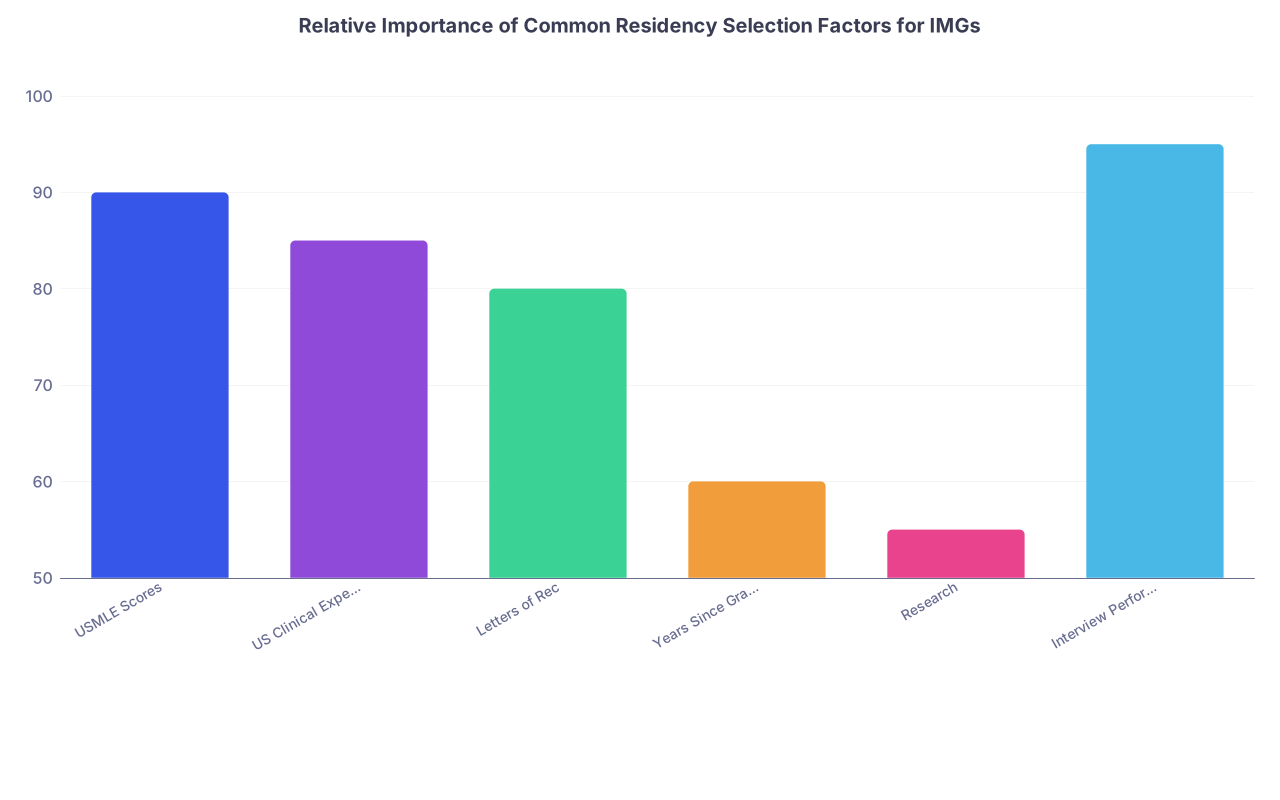
| Category | Value |
|---|---|
| USMLE Scores | 90 |
| US Clinical Experience | 85 |
| Letters of Rec | 80 |
| Years Since Graduation | 60 |
| Research | 55 |
| Interview Performance | 95 |
Years since graduation matters. But if your scores are borderline, your US experience is minimal, and your letters are generic, the recency just becomes another strike.
Conversely, if:
- Your USMLE scores are strong (or improved after an early failure).
- You have multiple solid US clinical experiences with strong letters.
- You’ve shown productivity (research, QI, teaching, leadership).
Then being 5–7 years out hurts less than everyone says.
The people who scream “automatic rejection” are often the ones who ignored the rest of the portfolio and then blamed “the gap” for everything.
How to Handle Gaps Strategically (Not Desperately)
You cannot erase the past. But you can absolutely reframe it.
Here’s what works.
1. Convert “empty time” into concrete activity
If you’re currently in a gap:
- Get into anything clinical: local hospital, clinic, telemedicine back home, even unpaid observerships.
- Attach yourself to a research project, quality improvement initiative, or teaching role.
- Collect documents: job contracts, certificates, emails from supervisors—these become proof when programs ask.
“Studying” only counts if it’s tied to results (exams passed, scores improved, maybe tutoring or teaching others).
2. Build a coherent narrative in your personal statement
Bad version:
“I took some time to prepare for USMLE and think about my goals.”
Better version:
“Over two years after graduation, I dedicated myself to USMLE preparation while working part time in an outpatient clinic. Managing patients with limited resources reinforced my interest in internal medicine and led me to pursue US training, where I can combine guideline-based care with my experience in resource-constrained settings.”
You’re not apologizing for existing. You’re explaining the intentionality behind your decisions.
3. Get letters that address your recency indirectly
Ask your letter writers to comment on:
- Your current clinical knowledge.
- Your work ethic and ability to adapt.
- Your readiness for residency.
A line like, “Despite being several years out from graduation, Dr. X’s medical knowledge is current and on par with other residents I’ve worked with,” does a lot of heavy lifting.
Program Filters: The Ugly, Practical Reality
Let’s talk about something you almost never see openly discussed: hard filters.
Many programs use ERAS filters like:
- Step 1/2 score cutoffs
- Number of attempts
- Visa requirement
- Years since graduation (e.g., >5 or >7 years)
That’s where a lot of IMGs get silently killed. The coordinator never even sees your story.
But here’s the part everyone conveniently ignores: those filters vary wildly.
Some community programs never set a strict graduation year filter because they need more applicants.
Some university programs say “within 5 years preferred” but don’t actually filter, they just use it as a talking point.
Your job is not to find the mythical “perfect” rule set. It’s to:
- Apply broadly.
- Prioritize programs that historically interview older grads / IMGs.
- Stop wasting time on rumors and actually check program websites or contact them directly.
I’ve seen applicants change their entire career plan based on something a random anonymous user posted on SDN in 2015. That’s insane.
What “Too Late” Actually Looks Like
There is a point where the question becomes legitimate: “Am I too far out?”
If:
- You’re 10–15+ years since graduation,
- With no strong, recent clinical or academic activity,
- And weak or outdated scores,
then yes, the odds start approaching zero for categorical positions—especially in competitive metro markets.
But even then, some still manage:
- Prelim positions as an entry point.
- Research tracks that eventually convert.
- Community FM or IM programs in less popular locations that are more flexible.
The bar isn’t “automatic rejection.” The bar is “Are you bringing enough current, demonstrable value to outweigh the risk of an older grad?”
For most people under the 7–8 year mark with reasonable activity, the answer can still be yes.
Stop Asking “Do Gaps Matter?” Ask This Instead
The obsession with the raw number of years since graduation is lazy thinking.
A better set of questions:
- If I were a PD reading my CV, would I believe that I’m clinically ready in July?
- Does my timeline show growth, responsibility, and consistency—or chaos and avoidance?
- Can I explain every year since graduation in a way that makes sense and supports my story?
Because here’s the fundamental truth:
Programs do not reject years. They reject risk.
If your gap screams “risk,” fix that.
If your gap tells a story of work, growth, and deliberate preparation, stop apologizing for it.
Key Takeaways
- A gap after graduation is not automatic rejection; the quality and explanation of that time matters far more than the raw number of years.
- Long, unstructured, or unexplained gaps with no clinical or academic activity are toxic; structured work, research, or meaningful life events are usually acceptable, even past 3–5 years.
- For IMGs, strong scores, recent US clinical experience, and powerful letters move the needle more than graduation year alone—build those, and your “gap” becomes a footnote, not a verdict.