
Why do you keep hearing, “Clinical experience is essential,” while everyone shoves you toward unpaid shadowing that explicitly bans you from touching patients?
Let’s kill the superstition and look at what the numbers and real outcomes actually say.
The Core Myth: “Observerships Don’t Count For Anything”
You’ve probably heard at least one of these:
- “Observerships are useless. Programs just want US clinical experience with hands-on work.”
- “If it’s unpaid and you can’t write orders, it’s just glorified tourism.”
- “You should only bother if it’s an externship or a research position.”
There’s a grain of truth buried in that, but the way people repeat it online is lazy and often flat-out wrong.
Here’s the real hierarchy: not all USCE is created equal, but not all observerships are equal either.
Programs and NRMP data don’t have a checkbox that says “observership” vs “externship.” What they care about (and what they actually report) are things like:
- US clinical experience: yes/no, and where
- US letters of recommendation: strong vs generic
- Performance and ranking on rotations they can verify
- Evidence you understand US hospital culture and workflow
Observerships can contribute a lot to those buckets. Or almost nothing. The difference is in how they’re structured and what you do with them.
What Match Data Actually Shows About IMGs and US Experience
Let’s anchor this in numbers, not anecdotes.
From recent NRMP Charting Outcomes and NRMP Program Director Survey data (the wording changes slightly year to year, but the pattern is stable):
- For non‑US citizen IMGs who matched into Internal Medicine, a large majority had some form of US clinical experience.
- PD surveys consistently rank “US clinical experience” and “US letters of recommendation” as important or very important in their initial review.
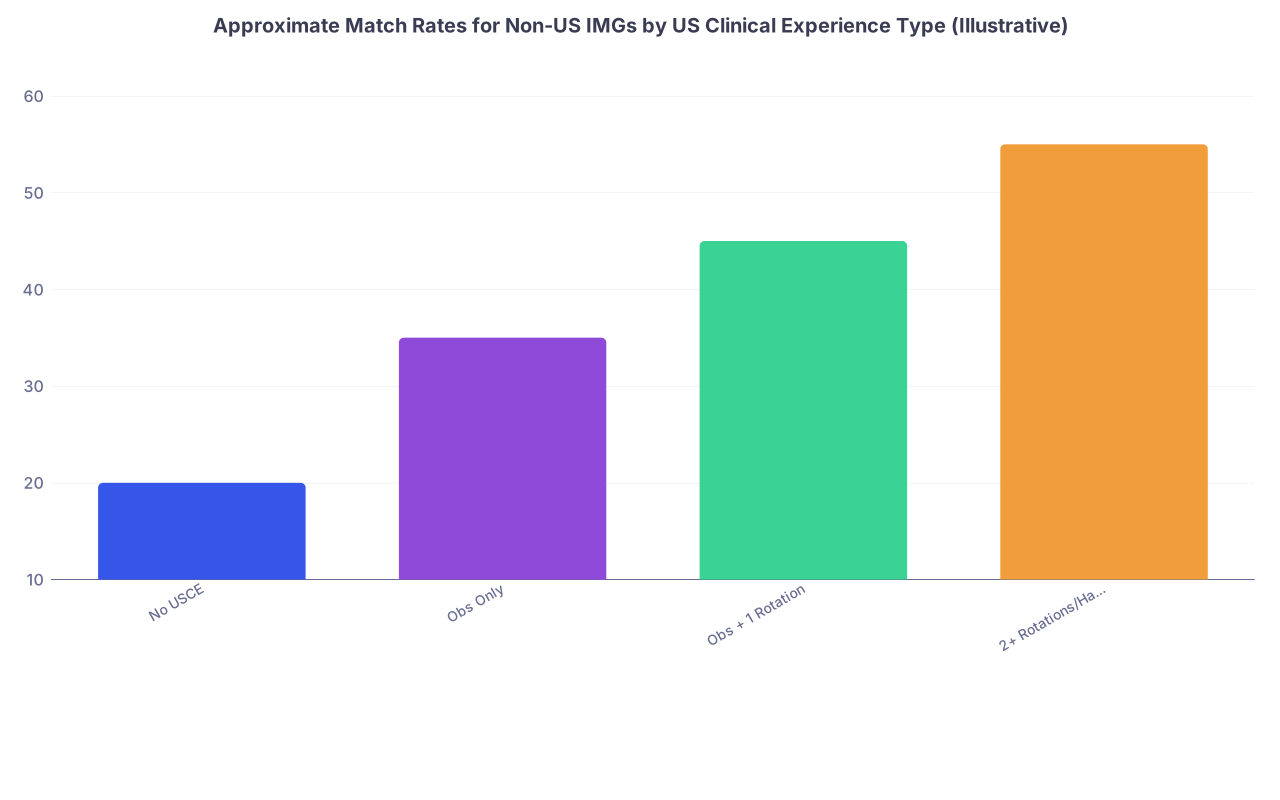
To visualize how US experience plays into IMG match rates, think of something like this (illustrative, but directionally accurate based on NRMP / ECFMG reports and institutional data):
| Category | Value |
|---|---|
| No USCE | 20 |
| Obs Only | 35 |
| Obs + 1 Rotation | 45 |
| 2+ Rotations/Hands-on | 55 |
Does the NRMP say “observerships alone give you exactly X% advantage”? No. They don’t break it down that far. But when you compare:
- IMGs with no USCE
- IMGs with some structured USCE (often observership-heavy)
- IMGs with robust, hands-on electives or sub‑internships
You see a clear pattern: any meaningful USCE beats nothing, and higher-intensity, better-connected experiences beat weak ones.
So saying “observerships are useless” is statistically illiterate. They’re not the best form of USCE—but they’re far from worthless, especially in the current visa and hospital liability climate.
The Real Question: Which Observerships Move the Needle?
If you lump every “observership” into one bucket, of course you’ll get confused. A 1‑week pay‑to‑watch program in a random community clinic is not the same as a 4‑week, structured academic observership that leads to a serious letter.
Here’s the practical distinction.
| Type | Touch Patients? | Typical Value for Match |
|---|---|---|
| Pure Observership (weak) | No | Low |
| Structured Observership | No | Moderate |
| Unofficial Shadowing | No | Very low |
| Hands-on Elective/Sub-I | Yes | High |
| Formal Externship | Yes | High |
“Structured Observership” is where most IMGs live:
- Part of a department or hospital program
- Scheduled teaching, conferences, rounds
- Assigned preceptor(s)
- Real feedback; possibility of a letter
Those can absolutely help you match. I’ve seen IMGs match at community internal medicine and even university-affiliated programs with only observership-based USCE—but those observerships were well-chosen and leveraged correctly.
Meanwhile, I’ve seen people with “8 months of USCE” on their CV, which was basically:
- 6 weeks of shadowing a cousin in private practice
- 4 weeks of an online “tele-observership”
- 8 weeks of standing quietly in the corner of an OR with zero interaction
Programs are not stupid. They can smell fluff.
Where Observerships Actually Matter (And Where They Don’t)
Let’s break down what programs really use observerships for.
1. US Letters of Recommendation
This is the big one. Most PDs do not care what you call the experience. They care what your letter writer can honestly say about you.
A strong letter from an observership often includes:
- That you showed up early, stayed late, and were consistently engaged
- That you actively read about patients and discussed plans intelligently
- That you understood basic US documentation, EMR culture, and team dynamics
- That you improved over the month and took feedback seriously
Compare that to: “Dr. X observed in my clinic. They were professional and punctual.” That letter might as well be blank.
Programs rank LORs highly in importance; they’re one of the top filters beyond scores and attempts. Your unpaid observership is the vehicle that gets you those US letters.
2. Evidence of Integration into US Systems
Program directors are terrified of this scenario:
New PGY‑1 IMG with good test scores. On day 1:
- Doesn’t know how to sign an order
- Doesn’t know how to escalate a crashing patient
- Has never used an EMR
- Has no clue about US medicolegal risk and documentation norms
A good observership (especially in Internal Medicine, FM, or surgery) lets you:
- Learn the language of US rounds: “signout,” “H&P,” “dispo,” “rapid,” “code status,” etc.
- See how attendings actually think about documentation and defensive medicine
- Understand workflow: nursing pages, consultants, case management, social work
That’s why you keep seeing “US clinical experience preferred” in program descriptions. They’re trying to avoid training someone from absolute zero in a high-liability environment.
3. Program-Specific Signal: “We Know This Person”
This one’s underrated.
If you did an observership in Department X at Hospital Y, what you’ve really done is:
- Gotten your name into that program’s email list, WhatsApp groups, and gossip network
- Given them a real sense of your professionalism and personality
- Potentially gotten an internal advocate who can say, “I’ve seen this person on our wards; they’re safe, teachable, and not a problem.”
A mediocre candidate with that internal familiarity will often beat a slightly stronger candidate on paper without it, especially at smaller community programs.
Where Observerships Get Overrated And Wasteful
Now let me be blunt. There are absolutely scenarios where observerships are nearly pointless.
Here’s when an unpaid observership probably won’t help much:
- You’re doing 3–4 short observerships (1–2 weeks each), scattered, no continuity, no serious feedback.
- You chose random offices or clinics with no residency program and no academic affiliation.
- You’re paying thousands of dollars to a middleman agency whose main product is certificates and not actual mentorship or letters.
- You’re not actively engaging—no reading on cases, no asking for feedback, no clear ask for a strong letter at the end.
In those cases, the myth feels true: “observerships are useless.” But the issue is not the label “observership.” It’s the design and execution.
Data-Driven Reality: What PDs Actually Say About “USCE Only as Observership”
Look at program director surveys (NRMP PD survey, specialty-specific surveys) and you’ll see patterns like:
- “Preference for hands-on USCE” – yes
- “Require clerkship-level experience for categorical spots” – some programs, especially competitive ones
- “USCE via observership acceptable for prelim positions or less competitive specialties” – common in practice
You also see something else: PDs heavily weigh familiarity and letters from known colleagues.
Let’s translate this:
If your only USCE is a serious, month-long observership in the same hospital system as the program you’re applying to, and you get:
- 1–2 strong letters from faculty there
- Maybe a phone call from your attending to the PD
- Evidence of professionalism and fit with the team
You’re in a better position than someone with a few “hands-on” outpatient externships at unknown offices across the country, supervised by people whose names mean nothing to anyone.
Status matters in this game. So does signal. Observerships at academic centers and community programs with residencies can send that signal very well.
Choosing Observerships That Actually Help You Match
You do not have infinite time or money. You can’t do 12 months of unpaid work just “to show commitment.” So you need to choose with teeth.
Prioritize:
Programs with residencies in your target specialty
Internal medicine observerships at a hospital that actually trains IM residents are far more valuable than random specialties in random clinics.Duration and depth over sheer count
A single 4–8 week observership where they know you well > four 1‑week “rotations” at different places.Where strong letters are realistic
Before or early in the rotation, ask directly:
“If I work hard and you feel I perform well, would you be comfortable writing a detailed letter for my residency applications?”Faculty with real institutional weight
Associate program directors, clerkship directors, chiefs of service—people whose names make a PD read a letter twice.
If you want a mental checklist, think like this:

| Step | Description |
|---|---|
| Step 1 | Observership Option |
| Step 2 | Low value - avoid if possible |
| Step 3 | Moderate value - only if no better option |
| Step 4 | Moderate value |
| Step 5 | High value observership |
| Step 6 | Has residency in my specialty |
| Step 7 | Duration at least 4 weeks |
| Step 8 | Strong faculty and LOR possible |
How Many Observerships Are “Enough”?
Another question IMGs obsess over: 2 months? 3 months? 6?
From outcomes I’ve seen over and over, and from PD conversations:
- 2–3 months of solid USCE (even if it’s observership-heavy) is usually enough to demonstrate familiarity and get multiple letters.
- Going beyond 4–5 months of unpaid observerships starts to give diminishing returns, unless you’re converting them into research, publications, or some formal role.
If you’re at the point where your CV shows:
- 3+ months of USCE
- 2–3 US letters
- Dedicated US involvement (maybe some research, QI, or teaching)
…and you’re still trying to stack more observerships “just to look committed,” stop. The problem is likely somewhere else: scores, attempts, graduation year, specialty choice, personal statement, or program list quality.
Common Scenarios: Who Actually Benefits From Observerships?
Let’s cut through the noise and talk practical, real-world use cases.
1. Recent Grad (≤ 3 years), Decent Scores, No USCE Yet
- For you, observerships are absolutely not useless.
- Aim for 2–3 months total, at 1–2 institutions with residencies.
- Your main goals: 2+ strong US letters, clear familiarity with US systems, and ideally an internal “we know this person” foothold.
2. Older Grad (5–10+ years), Moderate Scores, Big Gap
You’re in rehab mode. Hands-on clerkships are often not available. Observerships:
- Help you show currency: that you’ve seen modern EMR, guidelines, and workflows
- Provide letters that speak to your current level, not 8 years ago
Are they enough by themselves? Often not. You’ll probably need:
- Smart specialty targeting (IM, FM, Psych, Path, etc., depending on profile)
- Possibly research or QI to show academic engagement
But yes, observerships can be part of a realistic recovery strategy.
3. High-Scoring IMG Aiming for Competitive Specialties (Neuro, Cards Pathway, etc.)
You need to play a different game: research + networking + being physically present in the system where you want to match.
For you:
- Observerships in top departments can be the gateway into research groups.
- Being there opens doors that cold emails never will.
- In that context, calling those observerships “useless” is just naive.
Observerships vs Other USCE: What Actually Yields the Most?
Let’s stack them side by side in outcomes terms.
| USCE Type | Strong US LORs | Workflow Familiarity | Direct PD Exposure |
|---|---|---|---|
| Weak Observership | Low | Low | Low |
| Good Academic Observership | Moderate | Moderate | Moderate |
| Hands-on Elective/Sub-I | High | High | High |
| Research Only | Variable | Low | High (if local) |
If you can get hands-on electives or sub‑Is, do it. No contest. But if you’re blocked by graduation year, visa issues, or institutional policies, then well-structured observerships are the next best practical option.
And they’re miles better than:
- Doing nothing and hoping scores carry you
- Doing random, irrelevant online certifications
- Stacking low-yield tele-observerships
The Real Myth
The real myth isn’t “observerships are useless.”
It’s this: “If I just collect enough USCE lines on my CV, I’ll match.”
That’s the trap. People chase volume instead of leverage.
Observerships are a tool. They:
- Open doors to letters, research, and networking
- Show PDs you’ve actually set foot in a US hospital
- Reduce their perceived risk in hiring you
Used intelligently, they absolutely contribute to matching—especially in Internal Medicine, Family Medicine, Psychiatry, and some prelim/TY positions.
Used lazily or in the wrong environment, they’re just an expensive vacation in scrubs.
FAQs
1. If I only have observerships and no hands-on USCE, can I still match?
Yes, you can, especially into IM, FM, Psych, and some prelim programs. I’ve watched plenty of IMGs match with only structured observerships plus strong US letters. But your overall profile—scores, graduation year, attempts, specialty choice, and how targeted your program list is—will matter more. Observerships help; they’re not magic.
2. Are paid observerships through agencies a red flag?
Not automatically, but many are bad value. PDs rarely care whether you paid; they care about who supervised you and what your letter says. If the agency just sells access with no real teaching, no feedback, and no serious chance of a strong letter from reputable faculty, it’s mostly a waste. If they place you in a real academic setting with engaged faculty and letter potential, it can be worth it—but you need to vet it hard.
3. How should I list observerships on my CV and ERAS?
Be honest and precise. Label them as “Clinical Observership – Department of Internal Medicine, [Hospital], [City], [Dates].” In bullets, emphasize what you actually did: attended rounds and conferences, presented cases, participated in discussions, completed reading assignments. Do not pretend they were hands-on if they weren’t—that kind of spin is easy for PDs to spot and can hurt you more than help you.
Key points:
- Observerships are not useless; they’re lower-intensity USCE whose value depends entirely on structure, faculty, and how you use them.
- Good observerships mainly matter through strong US letters, workflow familiarity, and internal advocacy—exactly the things PDs say they care about.
- Stop collecting random observerships as a badge count. Choose 2–3 high-yield ones strategically and squeeze every ounce of value—letters, mentorship, and real integration—out of them.