Educational disclaimer: This article is for general educational purposes only and is not financial, investment, legal, or professional advising. Policies vary by school, and applicants should confirm letter requirements with official admissions offices, prehealth advisors, or other qualified professionals.
One strong science letter is not your problem. One strong science letter plus a pile of weak substitutes? That's the problem.
Let me tell you what really happens in file review. Most admissions committees are not sitting there like robots counting to two and throwing your application into a fire at 1.5 science letters. They're asking a more basic question: do we have enough credible academic evidence from people who actually taught or supervised this applicant closely? If the answer is yes, you're alive. If the answer is no, then suddenly your missing ideal letter becomes a symbol of something bigger, thin faculty relationships, shaky academic depth, or worse, no one in science willing to really vouch for you.
That distinction matters. A lot. Because applicants waste enormous energy apologizing for the wrong thing. They fixate on the fact that only one science professor knows them well, when the real issue is whether the rest of the letter packet builds trust. I've seen applicants with one excellent science letter do just fine because the supporting cast was smart: a research PI who could discuss their analytical discipline, a thesis advisor with real examples, a committee letter that clearly endorsed their academic readiness. I've also seen applicants tank themselves by forcing in a second "science" letter from a professor who barely remembered them and wrote three bland paragraphs that screamed obligation.
There's also the policy reality. Some schools do require two science letters, full stop, and if you ignore that, you may get screened out before anyone appreciates your nuance. Other schools are looser than anxious applicants realize. They may accept a committee letter, a research supervisor, a graduate science instructor, or a broader faculty package if the academic case is persuasive. The public-facing rules and the internal interpretation are not always the same thing. That's one of the quiet truths nobody explains well.
So your job isn't to panic. Your job is to build a recommendation strategy that answers the concerns admissions committees actually have. Not the ones Reddit invented. Not the ones your most neurotic classmate is whispering about. The real ones.
What Program Directors and Faculty Quietly Care About More Than the Letter Count
Here's the insider hierarchy. Experienced reviewers care about three questions.
Can you handle hard academics? Do faculty genuinely respect you? Will you function like a professional in a demanding training environment?
That's it. That's the game.
If your letters answer those three questions well, the file feels sturdy. If they don't, no amount of category compliance saves you. I've watched faculty readers skim past technically correct letters because they were empty. Generic praise. No examples. No texture. "Student earned an A and was a pleasure to have in class." Fine. And useless.
A detailed letter from someone who taught you intensely is almost always more valuable than a category-perfect letter from a nominal science professor who knew you as Seat 47 in Biochem. Faculty can tell when a writer actually observed your mind working. They mention how you approached a failed experiment, how you pushed a discussion beyond the assigned reading, how you handled ambiguity in a data set, how you showed up after bombing the first exam and rebuilt your study strategy. Those details carry weight because they sound true. Truth has a texture. Weak letters don't.
And yes, weak letters hurt more than missing ideal letters. This is where applicants sabotage themselves. A lukewarm science letter doesn't read as neutral. It reads as informative. Reviewers notice hedging language immediately: "performed satisfactorily," "completed all course requirements," "should be able to succeed," "I recommend without reservation" versus "I recommend" are not the same sentence. Faculty readers have written these letters themselves. They know the code. If someone had direct access to your academic performance and still wrote cautiously, that caution becomes part of your story.
Behind the scenes, committees also read around the letters. They cross-check everything. Your grades in upper-level science. Your MCAT trajectory. Whether your research description sounds like you actually understood the work or just pipetted obediently. Whether your committee letter echoes enthusiasm or sounds sanitized. Whether your clinical supervisor describes maturity, humility, and reliability. If the total file supports your academic story, one missing ideal box is survivable. If the rest of the file is thin, the missing science letter suddenly looks like evidence, not logistics.
So don't chase category purity for its own sake. Chase evidentiary strength. That's what sophisticated applicants do. The rest are just assembling paperwork.
Your Best Backup Options If the Second Science Letter Is Weak or Unavailable
If you only have one truly strong science professor, your next move is not random. There is a hierarchy of backups, and some are far better than others.
The strongest substitute is usually a research PI in a serious scientific setting, especially if that person directly supervised your thinking rather than just your attendance. A good PI letter can do heavy lifting. If the writer can describe how you framed hypotheses, interpreted messy results, dealt with failed protocols, read primary literature, or developed independence over time, that letter starts functioning like a science competency letter even if the school doesn't formally label it that way.
Next best are people like upper-level lab instructors, thesis advisors, graduate science instructors, physician-scientist mentors, and postbac or SMP science faculty. Why? Because they often know you in a way large lecture professors don't. They can speak to rigor, consistency, and intellectual maturity with actual examples. For nontraditional applicants, these newer evaluators may be far more useful than trying to excavate a ten-year-old undergraduate professor who vaguely remembers your final grade.
Committee letters deserve special attention. If your school offers a committee process and that committee letter is respected, use it strategically. A well-written committee letter can absorb structural awkwardness because it synthesizes multiple faculty impressions and states, plainly, that the applicant is academically ready for medicine. I've seen committee letters rescue applicants with imperfect individual letter mixes because the committee effectively said, "We know this student well, and we stand behind them." That institutional endorsement matters.
Bad substitutions are easy to spot and painful to read. A shadowing physician who barely knows you cannot comment on your scientific ability. A famous faculty member whose only real interaction with you was one conference handshake is dead weight. A volunteer coordinator trying to praise your "analytical mind" when they've only seen you check people in at a clinic is not helping. Prestige without substance is one of the dumbest recurring mistakes in this process.
And yes, school-by-school flexibility is real. Some schools are strict. They want exactly what they published, and arguing with that is pointless. Others will tell you directly that a PI, graduate science instructor, or committee packet is acceptable. The people who get into trouble are the ones who assume instead of verify.
For nontraditional applicants, let me be blunt: recency matters. If your undergraduate science coursework is old and your recent academic work is stronger, then your postbac physiology professor or graduate biostatistics instructor may be the right voice, not the organic chemistry professor from another era. Medical schools want current evidence that you can still thrive in rigorous science. Old nostalgia letters don't provide that.
The right strategy here is simple. Build the strongest academic case possible with people who truly know your mind. Not just your resume.
How to Ask for the Letter So It Reads Like a Strong Endorsement Instead of a Favor
Most students ask for letters badly. Too casually, too late, too vaguely. Then they act shocked when the result sounds generic.
Here's what faculty actually respond to: clarity, professionalism, and usable material.
When you ask, bring a package. Your CV. Transcript. Personal statement draft, even if rough. The class or lab work you did with them. A short reminder of specific interactions. A school list or at least the type of programs you're applying to. A deadline grid. And most importantly, a short bullet list of qualities or experiences they directly observed. Not fantasy traits. Observed ones. "Led our enzyme kinetics presentation after reorganizing the group." "Came to office hours three times to troubleshoot study approach after first exam." "Independently revised the statistical analysis in my honors thesis." That kind of thing.
This does two things. First, it jogs memory. Second, it makes specificity easy. Faculty are busy. The students who get strong letters are often the ones who quietly make it easier to write one.
And ask the question that mature applicants ask: "Do you feel you can write me a strong letter of recommendation?" Use that exact concept. Strong. Not just "a letter." This gives the writer a graceful exit. Good faculty appreciate that. If they hesitate, dodge, or say something lukewarm like, "I can certainly submit something," believe them. That is not a yes. That is a warning flare.
I've seen this over and over. The applicant thinks they succeeded because the professor agreed. Then six months later the file contains a bloodless letter written out of politeness. The student never knew. The committee did.
If your relationship is thin but salvageable, rescue it ethically. Don't beg. Re-engage. Schedule a meeting. Talk through your path to medicine. Revisit substantial work from the course or lab. Ask an intelligent question about the field. Give them enough context to remember how you think, not just who you are. Sometimes a thin relationship becomes a strong enough one if you handle it like an adult and not like someone collecting signatures.
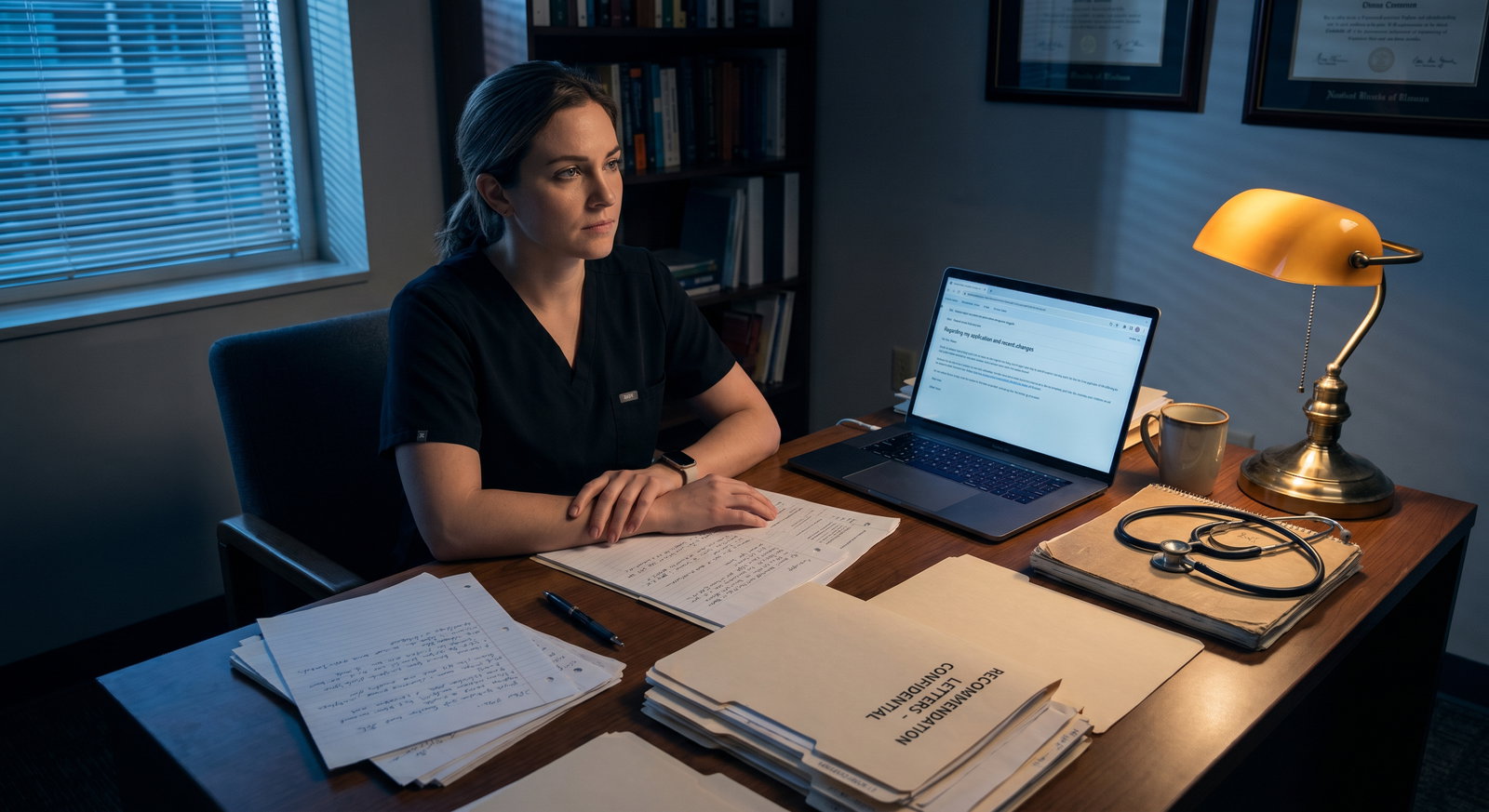
Watch for warning signs. Slow replies. Vague acceptance. No questions about your goals. Obvious lack of memory. Repeated deadline misses. These are not minor inconveniences. They are clues. Strong letter writers usually engage. They ask where you're applying. They ask what you've been doing since their class. They often want to help. The process has energy to it.
Timing matters too. Ask early. Earlier than you think. Waive your right to view the letter. That waiver still matters symbolically; confidential letters carry more credibility. Then follow up professionally, not neurotically. A short reminder with the deadline, submission instructions, and a thank-you. Not a stream of anxious messages every four days.
The best letters do not sound like favors. They sound like endorsements. There is a difference, and committees can hear it instantly.
How to Protect Your Application If Requirements, Timing, or Letter Quality Still Aren't Ideal
Sometimes you do everything right and the situation is still messy. Fine. Then you triage.
Sort your school list into three buckets. Strict science-letter requirement schools. Flexible schools. Schools where a committee letter can substitute or soften the issue. That spreadsheet matters more than your feelings. A surprising number of applicants build school lists based on metrics and geography but never pressure-test the letter requirements until they're already cornered. Bad move.
Then decide whether to apply now or delay. If your second available science letter is likely weak, and many of your target schools are flexible, I usually favor applying strategically now with a stronger overall package rather than poisoning the file with a hesitant endorsement. But if your target list is packed with schools that strictly require two science letters, and your broader academic evidence is only average, a short delay may save your entire cycle. Delay is painful. A wasted cycle is worse.
You also need to reinforce academic credibility elsewhere. Strong recent science grades help. A solid MCAT helps more. Meaningful research output, a thesis, a poster, a publication, or even a well-described long-term research role can support the scientific side of your candidacy. Your activity entries and secondaries should sound scientifically literate. Not like you were physically present near science. There's a difference.
Here's the faculty perspective on damage control: committees forgive imperfect logistics much more readily than they forgive the sense that an applicant is hiding weak support. If your letter mix is unconventional for a legitimate reason, handle it directly through school selection, committee guidance, or a concise clarification when appropriate. Don't play dumb and hope nobody notices. They notice.
And stop relying on rumor. Talk to your prehealth office. Ask the committee letter office what schools accept. Email admissions offices when policy is unclear. Get answers from people who actually control the process, not anonymous posters who applied three cycles ago and still speak with fake certainty.
If you have one truly strong science professor, you are not sunk. Not even close. You just need the rest of the file to be deliberate, coherent, and honest. Calm beats panic here. Strategy beats checkbox-chasing. Every time.
Common Mistakes That Quietly Undermine Letter Strategy
The biggest unforced errors are painfully predictable. Applicants assume every school defines "science faculty" the same way. Wrong. They ask people who barely know them. Wrong. They wait too long. Wrong again. They chase title prestige over content. Classic mistake.
Another subtle error is using a weak second science letter to soothe your own anxiety. That letter may satisfy your nerves while quietly damaging your file. If it reads tepid, reviewers will not reward you for trying. They will wonder why your own science faculty sound unconvinced.
Applicants also create inconsistency without realizing it. Their personal statement says science is central to their identity, but the only letter with real detail comes from outside science, while nobody in STEM seems eager to advocate. That mismatch raises eyebrows fast.
And don't stay silent if your letter mix is unconventional for a real reason. Handle it through smart school selection, committee guidance, or a brief clarification when appropriate. Silence is not strategy.
The sharpest applicants don't build a random stack of letters. They build a portfolio. Each recommender covers a different proof point. Academic rigor. Scientific thinking. Professionalism. Teamwork. Reliability. That's how you make one strong science letter enough.
You do not need a perfect set of letters. You need a believable one. That's a much more attainable goal, and if you build it carefully, it works.