
The blunt truth: yes, it’s not just okay to ask for a strong letter of recommendation — it’s smart. But there’s a right way to do it, and a few ways to absolutely screw it up.
Let me walk you through how to do this like a grown adult, not a panicked applicant.
The Core Answer: Yes, You Should Ask About a “Strong” Letter
Here’s the actual script you’re looking for:
“I’m applying to medical school this cycle and I was wondering if you’d feel comfortable writing a strong letter of recommendation for me?”
That’s it. That sentence is standard, professional, and used constantly in premed advising offices. You’re not being rude. You’re not being arrogant. You’re doing exactly what responsible applicants do.
Why this works:
- It gives them an out if they can’t write you a strong letter.
- It signals you understand that not all letters are equal.
- It forces them to reflect honestly on whether they know you well enough and are enthusiastic enough.
Here’s what’s worse than asking this:
Not asking, and ending up with a lukewarm, generic, or actually harmful letter that quietly sinks your application.
Why Wording Matters (and What Not to Say)
You’re not asking, “Will you write me a letter?”
You’re asking, “Can you write me a strong letter?”
Those are completely different questions.
Bad versions you should avoid:
“Can you write me a letter? I just need one more for my application.”
Translation to them: you’re using them as a checkbox.“Since I got an A, I was hoping you could write me a letter.”
Translation: you think grades alone = good letter. They don’t.“Can you write me the best letter you can?”
Weirdly pushy and implies you’re grading their effort.
The standard, grown-up version:
“Would you feel comfortable writing a strong letter of recommendation for my medical school application?”
You can say this in person, over Zoom, or in an email. In person + follow-up email is ideal. Email-only is fine if that’s realistically how you interact with them.
What Their Answer Really Means
Mentors, professors, and physicians usually won’t say, “Your letter will be bad.” They’ll say softer versions that mean the same thing.
Here’s the translation guide.

If you ask for a “strong letter” and they say:
“Absolutely, I’d be happy to. I think I can speak very positively about you.”
→ This is a green light. Good.“Yes, I’d be glad to. Make sure you send me your CV and personal statement.”
→ Also good. Standard ask.“I can write you a letter, but I’m not sure how strong it would be since I don’t know you that well.”
→ That’s a no to a strong letter. Believe them.“I can mention that you did well in my course, but I don’t know much about you beyond that.”
→ Translation: this will be a generic, borderline useless letter.“I’m really busy and not sure I can give it the attention it deserves.”
→ Also a polite no.
Your job is simple:
If they hesitate, hedge, or undersell it at all → thank them and do not use them as a recommender.
You can reply with:
“Thank you for being honest — I really appreciate that. In that case, I might try to find someone who knows me a bit better for this particular letter, but I’m grateful for your time and your course/research/etc.”
No drama. No guilt. Just move on.
Who You Should Actually Be Asking for Letters
The quality of your letter matters more than the “fancy” title of the letter writer. Weak letter from a big name > bad move. Strong letter from a mid-level faculty or community physician > excellent move.
Good potential letter writers:
- Professors who’ve seen you think, struggle, and improve
(office hours, projects, long email feedback, not just an A on exams) - Research mentors who’ve watched you over months, not weeks
- Clinical supervisors who’ve seen you with patients (physicians, NPs, PAs)
- Volunteer coordinators who can speak to your consistency and character
Red flags:
- You only took one giant lecture with 300 students and never talked to them
- You were “fine” but not particularly noticeable or engaged
- You barely remember them and assume they remember you (they don’t)
Ask people who can talk about you in specifics:
stories, examples, growth, behavior, work ethic, how you handle feedback.
Those are the letters that help.
Exactly How To Ask (With Scripts)
Let’s get concrete. Here’s how to do this without sounding awkward.
Asking in person or over Zoom
You:
“Professor Smith, I’ve really appreciated your mentorship in the lab this year. I’m applying to medical school this upcoming cycle, and I wanted to ask if you’d feel comfortable writing a strong letter of recommendation for my application?”
Then stop talking. Let them answer.
If they say yes:
“Thank you so much, I really appreciate it. What would be most helpful for me to send you? I can share my CV, draft personal statement, and the list of schools if that helps.”
If they waffle or indicate it might not be strong:
“I really appreciate your honesty. I may try to find someone who knows my work a bit better for this, but thank you again — your feedback and mentorship have meant a lot.”
Asking by email
Subject lines that actually work:
- “Request for a strong letter of recommendation”
- “Medical school LOR request (if you feel you can write a strong letter)”
Body:
Dear Dr. Lee,
I’ve really enjoyed working in your lab over the past year and have learned a lot from your mentorship, especially on the [X] project. I’m applying to medical school this coming cycle and wanted to ask if you’d feel comfortable writing a strong letter of recommendation on my behalf.
If so, I’m happy to send my CV, draft personal statement, transcript, and a brief summary of the work I’ve done in your lab to make things easier.
If you don’t feel you can write a strong letter, I completely understand and appreciate your honesty.
Best,
[Your Name]
[Premed student, University X]
Notice the key pieces:
- You remind them how they know you.
- You use the word strong directly.
- You explicitly give them permission to say no.
What Makes a Letter “Strong” From an Admissions Point of View
Admissions committees read hundreds of letters. They know within a few sentences whether a letter is generic filler or actually meaningful.
Here’s what strong letters usually have in common:
- Specific examples: “She stayed late multiple nights to help the rest of the group finish…”
- Comparison language: “One of the top 5% of undergraduates I’ve worked with in the last 10 years.”
- Clear enthusiasm: unambiguous positive tone, not lukewarm politeness.
- Multiple dimensions: work ethic, curiosity, maturity, communication, integrity, teamwork.
Here’s what weak letters look like:
- Overly short (one vague paragraph)
- Purely descriptive: “He attended class regularly and got an A.”
- Passive praise: “She seems to be interested in medicine.”
- Faint praise: “He eventually completed the project.”
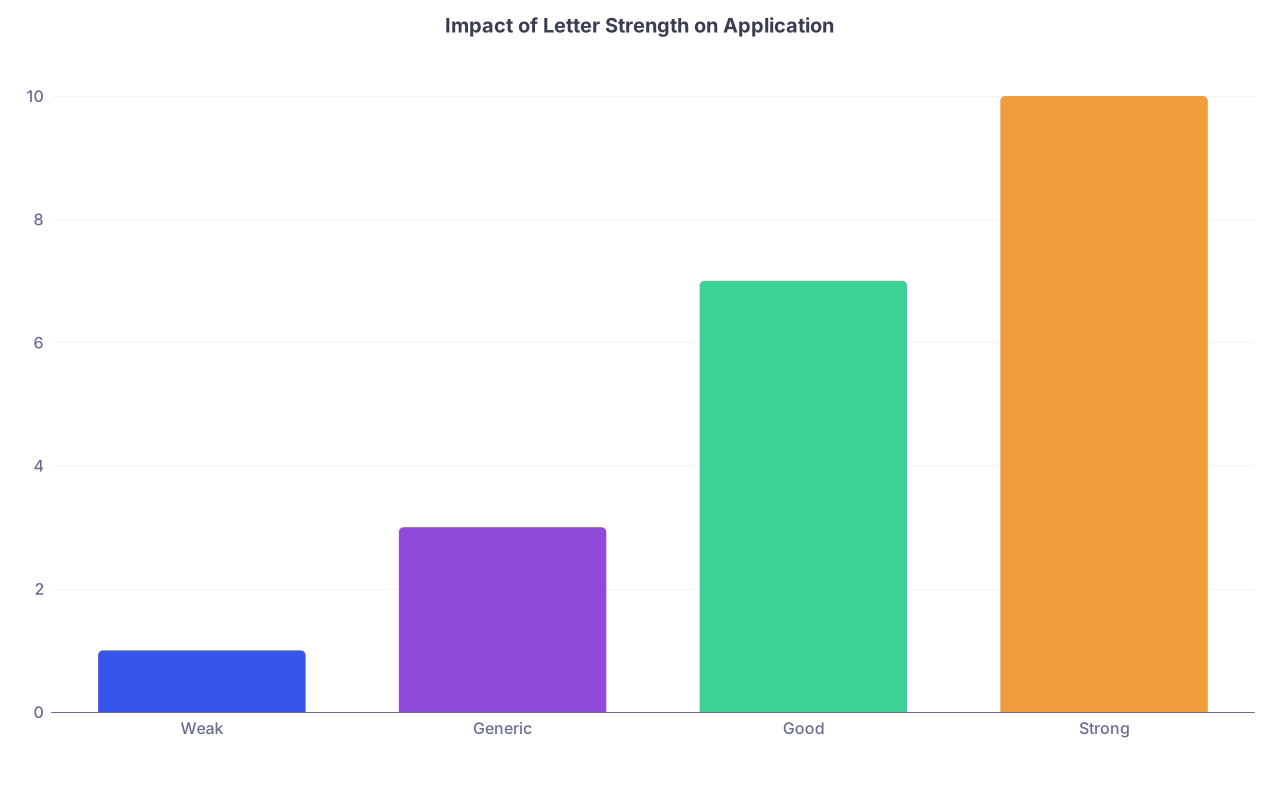
| Category | Value |
|---|---|
| Weak | 1 |
| Generic | 3 |
| Good | 7 |
| Strong | 10 |
You obviously can’t read your own letters. That’s normal and often better. But you can increase the chances that the letter is strong by:
- Choosing the right people
- Asking the right question (“strong letter?”)
- Giving them useful materials
How Many People Should You Ask, and When?
You’re premed. You’re also paranoid. So yes, people over-ask and over-collect letters.
Rule of thumb: ask a little earlier and a little wider than you think you need, but don’t hoard 15 letters “just in case.”
Typical med school expectations (varies by school):
- 2 science faculty letters
- 1 non-science faculty letter
- 1–2 additional letters (research, clinical, service, PI, etc.)
- Or a committee letter (undergrad prehealth office) + 1–2 extras
| School Type | Science Faculty | Non-Science | Other/Optional |
|---|---|---|---|
| Public State MD | 2 | 1 | 1–2 |
| Private MD | 2 | 1 | 1–3 |
| DO Schools | 1–2 | 0–1 | 1–2 (DO preferred) |
| Committee Letter | Covered inside | Covered | 1–2 extra |
Timeline:
Ask 6–8 weeks before you need the letter submitted. Earlier if they’re known to be slow or it’s a busy time (end of semester).
Reminders are fine. Harassing isn’t.
Reasonable reminder email:
“Hi Dr. X, just a quick reminder that if you’re still able to write my letter, schools start downloading letters around [date], so submitting by [earlier date] would be ideal. Please let me know if you need anything else from me. Thanks again.”
If they ignore two reminders → have backups. This is why you ask multiple people early.
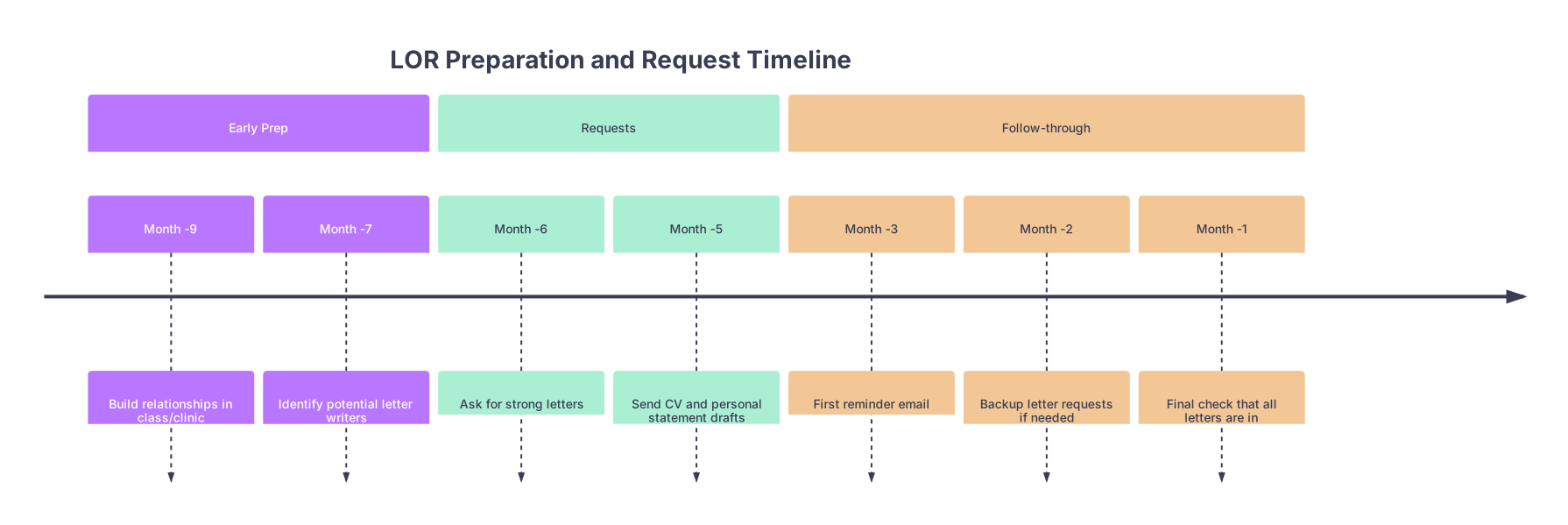
| Period | Event |
|---|---|
| Early Prep - Month -9 | Build relationships in class/clinic |
| Early Prep - Month -7 | Identify potential letter writers |
| Requests - Month -6 | Ask for strong letters |
| Requests - Month -5 | Send CV and personal statement drafts |
| Follow-through - Month -3 | First reminder email |
| Follow-through - Month -2 | Backup letter requests if needed |
| Follow-through - Month -1 | Final check that all letters are in |
How to Make It Easier for Your Letter Writer (So They Actually Help You)
If someone agrees to write a strong letter, make it painless for them.
Send a single, organized email with:
- Your CV or resume
- Your unofficial transcript
- Draft of your personal statement (even if rough)
- A short bullet list: how you know them, key projects, dates
- Any specific points you’d love if they could mention
(e.g., “my growth from quiet student to small-group leader in your course”)
You can say:
“To make this as easy as possible, I’ve attached a few documents and listed below some experiences and qualities I hope my letters can collectively highlight. Feel free to use whatever is helpful and ignore the rest.”
You’re not scripting their letter. You’re giving them ammo.

What If You Already Asked Without “Strong” and Now You’re Worried?
This happens constantly.
You asked: “Can you write me a letter?” They said yes. Now you’re reading this and panicking.
You have two options:
Circle back politely and clarify
“Thank you again for agreeing to write a letter. Since medical schools really emphasize the impact of strong letters, I wanted to confirm that you feel you can write a strong, positive letter on my behalf. If not, I completely understand and can find someone who knows my work better.”
Line up an additional recommender who you know can be strong, and prioritize sending that letter to schools that allow extras.
If your gut feels off — they seemed hesitant, don’t know you well, or barely remember you — trust your instincts and find someone better.
FAQs
1. Is it rude to ask if they can write a “strong” letter?
No. It’s standard, professional language. I’ve seen premed advisors teach this exact phrase. What’s rude is silently backing them into writing a weak letter because you were too scared to be clear.
2. Should I ever ask to read my own letter?
In the U.S., for med school, usually no. You almost always waive your right to view the letter because confidential letters are taken more seriously. If you don’t trust someone enough to write fairly about you without you reading it, they shouldn’t be your recommender.
3. How many letter writers should I ask total?
Typically 4–6, depending on your schools and whether you have a committee letter. You might not end up using all of them for every school, but having a bench of strong letters is much safer than scrambling in June.
4. What if I did well in a class but the professor doesn’t know me personally?
Then they’re a weak recommender until you fix that. Go to office hours, talk about the material, discuss your goals, maybe do a project or independent study. Or find another professor who actually knows you. A’s alone don’t produce strong letters.
5. A professor said they can write me a “good” letter but not a “strong” one. What do I do?
Treat that as a no. “Good” is often code for generic. You want letter writers who are confident they can be strongly positive and specific. Thank them and find someone else.
6. Can I ask a resident or fellow for a letter instead of an attending?
Yes, but with a catch: ideally the resident/fellow drafts or contributes, and the attending co-signs or submits it under their name. Programs usually prefer letters from attendings or faculty, but residents often know you better clinically. Ask the resident: “Would Dr. X be willing to co-sign if you helped with the letter?”
7. What if someone agrees but then never submits the letter?
First, send 1–2 polite reminders spaced a week or two apart. If there’s still nothing, assume it’s not coming and move on with backup writers. This is exactly why you start early and don’t rely on a single “must-have” letter.
Bottom line:
- Yes, you should explicitly ask if they can write a strong letter. That one word protects your application.
- Choose recommenders who know you well, give them materials to work with, and start early enough to replace anyone who hesitates or disappears.