
You’re sitting outside someone’s office with your email draft open on your phone. Your stomach hurts, your cursor blinks at “Dear Dr.…” and your brain is screaming, “They’re busy. You’re annoying. Don’t send this.”
And then you think: if I already feel like a burden just asking a question… how the hell am I supposed to ask for mentorship or a letter of recommendation?
Why Asking for Help Feels So Awful (Especially for People Like Us)
Let me just say the thing out loud: a lot of us don’t avoid asking for help because we’re “independent.” We avoid it because we’re terrified of being seen as needy, incompetent, or inconvenient.
You’re not imagining this dynamic. You’ve probably had some version of:
- The teacher in high school who sighed when you asked for clarification.
- The attending who said, “We went over this already,” in front of everyone.
- The parent who only helped after making it abundantly clear you were interrupting something more important.
So now you’re premed or in early med school, and you’re told:
“Get mentors. Build relationships. Network. Ask for strong letters.”
And internally you’re like, cool, sure, I’ll just go cold-email someone with 300 unread messages and ask them to spend their time and reputation helping me. No stress.
Here’s the messed up truth:
The people who worry the most about being a burden? They’re almost never the problem students. The ones who actually waste people’s time don’t agonize about it like you’re doing right now.
That anxiety you feel is actually a sign you’ll probably be a respectful, low-drama mentee.
What Mentors Actually Think When You Ask For Help
Let me be blunt: some faculty are bad at boundaries and communication. Some are burned out. Some shouldn’t be mentoring at all.
But most potential mentors fall into one of three reaction buckets when a student reaches out:
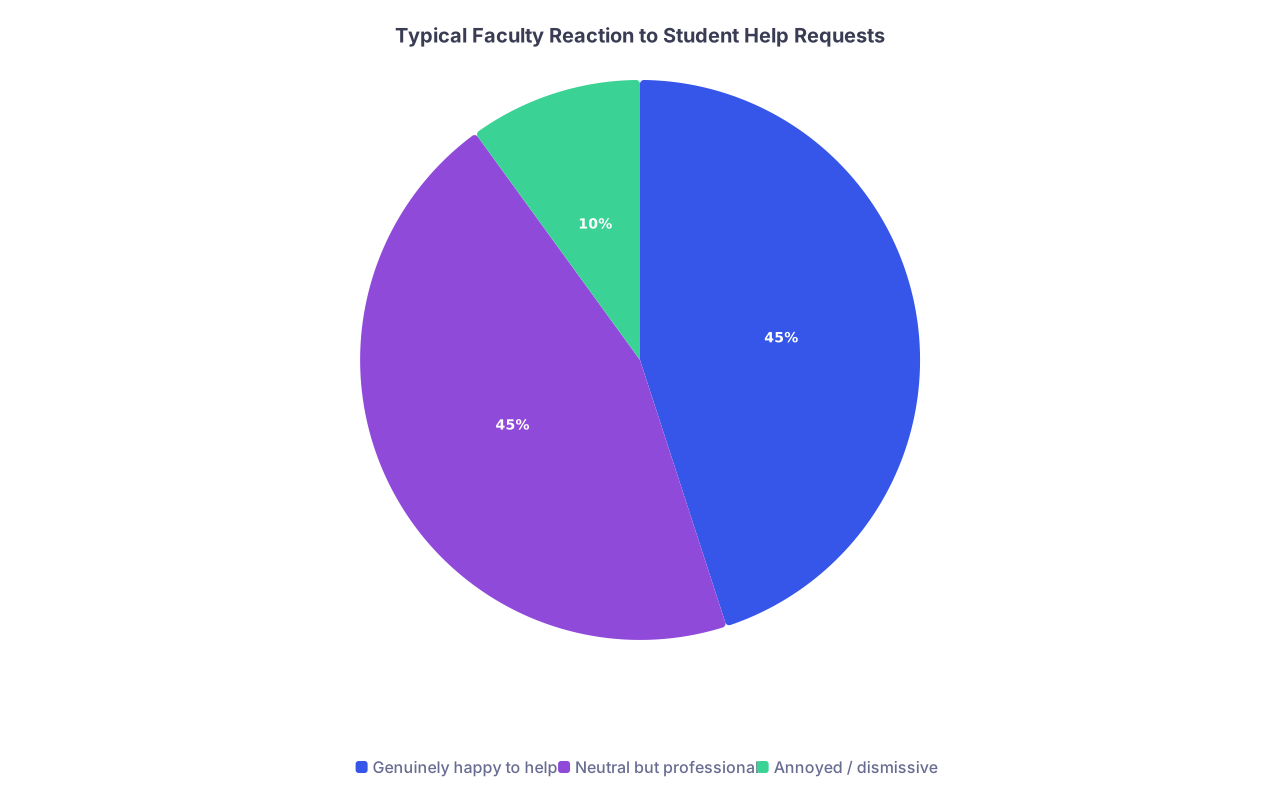
| Category | Value |
|---|---|
| Genuinely happy to help | 45 |
| Neutral but professional | 45 |
| Annoyed / dismissive | 10 |
That last slice? The “annoyed/dismissive” people? They feel like 90% in your head because they hurt the most. But they’re not the majority.
What most decent mentors think when you reach out (and you do it halfway thoughtfully):
- “Okay, this student seems serious.”
- “I remember being in their shoes.”
- “This might be a good candidate for my project / lab / letter pool.”
They are not sitting there thinking: “Wow, what a burden, how dare this student email me.”
You know who they do get annoyed by?
- The student who sends a single sentence email: “Can you write me a letter?” with no context.
- The one who disappears for months and then reappears asking for a last-minute letter due tomorrow.
- The student who clearly wants their name on a project but not the work.
You’re here reading this, spiraling about not wanting to inconvenience anyone. That already puts you in a completely different category from the genuinely inconsiderate crowd.
How to Ask Without Feeling Like You’re Begging For a Favor
Let’s make this very concrete. Because vague “reach out to mentors” advice is useless when your heart rate jumps to 130 every time you hover over “Send.”
Think of it as three steps:
- Make it low-friction for them.
- Show them why it makes sense to help you.
- Give them an easy, graceful way to say no.
That’s how you stop feeling like “a burden” and start feeling like “someone making a reasonable ask.”
Step 1: Make the ask specific and contained
“Can you be my mentor?” is huge and vague. Feels heavy. Feels like you’re asking them to adopt you academically.
Instead, you ask for something small but real:
- A 20–30 minute meeting to ask about their path.
- Feedback on a draft or idea.
- Advice about next steps in a specific area (research, clinical, gap year, etc.).
You’re signaling: I’m not dumping my whole life on you. I have a focused question and I respect your time.
Here’s an example email that’s not cringe:
Dear Dr. Lopez,
My name is [Name], and I’m a second-year student interested in [field, e.g., cardiology and clinical research]. I’ve really enjoyed your lectures on [specific topic] and was especially interested in your work on [X project].
I’m currently [brief context – e.g., exploring potential research opportunities for the coming year] and would be very grateful for the chance to ask you a few questions about your path and get your perspective on how a student in my position might get started.
If you’re available, would you be open to a brief 20–30 minute meeting sometime in the next few weeks? I’m happy to work around your schedule.
Thank you for your time and consideration,
[Name]
[School / Year]
You’re not begging. You’re not oversharing. You’re presenting yourself as a serious person asking a serious, bounded question.
From “Quick Meeting” to “Actual Mentor”: How That Bridge Happens
This is where people panic: “Okay, even if I get the meeting, how do I not waste it? And how does this turn into actual mentorship or letters later?”
You don’t walk into the first meeting saying, “Will you be my mentor and future letter writer?” That’s weird. And it triggers all your “I’m a burden” alarms.
Instead, you treat it like a test drive. For both of you.
Here’s a simple blueprint for that first meeting:
- Show that you did your homework. Mention a paper, lecture, project.
- Ask 2–4 real questions you actually care about.
- Be honest (but not chaotic) about where you are and where you’re stuck.
- Before leaving, ask something like: “Are there any next steps you’d recommend for someone like me?”
If they suggest something small—reading a paper and emailing them thoughts, talking to someone in their lab, coming to a meeting—that’s the door opening.
Your job is to do exactly what they suggested, on time, and then follow up.
That’s how you stop feeling like a burden: you become someone who takes work off their mental plate because they don’t have to chase you, remind you, or wonder if you’re serious.
“But What If They’re Secretly Annoyed?” (The Brain’s Favorite Horror Story)
Let’s walk through the worst-case scenarios your brain is obsessed with.
Scenario 1: They don’t answer your email
Your brain: “They hate me.”
Reality: Their inbox is a disaster.
Give it 7–10 days. Then send a short, polite follow-up:
Dear Dr. Lopez,
I just wanted to briefly follow up on my email below in case it got buried. I’d still be very grateful for the opportunity to speak with you, if your schedule allows.
Thank you again,
[Name]
If they don’t respond to that?
You move on. That’s data, not a verdict on your worth. They’re either too busy, disorganized, or uninterested to be a good mentor for you anyway.
You are not a burden for sending two polite emails.
Scenario 2: They say no
This one stings more. If someone says something like:
- “I’m not taking on new students.”
- “My schedule doesn’t allow for meetings right now.”
Your brain hears: “You’re not worth my time.”
But step back. Imagine a really great, in-demand physician with a full clinical load, leadership roles, and three kids. Sometimes “no” is actually an act of responsibility. They know they’d half-mentor you and that’s worse than not mentoring at all.
You can reply with:
Thank you for letting me know, and I appreciate your time. If there’s anyone you’d recommend I reach out to with similar interests, I’d be grateful for any suggestions.
Again: you’re being reasonable. Professional. Not a burden.
Scenario 3: They agree, but then seem rushed or distracted in the meeting
This one triggers the “I’m annoying them” feeling hard.
Sometimes they are rushed. Clinics run late. Their phone is buzzing. Their brain is in five places.
That doesn’t mean you were wrong to ask.
You still:
- Show up prepared.
- Keep to the time you asked for.
- Ask 1–2 key questions you’d really regret not asking.
Then you send a short thank-you email afterward. If they were just having a chaotic day, that follow-up gives them a chance to re-engage like a human being later.
When It Comes to Letters of Recommendation: How to Not Feel Like You’re Using People
This is the part that freaks people out the most. Because a letter of recommendation feels… transactional. Like, “Please spend an hour writing about how great I am so I can move on with my life.”
The only way this doesn’t feel gross is if you:
- Ask the right people.
- Give them what they need to say yes or no honestly.
- Make it as easy as humanly possible to help you.
| Potential Writer | Good Choice? | Why |
|---|---|---|
| PI who knows your work | Yes | Can speak to work ethic, detail |
| Doc you shadowed 1 day | No | Doesn’t know you |
| Course director (A, engaged) | Yes | Saw your performance |
| Famous name who barely remembers you | No | Name > substance |
You’re not a burden if:
- You’ve shown up consistently.
- You’ve done real work with them (class, research, clinic, project).
- You ask early and give a clear timeline.
Here’s what a not-burden email looks like for a letter:
Dear Dr. Lopez,
I hope you’re doing well. I’ve really appreciated the opportunity to [take your course / work in your lab / work with you on X]. I’m in the process of applying to [medical school / a summer program / research position], and I was wondering if you’d feel comfortable writing a strong letter of recommendation on my behalf.
Working with you, I’ve particularly valued [specific thing: your feedback on my presentation, learning to analyze data, your teaching on X]. I believe you’ve seen how I [show up early, handle feedback, think through problems, work with patients, etc.], and I think your perspective would be very meaningful to my application.
The letter would be due on [date], and I’d be happy to provide my CV, personal statement draft, and any additional information that would be helpful.
I completely understand if your schedule doesn’t allow or if you don’t feel you know me well enough to write a strong letter.
Thank you for considering this,
[Name]
Notice the key parts:
- You say “strong letter” so they can be honest if they can’t do that.
- You give them an out. That’s how you stop feeling like you’ve cornered them.
- You offer materials so writing it is easier.
That’s not burdening someone. That’s how grown-up professional asks work.
How to Stop Apologizing For Existing (At Least When It Comes to Mentorship)
Your “I feel like a burden” script is strong. I know. It doesn’t vanish because you read one article and send one email.
But you can build evidence against it.
Here’s the pattern I’ve seen again and again:
- Student agonizes over reaching out.
- They finally muster the courage.
- The reply is either:
- Warm and positive → shock.
- Neutral but agreeable → “oh, that wasn’t so bad.”
- Non-existent → it stings, but then they find someone better.
The world doesn’t explode. Their reputation doesn’t tank. No one sends a department-wide email saying, “Look at this needy student asking for help.”
And slowly, experience beats anxiety.
Use tools like this if you need structure:

| Step | Description |
|---|---|
| Step 1 | Identify 3-5 potential mentors |
| Step 2 | Research each person briefly |
| Step 3 | Draft short, specific email |
| Step 4 | Send to first 1-2 mentors |
| Step 5 | Send brief follow-up |
| Step 6 | Schedule meeting |
| Step 7 | Move on to others |
| Step 8 | First meeting |
| Step 9 | Follow their suggested next step |
| Step 10 | Re-evaluate: Potential mentor? |
| Step 11 | No response in 7-10 days? |
| Step 12 | Still no response? |
Reasonable. Stepwise. Not clingy. Not “too much.”
Quick Reality Check: You Are Supposed to Need Help at This Stage
One last thing, because this piece of the story gets twisted a lot.
You’re a premed or early med student. You are not supposed to know how to:
- Navigate research politics
- Design your “perfect” CV strategy
- Interpret every hidden rule of letters of recommendation
- Choose between 10 sub-specialties you barely know
Faculty, residents, advisors, and mentors exist because no one can do this alone without wasting years and burning out.
Using the system as it was designed—asking for mentorship, asking for letters—is not burdening people. It’s participating in the actual structure of this profession.
You are not sneaking in the side door begging for special treatment. You are walking in the front door and saying, “I’m doing the work. I’m trying. I need guidance.”
That’s what you’re supposed to do.
FAQs
1. What if I genuinely don’t have anyone who knows me well enough for a letter?
Then your priority isn’t letters yet; it’s relationships. Start now, even if you feel late. Go to office hours, show up consistently in one lab or volunteer setting, and let at least 2–3 people actually see you work over time. It’s uncomfortable, yes. But it’s fixable. Better an honest relationship built now than another year of hiding and hoping.
2. Is it rude to ask more than one person for mentorship or advice?
No. In fact, it’s smart. You’re not signing a contract. You can have a research mentor, a clinical mentor, and a “life sanity” mentor who’s just good at talking through decisions. The disrespectful part isn’t having multiple mentors; it’s wasting their time, ghosting, or never following through. You won’t do that—you’re literally worrying about being a burden.
3. How early is too early to ask someone if they’d consider writing me a letter someday?
If you’ve barely exchanged names: too early. If you’ve worked with them for a semester, on a project, or in a longitudinal clinic, and they’ve seen you show up consistently? It’s not too early to say something like, “I’m planning ahead for applications next year and starting to think about potential letter writers. If things continue to go well, do you think you might feel comfortable writing for me when the time comes?” That gives them space and time.
4. What if I ask for a letter and they say yes, but I’m scared it’ll be lukewarm?
That’s why you use the phrase “strong letter” in your ask. It gives them an out. If they’re vague, hesitant, or say something like “I can write a letter, but I don’t know you that well,” that’s your cue to thank them and not use them as a primary letter writer. A weak letter is worse than none. Protect yourself by choosing people who light up a bit when they talk about your work.
5. How many times can I follow up before it becomes pestering?
For an initial meeting or mentorship ask: two emails total (initial + one follow-up) is reasonable. For a letter that’s already been agreed to: a gentle reminder 2–3 weeks before it’s due, and then again 5–7 days before if needed. If you’re polite, include the deadline, and offer to resend links/materials, that’s not pestering—that’s being organized. If they still don’t come through, that’s on them, not you.
Key points:
You’re not a burden for asking for guidance or letters; you’re doing exactly what serious applicants are supposed to do.
The difference between “annoying” and “professional” isn’t whether you ask—it’s how you ask, how you follow up, and how you follow through.