
Last spring, I sat in a selection committee room while a premed’s file was projected on the screen. Two glowing letters. One from a doctor she’d shadowed at a big-name academic center. One from a community internist she’d worked with weekly for nine months. The committee spent about nine seconds on the shadowing letter. The longitudinal one turned into a five-minute discussion—and was the reason she got an interview.
You’re told “get clinical exposure” and “get strong letters.” Nobody tells you which experiences actually produce the kind of letters faculty secretly look for. Shadowing vs longitudinal mentorship is where most applicants quietly shoot themselves in the foot. Let me walk you through what really happens when we read these letters.
What Committees Actually See When They Read Your Letters
Forget the official language. On paper, all letters “support the applicant” and “highly recommend.” That’s background noise. We’ve all learned to ignore it.
Here’s what the faculty at med schools and residency programs are really scanning for when your letter loads on the screen:
- How long did this person know you?
- How often did they see you?
- Did they see you do anything, or just exist in their peripheral vision?
- Can they compare you to others they’ve worked with?
- Did they stake any of their own reputation on you?
We’re not consciously thinking in bullet points. But after you’ve read a few thousand letters, your brain auto-sorts them into tiers in about 15–20 seconds.
Shadowing-based letters almost always fall in the same bucket: “Polite, generic, observational, limited.” Longitudinal mentor letters—when done right—land in the “this person is vouching with their throat on the line” bucket.
To understand why, you need to look at how these letters are actually used behind closed doors.
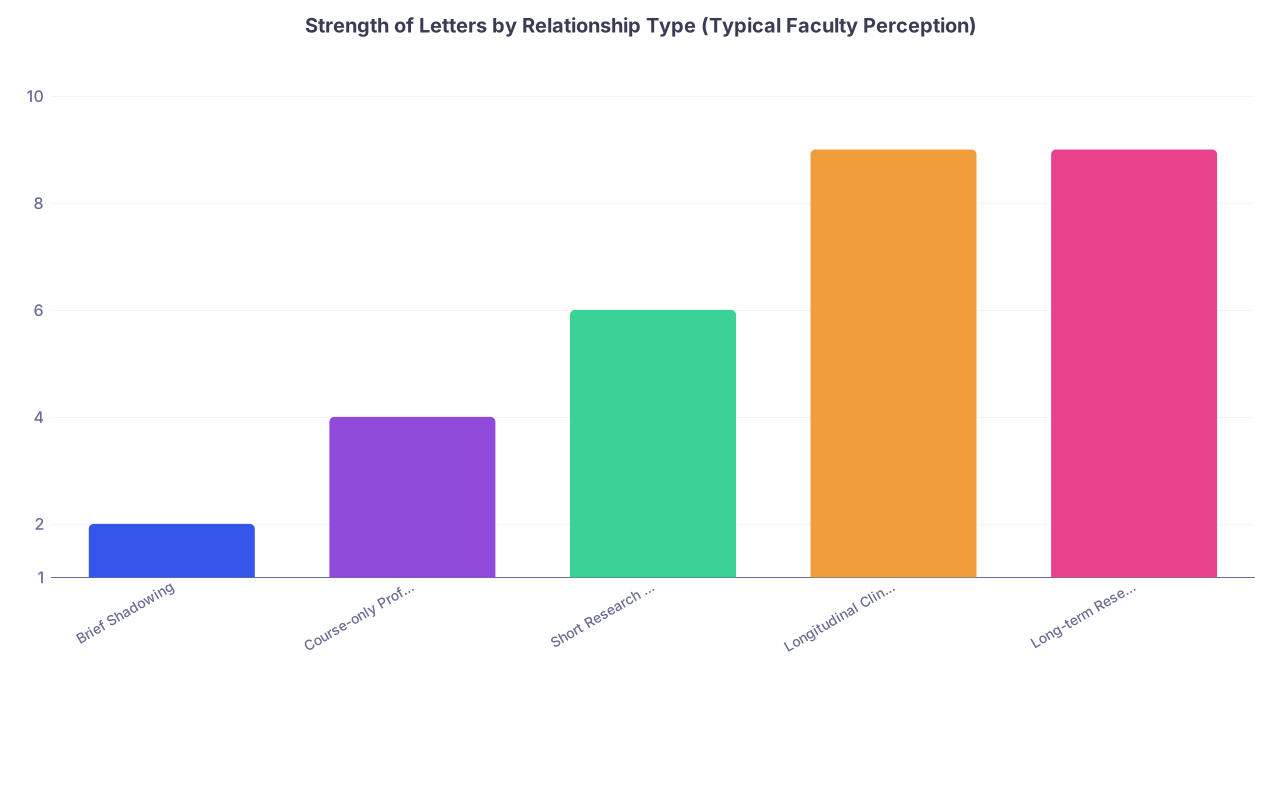
| Category | Value |
|---|---|
| Brief Shadowing | 2 |
| Course-only Professor | 4 |
| Short Research (2-3 mo) | 6 |
| Longitudinal Clinical Mentor | 9 |
| Long-term Research PI | 9 |
No one says this in the brochure. But this is how they’re mentally ranked.
Why Shadowing Letters Almost Always Disappoint
Most premeds massively overestimate the value of a shadowing letter, especially if the physician has a big name or a fancy institution in their email signature.
Let me tell you what those letters actually look like when they hit committee.
I’ve lost track of how many versions of this I’ve read:
“I had the pleasure of having Ms. A. shadow me in my cardiology clinic for two weeks in the summer of 2023. During this time, she observed patient encounters, asked thoughtful questions, and showed great interest in the field of medicine.
She was punctual, professional, and courteous to staff and patients. I fully expect she will excel in medical school and beyond.”
That’s it. Different font. Same content.
Here’s the problem, from a reviewer’s perspective:
The physician didn’t see you do anything that matters.
Shadowing is passive by design. You aren’t documenting, you aren’t calling consults, you aren’t adjusting meds. You’re watching. Sometimes from the hallway.The time frame is too short to mean much.
Two afternoons. One week. “Over the course of several days.” That kind of phrasing shows up constantly. We know you can be charming for a week. That doesn’t tell us who you are under stress or over time.It’s impossible to differentiate you from every other shadow.
Many attendings see a rotating cast of observers. Unless you did something truly standout (and most can’t, given the limits on shadowing), your letter sounds exactly like the last ten people they wrote for.There’s no real risk for the letter writer.
If you turn out to be a disaster as a med student, that cardiologist doesn’t care. They barely knew you. Their name on your file meant almost nothing because they didn’t vouch for you based on actual performance.
Faculty recognize this instinctively. So when they see “Dr. X, whom I shadowed,” their expectations drop before they even open the letter.
The only shadowing letters that sometimes break this pattern are when what you did was not actually shadowing—when you gradually morphed into a longitudinal worker/mentee and just never changed the label.
If your “shadowing” was really you:
- showing up weekly for months
- helping with pre-charting, calling patients, doing basic follow-up within legal bounds
- becoming part of the clinic rhythm
that’s not pure shadowing anymore. That’s a longitudinal relationship. And those letters read very differently.
But let’s be blunt. If your physician can’t honestly write “I worked with this student regularly for at least three months,” the letter is almost guaranteed to be low-yield compared to what you could have gotten elsewhere.
What Longitudinal Mentor Letters Do That Shadowing Never Can
When a true longitudinal mentor writes for you, the entire tone of the letter changes. You can spot these within three sentences.
Here’s the format that quietly makes selection committees lean forward:
“I have worked closely with Mr. B. for the past 10 months in my internal medicine clinic, where he volunteered weekly as a patient navigator and research assistant.
I can speak in detail to his work ethic, clinical reasoning at his current level, and his growth over time.”
Notice the difference already? Length of time. Specific role. Domains of evaluation.
A strong longitudinal letter lets faculty do what they actually want to do: assess your trajectory, not just your personality.
The insider advantages of a longitudinal mentor:
They can describe growth.
Committees salivate over phrases like:- “Over the course of the year, I watched her go from tentative and quiet to comfortably leading portions of the patient interview under my supervision.”
- “His written notes became progressively more focused and clinically relevant, reflecting a growing ability to separate noise from signal.”
Growth over time is the single clearest marker that you will not plateau in M2 and crumble on the wards.
They can give concrete behavioral examples.
Shadowing letters give adjectives. Longitudinal letters give stories.The story is what sells you, not the flattery.
Example that sticks in a room:
“One morning our MA called in sick unexpectedly. Without being asked, she stepped in to room patients, bring them back, and update the list, all while staying well within her scope. She kept clinic from falling apart that day.”
That tells the committee more about who you are than two paragraphs of “hard-working and compassionate.”
They can compare you to real benchmarks.
The magic phrases faculty look for:- “On par with a strong first-year medical student”
- “In the top 5% of undergraduates I have worked with in my 15 years of practice”
- “More prepared than many interns I have met in terms of professionalism and reliability”
You only get those comparisons when someone has seen a lot of trainees and has seen you over time.
They’re more willing to take a reputational risk.
A mentor who’s spent a year with you will either write a very strong letter—or politely decline. That’s exactly what you want. Lukewarm letters from long-term mentors are deadly because they stand out in the pile.When they are strong, though, we can tell the writer is putting their name on the line. And that carries real weight.
The Subtext Faculty Read That You Don’t See
Here’s the part that almost nobody tells premeds: faculty don’t just read the text of the letter; they read the subtext of how the relationship formed.
We are silently asking:
- Who did this student choose to invest time with?
- Who chose to invest time back?
- Did this student show the judgment to move beyond passive roles into meaningful ones?
Let me unpack the signals.
When I see “shadowed Dr. Y for a month,” I infer:
- You did the minimal, most accessible form of clinical exposure.
- You probably didn’t organize your time well enough to secure a deeper recurring role, or you didn’t understand early enough that you’d need one.
- The physician may not even remember you that clearly.
When I see “worked with Dr. Z weekly for 8 months as a medical assistant / scribe / research coordinator / clinic volunteer,” I infer:
- You learned the value of showing up repeatedly.
- You were reliable enough that the clinic wanted you back.
- You cared enough to build an actual relationship, not just collect experiences.
That’s why a shorter letter from a community doc who knows you extremely well can beat a longer, beautifully written letter from a big-name academic who barely remembers your last name.

Let me give you a real example from a committee discussion:
Applicant A:
- Shadowing letter from “Director of Cardiology, Prestigious University Hospital”
- 3 paragraphs, all compliments, knew student for “several days”
- Described as “bright, inquisitive, compassionate”
Applicant B:
- Longitudinal letter from “Family Medicine Physician, Community Clinic”
- 1.5 pages, concrete anecdotes
- Knew student for 14 months, weekly contact
Around the table, people said out loud:
- “The cardiology letter is nice but basically a shadowing template.”
- “This family medicine doc clearly knows this student very well.”
- “I’m more confident about B’s day-to-day behavior than A’s.”
B got the interview first. A needed their stats to carry the rest.
Name recognition can help you on the margins. But depth of relationship beats prestige more often than applicants think.
The Ugly Secret: Which Letters Are Quietly Discounted
When faculty say “we look at letters holistically,” what they mean is: we glance at them all, but we only really care about a few.
Here’s the hierarchy that actually plays out in most rooms, whether people admit it or not:
| Letter Type | Typical Impact Level (1–10) |
|---|---|
| Brief shadowing letter (few days–2 weeks) | 2–3 |
| Course-only, large lecture professor | 4 |
| Short-term research (1 semester) | 5–6 |
| Longitudinal clinical mentor (6+ months) | 8–9 |
| [Long-term PI](https://residencyadvisor.com/resources/letters-of-recommendation/how-pds-rank-science-vs-clinical-vs-research-mentors-in-recommendation-files) / intensive research mentor | 8–9 |
Nobody’s going to say, “We ignore shadowing letters.” That would be too blunt for public consumption. But behind closed doors, when time is short and we’re triaging applications, those letters barely move the needle.
I’ve watched committee members literally skim a shadowing letter in under ten seconds, then go back to discussing MCAT breakdowns and GPA trends. Not because they’re cruel. Because they know there’s not much substance there.
On the other hand, when they hit a letter with phrases like:
- “Over the course of the year…”
- “On at least twenty separate occasions…”
- “In my decade of teaching premeds…”
the entire room shifts. People start quoting lines aloud. That’s when a borderline MCAT or slightly messy semester gets forgiven.
The other ugly secret: generic superlatives without concrete backing are a red flag, not a boost.
If a shadowing letter says:
“She is one of the most outstanding students I have met,”
but then gives zero examples of anything beyond watching and asking questions, seasoned committee members smell inflation. It actually decreases the credibility of the entire letter.
How to Turn a “Shadowing Doc” into a True Longitudinal Mentor
This is where you have more control than you think.
Most of you treat shadowing as a one-off transactional event. That’s why it produces worthless letters. If you take nothing else from this, remember: your goal is not to collect shadowing hours; your goal is to convert one or two physicians into long-term advocates.
That requires three deliberate moves.
1. Stay with one physician longer than is comfortable
Students love variety. “I shadowed 12 different specialties.” Great for your curiosity. Terrible for letters.
If you had to choose, I’d rather you spend:
- 9 months with one internal medicine doc,
than:
- 2 weeks each with 4 different specialists + 1 month drifting around.
Because only that first scenario produces the kind of letter that will save you when your MCAT is a point or two below the median.
2. Gradually shift from passive observer to low-level contributor
You cannot walk in day one and demand responsibilities. You earn them.
But if you’re still silently following behind the physician after 3 months, you’ve wasted the opportunity.
Things I’ve watched strong premeds do in real clinics:
- Start with: standing back, watching, asking a few thoughtful questions between patients.
- Then: offering to help call patients with appointment reminders or satisfaction surveys (within clinic policy).
- Then: prepping rooms, bringing patients back, taking basic histories (if the physician and clinic are comfortable and you’re not crossing legal or institutional boundaries).
- Then: helping with patient education handouts, follow-up instructions, or even basic reminders for chronic disease management (scripted, under supervision).
By month 4–5, the mentor can truthfully write that you contributed to clinic flow, engaged with patients, and functioned like a low-level team member. That’s pure gold for a letter.
3. Explicitly ask for developmental feedback several times
This is the part that separates “person I once shadowed” from “mentee I’ve been investing in.”
If you periodically ask:
- “Is there anything I could be doing better when I talk to patients?”
- “What should I work on if I want to be more helpful to the team?”
- “Can you tell when I’m getting in the way vs being useful?”
the attending starts to think of you as a trainee, not a tourist.
And trainees get stronger letters than tourists.
At that point, when you eventually ask for a letter, your request lands very differently. You’re not asking a stranger for a favor. You’re asking a mentor to document work they’ve already seen.

| Step | Description |
|---|---|
| Step 1 | Start Shadowing |
| Step 2 | Show Up Consistently |
| Step 3 | Ask Good Questions |
| Step 4 | Offer Small Help Tasks |
| Step 5 | Take On Regular Role |
| Step 6 | Seek Feedback |
| Step 7 | Request Strong Letter |
This is the trajectory that leads to letters committees actually discuss, not just file.
For Medical Students: The Same Rules, Higher Stakes
If you’re already in med school, the shadowing vs longitudinal question just shifts names.
Now it’s:
- 2-week elective vs 3-month continuity clinic
- Random away rotation vs home mentor who has watched you grow for a year
- Flyby subspecialty consult attending vs core clerkship director who saw you daily
The faculty perspective doesn’t change. The people who’ve watched you over time will always be able to write the letters that move the needle.
Some med students make this mistake: they chase big-name surgeons or subspecialists for letters after 2–3 weeks on an away rotation, assuming the prestige will carry them. They end up with detailed descriptions of a narrow time slice.
Meanwhile, the student who invested steadily in one mentor at their home institution, showed up to clinic, followed a project from start to finish, and asked for feedback three times … that student gets the letter that starts with:
“I have watched her evolve from an uncertain third-year student to one of the strongest sub-interns I have worked with in the past five years.”
Guess whose letter gets quoted during rank meetings.

How to Ask for the Right Letter (And Avoid the Wrong One)
Last piece of insider advice: the ask matters, especially when trying to turn a shadowing doc into a mentor letter.
You do not say:
- “Can you write me a letter for med school?”
You say:
- “Given how long we’ve worked together and that you’ve seen me interact with patients and the team, do you feel you could write a strong, detailed letter of recommendation for my medical school application?”
The words “strong” and “detailed” are intentional. They give the mentor an easy out if they can’t do that.
If your only relationship with a physician is 10–20 hours of shadowing spread over a couple of weeks and you still push for a letter, here’s what you’re really telling committees:
- You either don’t understand what a strong letter looks like.
- Or you didn’t build the kind of relationships that would allow you to get them.
Both are avoidable.
So if you’re sitting on three shadowing letters and no longitudinal mentor, the harsh truth is: your problem isn’t letter strategy; it’s how you spent the last 1–2 years. Fix that now, not after you click “submit.”

The Bottom Line: What Faculty Secretly Prefer
Let me strip this down to what actually matters.
First: Faculty overwhelmingly prefer letters from longitudinal mentors who have seen you consistently over time, watched you grow, and can give specific stories of your behavior, reliability, and trajectory. Shadowing letters rarely rise above generic, no matter how impressive the letterhead.
Second: A modestly known community physician who knows you well is usually more powerful than a famous academic you barely met. Committees read for depth of relationship, duration, and risk taken by the writer—not just the title line.
Third: Your real task isn’t to collect letters. It’s to build one or two relationships that naturally lead to strong letters. Shadowing can be the doorway. If you stop there, you’ve wasted most of its value.