
The dirty secret about letters of recommendation? Admissions can smell a “courtesy letter” in about five seconds—and it tells them as much about your mentors as it does about you.
Let me walk you through how that actually plays out behind the scenes, because nobody on your campus is going to say this out loud. Your premed advisor will say “Get strong letters.” Your dean will say “Ask people who know you well.” Those are platitudes. In committee, the conversation sounds very different.
I’ve sat in rooms where fifty applications were on the table, and the entire discussion of someone’s letter was: “This is clearly a courtesy.” One sentence. And that applicant is done.
What a “Courtesy Letter” Really Is (From the Other Side of the Table)
A courtesy letter is not always a bad letter. That’s what confuses students.
A courtesy letter is a letter someone writes because:
- They feel obligated
- You asked nicely and they didn’t want to say no
- Their institution pushes them to write for any student who requests one
But here’s the real definition we use internally:
A courtesy letter is any letter where the writer is clearly not sticking their neck out for you.
That’s all. They will describe you. They will not advocate for you.
On admissions, we essentially sort letters into three piles: advocacy, neutral, and risk/negative. Courtesy letters live in the neutral bucket. And neutral is lethal in competitive pools.
Here’s how a faculty member once put it to me in a ranking meeting at a mid-tier MD program:
“If the letter writer wouldn’t be uncomfortable if the applicant read the letter out loud in front of them, it’s not advocating. It’s just describing.”
Courtesy letters are descriptive. Vague. Formulaic. Safe. And very easy to recognize once you’ve read a few thousand.
How Admissions Spot Courtesy Letters in Under 30 Seconds
No exaggeration: under 30 seconds. Many times in under 10.
Let me show you exactly what we look for.
1. The Language of Minimal Investment
Read enough strong letters and your brain starts highlighting certain phrases in red. Not because the phrases are “bad,” but because they scream: “I’m not really putting anything on the line here.”
These are classic courtesy tells:
- “I had the pleasure of having X in my course…”
- “X completed my [course/rotation] and performed satisfactorily.”
- “X was always punctual and respectful.”
- “I am pleased to recommend X for your program.”
- “I expect that X will do well in medical school.”
- “I can recommend X without reservation.” (Believe it or not, this one is often boilerplate when it’s not followed by specifics.)
Notice something? None of those sentences actually mean anything unless they’re backed by concrete examples and superlatives.
Here’s how this goes in the committee room:
Reader 1: “Letters?”
Reader 2: “All courtesy. No push.”
Rest of the room: nods, moves on
That’s not hypothetical. That’s how it’s actually discussed.
Contrast that with advocacy language:
- “X is among the top 5% of undergraduates I have taught in 20 years.”
- “I urge you to give X your strongest consideration.”
- “I would choose X as my own physician without hesitation.”
- “If I had a spot in my lab/clinic, I would recruit X tomorrow.”
You feel the difference. We do too. Immediately.
2. The Dead Give-Away Structure: Template with Your Name Dropped In
You’ve probably seen this kind of letter without realizing it:
Paragraph 1: “I am pleased to write this letter for X, who took my [course] in [term].”
Paragraph 2: General description of course + the fact that it was “rigorous.”
Paragraph 3: One generic sentence about your performance: “X earned an A and was a diligent student.”
Paragraph 4: Two cliches: “I am confident X will succeed in medical school and beyond. I recommend them without reservation.”
That’s a courtesy letter skeleton.
Admissions readers recognize templates instantly; they read them all day. When your letter sounds exactly like the last ten students’ from that professor, it loses all weight. Some schools even see multiple applicants from the same institution in the same cycle with identical first and last paragraphs—different names and grades. We notice.
3. The “Knows You on Paper Only” Problem
There’s a question every serious reader is silently asking:
“Does this person actually know this applicant as a human being, or just as a grade in a spreadsheet?”
Courtesy letters scream “spreadsheet.”
We look for:
- No personal anecdotes
- No specific patient/clinical scenario
- No story of growth or resilience
- No reference to your interests, motivations, or character beyond “hardworking”
Here’s an example I saw from a large state school:
“X was a student in my 300-person biochemistry course. X consistently scored above average and obtained an A. X attended class regularly and was always respectful. I believe X has the potential to succeed in further studies.”
Translation: I barely know this person. They got an A. That is all.
Now look at how a real advocate writes, even if they only know you from a course:
“X earned one of the top 5 scores in my 280-student biochemistry course, but what stood out even more was their willingness to help struggling peers during weekly review sessions. I remember one case where X stayed after a 3-hour exam to walk a small group through questions they had missed, without a hint of condescension. That type of quiet leadership is rare at the undergraduate level.”
Same context—course only. Completely different signal. One is courtesy. One is investment.
4. Vague Comparisons or No Comparisons at All
We pay attention to how writers compare you to peers. Courtesy letters dodge this.
Weak/neutral:
- “X is a strong student.”
- “X did well in my course.”
- “X is above average.”
Good but still somewhat generic:
- “X was among the better students in my class.”
High-impact advocacy:
- “Top 5 of 200 undergraduates I’ve mentored.”
- “Top 10% of all students I’ve taught in 10 years.”
- “The best student in this year’s cohort.”
When there’s no comparison at all, and the letter is short or generic, we assume the writer either can’t or won’t go to bat for you. Both are bad signs in a competitive pool.
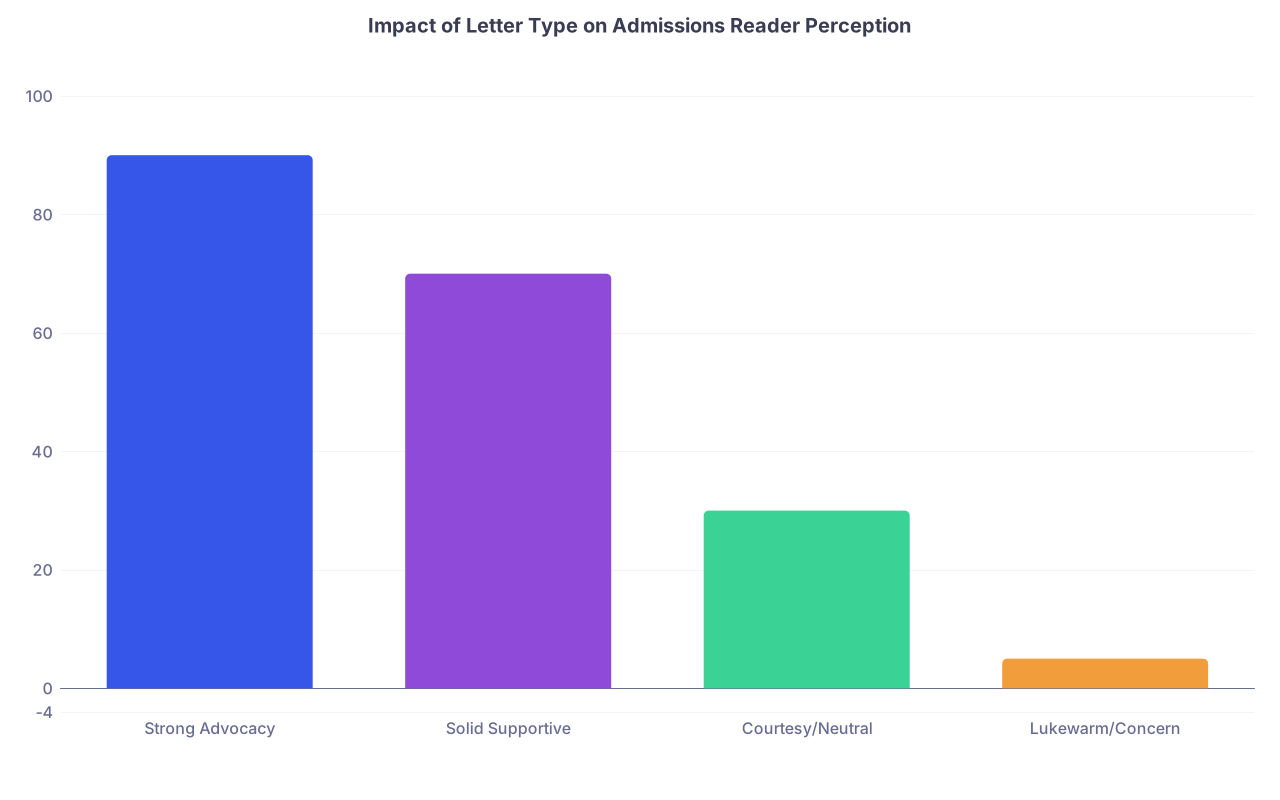
| Category | Value |
|---|---|
| Strong Advocacy | 90 |
| Solid Supportive | 70 |
| Courtesy/Neutral | 30 |
| Lukewarm/Concern | 5 |
(Those numbers aren’t exact statistics; they reflect how often each type of letter meaningfully helps you in decision-making. Courtesy sits barely above “might as well not exist.”)
5. Short Letters from People Who Should Have More to Say
A one-page letter from a course director with 300 students? Fine. It might be brief but still decent.
A one-page letter from:
- Your PI after two years in the lab
- Your primary clinical supervisor from a year-long scribe job
- A physician you shadowed for months and claim as your “mentor”
That’s a red flag.
We know how much material a real mentor has. They’ve seen your good days, your bad days, and everything in between. When they produce 3 tight paragraphs and no specific story, what we hear is:
“I’m willing to confirm this person showed up. I’m not willing to endorse more than that.”
6. Tone: Carefully Polite, Emotionally Flat
Courtesy letters are emotionally dead. You can feel when a writer is genuinely excited about someone.
Courtesy:
“X is a hardworking and dedicated student who will be a good medical student.”
Advocacy:
“X is the kind of student you remember years later. When I heard they were applying to medical school, I genuinely felt thrilled, because I know they will raise the standard of any class they join.”
Same idea, different temperature. We’re reading for temperature.
What Courtesy Letters Reveal About Your Mentors (And About You)
Now the part nobody tells you in undergrad: a courtesy letter doesn’t just reflect the writer. It reflects your entire support ecosystem.
Admissions readers infer things. Constantly. It’s their job. Here’s what they quietly think when they see a string of courtesy letters in someone’s file.
1. “This student doesn’t have real advocates.”
Harsh, but this is the gut reaction.
If all three of your letters are neutral or template-style, it suggests you never developed deep working relationships with faculty, PIs, or clinicians. That makes people nervous, especially for medicine, where success is built on mentorship and team dynamics.
Red flag thoughts in the room:
- “Who actually knows this person?”
- “Who would go to bat for them when things get hard in residency?”
- “If nobody is willing to take a risk on their application, why should we?”
Nobody says that into the microphone during formal committee. But in the hallway afterward, yes, absolutely.
2. “This institution produces a lot of junk letters.”
Certain colleges and med schools are known for this. Big names too.
We see a pattern:
- Same pre-health advising office
- Same two or three major science departments
- Same letter style: 4 paragraphs, all generic, no ranking
The message we get: This institution teaches its faculty to protect themselves, not their students. They’re trained to write safe, liability-proof letters. And so every student looks the same on paper.
That doesn’t mean we punish you for your school. But it does make it harder for you to stand out. You’re fighting upstream against your own letter culture.
| Letter Type | Typical Length | Specific Examples | Comparative Ranking | Reader Impact |
|---|---|---|---|---|
| Strong Advocacy | 1.5–2.5 pages | Multiple stories | Clear, top-tier | Big positive |
| Solid Supportive | 1–2 pages | 1–2 specifics | Some comparison | Moderate help |
| Courtesy/Neutral | ~1 page | Generic praise | None/vague | Little effect |
| Lukewarm/Negative | Any | Concerns hinted | Avoid comparisons | Hurts badly |
3. “This mentor is protecting themselves more than they’re helping.”
Let me be brutally direct: many faculty are more afraid of saying something too strong than they are invested in getting you into medical school.
There are three categories of writers:
- The advocates – They’ll go to bat for you.
- The obligers – They say yes, but they play it safe.
- The avoiders – They quietly discourage or decline.
Courtesy letters mostly come from obligers. These are not bad people. They’re just not the people who will change your life.
And yes, we absolutely judge letter writers. If I see a world-famous PI write a bloodless, two-paragraph “X did the work assigned” letter, they drop in my internal list of “don’t bother” recommenders. Students don’t know this… but admissions offices absolutely remember patterns from particular names.
4. “This student may not understand how this game works.”
When your personal statement claims deep clinical passion and your “primary mentor” writes two vague paragraphs without one patient story, something doesn’t add up.
Either:
- You overrepresented the depth of that relationship
- You chose a letter writer poorly
- You didn’t give them what they needed to write something meaningful
- Or they have concerns they’re not voicing explicitly
Any of those scenarios hurts you.
How to Avoid Courtesy Letters Before They Happen
You cannot fix a courtesy letter after it’s uploaded. The prevention has to happen 6–24 months earlier.
Here’s how people who actually get strong letters play the game.
1. Choose Letter Writers Who’ve Seen You Struggle (and Recover)
The best letters are not from people who’ve seen you be flawless. They’re from people who’ve seen you:
- Mess something up
- Get critical feedback
- Adjust, improve, and come back stronger
If all your relationships are “I went to class, did well, and left,” you are setting yourself up for courtesy letters. Strong mentorship is built in the messy parts: tough experiments, complicated patients, actual responsibility.
So, lean into:
- Long-term lab work (at least a year, preferably more)
- Longitudinal clinical roles (scribing, MA, EMT, clinic volunteer where staff actually know you)
- Meeting with professors outside class before you ever need a letter
You’re not collecting signatures. You’re collecting people who’ve genuinely witnessed your growth.
2. Ask the Right Question, Not “Can You Write Me a Letter?”
This one is non-negotiable.
Do not ask:
“Can you write me a letter of recommendation?”
Ask:
“Do you feel you know me well enough to write a strong letter of recommendation for medical school?”
The word “strong” forces honesty. It gives them permission to say no. You want them to say no if they’re going to produce a courtesy letter.
I’ve watched good mentors do this:
Student: “Would you write a strong letter for me?”
PI: “I can write you a supportive letter describing the work you’ve done, but I don’t think I can compare you to my best students yet. If you’re okay with that, I’ll do it. If you’d rather ask someone else, I won’t be offended.”
That mentor just saved the student from a neutral letter. Many won’t be that explicit. The word “strong” is what opens that door.
3. Feed Them Real Material (Most Students Don’t)
Faculty are busy. Clinicians are drowning. If you hand them nothing but your CV and a deadline, you’re begging for a courtesy letter.
What high-performing applicants do instead:
- Send a concise “brag sheet”: 1–2 pages with bullet points of specific stories, projects, challenges, and growth moments they’ve seen you navigate
- Remind them of particular patient cases, experiments, presentations you did under their supervision
- Tell them what you hope they can speak to (work ethic, resilience, leadership, clinical maturity, etc.)
This doesn’t “script” the letter. It jogs their memory so they can write from reality. And it nudges them away from generic filler.
4. Mix Your Letter Types Intentionally
Not every letter has to be a two-page symphony.
A realistic, strong set might look like:
- One big advocacy letter from a research PI or major mentor
- One strong clinical letter from someone who saw you with patients or in a clinical environment
- One academic letter from a demanding upper-level science course
If your school insists on a committee letter, understand: the individual letters that feed into that packet still matter for admissions at many programs, especially MD/PhD and competitive MD schools. Don’t assume the committee letter alone will carry you.
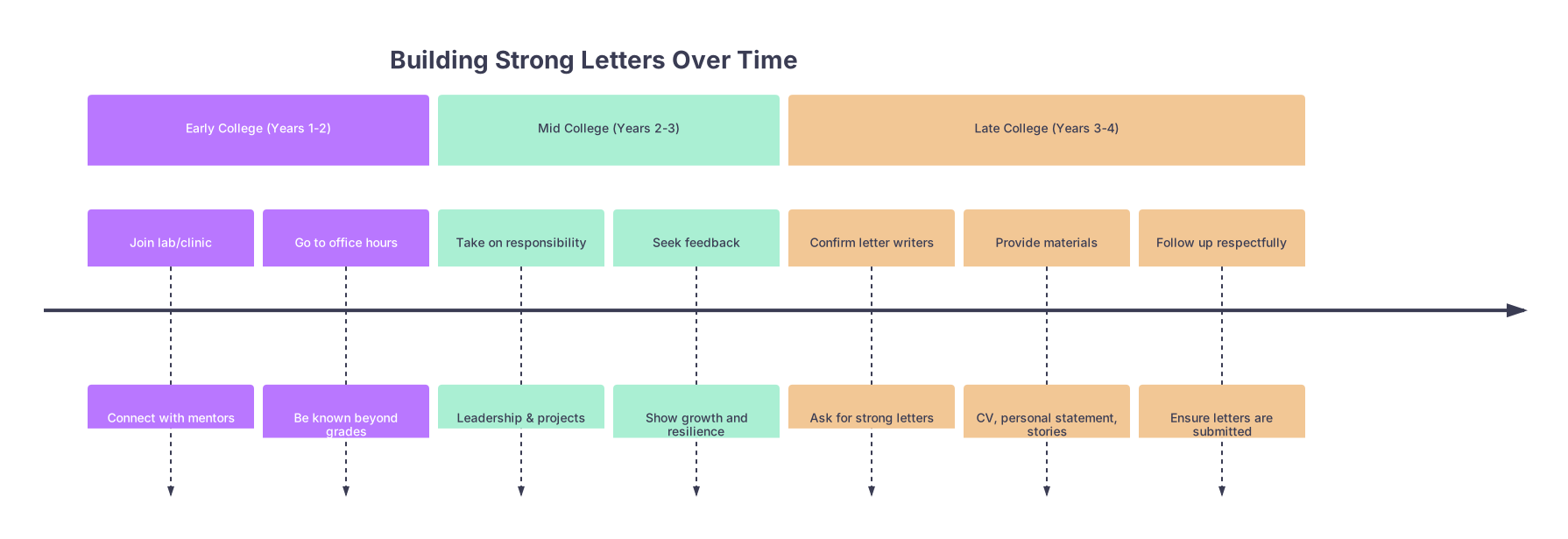
| Period | Event |
|---|---|
| Early College (Years 1-2) - Join lab/clinic | Connect with mentors |
| Early College (Years 1-2) - Go to office hours | Be known beyond grades |
| Mid College (Years 2-3) - Take on responsibility | Leadership & projects |
| Mid College (Years 2-3) - Seek feedback | Show growth and resilience |
| Late College (Years 3-4) - Confirm letter writers | Ask for strong letters |
| Late College (Years 3-4) - Provide materials | CV, personal statement, stories |
| Late College (Years 3-4) - Follow up respectfully | Ensure letters are submitted |
5. Pay Attention to Warning Signs Before You Ask
If you want to avoid courtesy letters, you have to read the room.
Worrisome signs:
- They frequently forget your name or confuse you with other students
- They’ve never seen your work outside standard course requirements
- They give everyone the same level of generic praise
- They seem hesitant or lukewarm when you bring up med school
If they don’t light up at the idea of writing on your behalf, that’s data. Believe it.
What To Do If You Suspect You Already Have Courtesy Letters
You won’t see the letters, so you’re working on suspicion and pattern recognition.
Clues you might have courtesy letters:
- You asked last-minute and the writer agreed with no questions
- You never gave them specific material, and they didn’t ask for any
- Their email response was extremely short and formal
- You have no substantial relationship, but they said yes immediately
Can you fix it in the same cycle? Usually not. Most systems won’t let you remove or swap letters once they’re in use. A few programs allow adding additional letters, but that can backfire if it looks like you’re trying to bury weak ones.
What you can do:
- For future cycles (if you have to reapply), completely rebuild your letter strategy
- For current cycle, make sure the rest of your application tells a coherent, specific, human story so that weak letters don’t sink you everywhere
And privately, take it as a data point: your mentor network needs work. Better to learn that now than as a burnt-out intern with no one to call.