The idea that you need a big-name university and a bench of MD mentors to get strong letters is wrong. You need strategy, not a famous ZIP code.
You have a small college, limited MD exposure, maybe no academic medical center down the street. Fine. You can still produce competitive, even excellent, letters of recommendation (LORs) for medical school. But you cannot wing it. You need a system.
I am going to walk through exactly how to build that system: who to target, how to get them to know you well enough to write, what to do if you literally know zero physicians, and how to package everything so admissions committees stop caring where you came from and focus on who you are.
1. Understand What “Competitive LORs” Actually Mean
Most premeds fixate on titles. “I need an MD from Harvard to write my letter.” No. You need letters that do these four things:
Prove you can handle the academics of med school
– Concrete examples of high-level performance
– Evidence of persistence, improvement, and intellectual curiosityDemonstrate clinical readiness and professionalism
– Reliability, communication, empathy, maturity
– Someone who has seen you in patient-related or responsibility-heavy settingsShow depth, not just praise
– Specific stories: “She stayed after lab to help another student debug their code”
– Comparative statements: “Top 5% of students I have taught in 20 years”Come from writers who actually know you
– This matters more than famous names
– A detailed letter from a community college prof > one paragraph from an MD who barely remembers you
Admissions readers can smell a “favor letter” from 20 feet away. Vague, generic, overblown. If your school is small and you do not have many MD mentors, your competitive advantage is that your writers can know you really well.
2. Know the Typical LOR Requirements (and Where You Fit)
You cannot play the game if you do not know the rules. Different medical schools structure LORs slightly differently, but this is the usual pattern:
| Requirement Type | Common Expectation |
|---|---|
| Science Faculty Letters | 2 letters |
| Non-Science / Humanities | 1 letter |
| Physician / Clinical | 1 letter (often strongly preferred) |
| Committee Letter | 1 (if your school offers it) |
| Total Letters Accepted | Usually 3–6 |
Small college reality:
- You may have only a few science faculty.
- There may be no formal premed committee.
- You may not know any MDs personally.
You fix this by mapping your situation against requirements early (sophomore year at the latest):
- Make a list of 15–20 target schools.
- For each, write down:
- How many science letters?
- Do they require a physician letter or just “recommend” it?
- Do they accept letters from DOs, NPs, PAs?
- Identify the strictest overlap and plan to meet that standard.
You are designing a LOR strategy to pass the highest common bar, not the easiest one.
3. Build High-Yield Relationships With Limited Faculty
You cannot create strong letters in a week. You build them over semesters.
At a small college, you actually have an edge: fewer students, more access. The problem is students do not use that access intelligently.
Step 1: Pick Your “Core Three” Early
By the end of your second year, you should already be targeting three potential letter writers:
- Science #1 – Someone who teaches a rigorous class (e.g., Organic Chemistry, Cell Biology, Biochemistry) where you are already doing well or can improve dramatically.
- Science #2 – Another science or math professor who has taught you in at least one challenging course and ideally seen you in lab or projects.
- Non-Science – A humanities or social science professor who can speak to your writing, critical thinking, or communication.
Do not wait until senior year to “decide.” That is how you end up with mediocre letters written in a rush.
Step 2: Stop Behaving Like a Ghost in Their Class
You are building a relationship, not just a transcript.
In each target professor’s class:
- Sit in roughly the same seat each session so you are visually recognizable.
- Ask at least one thoughtful question every week or two. Not “Will this be on the test?” Something like:
- “How does this concept connect to X we covered last week?”
- “Do researchers disagree on this mechanism?”
- Go to office hours regularly. Early in the term, even when you do not need help.
- Email once or twice per semester with something like:
- “I read this article on CRISPR in Nature; it reminded me of your lecture on gene editing. Curious what you think about X concern.”
What you are doing is simple: giving them data points they can later use in a letter.
Step 3: Create a Second Dimension Beyond Class
You want at least one of your science writers to know you outside the standard student role. Options:
- Join their lab (even if it is a small, underfunded project).
- Ask to assist with course development, like building question banks or organizing review sessions.
- Volunteer to tutor for a class they coordinate.
- Help with departmental tasks: open house, prospective student days, outreach events.
I have seen letters where the professor says:
“Beyond his performance in Biochemistry (A, top 3 in a class of 50), he worked with me for two semesters as a learning assistant. He developed review sessions, mentored struggling students, and routinely stayed late to ensure they understood the material.”
That reads like a different human than “She did well in my class and always attended lecture.”
4. When You Have Zero or Few MD Mentors: Build Them
This is the part most small-college students mishandle. They either panic or they collect superficial “I barely know you” MD letters. Both are bad.
You are going to manufacture real MD relationships using a deliberate process.
Step 1: Secure Longitudinal Clinical Exposure
Not a weekend shadowing. Not “I volunteered once a month for 6 months.”
You want one primary clinical environment where you show up regularly for at least 6–12 months:
- Local community hospital
- Free clinic or FQHC
- Hospice
- Primary care office
- ED tech / scribe position, if possible
Your constraints:
- Limited nearby physicians? Look at:
- Rural clinics
- VA facilities
- Telehealth-adjacent roles where you are on-site with an MD supervisor
- Transportation issues? Talk to your prehealth advisor about possible school-funded rides, carpooling, or remote-ish options (e.g., clinical research with MD oversight).
Goals:
- Be present weekly (4–8 hours / week).
- Work under or around physicians enough that they see you doing something real, not just standing in a corner.
Step 2: Identify the MD (or DO) Who Actually Sees You Work
Ignore titles. You want someone who can make statements like:
- “She consistently takes initiative with patients…”
- “He stayed late on multiple occasions when the clinic was short-staffed…”
- “In three separate difficult encounters, I saw her maintain composure and empathy…”
If a nurse, PA, or clinic coordinator has seen more of your real behavior than any physician, that is a signal: you probably need more direct MD interaction before asking for a letter.
Step 3: Transition From “Shadow” to “Known Quantity”
Here is how you do that in practice:
Show up prepared
- Read up a bit on common conditions seen in that clinic (hypertension, diabetes, etc.).
- Know basic terminology so you are not constantly confused.
Ask for small responsibilities (within legal and clinic boundaries)
- Room patients (if allowed)
- Take vitals (after training)
- Update medication lists
- Do chart prep
- Call to remind patients about appointments (if part of role)
Have brief but substantive conversations with the physician
- “I noticed we saw several patients today struggling with medication adherence. Do you find any particular counseling strategies work better?”
- “You mentioned shared decision-making. How do you balance that with time pressure on a busy clinic day?”
You are not trying to impress them with jargon. You are trying to show you are engaged, observant, and thinking like a future clinician.
Step 4: Convert Clinical Engagement Into a Real Letter
After 3–6 months of regular presence (not two afternoons), you approach the physician with a clear, respectful ask:
- Ask in person if possible, calendar ahead of deadlines. Something like:
“Dr. Khan, I have been working here since last August, and I really value what I’ve learned. I am applying to medical school this coming cycle and I was wondering if you would feel comfortable writing a strong letter of recommendation based on what you have seen of my work here.”
If they hesitate or seem lukewarm, you pivot:
“I completely understand. I only want letters from people who know me well enough to write strongly. Thank you either way.”
If they agree, you give them a letter packet (we will get to that later) that makes their job easy.
5. When You Truly Have No MDs: Use Strategic Substitutes
Some students are in regions with almost no physicians available for shadowing, or face serious logistical barriers. If that is you, here is the honest approach:
- Verify which schools require a physician letter and which just “recommend” it.
- Under constraints, you might:
- Prioritize schools without a hard MD letter requirement.
- Use a PA, NP, or DO letter where acceptable.
- Pair a strong clinical supervisor letter (nurse manager, clinic coordinator) with robust non-clinical letters that emphasize similar qualities: professionalism, reliability, work ethic.
Some schools will still side-eye the lack of MD. But if your story clearly shows geography or access limitations and the rest of your file is excellent, you are still in the game.
6. How to Turn Ordinary Faculty into Strong Advocates
At a small college, your professors are basically your brand managers. If you treat them like vending machines for grades, you will get vending machine letters: bland, canned, forgettable.
Here is the system to avoid that.
Stage 1: Performance + Visibility
In every course taught by a potential writer:
- Aim for top-tier performance. Obvious, but non-negotiable.
- Submit high-quality work on time. Consistently.
- When you struggle, engage openly:
- “I did poorly on Exam 1. I have changed my study process like this… Do you have feedback on how to improve further?”
Admissions committees love to hear about growth. Professors remember students who own their gaps and get better.
Stage 2: Narrative Alignment
Do not let your letters tell five unrelated stories. Decide on 2–3 core themes you want echoing across your letters, such as:
- First-gen student who built their own path without institutional support
- Rural student committed to returning to underserved communities
- Non-traditional student balancing work, family, and school
- Research-driven student who translates science to human impact
Then, nudge each writer toward the angle they know best:
- Science Prof 1: Academic rigor, curiosity, resilience.
- Science Prof 2: Teamwork in lab, persistence in troubleshooting experiments.
- Non-Science Prof: Communication, empathy, perspective taking.
- Physician: Professionalism, empathy, handling of real clinical situations.
You are not scripting them. You are aligning.
7. The Letter Packet: Make It Easy To Write You a Great LOR
Most students do this part lazily. They send a CV and a deadline. Then they wonder why their letters sound generic.
You will send every letter writer a tight packet:
Your LOR Packet Should Include:
Cover note (1 page max)
- Why you are asking them specifically
- Your intended angle / what you hope they can speak to
- Application timeline and key deadlines
- Whether it needs to go to AMCAS/Interfolio/committee, with clear instructions
Resume or CV (2 pages max)
- Organized by Education, Research, Clinical, Service, Leadership
Personal statement draft
- Even if it is not final, they need your “why medicine” narrative
Transcript (unofficial is fine)
Bullet list of interactions / examples they might recall
Example for a professor:- “Top 3 score on final exam (96/100) in Organic Chemistry I”
- “Presented extra-credit seminar on beta-lactam resistance mechanisms”
- “Came to weekly office hours for first month after struggling with Exam 1 (72 to 90 on next exam)”
Explicit ask for a strong, detailed letter
- “If you do not feel you can write a strong and specific letter, I completely understand. Please let me know so I can plan accordingly.”
Do this 6–8 weeks before your first deadlines. Minimum.
8. Timeline: When To Start What (Small College Version)
Here is a compact, realistic timeline if you are at a small college and aiming to apply after junior year:
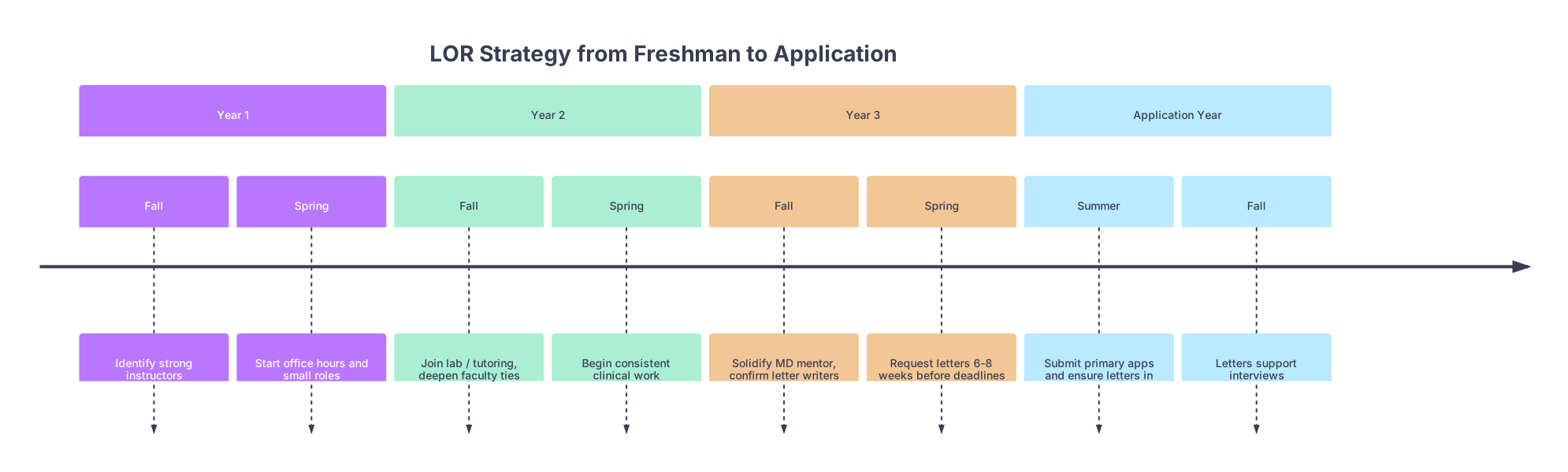
| Period | Event |
|---|---|
| Year 1 - Fall | Identify strong instructors |
| Year 1 - Spring | Start office hours and small roles |
| Year 2 - Fall | Join lab / tutoring, deepen faculty ties |
| Year 2 - Spring | Begin consistent clinical work |
| Year 3 - Fall | Solidify MD mentor, confirm letter writers |
| Year 3 - Spring | Request letters 6-8 weeks before deadlines |
| Application Year - Summer | Submit primary apps and ensure letters in |
| Application Year - Fall | Letters support interviews |
If you are already behind this curve (junior or senior now, minimal MD contact), do not waste time feeling bad about it. Compress the timeline:
- Start longitudinal clinical work now, even if apps are 6–9 months away.
- Meet individually with 2–3 faculty this month to rebuild or deepen relationships.
- Cut low-yield activities to free hours for high-contact settings (clinic, lab, tutoring).
9. Packaging From a Small College: Make Your Context an Asset
Admissions committees are not dumb. They know small colleges often lack premed infrastructure.
Your job is to make your context work for you, not look like a deficit.
Here is how:
A. Use Secondaries and Interviews To Explain Context Briefly
When a prompt asks about challenges, disadvantages, or your path:
- You do not whine about lacking MD mentors.
- You explain how your school had limited clinical exposure or research resources, then show what you did about it:
Example:
“My liberal arts college did not have an affiliated medical center or premed committee. To build meaningful clinical experience, I arranged transportation to a community clinic 45 minutes away and volunteered there weekly for the next year, eventually training new volunteers and assisting with patient education materials.”
Suddenly your small-college background looks like initiative and grit, not a flaw.
B. Highlight Depth Over Breadth in Your Activities
Small-college students often cannot chase 14 different brand-name experiences. Good. That usually leads to superficial letters anyway.
Focus your activities on 3–4 deep commitments:
- 1–2 years in one clinic
- 1–2 years in one research or academic mentorship role
- 1–2 years in one service or leadership position
Then your letters say things like: “I have worked with her for four semesters and watched her evolve from a quiet student to a leader in our advanced lab course.” That sticks.
C. Ask Writers To Explicitly Address Context
You can gently mention in your cover note:
“Our college does not have a premedical committee or affiliated hospital, so your letter provides crucial context on my preparation and performance here.”
A good professor will translate that into:
“Our institution is a small liberal arts college without a formal premedical committee. In this environment, [Student] has intentionally sought out rigorous opportunities, including…”
That tells committees: this student squeezed the most out of what was available.
10. Quality Control: How To Avoid Weak or Damaging Letters
Not all letters help you. Some hurt.
Red Flags You Must Avoid
Writers who barely know you
- “I had her in my class and she got an A.” Useless.
Writers with mixed or negative impressions
- If you had conflicts, professionalism issues, or inconsistent performance, do not ask them out of guilt or hierarchy.
Last-minute letters
- Anything requested 1–2 weeks before a deadline is likely to be rushed and generic.
Overly personal, under-professional letters
- The “like a daughter to me” style with no concrete evaluation is not what you want.
How To Smell Weak Interest Before It Is Too Late
When you ask, notice:
- Do they respond with enthusiasm? (“Absolutely, I’d be happy to.”)
- Or with hesitation? (“I suppose I could write something.” “I do not know you that well, but…”)
If there is hesitation, you politely back out. You are not obligated to take every yes.
11. Using Interfolio or Similar Services Strategically
If your small college does not have a premed committee or letter storage, use something like Interfolio.
Advantages:
- Central place to store letters for multiple cycles.
- You can request letters before you apply and then forward to AMCAS, AACOMAS, TMDSAS, etc.
- Avoids last-minute panic chasing faculty on vacation.
Workflow:
- Create an Interfolio account.
- Add each letter writer with clear deadlines and instructions.
- They upload confidentially (you waive your right to view).
- When ready, you assign letters to your application services.
12. Concrete Example: Turning a “Weak” Situation Into a Strong LOR Set
Let me spell out a believable scenario.
Student:
- Small rural college, no med center, no premed committee
- No MDs in family, no hometown hospital
- Wants to apply MD
What they do over 2–3 years:
Academics
- Crushes Organic Chem I & II with the same professor; joins their small lab the next year.
- Becomes a peer tutor for General Chemistry.
Non-Science
- Takes a health policy seminar with a political science professor; writes a standout paper on Medicaid expansion; continues as a research assistant on a local policy project.
Clinical
- Finds a community health clinic 40 minutes away.
- Volunteers weekly, then shifts into an expanded role: intake, Spanish interpretation, patient education materials.
- Works closely with one MD and the clinic manager.
Letters they end up with
- Science #1: Organic Chem professor + research PI (2+ years of contact).
- Science #2: Biology professor who oversaw independent study project.
- Non-Science: Health policy professor (class + research).
- Physician: MD from the community clinic with 1+ year of longitudinal contact.
- Optional: Clinic manager letter for secondary use at schools that allow extra letters.
That set competes just fine with letters from big-name universities because it is deep, specific, and longitudinal.
13. Final Checks Before You Hit Submit
Right before you submit your primary applications, make sure:
You have at least:
- 2 science faculty letters
- 1 non-science letter
- 1 clinical/physician letter (or closest acceptable equivalent for your target schools)
Each letter writer:
- Has your full packet (resume, draft personal statement, transcript, bullet examples, deadlines).
- Knows your intended angle or themes.
- Has at least 4 weeks left before their earliest due date.
You have a backup for at least one science and one non-science letter in case a writer flakes.
Key Takeaways
- Prestige of your college and access to famous MDs matter far less than depth, specificity, and honesty in your letters.
- Longitudinal relationships—semester after semester in class, clinic, or lab—are your main weapon as a small-college student.
- Your job is to make writing a strong letter easy: build real relationships, choose the right people, give them a complete packet, and start months before you apply.