
The obsession with “science letters only” is overrated — and sometimes flat-out counterproductive.
If you’re a serious premed, you’ve probably heard some version of this: “Non‑science letters are fluff. Med schools only care about science profs who can talk about your academic rigor.” That advice is half-true, misapplied, and often based more on rumor than on what admissions committees actually say and do.
Let me be blunt: a strong, detailed letter from a non‑science mentor who truly knows you is often more valuable than a generic letter from a science professor who barely remembers your face. The nuance is where students get burned — either by overvaluing random non‑science letters, or by avoiding outstanding non‑science mentors because someone on Reddit said “they don’t count.”
Let’s fix that.
What Schools Actually Ask For (Not What Reddit Says)
Most U.S. MD schools are not vague about this. They tell you, in plain English, what they want.
Here’s the pattern across many allopathic schools:
- 2 science faculty letters (biology, chemistry, physics, math – “BCPM”)
- 1 non‑science or “humanities/social science” faculty letter
- Optional: additional letter(s) from research PI, clinical supervisor, or other mentor
Some schools accept a committee letter instead, but the committee letter itself is usually built from underlying science and non‑science letters.
To ground this, here’s a snapshot of real policies (condensed):
| School (example) | Science Faculty Required | Non‑Science Faculty Required | Other Letters Allowed |
|---|---|---|---|
| State MD Program | 2 | 1 | 1–2 optional |
| Mid‑tier Private MD | 1–2 | Strongly recommended | PI, clinical, advisor |
| [Top‑tier Research MD](https://residencyadvisor.com/resources/letters-of-recommendation/do-top-schools-only-value-academic-mentors-what-acceptance-patterns-show) | 2 | 0–1 | PI *highly valued* |
| DO Program Example | 1 (can be DO physician) | Recommended | Additional mentors |
| Committee Letter Use | Within committee letter | Within committee letter | Sometimes 1 extra |
Is this every school? No. But it captures the general reality: non‑science letters are not some fringe extra. They’re baked into requirements or recommendations at a lot of places.
Where students get confused is priority:
- Science letters → demonstrate you can handle rigorous, technical coursework.
- Non‑science letters → demonstrate traits like communication, professionalism, maturity, growth, integrity.
- Mentor/employment/PI letters → show you in real-world, longitudinal contexts (research, work, volunteering).
Here’s the annoying secret: on paper, science letters look more “important.” In practice, the quality and specificity of the letter often matters more than the category.
What the Data and Adcoms Actually Care About
No, there isn’t a giant multi‑center RCT of “science vs non‑science letters and odds ratios for AAMC acceptance.” But we do have:
- Published school policies
- AAMC and NRMP surveys of what admissions committees value
- Pattern recognition from thousands of applications reviewed over years
- What adcom members say publicly and privately
From those sources, you see three themes over and over:
- Letters are used to differentiate applicants with similar metrics.
- Committees value specific behavioral evidence (“She led our capstone group, mediated conflict…”) over vague praise (“He was a pleasure to teach.”).
- Longitudinal relationships (mentors who’ve known you 1+ years) are weighted more than one‑semester drive‑by letters.
AAMC surveys of admissions officers (for both MD and DO) repeatedly rank letters of evaluation/rec as “important” or “very important” in deciding whom to interview and accept. But they are not looking for one magical category. They’re asking:
- Who has actually seen you handle challenge?
- Who can speak to your reliability, integrity, and growth?
- Who can attest that your personal statement persona matches reality?
That can absolutely be a non‑science mentor.
The Big Myth: “Non‑Science Mentors Don’t Count”
This one sticks around because it has a tiny grain of truth.
The grain of truth: If a school requires 2 science faculty letters and you submit 0 science letters and 3 glowing non‑science letters instead, you’re in trouble. Requirements are not suggestions.
But from that, people make a leap: “non‑science letters are just filler.” That’s wrong.
Here’s what actually happens in committee rooms.
I’ve seen application meetings where:
- Applicant A had a 3.92 sGPA, a 519 MCAT, two lukewarm science letters (“smart, quiet, did well in exams”), and a non‑science letter from a philosophy professor describing 3 years of deep engagement, office hours debates, and a transformation in how the student approached ethics and disagreement.
- Applicant B had similar stats but all three letters were generic faculty boilerplate. No concrete stories, no sense of the human.
Who did people fight harder for? Applicant A. That humanity and depth matter, especially at mid‑to‑high tier schools drowning in stats robots.
Non‑science mentors are “worth it” when:
- They’ve known you for a long time (Multiple courses, or courses + advising, or project work).
- They’ve seen you in non‑ideal conditions: group work conflicts, heavy workload, personal struggles, leadership stress.
- They can tell specific stories that connect to things med schools actually care about: communication, empathy, integrity, self‑awareness, resilience.
You know what’s not worth it? A random sociology prof who barely remembers you saying, “She got an A and attended class. She’ll make a fine doctor.” Replace “sociology” with “organic chemistry” and the statement is still true.
The problem is not “non‑science.” The problem is “generic.”
Where Non‑Science Mentors Add Unique Value
Non‑science mentors often see parts of you science faculty never touch. That’s their entire value proposition.
Common scenarios where a non‑science mentor is uniquely powerful:
- You did a long‑term project (thesis, capstone, honors paper) in history, policy, sociology, philosophy, literature.
- You took multiple discussion‑heavy courses where you talked about ethics, identity, culture, social inequity, or communication.
- You worked closely with a professor on something public-facing: presentations, community-engaged work, creative projects, or debate.
- You served as a TA, tutor, or peer leader in a non‑science department and the faculty saw your teaching and mentorship skills up close.
These letters can bring things into view that your science profs rarely mention:
- How you handle disagreement and complex ethical questions
- How you write, argue, and revise your thinking when challenged
- How you interact in diverse groups, especially around sensitive topics
- How you handle ambiguity, nuance, and non-quantitative problems
That matters. Medicine is not a series of physics problem sets.
How Admissions Actually Weighs Different Letter Types
Let me translate the unspoken hierarchy that often drives decisions. Consider this a rough, generalized mental model — not gospel.
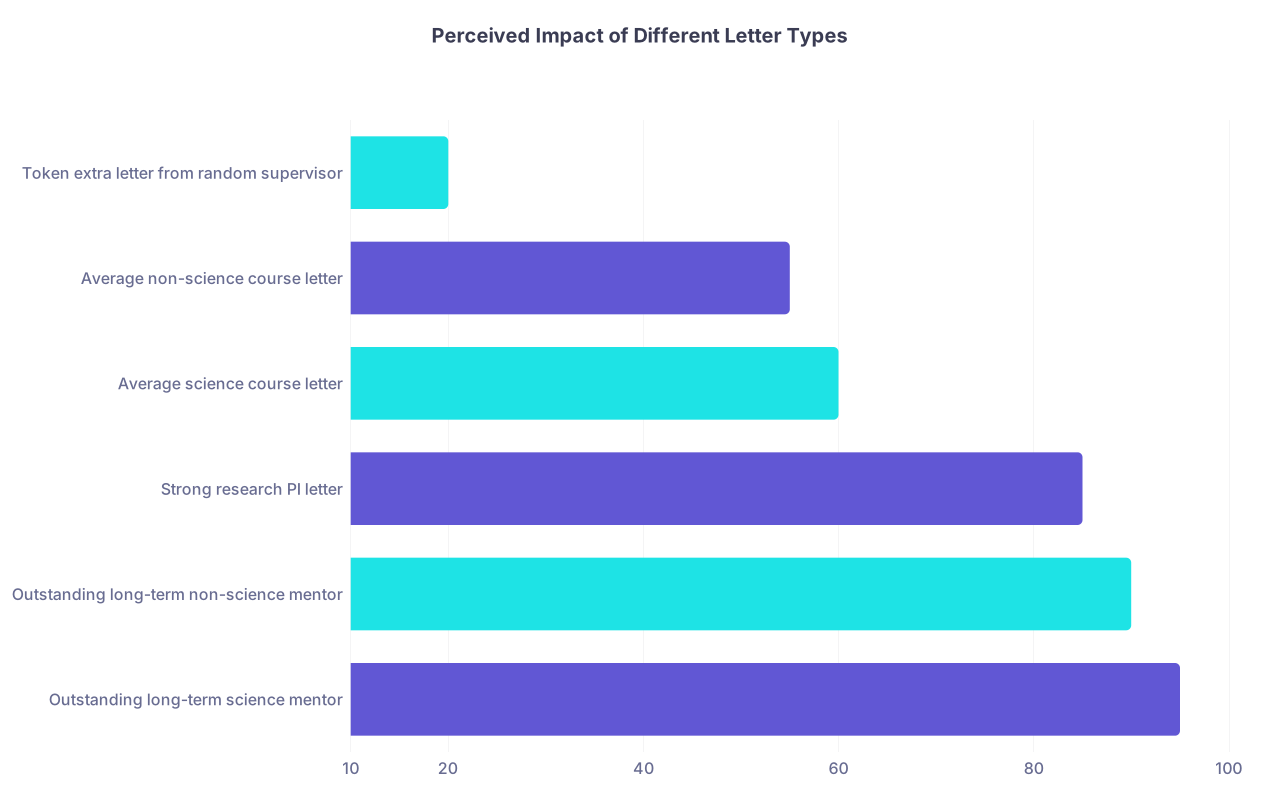
| Category | Value |
|---|---|
| Outstanding long-term science mentor | 95 |
| Outstanding long-term non-science mentor | 90 |
| Strong research PI letter | 85 |
| Average science course letter | 60 |
| Average non-science course letter | 55 |
| Token extra letter from random supervisor | 20 |
Here’s what that chart is saying in plain language:
- Best case: A science mentor who’s known you >1 year and writes a detailed, story-filled letter. Gold.
- Very close behind: A non‑science mentor with the same depth and specificity. Nearly as good, and sometimes more memorable.
- PI letters: Strong if you’ve been in the lab for a while, show initiative, and the PI actually mentors you.
- Average “I taught them once” letters: Adequate for checking boxes. Not game-changers.
- Extra fluff letters (“I supervised them for 4 weeks at the summer camp”): Often ignored unless unusually strong.
The differences are driven more by depth and specificity than subject area.
If you’re aiming for competitive schools, they want to see:
- At least one letter verifying your ability in rigorous science/technical settings.
- At least one letter showcasing your interpersonal, ethical, and reflective side. Very often, that’s non‑science.
Common Bad Advice About Non‑Science Mentors
Let’s dismantle a few recurring pieces of nonsense I see premeds repeating.
“Never use non‑science recommenders for top schools”
Flatly wrong. Many top schools explicitly welcome non‑science letters, especially from humanities/social science faculty who know you well. They’re training physicians, not lab technicians.
What is true: top research schools often heavily weight research PI letters. That does not make non‑science letters worthless; it just means you need the right mix.
“A famous non‑science prof is better than an unknown science prof”
Nope. Committees care much more about content than name recognition. I’ve read letters from big‑name faculty that were useless: two paragraphs, vague praise, zero substance. I’ve also read letters from obscure community college instructors that were meticulous, narrative, and incredibly persuasive.
Pedigree is a cheap proxy. Substance wins.
“If you have a committee letter, your individual letters don’t matter”
Also untrue. Committee letters are often stitched together from underlying faculty comments, but individual letters are frequently still visible to the committee. Weak individual letters can drag down the committee summary; strong ones can lift it.
When a Non‑Science Mentor is a Strategic Asset
Let’s talk strategy. Here are situations where I’d actively push you toward using a non‑science mentor — even over an available science person.
You transferred or had huge intro STEM lecture courses and do not have strong relationships with science faculty yet, but:
- You have a political science professor who has taught you 3 times, supervised your thesis, and watched you manage a big setback.
- That letter will be far more credible and detailed than a “top 5% of 400-person class” letter from a stranger.
You have a check-the-box science letter already (decent but not amazing), and:
- Your best, clearest evidence of growth, leadership, and maturity is through a humanities advisor or social science mentor.
- That non‑science letter may be the only place your actual trajectory shows up.
Your application theme is heavily tied to non‑science areas:
- Public health, health policy, medical humanities, narrative medicine, community advocacy.
- A non‑science mentor who can attest that your engagement here is real — not an “activism cosplay” add-on — is extremely valuable.
How to Choose and Use a Non‑Science Mentor Wisely
The decision isn’t “science vs non‑science.” It’s which humans can write the strongest, most specific, most longitudinal letters within the constraints of each school’s requirements.
Here’s a simple decision sequence that actually reflects how committees think:

| Step | Description |
|---|---|
| Step 1 | List all potential letter writers |
| Step 2 | Eliminate those that dont fit minimum science/non-science rules |
| Step 3 | Assess how well they know you |
| Step 4 | Lower priority unless no better options |
| Step 5 | Evaluate specificity & stories they can tell |
| Step 6 | High-priority recommender |
| Step 7 | Meets school type requirements? |
| Step 8 | Know you >1 semester or in multiple roles? |
| Step 9 | Can they describe growth, challenges, and behavior? |
Ask yourself, for each non‑science mentor:
- How long have they known me? In how many contexts?
- Have they seen me deal with difficulty or conflict?
- Do they know my reasons for medicine and can they credibly connect my behavior to those goals?
- When I asked them for a letter, did they sound enthusiastic and specific, or polite and non‑committal?
If their answer to “Can you write me a strong letter of recommendation?” is anything short of “Absolutely,” walk away.
And yes, ask it that directly. “Strong letter” is code in academia; they know what it means.
How Many Non‑Science Letters Is Too Many?
You can absolutely overdo this.
General rule set (for a typical MD applicant, adjust for school quirks):
If the school requires 2 science + 1 non‑science:
- Hit that minimum.
- Add at most 1–2 additional letters (research PI, long-term clinical supervisor, another mentor).
- Do not send 5+ letters total. They won’t help you; they’ll dilute the impact.
If the school only specifies “academic letters”:
- Aim for at least 1 science + 1 non‑science if possible.
- Add a PI or clinical mentor letter if it’s truly strong and long-term.
If you’re light on science relationships:
- Still meet formal requirements — that’s non‑negotiable.
- Use your strongest non‑science mentor as your primary character/behavior advocate.
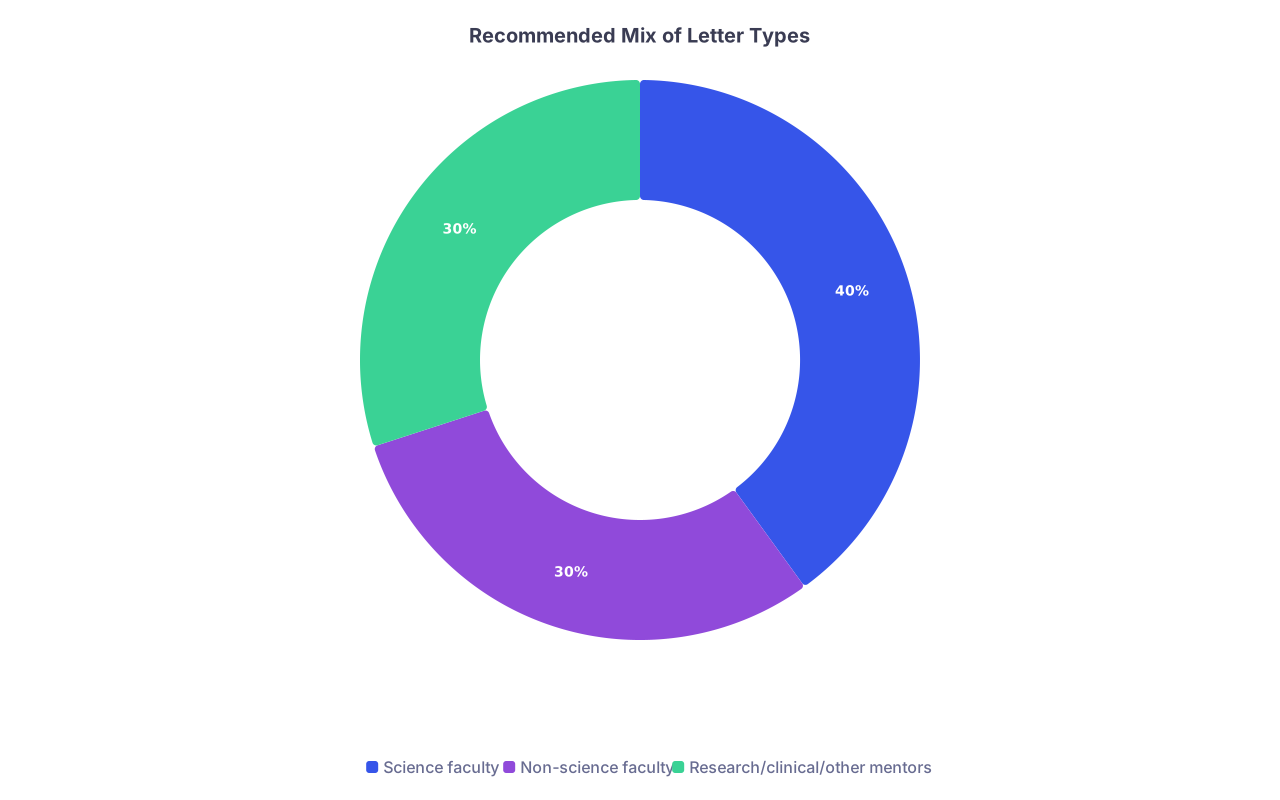
| Category | Value |
|---|---|
| Science faculty | 40 |
| Non-science faculty | 30 |
| Research/clinical/other mentors | 30 |
Think of it as a portfolio: science for academic rigor, non‑science for human traits, research/clinical for real-world professional behavior.
The Red Flags Committees Notice (That You Don’t)
There are situations where heavy reliance on non‑science mentors raises eyebrows:
- Your application screams “hardcore science/research,” but you have zero strong letters from people who actually saw you in rigorous scientific settings.
- You have a stellar non‑science letter talking about empathy and communication… and your clinical supervisor’s letter is bland or negative by omission (“showed up, did tasks”).
- You strategically avoid asking any science faculty because you burned bridges, were caught cheating, or were chronically absent.
Non‑science letters are not a bandage for deeper pattern problems. They’re an amplifier for strengths and an explainer for context.
How to Make a Non‑Science Mentor Letter High-Impact
If you’re going to lean on a non‑science mentor, help them help you. Without writing the letter for them (don’t do that), you can:
- Share your personal statement draft and activities list, so they understand your narrative.
- Remind them of specific projects, incidents, or turning points you experienced in their class/group.
- Mention a few qualities schools care about that they’ve actually seen: handling feedback, ethical reasoning, teamwork, perseverance.
You are not scripting them. You’re jogging their memory so they can write something concrete.
The best letters I’ve seen from humanities and social science faculty read like this:
“In my seminar on Health, Inequality, and Narrative, [Student] did not simply complete assignments. She consistently took on the hardest perspectives — often arguing from positions she personally disagreed with — to test her thinking. During a particularly contentious discussion about resource allocation, she paused, named her own bias, and invited a quieter classmate to share their lived experience before continuing. That level of self-awareness and facilitation is rare in undergraduates.”
That’s 100x more persuasive than “top 5%, writes well, nice person.”
So, Are Non‑Science Mentors “Worth It”?
Yes — when used correctly.
They are not consolation prizes. They are not “less than” by default. They’re one of the few chances an admissions committee has to see you operate in the messy, human, ambiguous world that looks a lot more like medicine than your orgo midterm does.
The real mistake is not choosing a non‑science mentor. The real mistake is treating letter categories as checkboxes instead of choosing the people who can most accurately, concretely, and compellingly describe who you are when no one is grading you.
Years from now, you will not remember whether your best letter came from physics or philosophy. You will remember the mentors who actually saw you, pushed you, and were willing to put their name on the line to say, “This one belongs in medicine.”