It is late September of your sophomore year. You are hovering outside a professor’s office, rehearsing a question about glycolysis that you already understand. You are not here for glycolysis. You are here because in 18–30 months you will need a strong medical school letter, and right now this professor barely recognizes your face.
This is exactly when the “three‑visit rule” matters.
You cannot ask for a meaningful letter after one lab demo or a single A on an exam. By the time you say, “Would you be willing to write me a strong letter of recommendation?” there should already be a track record: multiple substantive encounters, increasing depth, and clear evidence that they know you as a person, not just a name on a roster.
Here is the timeline. Month‑by‑month first. Then zooming into the three‑visit rule itself: what each visit should contain, by when it must happen, and how this plays out from premed through medical school.
Big Picture Timeline: When You Need Deep Mentor Relationships
Let us anchor the calendar.
Most traditional premeds apply to medical school the summer after junior year.
- Primary applications (AMCAS/AACOMAS/TMDSAS): open May, submit June–July
- Secondaries: June–August
- Letters of recommendation: often due or strongly preferred by July–August of your application year
That means:
- You need letter writers committed by March–May of your junior year.
- They need to already know you well by then. Which does not happen overnight.
| Time Point | Mentor Relationship Goal |
|---|---|
| Sophomore Fall–Spring | Identify & start visiting potential mentors |
| Sophomore Summer | Maintain light contact / research shadowing |
| Junior Fall | Reach 2nd–3rd substantive visit with 2–3 key mentors |
| Junior Winter–Early Spring | Confirm letter writers, provide materials |
| Junior Late Spring–Summer | Applications submitted, letters finalized |
If you are non‑traditional or applying later, shift the dates, not the structure. You still need those three (or more) meaningful contacts before you ask.
The Three‑Visit Rule: What It Actually Means
The three‑visit rule is simple:
Do not ask for a serious, personalized letter of recommendation from a professor or physician until you have had at least three meaningful, one‑on‑one interactions with them, spaced over time, where you:
- Show up prepared.
- Reveal something about your interests, goals, or thinking.
- Demonstrate growth or follow‑through between visits.
One email and two office hours where you sit in silence do not count.
This rule protects you from weak, generic letters. The kind that say, “She earned an A in my course and attended class regularly.” I have seen those letters. They hurt equally strong and average applicants, because committees read them as: “This faculty member has nothing real to say.”
Your goal: by the time you ask, the mentor can honestly say:
- “I have watched this student improve over the term/year.”
- “They followed up on feedback.”
- “They engaged with material beyond the minimum requirements.”
So let’s lay out when those three visits should occur for premeds.
Freshman Year: Seeding Relationships (Not Yet Asking)
You are not asking for letters as a freshman. You are planting.
Fall Semester (Months 1–4)
At this point you should:
Identify 2–3 potential academic mentors:
- Intro biology, chemistry, or a small seminar where you can stand out.
- Someone who actually interacts with undergrads, not only a 300‑student lecture ghost.
Start low‑stakes contact:
- Ask 1–2 genuine questions over the term via office hours or after class.
- Participate in class once in a while so your face and name pair together.
This is pre‑visit stage. You are just warming up and figuring out who is approachable and who is not.
Spring Semester (Months 5–8)
By late spring of freshman year, you should:
- Pick one professor to practice the three‑visit pattern with, even if they will not ultimately be a letter writer. You are learning the skill.
For that one professor:
Visit 1 (early–mid semester)
- Reason: Clarify a concept or discuss a problem set you struggled with.
- Goal: Show you care about depth, not just points.
- Time: 10–15 minutes.
Visit 2 (late semester)
- Reason: Show them improved work, ask about how they think about the field, or briefly ask about opportunities (research, seminars).
- Goal: Demonstrate growth and curiosity.
Do not ask for a letter. You are too early, and you are not applying anywhere that matters for this yet.
But by the end of freshman year, you should have at least one professor who would recognize you in the hallway and say, “Oh, yes, hi [Your Name].”
Sophomore Year: First Real Mentor Tracks
This is when the timeline starts to matter.
Sophomore Fall (Months 9–12)
At this point you should:
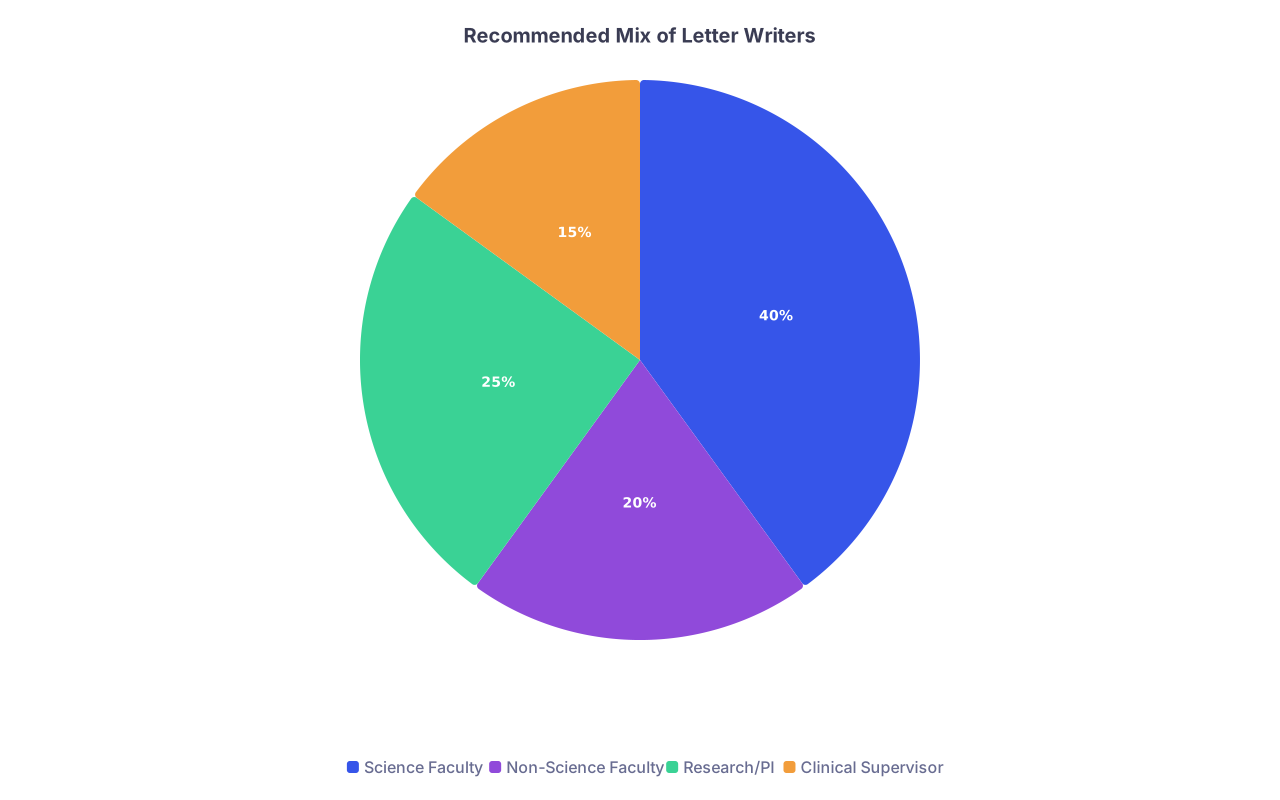
- Select 3–4 realistic potential letter writers for your eventual med school application. Ideally a mix of:
- 2 science faculty (biology, chemistry, physics, or relevant upper‑level courses)
- 1 non‑science/humanities or social science faculty
- 1–2 clinical or research mentors (these often come slightly later, but start now if you can)
For each of 2–3 of these people, aim for:
Visit 1 (within first half of the semester)
- Office hours or scheduled meeting.
- Purpose:
- Go over an assignment or exam strategy.
- Ask one thoughtful question about their area of work.
Follow‑up by email:
- Thank them briefly and mention one specific thing you found helpful.
- This is not networking spam. It is anchoring your name in their memory.
Sophomore Spring (Months 13–16)
Now you start stacking the rule.
For your top prospects (those who seemed engaged and not annoyed):
Visit 2 (early–mid semester)
Show continuity. Example:
- “Last time we talked about X; I tried Y strategy and saw this result.”
- Or, “I read the review article you recommended; I had a question about…”
Duration: 15–20 minutes.
Add a bit of personal context: why you like this field, an early thought about medicine, or an interest in research.
Visit 3 (late semester)
- This is where the relationship either becomes real or fizzles.
- Goals:
- Demonstrate improvement (better exam, project, or paper).
- Ask for advice slightly beyond the course:
- Summer opportunities
- Reading to explore the field
- Whether they ever involve undergrads in their work
Still do not ask for a med school letter. You are a sophomore. But by May of sophomore year, you want at least one professor for whom the three‑visit rule is satisfied and the relationship feels genuine.
That person can become:
- A summer project supervisor
- A future thesis advisor
- A future letter writer after another course or research stint
Junior Year: Turning Relationships into Letters
This is the critical year for premeds.
By now, the three‑visit rule should not be starting. It should be culminating.
Junior Fall (Months 17–20)
At this point you should:
- Have 2–3 professors and ideally 1 research or clinical mentor who:
- Know your name without prompting
- Have seen your work over time (not just one exam)
- Have talked with you at least three times in real conversations
You are now in “relationship deepening” mode, not first contact.
Concrete steps:
Enroll in another course or independent study with one prior professor if possible.
For each likely letter writer, plan:
- Visit 3 or 4 (if you are behind schedule)
- If you only managed 1–2 interactions so far, you need to accelerate early in the semester.
- Meet to discuss:
- Academic planning for senior year
- Your interest in medicine and what you are doing to explore it
- How their course has influenced your direction
- Visit 3 or 4 (if you are behind schedule)
For research/clinical mentors:
- Start taking on more responsibility so they see your reliability and growth over several months.
By November of junior fall, you should know exactly who your top 3–5 target letter writers are.
| Category | Value |
|---|---|
| Science Faculty | 40 |
| Non-Science Faculty | 20 |
| Research/PI | 25 |
| Clinical Supervisor | 15 |
Junior Winter–Early Spring (Months 21–23)
This is usually the window when you formally ask.
Timing guidelines:
- Ask 8–12 weeks before you want letters uploaded (often that means February–April for June applications).
- That means the three‑visit minimum must be completed before you ask. No exceptions.
When you ask, your mentor should already have:
- Seen your work
- Watched you respond to feedback
- Heard at least something about your future plans
If you realize in January that one of your intended writers has only seen you once? Switch targets or delay the ask until you have two more meaningful visits. Do not gamble on a lukewarm letter.
What Each Visit Should Actually Look Like
Let us get precise. “Visit” does not mean standing awkwardly for 3 minutes while others line up outside the door.
Visit 1: Establish Presence
When: Early in the semester you first have them (freshman/sophomore/junior).
Duration: 10–15 minutes.
Content:
- Introduce yourself clearly (name, year, major).
- Anchor your interest: “I am considering medicine / research in X area.”
- Ask 1–2 specific questions:
- About a concept you attempted already
- About how to approach the course effectively
Goal: You become a real person, not a silent row‑3 student.
Visit 2: Show Follow‑Through
When: 3–8 weeks after Visit 1.
Duration: 15–20 minutes.
Content:
Start with continuity:
- “I tried the study strategy we discussed; my score improved from 78 to 90 on the last quiz.”
- Or, “I read that article you suggested; I had a question about…”
Add mild personal context:
- “I am exploring whether I want to pursue medicine or graduate school in X. How did you decide?”
Goal: Demonstrate growth and seriousness. Plant the idea that you are someone who acts on advice.
Visit 3: Transition to Mentor
When: Late semester or in a subsequent course / research period.
Duration: 20–30 minutes.
Content:
Bring tangible evidence of your improvement or work:
- A revised paper
- A poster draft
- Data you helped collect
- A reflection on a clinical experience
Ask for broader guidance:
- “I am planning my next two years with an eye on medical school. Given what you have seen of my work, do you have advice?”
- “Are there opportunities in your lab / department / network that might be a good fit?”
Goal: Shift them from “course instructor” to “ongoing mentor.” After this, asking for a letter is natural.
When You Are In Medical School: Same Rule, Higher Stakes
The three‑visit rule does not stop when you get in. It becomes more crucial.
You will later need:
- MSPE (Dean’s letter – more standardized, less in your control)
- Specialty‑specific letters (attendings, sub‑I supervisors, research mentors)
Pre‑Clinical Years (MS1–MS2)
At this point you should:
- Identify 2–3 faculty whose teaching style and field interest you.
- Show up repeatedly:
- Small‑group instructors
- Longitudinal clinic preceptors
- Research supervisors
For anyone you might want a letter from:
- Get to three substantive interactions before the end of MS2 if possible:
- Case discussions where you speak up
- Office‑hour‑style conversations about career planning
- Research meetings where you present even a small piece of work
Your future specialty letter writers often emerge from early elective work or research that starts in MS1–MS2.
Clinical Years (MS3–MS4)
On core rotations, you will see many attendings briefly. Do not try to collect letters from everyone. That is a mistake.
Instead:
On each rotation, pick 1 attending or senior resident you actually work with over multiple days/weeks.
Build the three‑visit sequence into normal clinical life:
- “Visit” here means:
- Feedback conversations at mid‑point and end of rotation
- A case you present that leads to extended discussion
- A sit‑down about career plans
- “Visit” here means:
At the end of a 4‑week rotation, your attending should have:
- Seen you handle different patients
- Given you at least one piece of feedback that you then acted on
- Had at least one 10–15 minute career/mentoring discussion
Only then do you ask, “Would you feel comfortable writing me a strong letter for internal medicine residency?” Or surgery. Or pediatrics.
Red Flags and Bad Timing: When Not to Ask
Three visits are a minimum, not a magic number. There are situations where even after three, you should not ask.
Do not ask if:
- You have never demonstrated improvement after feedback.
- All your encounters were logistical (“When is the exam?” “Can I get an extension?”).
- The mentor has hinted at being overwhelmed or uncomfortable writing letters (“I do not really know my students well enough to write personalized letters”).
If you are up against a deadline and do not have any three‑visit‑qualified mentors?
- Prioritize those who:
- Have seen your work more than once (multiple assignments, multiple clinic days).
- Have at least some positive things to say about your performance.
Even then, be explicit in your ask:
- “I realize we have not had as many one‑on‑one conversations as ideal, but given your familiarity with my work in X, would you be comfortable writing a strong, detailed letter for my application to Y?”
If there is hesitation or a vague non‑answer, respect it and move on. A lukewarm letter can quietly sink you.
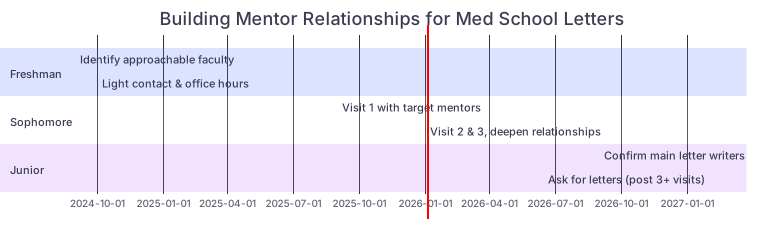
Putting It All Together: A Mini Gantt of Your Relationship‑Building
Here is the overall structure, visually.
| Task | Details |
|---|---|
| Freshman: Identify approachable faculty | a1, 2024-09, 4m |
| Freshman: Light contact & office hours | a2, 2024-10, 5m |
| Sophomore: Visit 1 with target mentors | b1, 2025-09, 2m |
| Sophomore: Visit 2 & 3, deepen relationships | b2, 2026-01, 4m |
| Junior: Confirm main letter writers | c1, 2026-09, 3m |
| Junior: Ask for letters (post 3+ visits) | c2, 2027-02, 3m |
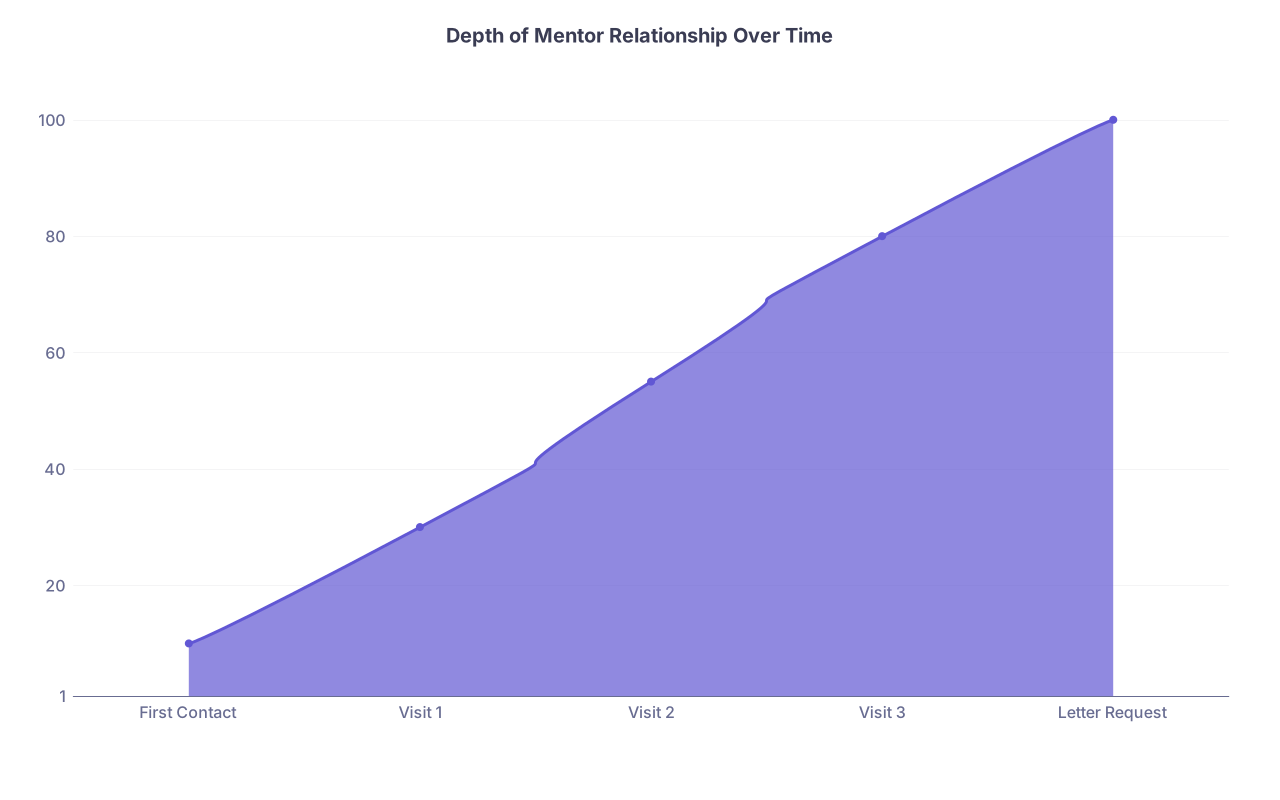
And the internal rhythm for each mentor looks like this:
| Category | Value |
|---|---|
| First Contact | 10 |
| Visit 1 | 30 |
| Visit 2 | 55 |
| Visit 3 | 80 |
| Letter Request | 100 |
How to Keep Relationships Warm Between Visits
You cannot always take another course or rotation with the same person. That is fine. You maintain presence in small ways.
Strategies that actually work:
Occasional email updates (2–3 times a year, not weekly spam):
- “I wanted to thank you again for your support in [class/research]. I just presented a poster at [conference]. Your feedback on my earlier draft was central.”
Dropping by office hours once a term to say hello and ask one thoughtful question related to their work or your path.
Sharing final products:
- “Here is the final version of the paper you helped me outline.”
- “We just submitted the manuscript from the project you supervised.”
Do this before and after you request a letter. It gives them real material to talk about and reminds them that their investment matters.

Clinical Mentors: Slightly Different Calendar, Same Rule
Physicians often work in compressed blocks. You may only be with them:
- For a few weeks in a shadowing experience
- A single summer in a clinic
- One sub‑I rotation in fourth year
The three‑visit rule still applies, but “visits” are:
- Three extended clinical days where:
- They actually observe you interacting with patients
- You ask for feedback and then revise your approach
- You discuss your career path briefly
It is not about separate scheduled sit‑downs as much as:
- Consistent, visible growth
- At least one structured feedback conversation
- One brief but real “what are you thinking about specialty‑wise?” talk
Again, you should not ask for a letter on day 2 of shadowing because “we hit it off.” That reads as premature and transactional.

The Core Takeaways
Do not ask for a serious letter until you have had three meaningful, spaced, growth‑oriented interactions with that mentor. That is the bare minimum for a personalized, strong letter.
Back‑plan your relationships: if you are applying to medical school after junior year, you should be hitting your third visit with potential letter writers by early junior year, not scrambling in April.
Treat each visit as a step up:
- Visit 1: show up and be visible
- Visit 2: demonstrate follow‑through
- Visit 3: transition them into a true mentor
If you follow that timeline, you do not “ask a stranger for a favor.” You invite a mentor to formally endorse a story they already know. And those are the letters that actually move an application.