
You are the quiet one in the back of the lecture hall. You do fine on exams, you understand the material, but nobody is ever going to describe you as “the most vocal student in the room.”
Then you walk into lab. Suddenly you are awake, engaged, actually interested. You remember tiny protocol details without trying. You fix other people’s pipetting mistakes. You find bugs in analysis scripts. But your PI? Barely knows your name. You say “Good morning,” he grunts. Group meetings are dominated by the postdocs. You sit, take notes, maybe ask one question a month.
Yet you keep reading that “strong letters of recommendation” are make-or-break for medical school.
Here is your problem:
You are good in the one setting where letters can be gold (research), but your strengths are invisible to the person who has the power to write the letter.
Let’s fix that.
Step 1: Know What a “Strong PI Letter” Actually Looks Like
Before you try to get your PI to love you, you need the target clearly in mind. Most students have a fantasy letter in their head that does not exist in real life. Or they settle for generic fluff.
You want neither.
A strong research PI letter for premed or med school typically has:
Concrete observations
- Specific tasks you did: “Ran immunostaining independently for a 40-sample cohort.”
- Specific behaviors: “Volunteered to re-run failed Westerns late in the evening without prompting.”
- Specific growth: “Went from needing line-by-line supervision to designing her own control experiments.”
Comparative language
Committees read “hardworking, bright, motivated” a thousand times. What matters:- “Top 5% of undergraduates I have mentored in 15 years.”
- “On par with my first-year PhD students in initiative and technical skill.”
- “The only undergraduate I trusted to oversee new lab members at the bench.”
Evidence of character and professionalism
- Reliability: “Never missed a lab meeting and consistently arrived early.”
- Integrity: “Immediately flagged an unexpected result rather than trying to ‘fix’ the data.”
- Team fit: “Sought feedback from postdocs and incorporated it without defensiveness.”
Endorsement for medicine, specifically PI letters that say “good scientist” but ignore clinical potential are weaker. You want:
- “Her persistence and empathy with struggling lab members would translate very well to clinical care.”
- “I have no hesitation recommending him enthusiastically for medical training.”
Your job in the lab is to give your PI raw material to write these sentences, and then to force those details into their working memory long enough for them to end up in the letter.
Everything else is decoration.
| Aspect | Weak Letter | Strong Letter |
|---|---|---|
| Specificity | Vague praise | Concrete examples & tasks |
| Comparison | No ranking | Clear comparison to peers |
| Time frame | Mentions briefly knowing you | Describes growth over months/years |
| Medicine focus | Generic academic praise | Explicit endorsement for medical training |
| Tone | Lukewarm/neutral | Confident, enthusiastic, unmistakably positive |
Step 2: Diagnose Your Starting Position (Be Brutally Honest)
You cannot move forward until you know how your PI actually sees you right now.
Ask yourself, no sugarcoating:
Does your PI know your:
- Name without checking a roster?
- Project in 1–2 sentences?
- Role (undergrad / postbac / med student)?
Over the last 4 weeks:
- How many one-on-one scientific conversations have you had with your PI?
- How many lab meetings have you spoken at (even just one question or update)?
- How many times did you proactively update your PI on progress?
Who actually supervises you:
- Postdoc or grad student only?
- Or the PI hands-on at least sometimes?
If the honest answers are:
- “They probably know my name, but I’m not sure.”
- “I mostly talk to the postdoc.”
- “I attend meetings but rarely speak.”
Then your starting point is: invisible but non-problematic.
That is workable. Not ideal, but fixable.
If your answers are:
- “I have weekly check-ins already.”
- “PI asks me directly about my data.”
- “I presented a poster or talk with their name on it.”
Then your starting point is visible but under-leveraged. Your path is shorter. We just need to formalize it into letter material.
Step 3: Build Visibility Without Becoming the Annoying Student
You do not need to become loud. You do need to become seen.
Here is a simple 6–8 week protocol to go from “quiet in the corner” to “obvious letter candidate,” without faking a personality transplant.
3.1. Week 1–2: Structured, Low-Risk Contact
Goal: Establish yourself as organized, thoughtful, and serious.
Send a short status email Subject: “Brief update on [Project X] – [Your Name]”
Body (3–5 sentences):
- One sentence reminding them what you are working on.
- 2–3 bullets with:
- What you completed last 2–3 weeks
- What you are doing this week
- One question or next step you are thinking about
Example: “I am continuing work on the [XYZ] project, focusing on optimizing the PCR conditions for the [ABC] gene panel.
- Completed: Ran two gradient PCRs testing annealing temps between 56–62°C; best results at 60°C with primer set B.
- This week: Planning to repeat at 60°C with additional controls and extend to 10 patient samples.
- Question: Would you prefer that I prioritize optimizing primer set C next, or proceed to scaling up with set B since it is working reasonably well?
Thank you,
[Name]”You have:
- Reintroduced yourself
- Shown initiative
- Posed a clear, bounded decision
Be visibly reliable
- Arrive when you say you will.
- Log experiments clearly where the PI can see them (electronic lab notebook, shared Google Doc, etc.).
- Respond to emails within 24 hours.
Quiet students who are rock-solid reliable stand out more than loud, unreliable ones.
In lab meetings: one contribution, every time Set a modest rule:
“At every lab meeting, I will either ask one content question or give one brief comment on someone’s data.”
Examples:
- “For sample 7, do you think the low signal could be due to storage time?”
- “Would running a no-RT control help confirm if that band is genomic contamination?”
You do not need to filibuster. One sentence. Repeated over weeks. That is how perception changes.

3.2. Week 3–5: Take Ownership of a Slice of Work
Letters become strong when a PI can say “this piece of the project was theirs.”
You are aiming for a clearly definable contribution. Not “helped with many things.” Something like:
- “Led optimization of the RNA extraction protocol for our low-input samples.”
- “Independently maintained and genotyped the mouse colony for the XYZ line.”
- “Cleaned and analyzed the pilot dataset for our stroke registry.”
How to make this happen:
- Ask for a defined responsibility
You say (to PI or main supervisor):
“I would like to take more ownership of a specific piece of the project so I can contribute more meaningfully. Is there a particular task or part of the workflow that would be helpful for me to own?”
You are not demanding authorship. You are asking to be useful.
- Once you have the task, document it publicly
- Update the lab wiki / protocol doc with:
- Current version of the protocol
- Your name as “maintainer” or “last updated by”
- Send a brief email to PI: “Per our discussion, I will be taking responsibility for [X: e.g., maintaining the REDCap database for the stroke registry]. I will plan to send a short status update every 2–3 weeks so you are aware of progress and any issues that arise.”
Now, 2–3 months later, this becomes letter content: “She took responsibility for maintaining and cleaning the registry with minimal oversight, and instituted several quality checks that improved data reliability.”
- Create one visual artifact
- Simple slide with:
- Why this task matters
- What it looked like before
- What you changed or standardized
- Offer to give a 3–5 minute micro-update at a lab meeting: “Would it be useful if I did a brief update next week on the new [X] protocol so everyone knows where things stand?”
You are not asking for a talk. You are solving a lab communication problem. PIs like that.
Step 4: Turn Your PI into a Witness, Not a Stranger
Good letters come from witnesses. People who have actually seen you think, struggle, and improve.
You need your PI to see at least some of that directly, not only through the postdoc pipeline.
4.1. Set up a short 1:1 meeting (even if you are shy)
This is where quiet students sabotage themselves. They think, “I do not want to bother them; they are too busy.”
Translation from PI perspective: “This student is not that serious.”
Ask for 15–20 minutes. You can literally say:
“Would you have 15–20 minutes sometime this month for me to get your feedback on my progress and how I can contribute more effectively to the lab? I want to make sure I am meeting your expectations and developing as a researcher.”
You come in with:
- One-page printout:
- Your name, role, time in lab
- Bullet list: what you have done so far (specific tasks)
- Bullet list: what you hope to gain (skills, types of responsibility)
- One or two long-term goals (e.g., apply to medical school in X year, interest in academic medicine, etc.)
In the meeting, ask three things:
- “From your perspective, what are my strengths so far?”
- “What skills or habits do you think I need to develop next?”
- “Is there a project or component where you think I could take more ownership over the next few months?”
You shut up and write. PIs are not used to undergrads asking for real feedback. It signals maturity.
6–12 months later, you can remind them of this conversation when asking for a letter: “I have tried to act on the feedback you gave me in [month], particularly regarding [X and Y].”
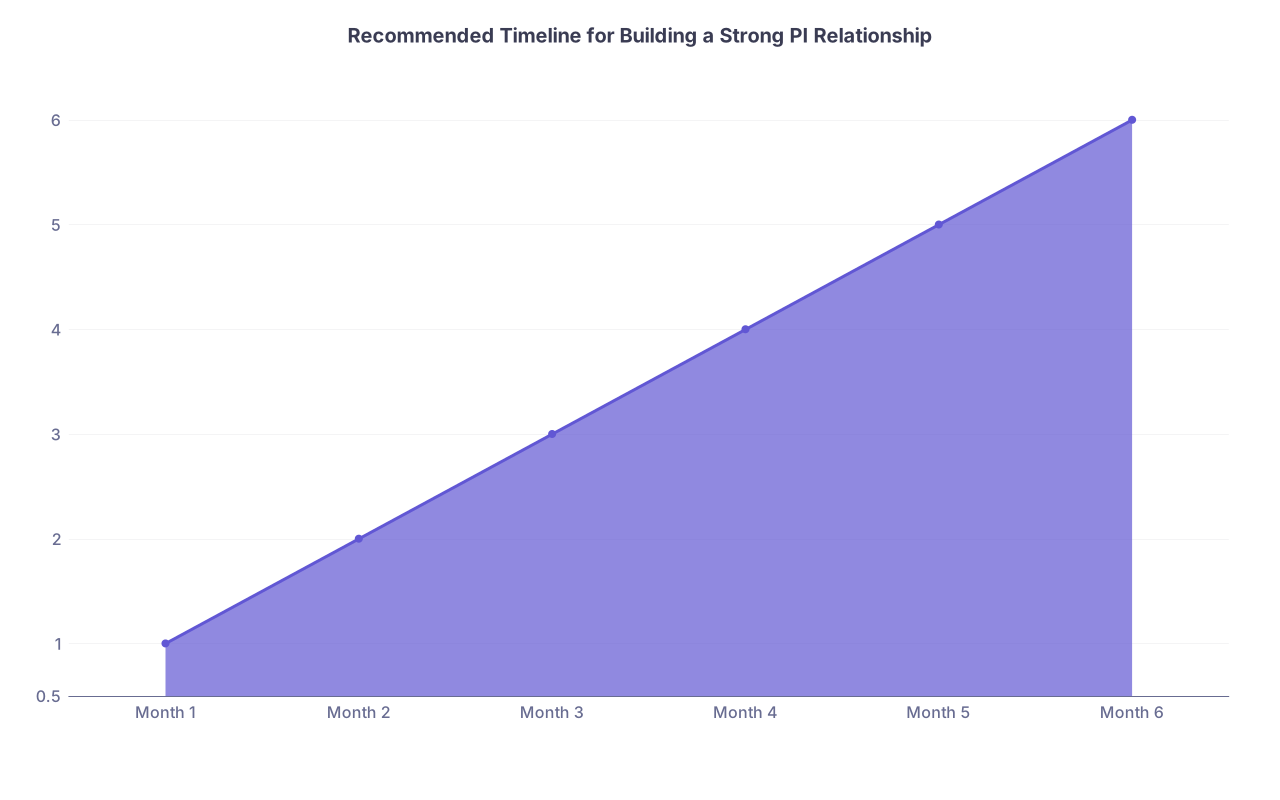
| Category | Value |
|---|---|
| Month 1 | 1 |
| Month 2 | 2 |
| Month 3 | 3 |
| Month 4 | 4 |
| Month 5 | 5 |
| Month 6 | 6 |
(Think of that as “relationship depth,” not math. It should slope up over time, not spike one week before you need a letter.)
4.2. Let them see you handle difficulty
If everything you show your PI is polished, you look like a tourist. Show process.
Examples of good “I am thinking” moments:
- “I repeated this twice and got conflicting results. I have three hypotheses why. Do you have a minute to hear how I am thinking about it?”
- “I read the new paper from [another lab] and realized our control might not be sufficient. Can I propose a small test to check this?”
This is where quiet students can actually shine. You have likely been thinking deeply already. Just externalize 10% of that thinking where the PI can hear it.
Step 5: Time the Ask Correctly and Phrase It So You Get a Strong Letter (or a No)
You do not want “Sure, I can write something” from a PI who barely remembers you. That letter can hurt you.
You want:
- Either: “Yes, I can write you a strong letter. Happy to.”
- Or: “I do not know you well enough for a strong letter” (so you can go elsewhere).
5.1. When to ask
For most people:
- Minimum: 4–6 months of consistent work in the lab.
- Stronger: 9–18 months, especially if you have:
- Presented at lab meeting
- Contributed to a poster / abstract / manuscript
- Taken ownership of some component
If you are earlier than that and have no one else, you can still ask, but manage expectations. More on that later.
5.2. Exact wording for the ask
Email subject: “Request for strong recommendation letter – [Your Name]”
Email body:
“Dear Dr. [PI Last Name],
I have greatly valued working in your lab over the past [X months/years], particularly on [briefly describe main project or role]. I am planning to apply to [medical school / MD-PhD programs] in the upcoming cycle and am hoping to secure 2–3 strong letters of recommendation from mentors who know my work well.
Would you feel comfortable writing a strong letter of recommendation on my behalf, commenting on my research abilities, work ethic, and suitability for a career in medicine?
If so, I would be happy to provide:
- A brief summary of my contributions in the lab
- My CV
- A draft of my personal statement
- Any additional information that would be helpful
Thank you for considering this,
[Name]
[Role, e.g., Undergraduate researcher, Class of 2026]”
The word “strong” is not decoration. It is a filter. It gives them permission to say no if they cannot.
If they respond with:
- “Yes, I would be glad to write a strong letter.” → Good.
- “I can write you a letter.” (no “strong,” very lukewarm tone) → You should treat that as a soft no and find someone else if possible.
- “I do not know you well enough” → Not ideal, but at least honest.
Step 6: Make it Easy for Them to Brag About You
Even good PIs forget details. They are juggling grants, manuscripts, and 15 other trainees.
Once they say yes, your job is to pre-load their brain with the points you want them to remember.
6.1. What to send them (packet, not chaos)
Put it in one email with attachments:
Your CV (up to date, no nonsense)
Draft of personal statement (or at least a one-page “Why medicine / my story” if PS not ready)
One-page “Research summary + bullet points”, including:
- Dates in lab
- Projects and your specific contributions
- Technical skills you learned
- Any presentations, posters, abstracts, or manuscripts (with your role)
- A short bulleted list: “Qualities I hope will come through in letters,” like:
- Persistence on long experiments
- Attention to detail in data analysis
- Ability to work quietly but reliably as part of a team
Deadline list and logistics
- Exact deadlines (earlier than official ones; build buffer).
- Links to letter submission portals (AMCAS, TMDSAS, individual schools).
- Any specific prompts they will see.
You write something like:
“I know you are extremely busy, so I have attached a brief summary of my work in the lab and my application materials. I highlighted a few qualities that I hope will come through in my application; if any of these align with your experience of working with me, it would be very helpful if you are able to comment on them with specific examples.”
You are not scripting their letter. You are jogging their memory. Ethically.

Step 7: Special Cases and How to Fix Them
You do not have the luxury of a perfect situation. Nobody does. Let us deal with the messy realities.
7.1. Case 1: You are only in the lab 5–10 hours a week
Common for premeds. You are worried that part-time means “not serious.”
Here is the fix:
- Make your consistency stand out.
- Same hours every week.
- Minimal cancellations.
- Maximize project continuity:
- Avoid being the “helper” for random tasks.
- Even part-time, own one recurring piece: maintaining a database, weekly QC on samples, etc.
- Extend the time frame:
- 2 years at 8 hours/week looks better than 3 months at 20 hours/week.
Then the PI can honestly write: “Despite limited weekly hours due to full-time coursework, he contributed consistently to our project over two years and became the ‘go-to’ person for [X].”
7.2. Case 2: Your PI is famous and distant; postdoc knows you best
Classic scenario in big labs.
What you do:
Ask the postdoc/grad for a detailed internal letter or email:
- They write a 1–2 page description of your work and qualities.
- This is not for schools; it is for the PI’s eyes only.
Then ask the PI for the official letter, explicitly referencing your main mentor:
- “I have been working primarily with [Postdoc Name] in your lab on [Project]. They have kindly offered to send you a detailed summary of my contributions, if that would be helpful.”
Often, the PI will:
- Take the postdoc’s narrative,
- Add their own observations,
- Put it on letterhead.
This is normal. Committees know how labs work. What matters is that the PI is still willing to attach their name and reputation to you.
7.3. Case 3: You started late and need letters in 3–4 months
Short runway. No way around that. You cannot manufacture a 2‑year relationship.
Here is what you can do:
- Increase frequency of interaction:
- Be in lab more hours if you can.
- Ask for a short check-in every 2–3 weeks.
- Focus on a discrete, well-defined project:
- “Pilot test of X.”
- “Short chart review of 30 patients with Y.”
- Be radically organized and proactive:
- Weekly updates.
- Take ownership of documentation.
- Offer to prepare a figure or table for a manuscript draft.
When you ask for the letter, frame it realistically:
“I know we have worked together for a relatively short time. Within that period, I have tried to contribute as much as possible to [X]. If you feel you have seen enough of my work and character to write a strong letter, I would be very grateful.”
If they say no? That is not a betrayal. It is an honest assessment. Better than a weak letter.

| Step | Description |
|---|---|
| Step 1 | Quiet in Class, New in Lab |
| Step 2 | Increase Visibility: updates, questions |
| Step 3 | Own a Specific Task or Project |
| Step 4 | Short 1:1 Meeting for Feedback |
| Step 5 | PI Sees Growth & Reliability |
| Step 6 | Ask for Strong Letter Explicitly |
| Step 7 | Provide Detailed Packet & Deadlines |
Step 8: Protect the Relationship After the Ask
You want this PI in your corner long term. For med school, maybe residency, maybe beyond.
Two things students often forget:
- Reminders without being a pest
If they have not submitted 2 weeks before your soft deadline:
Email 1: “Just a friendly reminder that my letter of recommendation for [application] is due on [date]. Please let me know if you need any additional information from me. I really appreciate your support.”
If close to deadline and still not in:
- You can send one more polite nudge.
- But you also need backup letters in case they drop the ball. Protect yourself.
- Close the loop
After letters are in and the cycle ends:
- Email with outcomes:
- “I wanted to share the good news that I have been accepted to [School]. Thank you again for your support; your letter made a significant difference.”
- If you stay in the lab:
- Keep showing up. Do not disappear the minute you get in.
This is how you build someone who will write multiple strong letters for you over years, not once.
If You Are Quiet: What You Do Not Need to Change
Let me be clear about what you do not need.
You do not need to:
- Become the loudest voice in lab meeting.
- Pretend to be extroverted or crack jokes with the PI.
- Dominate discussions or interrupt others.
- “Network” in the LinkedIn-influencer sense.
You do need to:
- Be visible in your work.
- Speak up occasionally with substance.
- Ask for feedback like an adult, not a child.
- Make your PI’s life easier, not harder.
Quiet competence is underrated. Most PIs know the difference between a flashy, unreliable student and a steady one they can actually trust.
Your goal is straightforward:
Be the person they trust. Then remind them of that at letter time.
Key Takeaways
- A strong PI letter is built on observable, specific contributions over time, not on you being loud or charismatic.
- You can go from “quiet and invisible” to “obvious letter candidate” by increasing structured contact, owning a defined slice of work, and asking directly for a strong letter with the right timing and materials.
- Do not chase generic praise. Build a relationship where your PI can honestly say, “I trust this person,” then hand them everything they need to put that trust on paper.