
Last fall, I sat in a faculty conference room while three committee members argued about a single application. Same MCAT range as everyone else, similar GPA, average extracurriculars. The only reason that student ended up on the interview list? One of the letters started with: “I would stake my reputation on this student.”
An hour later, we read another file. This time the room got very quiet by page two. The student had picked the wrong “big name” mentor—and that letter quietly buried their chances.
Let me walk you through what really happens on our side of the table when your mentor choices either make you or break you.
What Actually Happens When We Read Your Letters
Most premeds and early med students treat letters of recommendation like a checkbox. Get three. From “important people.” Done.
On the committee side, letters are not a checkbox. They’re a sorting weapon.
When we’re screening:
- We skim the first sentence.
- We scan for strength words.
- We look at who signed it.
- Then we decide if we’re going to invest time in the rest of your file—or move on.
And here’s the part nobody tells you: in faculty roundtables, we remember stories associated with letters, not GPAs. Someone will say, “Is this the student whose PI basically said they were a ghost in lab?” and everyone around the table suddenly remembers. Your choice of mentor gives us a pre-loaded story about you before you ever walk in the door.
Let’s break down the best and worst mentor choices I’ve actually seen, the stuff faculty talk about after the meeting, not at your premed advising session.
The Best Mentor Choices We’ve Seen
The strongest applications usually have at least one letter that does three things:
- Proves somebody really knows you.
- Shows you’ve done real, sustained work.
- Tells a story we can’t un-hear.
The mentor you want is not always the fanciest name. It’s the person who can do those three things.
1. The “I’d Hire Them Tomorrow” Letter
There was a student applying MD/PhD. Not from a prestige undergrad. Average name recognition. But one letter from their research PI changed the room.
The PI wrote:
“If this student applied for a technician position in my lab, I would offer it to them the same day, without hesitation. We gave them a project that had stalled for 2 years; they redesigned the experimental approach and generated publishable data within 4 months.”
That line—“I would hire them tomorrow”—does more than any generic “top 5%” phrase.
Behind the scenes reaction in the roundtable sounded like this:
- “Okay, this PI is putting their name on the line.”
- “If they’d re-hire them, they must’ve actually worked closely.”
- “This isn’t a courtesy letter.”
The key? The student chose a PI who:
- Saw them weekly.
- Knew their project inside out.
- Watched them problem-solve—not just pipette.
They didn’t chase the Nobel laureate down the hall. They stuck with the mid-career associate professor who actually paid attention to them.
2. The “I Saw the Whole Arc” Mentor
One of the most effective letters I’ve ever read was from a small college physiology professor. Not a famous name. No big grants. But the letter was lethal—in a good way.
They wrote:
“I first met her as a struggling freshman in my introductory course, where she barely passed the first exam. Over three years and four courses with me, I watched her transform into the student who organized weekly peer teaching sessions for her classmates. She did not start as a star. She became one.”
Faculty love arcs. Comeback stories. Growth. That professor had watched the student over multiple courses, office hours, and even a summer project. They could speak to:
- Academic resilience.
- Capacity to change study strategies.
- Leadership that wasn’t a résumé bullet—it was witnessed.
That’s the mentor students underestimate: the one who’s known you over time. The committee will trust them more than the “I have known this student for three months in my advanced seminar” celebrity professor.
3. The Clinician Who Actually Let You In
Clinical letters can be a disaster when you shadowed for 12 hours and then begged for a letter. But when they’re good, they’re very good.
One of the best I’ve seen was from a community internist at a teaching hospital about a premed scribe who worked with him for a year:
“I’ve never had a pre-med volunteer who could sit with a family after I left the room, answer their basic questions accurately, recognize what needed to be escalated, and later document the encounter at the level of a first-year resident. I stopped thinking of him as ‘a student’ and started thinking of him as part of the team.”
That line—“stopped thinking of him as a student”—gets under a faculty member’s skin. It tells us:
- This wasn’t passive shadowing.
- The physician trusted them with real responsibilities.
- They’ve seen how medicine feels on a Tuesday afternoon when everyone’s tired—not just on “exciting” days.
You get that kind of letter by finding a clinician who actually uses you in their workflow, week after week. Not the one you followed in silence two Saturdays in July.
4. The Underestimated Non-Science Mentor
I’ve seen an English professor’s letter carry more weight than a lukewarm basic science PI letter more times than you’d think.
One standout: a humanities professor at a state school wrote:
“I’ve taught for 25 years. This student is the one I’ve asked to guest-lead a full 50-minute seminar discussion in my absence. Not because they were the most talkative, but because they were the most prepared and most respected by their peers.”
That told us several things:
- Trust. Leaving your class in a student’s hands is not trivial.
- Communication skills, leadership, and critical thinking—all things that matter in medicine and in med school seminars.
- Longitudinal contact: this professor had multiple courses with the student.
You don’t need every letter from “Dr. Big Name, MD, PhD, Chair of Everything.” One strong non-science mentor who actually knows you can often speak more convincingly about your work ethic and character than your trophy-letter chaser.
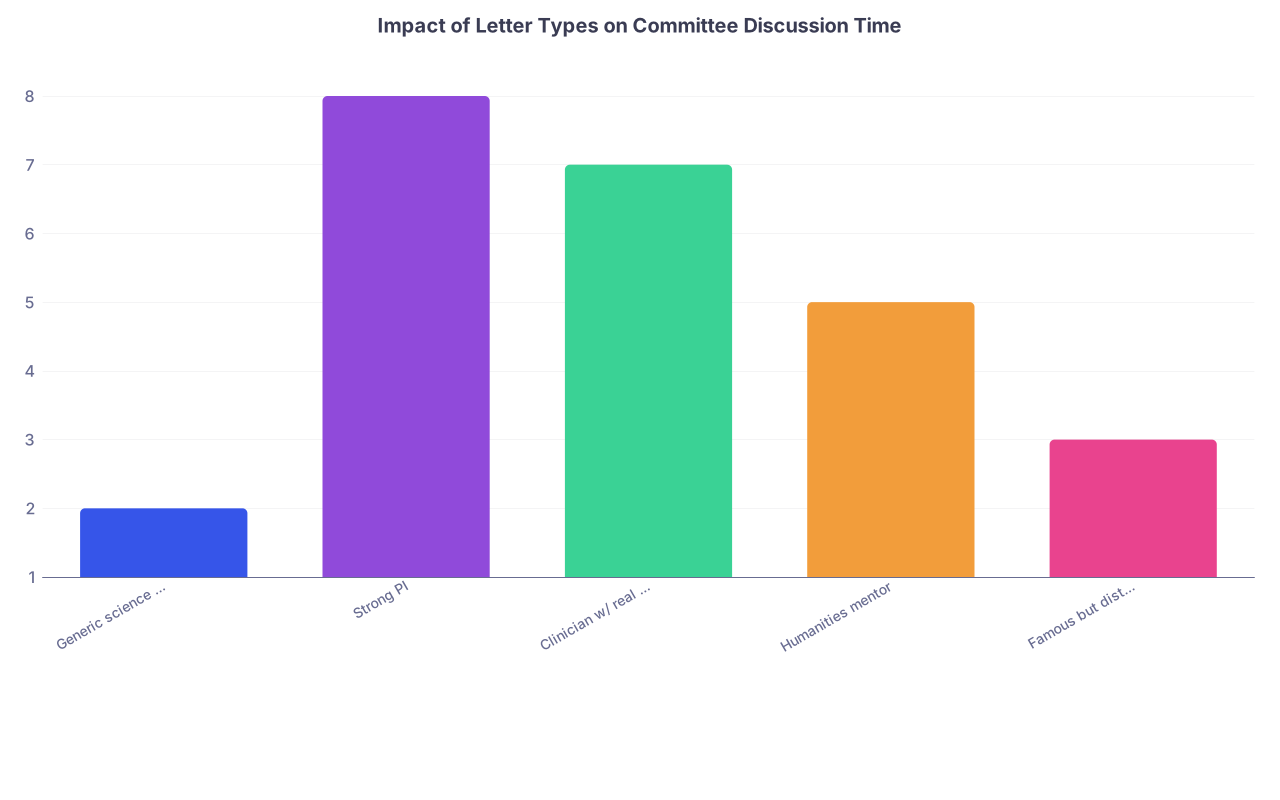
| Category | Value |
|---|---|
| Generic science prof | 2 |
| Strong PI | 8 |
| Clinician w/ real contact | 7 |
| Humanities mentor | 5 |
| Famous but distant name | 3 |
The Worst Mentor Choices We’ve Seen
Now the part nobody sugarcoats behind closed doors. The wrong mentor choice can quietly damage your application more than a single bad grade.
Here are the patterns that raise red flags every year.
1. The Famous Name Who Barely Knows You
You know the type. Lab with 20+ undergrads. PI is constantly on flights. You picked them because “they’re big in this field.”
We see those letters all the time. They read like this:
“I have known [Student] for approximately 6 months in the context of my research laboratory. They are punctual, polite, and eager to learn. They carried out assigned experiments as part of a larger team. I anticipate they will be successful in medical school.”
On the surface? Sounds fine. Neutral. Polite.
In the room, what we say:
- “So…this is a template.”
- “No specific project details, no ownership, no anecdotes.”
- “If that’s the best this famous PI could say, this student must have been invisible.”
The worst part is the contrast. When we read a deep, specific letter from a lesser-known PI and then a bland template from a huge name, we mentally downgrade the student’s judgment. You chased prestige instead of substance. Committees notice that.
2. The “Damned with Faint Praise” Letter
This is the true silent killer.
Red flag phrases faculty instantly recognize:
- “Completed all required work.”
- “Met expectations in the course.”
- “Performed at the level appropriate for their training.”
- “I expect they will do well if they continue to apply themselves.”
You’ll see none of the words “outstanding,” “exceptional,” “among the best I’ve taught,” “top X%,” or “enthusiastically recommend.” Those aren’t just nice add-ons. Their absence is information.
I sat in one meeting where a file had what looked like a positive letter. A junior faculty member at the table said, “This seems good.” The senior member replied, “No. Look at who wrote it. If Dr. X doesn’t say ‘top 10%,’ that’s a no.”
Different letter writers have known patterns. Committees get used to how various faculty grade their praise. When their language suddenly flattens out, we pick up on it.
This is why choosing a mentor who is lukewarm about you, or who likes you but doesn’t really rate you highly, is dangerous. A tepid letter from a “strong” recommender is worse than an enthusiastic letter from a less famous one.
3. The “I Barely Saw You” Clinical Letter
Students keep doing this: shadow for two or three days, then ask for a letter because “they’re an attending and it’ll look good.”
Those letters are useless at best, harmful at worst.
Prototype version:
“I interacted with [Student] over the course of several clinical shadowing sessions. They were appropriately dressed and arrived on time. They observed patient care and asked appropriate questions.”
That tells us nothing. It also tells us you asked for a letter from someone who had no business writing one. Weak judgment again.
What we say in the room:
- “So you found the first white coat and asked for a letter.”
- “They couldn’t say a single concrete thing about their clinical interaction, so there probably wasn’t any.”
One cycle, we had an applicant with three letters all like this—short, generic, observational. No research letter, no professor who really knew them. That’s when a committee member said, “Either nobody worked with this student long enough to write more, or they weren’t impressive when they did.”
Neither interpretation helps you.
4. The Backhanded “Honesty” Letter
Once in a while, we see a letter that outwardly looks supportive but has two or three sentences that make everyone sit up straight.
Examples I’ve personally heard quoted in the room:
- “At times, they required more supervision than their peers to complete tasks.”
- “They can be very enthusiastic, though occasionally this leads them to speak over others in team settings.”
- “They initially struggled with punctuality but improved after feedback.”
You might think that sounds like “balanced feedback.” On a residency eval, maybe. In a premed or med school LOR, it’s a landmine.
In one case, a research mentor clearly liked the student but wrote:
“He is not naturally the most organized student I’ve mentored, but with detailed oversight and frequent check-ins, he can produce solid work.”
A faculty member put the letter down and said, “We’re not taking on a project manager role for a med student. Pass.”
If you sense a mentor has “concerns,” even small ones, do not use them for high-stakes letters. You’re giving them a blank page and a formal channel to express those concerns. Some will.

How Faculty Actually Compare Your Letters
You think the committee reads your letters in isolation. We don’t. We read them against other applicants from the same school, the same lab, sometimes the same professor in the same batch.
I’ve sat in meetings where someone said: “This is Dr. Y’s third letter today. In the other two, he wrote ‘top 5%.’ Here he wrote ‘strong student.’ That’s not the same.”
We develop a mental calibration for frequent letter writers.
Let me show you how this plays out.
| Writer Type | Their Strong Phrases | Hidden Meaning to Committee |
|---|---|---|
| Stingy Senior PI | “Top 10% in my career” | Truly outstanding |
| Enthusiastic Clinician | “Great, excellent, superb” | Could be average, needs specifics |
| Department Chair | “Strong student” | Middle of the pack |
| Small College Prof | “Best this year” | Very good, maybe top of a small pool |
| Research Mentor | “Indispensable to project” | Trusted and central to the work |
When you choose mentors, you’re also choosing which internal scale you’ll be judged on—though you don’t know their scale. That’s why you talk to upperclassmen, lab alumni, and advisors who do know.
On the committee side, letters often decide borderline cases. Numbers get you in the “maybe” pile. Letters push you into “yes” or “no.”
How to Choose the Right Mentors (Based on What We Actually Value)
You’re not picking names. You’re picking stories.
The question isn’t “Who is important?” It’s “Who has watched me do hard things, over time, and would fight for me in writing?”
Here’s the internal checklist many of us run subconsciously when we read a letter:
- Duration: Has this person known you longer than a semester?
- Proximity: Did they interact with you weekly, or are they just the figurehead?
- Specificity: Do they mention actual projects, patients, assignments, or challenges?
- Comparison: Do they place you in a ranking (“top 5/10%,” “one of the best in X years”)?
- Risk: Do they use “reputation-risking” language—stake, without reservation, without hesitation?
When you’re choosing mentors, work backward from that.
What a Strong Pre-Ask Conversation Looks Like
Before you ever send a CV or draft, you should look a potential recommender in the eye and say something like:
“Dr. X, I’m planning to apply to medical school this cycle. I’ve valued working in your lab/class/clinic. Do you feel you know my work well enough, and positively enough, to write a strong, specific letter on my behalf?”
The word “strong” matters. The word “specific” matters. A good mentor will either say:
- “Yes, absolutely,” and start rattling off examples they’d include.
- Or they’ll hedge: “I can write you a supportive letter” / “I can state you did everything required.”
If you hear hedging, that’s your cue to walk away politely.
I’ve been in the room when students used letters from people who had clearly given the hedged version of that answer. The consequences weren’t abstract.

| Step | Description |
|---|---|
| Step 1 | Potential Mentor |
| Step 2 | Do not ask |
| Step 3 | Ask for strong, specific letter |
| Step 4 | Knows you >6 months? |
| Step 5 | Worked closely & directly? |
| Step 6 | Positive feedback history? |
Composite Examples: The File We Fight For vs. The File We Quietly Drop
Let me stitch this together into two composites I’ve seen versions of again and again.
The File We Fight For
This student’s stats: solid but not breathtaking.
Letters:
- Research PI (3 semesters + summer, mid-sized lab). Detailed, story-driven, describes independence, troubleshooting, ownership of a figure in a manuscript. Uses “top 5% of undergrads in my 10 years here.”
- Science professor (had them in two courses). Talks about improvement, teaching others, intellectual curiosity after class, “one of the few students I’d trust to explain difficult concepts to their peers.”
- Clinician (saw them weekly as a scribe/MA for a year). Describes reliability, emotional intelligence with patients, examples of difficult encounters handled well.
Committee reaction:
- “Not the highest MCAT, but these letters are all pointing in the same direction: reliable, growth-oriented, trusted.”
- “If three different mentors in different domains say versions of the same thing, I believe it.”
- “I’d be comfortable with this student taking care of my family someday.”
Someone will say, “We should interview them.” And no one will object.
The File We Quietly Drop
This student’s stats: slightly higher MCAT, equivalent GPA. On paper, stronger.
Letters:
- Famous PI they saw twice a month in lab meetings. Generic. “Completed assigned tasks,” “punctual,” “eager.”
- Big-name department chair who taught a 200-student class. Describes performance as “consistent with their grade,” no ranking, nothing personal.
- Clinician they shadowed for four mornings. “Observed,” “appropriate,” “asked good questions.”
Committee reaction:
- “No one seems to actually know this student.”
- “With numbers like this, they should have been able to impress somebody enough to write a deeper letter.”
- “Letters are fine, but fine doesn’t get you off the borderline pile in a competitive year.”
When it comes down to limited interview slots, we pick the first file over the second almost every time.
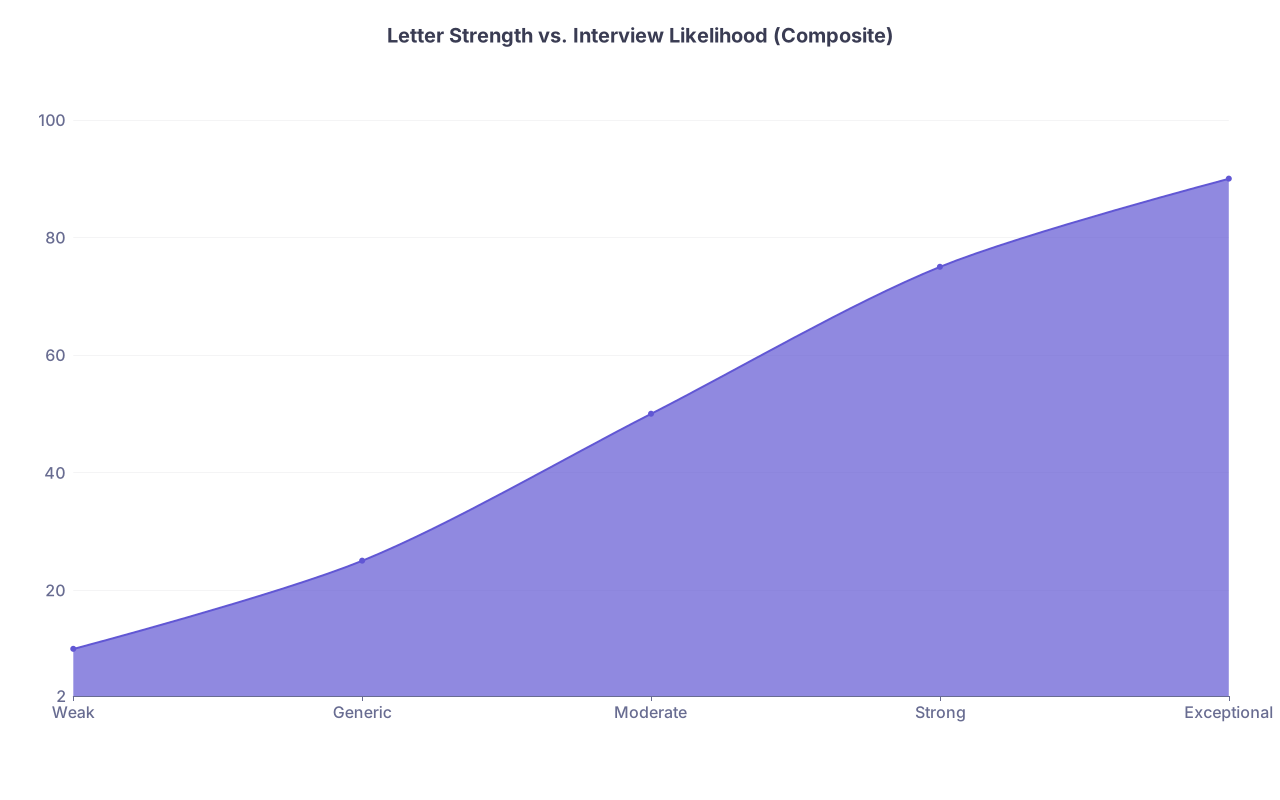
| Category | Value |
|---|---|
| Weak | 10 |
| Generic | 25 |
| Moderate | 50 |
| Strong | 75 |
| Exceptional | 90 |
How to Avoid the Classic Mentor Mistakes Early
You’re in premed or early med school. You don’t need letters yet—but you’re already building them.
What faculty actually notice years later:
- Who shows up consistently, not just when they need something.
- Who closes the loop on projects—finishes the dataset, the poster, the quality-improvement assignment.
- Who makes their life easier, not harder.
If you want the right mentor later, you build that now:
- Stay in the same lab more than one semester if it’s not toxic. Depth beats breadth.
- Take another class with a professor who liked you the first time.
- In clinical roles, aim for regular weekly presence, not a pile of random one-off shadowing days.
The best letters are not “requested.” They’re earned so thoroughly that when you finally ask, the mentor says, “Of course. I’ve been waiting for you to get to this stage.”
FAQs
1. Is it better to have a letter from a big-name faculty member who barely knows me or a lesser-known mentor who knows me very well?
Always choose the person who knows you well and thinks highly of you. A world-famous name on a generic, nonspecific letter actively hurts you when compared to your peers. On committees, we react much more positively to concrete stories, clear rankings (“top 10%”), and risk-taking language (“without reservation”) from a mid-level or even junior faculty member than a bland recitation of your CV from a star.
2. Can one lukewarm or bad letter really tank an otherwise strong application?
Yes. Especially in competitive pools where most numbers look the same. A single letter that hints at concerns about professionalism, reliability, or needing “a lot of supervision” can move you from the “interview” pile to the “no” pile. Even a lukewarm, generic letter can hurt you if your other letters are merely decent rather than outstanding, because we’re reading them as a set—and noticing patterns.
3. How many of my letters should be from research vs. clinical vs. coursework mentors?
For premeds, the usual pattern that works well is: one strong science faculty letter (coursework), one research mentor if you’ve done meaningful research, and one clinical or service mentor who’s seen you with patients or people in need over time. If you’re light on research, a second strong academic or service-based letter is fine. The key is not the exact distribution, but that each writer has seen you do real work over many months and can write something specific, enthusiastic, and comparative.
Years from now, you won’t remember the exact wording of your letters. You’ll remember who believed in you enough to put their name on the line—and whether you’d earned that trust long before you ever asked for it.