
You are a sophomore premed, sitting in the back of an Intro to Biology lecture. Your advisor just told you, “You’ll need at least three strong letters of recommendation for med school. Aim for science, clinical, and someone who knows your character.”
You nod. But inside you are thinking: from whom, exactly? My lab PI who barely knows my name? The hospital volunteer coordinator who supervises fifty students? The family friend who is an anesthesiologist and “happy to write something”?
This is where most people drift. They collect letters based on convenience and proximity, not strategy. Then they wonder why their “good” letters did not move the needle.
Let me be blunt: your letters of recommendation are not a formality. In competitive cycles, letters are often the tie‑breaker. A structured, intentionally built mentor triad — academic, clinical, and character — gives you three coordinated voices that make you look coherent, credible, and compelling.
Let me break this down specifically.
Why a Mentor Triad Beats Random Letters
Admissions committees are not just asking, “Is this person smart?” They are asking three separate questions:
- Will this person handle the science and academic load?
- Will this person function with real human beings in a clinical environment?
- Can we trust this person’s judgment, integrity, and trajectory over the next 30–40 years?
Your mentor triad exists to answer each question decisively, from a different vantage point.
Think of it this way:
- Academic mentor: “I have seen this applicant think.”
- Clinical mentor: “I have seen this applicant care for others.”
- Character mentor: “I have seen this applicant live.”
When those three line up, you stop looking like a GPA + MCAT score and start looking like a future colleague.
Here is the rough structure you are aiming toward:
| Mentor Type | Who They Are | Primary Focus | Typical Letter Strength |
|---|---|---|---|
| Academic | Science faculty / PI | Intellectual ability, work ethic, growth | High impact for academic readiness |
| Clinical | Physician / APP you worked closely with | Clinical potential, patient interaction | High impact for “fit” with medicine |
| Character | Longitudinal supervisor, coach, community leader | Integrity, reliability, leadership | High impact for trust and professionalism |
Most applicants accidentally duplicate one dimension (e.g., three classroom letters saying “hard-working A student”) and leave another dimension unaddressed. That is how you end up in the “solid but generic” pile.
The Academic Voice: The Person Who Has Seen You Think
We will start with the academic mentor because medical schools still care a lot about whether you will survive the curriculum. They want at least one, often two, letters that say “This person can handle rigorous science.”
Who this should be (and who it should not be)
The strongest academic letters usually come from:
- A science professor (biology, chemistry, physics, biochemistry, etc.) from a challenging upper‑level course where you excelled
- A principal investigator (PI) or research mentor who supervised you for at least 6–12 months
- Occasionally, a course director for a major core class (e.g., Organic Chemistry I/II, Biochem, Physiology)
Weak or lukewarm sources:
- A TA who technically taught you but has no real authority (they can co‑sign, but they should not be the primary name on the letter)
- A professor from a huge lecture who cannot pick you out of a lineup
- Someone outside the sciences when schools explicitly ask for science faculty
If your school requires two science faculty letters, one can be more “classroom focused” and the other more “research focused.” That pairing covers both performance under pressure and scholarly potential.
What the academic letter needs to say
A good academic letter is not “They got an A and came to office hours.” That is table stakes. It should answer:
- How did you handle complex material?
- How did you respond to challenge or failure?
- How quickly did you grow in sophistication?
- How do you compare to past students who went on to succeed in medical school?
A serious professor knows how to do this. The problem is they often do not know your story unless you feed it to them.
You should be prepared to give them:
- A concise CV or resume
- A short “academic snapshot” (1 page is fine) that covers:
- Toughest academic obstacle and how you handled it
- Example of a concept or project you pursued beyond course expectations
- Any meaningful research or scholarly output (poster, abstract, publication)
This lets them ground their praise in specific examples rather than generic statements.
How to cultivate this mentor early
You do not “get” an academic mentor by emailing them three weeks before AMCAS opens. You build one over 1–2 years. Here is a simple but effective process:

| Step | Description |
|---|---|
| Step 1 | Take challenging course |
| Step 2 | Perform at high level |
| Step 3 | Go to office hours regularly |
| Step 4 | Ask deeper questions about material |
| Step 5 | Join research or project if possible |
| Step 6 | Maintain contact after course ends |
| Step 7 | Request letter 2-4 months before needed |
The pattern is predictable. Students who end up with powerhouse letters are those who treated the professor like an intellectual resource, not a grade vending machine.
If you are already late in the game (e.g., senior year, no close faculty relationships), you will need to be more direct: choose the professor who knows you best (even if imperfectly), meet with them, and be upfront: “I am applying this cycle and would value your honest feedback on whether you could write a strong, detailed letter.” You want that phrasing. It gives them an exit ramp if the answer is no.
The Clinical Voice: Someone Who Has Actually Seen You with Patients
Too many premeds think a clinical letter is any letter written by a doctor. That is wrong. A letter from a physician who knows your parents, met you twice over dinner, and “is happy to help” is a liability, not an asset.
Admissions committees read tens of thousands of these. They can smell them in one paragraph.
Who this should be
Good clinical letter writers:
- Physicians or advanced practice providers (NP/PA) you have:
- Shadowed consistently (not 8 hours, think 40–100+ hours)
- Worked with as a scribe, MA, clinical research assistant, etc.
- Clinical volunteering supervisors who directly observed you with patients
- Longitudinal clinical mentors from a free clinic, FQHC, hospice, etc.
What matters is direct observation and longitudinal exposure. If they cannot describe your behavior with patients in detail, they should not be your clinical voice.
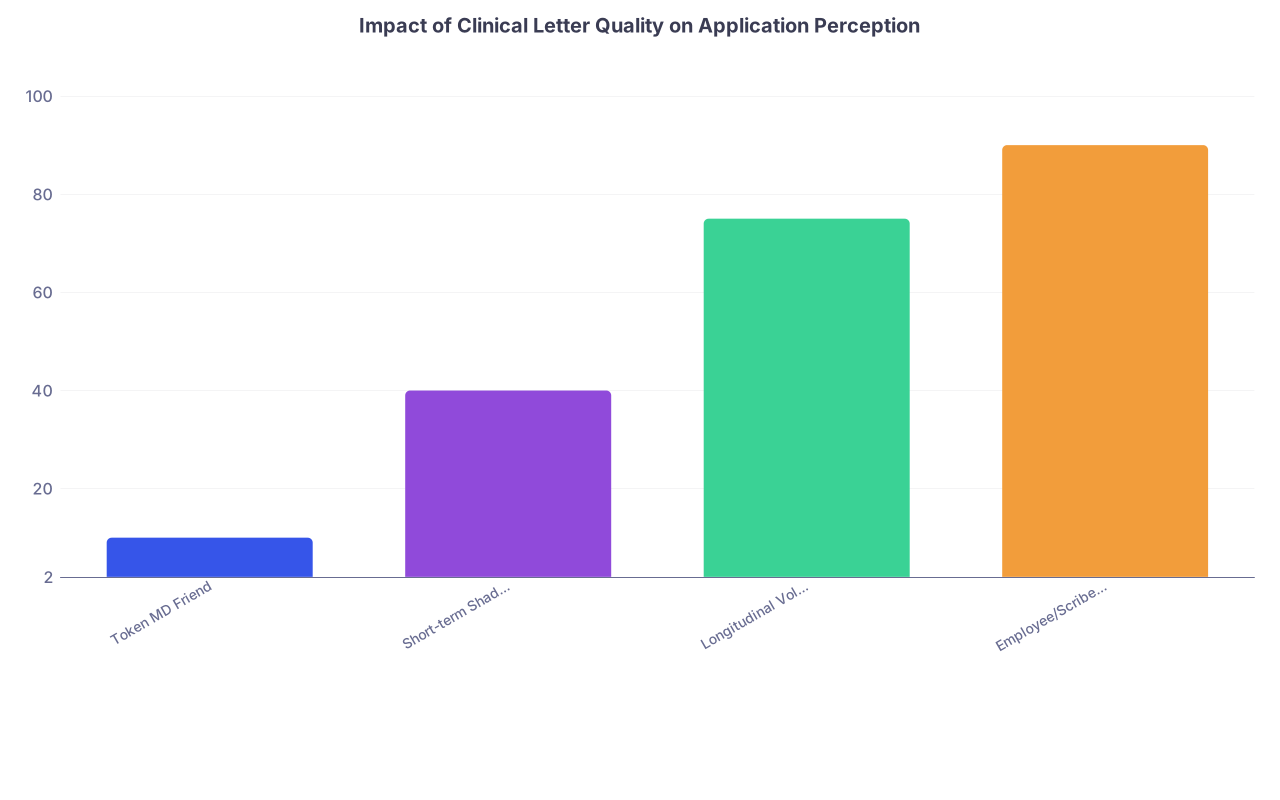
| Category | Value |
|---|---|
| Token MD Friend | 10 |
| Short-term Shadowing | 40 |
| Longitudinal Volunteering | 75 |
| Employee/Scribe Role | 90 |
Interpretation (yes, this is my judgment call): the further right you are on that chart, the more powerful the clinical letter tends to be.
What the clinical letter needs to say
You want this letter to answer these questions:
- How does this applicant interact with patients and families?
- How do they handle ambiguity, stress, or messy clinical situations?
- Do they show initiative, judgment, and appropriate boundaries?
- Would I be comfortable having this person on my team?
Let me give you a concrete contrast.
Weak clinical letter:
“I have known John for several months. He is punctual and eager to learn. He shadowed me in clinic and asked thoughtful questions. I am confident he will make an excellent physician.”
Strong clinical letter:
“Over 10 months, Maria spent one full day per week in my internal medicine clinic, eventually logging over 300 hours. Early on, she quietly observed. By month three, I trusted her to independently obtain focused histories in Spanish from established patients before I entered the room. I reviewed her notes and often found she had already identified the central issue in a visit — for example, linking a patient’s poorly controlled diabetes to her inability to afford test strips, which Maria uncovered with gentle, open‑ended questions. In reliability, maturity, and empathy she ranks in the top 5% of premedical students I have supervised over 15 years.”
Same “clinical exposure.” Vastly different impact.
How to set this up on purpose
You engineer strong clinical letters by doing three things:
Choose depth over breadth
- One clinic, one physician, one setting for six months beats three different volunteer gigs you drop after 8 weeks each.
Signal early that you are serious
- After a month or two, say something like:
“I plan to apply to medical school in the next couple of years. If I continue working with you and keep growing, would you potentially be open to writing a letter down the line?” - This does two things: it signals commitment and it makes them pay attention.
- After a month or two, say something like:
Give them raw material later
A few months before you need the letter, provide:- A brief reflection (1–2 pages) on:
- Specific patient encounters that shaped you
- Skills you improved under their supervision
- A bullet list of concrete contributions:
- “Independently roomed patients and obtained HPI and ROS”
- “Translated for Spanish‑speaking patients in >50 visits”
- “Helped design and implement a basic follow‑up call script for post‑discharge patients”
- A brief reflection (1–2 pages) on:
You are not writing the letter for them. You are giving them receipts.
The Character Voice: The Person Who Knows Your Core
This is the most underrated letter. It is also where a lot of applicants make sloppy choices.
Admissions committees do not just need to know you can memorize glycolysis and talk to patients. They need to know you are safe. That you are not going to falsify data, mistreat staff, or implode under stress. That your underlying character is aligned with the responsibilities of the profession.
Who this should be
Good character letter writers:
- Long‑term supervisors in non‑clinical roles:
- Work-study job supervisor you’ve had for 2–3 years
- Restaurant manager you worked under 20 hours/week during school
- Coordinator of a community program you have led for several years
- Coaches, directors, or program leaders:
- Varsity coach or club advisor who saw you handle wins, losses, and conflict
- Nonprofit director for whom you ran a major initiative
- Sometimes: religious or community leaders
- Only if the relationship is deep, not just “I see them at services”
Poor character letter choices:
- Family friends who cannot separate affection from assessment
- People who met you two months ago and “really like your energy”
- Anyone who will write something generic and overblown
What the character letter needs to say
The point of this letter is not to say, “They are nice and hardworking.” Everyone claims that.
You want it to focus on:
- Integrity (did you do the right thing when it cost you?)
- Responsibility (did you show up, follow through, and own your work?)
- Response to adversity and conflict
- Leadership style and how others respond to you
- Consistency over time
Example of a meaningful anecdote I have seen referenced:
“On one occasion, our team realized after an event that $400 in cash donations were unaccounted for. Before any of us noticed, Alex had already stayed late, reviewed the sign‑in logs, cross‑checked the donation envelopes, and found the missing funds misfiled with expense receipts. Alex could have left this for staff to resolve the next day. Instead, she stayed an extra 90 minutes, unprompted, to protect the integrity of our donors’ trust. That level of ownership is rare in undergraduates.”
This is what makes committees think: this is someone we can rely on.
Where to find this person if you feel like you have no one
Here is the honest reality: if you have never committed to anything longer than a semester, you have made this harder. Not impossible, but harder.
Look for:
- Any activity where you have shown up consistently for 1+ years — work, tutoring, religious community, a club, a team.
- The person who has seen you handle things behind the scenes:
- Schedule changes, late nights, interpersonal drama, minor failures.
Then do the same “strong letter” script:
“Would you feel comfortable writing a strong, detailed letter about my reliability and character over the past two years? I am applying to medical school, and schools value voices that know me in non‑academic contexts.”
If the person hesitates or says “I do not really know what to say in those,” that is your answer. Find someone else.
How to Make the Three Voices Complement Rather Than Repeat
Here is where this becomes a triad and not just “three people writing stuff.”
You want coordinated diversity. Each letter should reinforce a central narrative about you while adding its own layer.
Step 1: Decide your through‑line
Think in one sentence:
“I am a [type of person] who has consistently [done X] in [Y contexts].”
Example:
“I am a first‑generation student who has consistently built systems and teams around me, whether that was troubleshooting experiments in lab, creating a check‑in workflow at clinic, or running logistics for our campus food pantry.”
That thread — building systems, leading quietly, first‑gen perspective — should show up in different ways across your letters.
Step 2: Give each mentor a distinct angle
You do not control what they write, but you control what you ask them to emphasize.
For each mentor, you can send a short one‑pager titled “Things you’ve seen me do that med schools value.” Then choose 3–4 themes that differ slightly by person.
Example triad:
Academic mentor:
- Intellectual independence
- Analytical depth in research
- Ability to learn from critique
Clinical mentor:
- Empathy with vulnerable patients
- Poise under pressure
- Initiative within appropriate limits
Character mentor:
- Long‑term reliability
- Leadership by service
- Handling setbacks without excuses
You are not scripting them. You are focusing them.
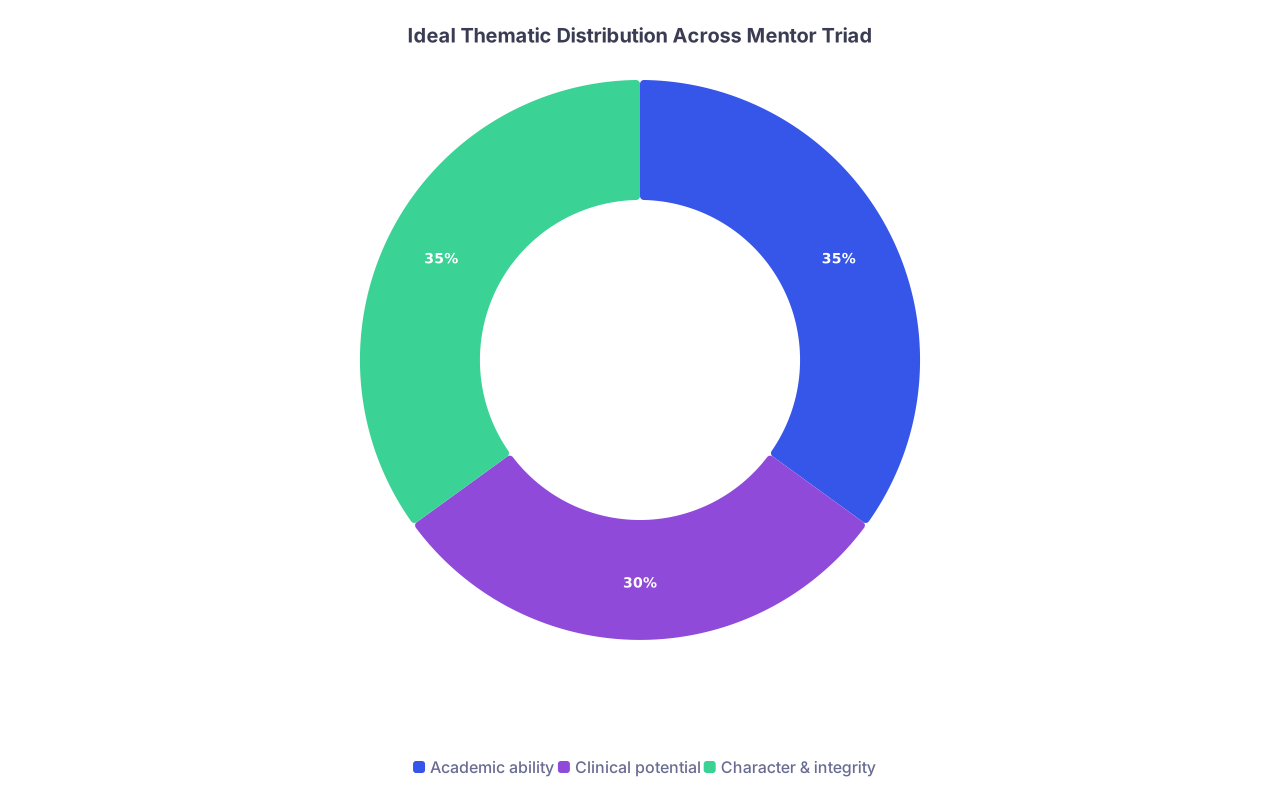
| Category | Value |
|---|---|
| Academic ability | 35 |
| Clinical potential | 30 |
| Character & integrity | 35 |
That distribution is the goal: balanced, overlapping enough to feel coherent, distinct enough to avoid redundancy.
Step 3: Timeline and mechanics
Do not underestimate logistics. Late or missing letters kill otherwise strong applications.
Here is a realistic timeline for someone applying in a June AMCAS opening:
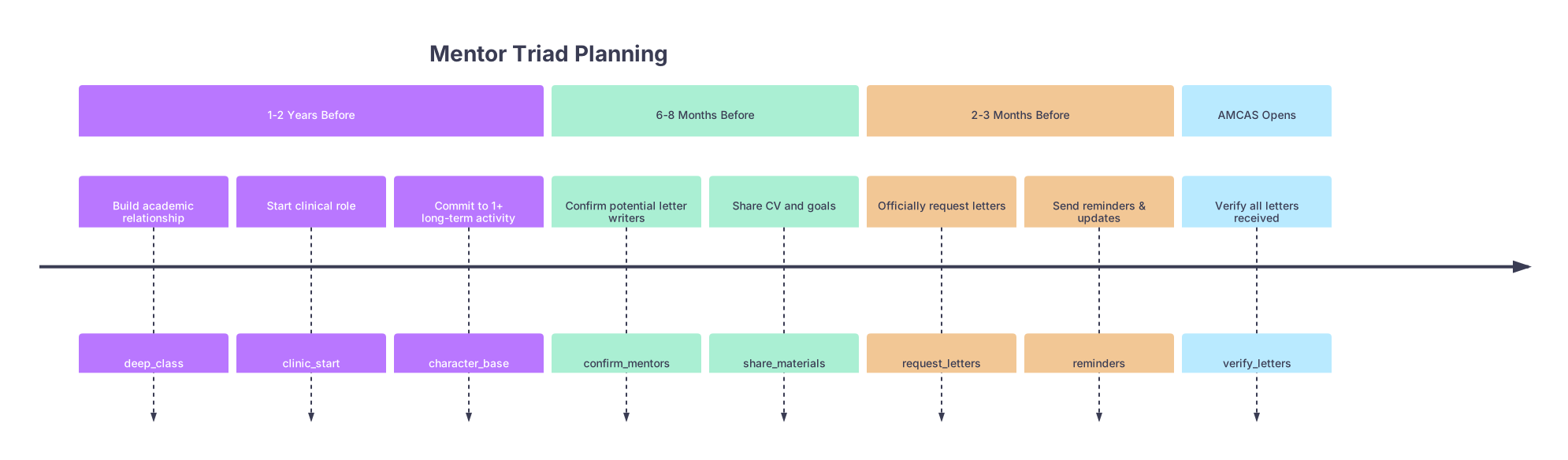
| Period | Event |
|---|---|
| 1-2 Years Before - Build academic relationship | deep_class |
| 1-2 Years Before - Start clinical role | clinic_start |
| 1-2 Years Before - Commit to 1+ long-term activity | character_base |
| 6-8 Months Before - Confirm potential letter writers | confirm_mentors |
| 6-8 Months Before - Share CV and goals | share_materials |
| 2-3 Months Before - Officially request letters | request_letters |
| 2-3 Months Before - Send reminders & updates | reminders |
| AMCAS Opens - Verify all letters received | verify_letters |
If you are already behind this schedule, you compress it — but you do not skip the “ask for strong letter” step.
How This Plays Differently for Premeds vs. Medical Students
The same triad logic applies in medical school when you are aiming for residency. It just shifts slightly.
Premed triad:
- Academic: undergrad science faculty / PI
- Clinical: physicians from premed roles, maybe a DO letter if targeting DO schools
- Character: long‑term non‑clinical supervisor
Medical student triad (for residency):
- Academic: core clerkship director or preclinical course director
- Clinical: attending from your target specialty plus one from a core rotation (e.g., IM, surgery)
- Character: can be:
- Program director from a major extracurricular (free clinic, student group)
- Research mentor who also knows your working style and reliability
| Phase | Academic Voice | Clinical Voice | Character Voice |
|---|---|---|---|
| Premed | Science professor / PI | Physician from clinical exposure | Long-term supervisor / coach |
| Early Med School | Preclinical course director | Core rotation attending | Longitudinal activity faculty mentor |
| Residency Apps | Clerkship/course director | Specialty attending (SLOR if EM) | Research / leadership mentor |
The mistake I see: medical students dumping the character letter altogether and replacing it with “famous name in the field who barely knows me.” Committees see right through that.
How to Ask for the Letter Without Sounding Awkward
You do not need a perfect script. You need clarity and respect.
In person or via video is best if the relationship is substantive. Email is acceptable if that is their norm.
Core elements:
- State the purpose and timeline.
- Ask explicitly if they can write a strong, detailed letter.
- Offer supporting materials.
- Give them a graceful “no” option.
Example email structure:
Dr. Smith,
I have greatly valued working in your lab over the past year, especially the opportunity to take ownership of the [X] project and learn from your feedback on my presentations. I will be applying to medical school this upcoming cycle, with primary applications submitted in June.
Would you feel comfortable writing a strong, detailed letter of recommendation on my behalf, focusing on my academic abilities and growth as a researcher?
I would be glad to send a current CV, a brief summary of my work in the lab, and a short statement of my goals in medicine to make this easier. Letters would ideally be submitted by [date].
If your schedule will not allow for this, or if you do not feel you know me well enough to write strongly, I completely understand and would appreciate your honesty.
Thank you for considering this,
[Name]
That last line — “I would appreciate your honesty” — is how you prevent weak letters. You want them to decline if they are not going to go to bat for you.

Handling Common Problems (Yes, Including Bad Letters)
A few rapid‑fire issues I see:
“My professor barely knows me, but I need a science letter.”
You are not the first. You still do the meeting, you still provide materials, and you still ask directly if they can write a strong, detailed letter. You may get a moderate letter. That is survivable if your other two are excellent.
Meanwhile, fix the pipeline for the future: build a deeper relationship with someone else for next cycle or for residency.
“I suspect one of my letters is weak, but I used a confidential system so I cannot see it.”
You prevent this, you do not solve it after the fact. That is the entire point of the “strong, detailed” question earlier. If you did that and they said “yes,” most faculty take that seriously.
If damage is already done and you are reapplying, you choose a different triad and you do not reuse that letter.
“A big‑name physician offered to write for me, but we only interacted a little.”
If they are a bonus letter on top of an already‑strong triad, fine. Name recognition can help at the margins.
If they would replace a true clinical or character mentor who knows you well? That is a bad trade. Choose depth over prestige.

Summary: What You Should Actually Do Next
If you skimmed everything else, focus here.
- Identify your three mentor “slots” — academic, clinical, character — and map real people to each, based on depth of relationship and direct observation.
- Commit now to deepening those relationships: consistent presence, honest conversations about your goals, and clear requests for strong, detailed letters with plenty of lead time.
- Coordinate the three voices by giving each mentor targeted material highlighting different but overlapping aspects of who you are.
Do this right and your letters stop being an afterthought. They become the part of your application that admissions committees quote when they argue to put you on their rank list.
FAQ (Exactly 6 Questions)
1. How early is “too early” to mention letters to a potential mentor?
If you have worked with someone regularly for at least 4–6 weeks and know you want a long‑term relationship, you can signal your future goals: “I am planning for medical school in a couple of years and hope to earn a strong letter down the line if I keep growing.” That is not a request; it is setting expectations. The formal ask usually happens 2–4 months before you need the letter submitted.
2. Do all three letters in the triad need to be used for every school?
No. AMCAS, AACOMAS, and TMDSAS all have maximums and typical patterns. Many MD schools are happy with 2 science + 1 other. In that case, you may combine the character and clinical roles if one person covers both very strongly (e.g., a long‑term clinical supervisor who also saw your leadership). But it is safer to have the full triad available in your letter service (Interfolio or similar) and select strategically per school’s guidelines.
3. Is it ever acceptable to have a non‑science academic letter instead of a second science letter?
If a school explicitly says they want two science faculty letters, you should follow that. For other schools, a non‑science academic letter from someone who knows your writing, reasoning, and intellectual maturity (e.g., Philosophy, History, Economics) can be an excellent addition. It does not replace science competence, but it can strengthen your overall academic narrative, especially if you have a humanities or social science dimension in your story.
4. How do I manage letters if I am taking a gap year (or several)?
Do not disappear. Before you graduate, ask key mentors if they are willing to write a letter that can be used within the next 1–3 years. Store those in a letter service (e.g., Interfolio), since faculty memory fades. During your gap years, cultivate at least one new mentor — often clinical or professional — who can speak to your more recent growth. For many non‑traditional applicants, the triad becomes: old academic PI, current clinical supervisor, and gap‑year job manager for character/professionalism.
5. What if I am at a huge university and cannot get close to any professor?
This is common but not an excuse. You create smaller environments inside the big one. Honors seminars, upper‑level electives, research labs, department clubs, and tutoring centers are all places where faculty‑student ratios shrink. If you truly cannot access any of those, then you lean on the best relationship you can create in a large class: sit in front, go to office hours, do a small independent project or presentation if possible, and follow up after the course ends. Not perfect, but still better than being invisible.
6. How many total letters should I aim to have, beyond the core triad?
For most MD applicants, 3–5 substantive letters are sufficient: your triad plus 0–2 additional letters (e.g., a second science professor, a second clinical mentor, or a research co‑mentor). More than 5 tends to dilute impact and annoy committees. I would rather you have 3 exceptional, detailed letters that fit the academic‑clinical‑character model than 7 lukewarm “nice student” notes that all say the same thing. Quality and complementarity beat sheer volume every time.