
The last 8 weeks before submission separate the applicants who “had good mentors” from the ones who actually used them. Most people underuse their letter writers and then wonder why their letters sound generic. Do not be that person.
You are in the Letters of Recommendation phase, not the “hope for the best” phase. At this point, your mentor touchpoints must be deliberate, scheduled, and strategic. Week by week. Sometimes day by day.
Let me walk you through the last 8 weeks before you hit submit on AMCAS/AACOMAS/TMDSAS (or a major post‑bacc / SMP / premed committee packet).
Week‑by‑Week Overview: The 8‑Week Map
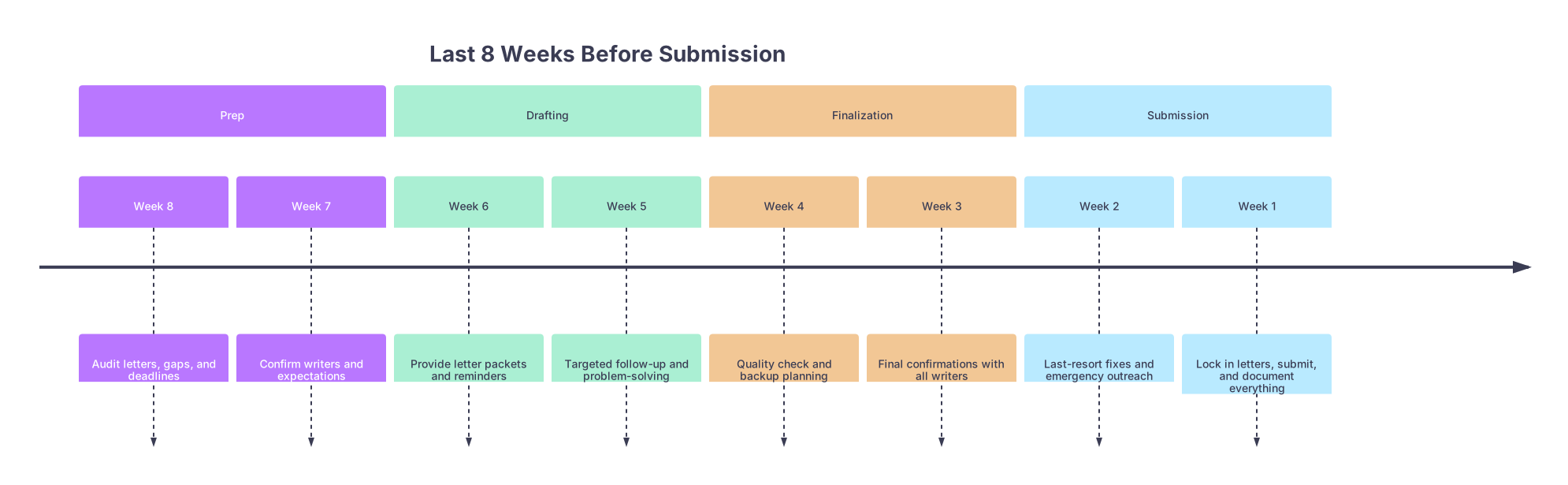
| Period | Event |
|---|---|
| Prep - Week 8 | Audit letters, gaps, and deadlines |
| Prep - Week 7 | Confirm writers and expectations |
| Drafting - Week 6 | Provide letter packets and reminders |
| Drafting - Week 5 | Targeted follow-up and problem-solving |
| Finalization - Week 4 | Quality check and backup planning |
| Finalization - Week 3 | Final confirmations with all writers |
| Submission - Week 2 | Last-resort fixes and emergency outreach |
| Submission - Week 1 | Lock in letters, submit, and document everything |
Here is the blunt truth: if your letters are not fully lined up by Week 4, you are behind. Not doomed. But behind.
Week 8: Letter Audit and Strategy Call
At this point you should stop “hoping it works out” and actually map your letter situation.
1. Do a cold, ruthless letter audit
Make a table. Not in your head. On paper or in a doc.
| Writer Type | Name / Role | Status | Confidence Level | Due Date |
|---|---|---|---|---|
| Science Faculty | Dr. Lopez (Orgo) | Asked, verbal yes | High | May 25 |
| Science Faculty | Dr. Chen (Bio) | Not asked | Medium | May 25 |
| Non-Science Prof | Dr. Hall (Philosophy) | Confirmed | High | May 25 |
| PI / Research | Dr. Patel | Asked, no reply | Low | May 25 |
| Clinician | Dr. Rivera (Hospital) | Confirmed | Medium | May 25 |
Identify:
- How many letters you actually need (per school / committee).
- Required types (science, non‑science, physician, PI, supervisor).
- Gaps: missing science? no physician? all letters from the same semester?
If you do not have at least:
- 2 strong science faculty letters, and
- 1 additional strong letter (non‑science / research / clinical / supervisor),
you must treat Week 8 as emergency recruitment week.
2. Schedule a 20–30 minute mentor strategy call
At this point you should:
- Pick one senior mentor (advisor, PI, premed committee member, or trusted physician).
- Email to say you want a targeted 20‑minute call to review your letter strategy before submission.
In that call, you should:
- Present your audit (briefly).
- Ask: “If you were on an admissions committee, what would you worry about in this letter profile?”
- Listen. If they flag “too few science letters,” “all from the same setting,” or “no one who knows your character well,” fix that now.
You are not asking them to micromanage. You are checking whether your current mix tells a coherent story.
Week 7: Confirm Writers and Expectations
By Week 7, every letter writer who matters should be officially asked, not just “planning to maybe write something.”
At this point you should formalize all requests.
1. Turn soft yeses into hard commitments
If anyone said “Sure, I can write you a letter” months ago, that is a soft yes. You need specifics.
Your email this week should:
- Confirm that they are still able and willing.
- Give the exact platform (AMCAS, Interfolio, school portal).
- Give the deadline (earlier than your real one by 7–10 days).
- Ask: “Would you feel comfortable writing me a strong, positive letter of recommendation for medical school?”
That “strong, positive” line matters. It gives them an out if they are lukewarm.
2. Clarify what each letter should emphasize
You are not scripting their letter. You are aligning expectations.
Quick bullets in your email:
- To a science professor: emphasize academic rigor, resilience in a tough course, intellectual curiosity.
- To a research PI: emphasize scientific thinking, persistence, ownership of projects.
- To a clinician: emphasize bedside manner, professionalism, reliability, ability to work with patients and teams.
At this point you should also ask: “Is there anything you would like me to send you to make this easier?”
This sets up Week 6.
Week 6: Deliver Complete Letter Packets
This is the week where you either make life easy for your mentors or you make it likely they rush your letter the night before.

At this point you should send every writer a complete, organized packet.
1. What goes in a good letter packet
For each writer, create a tailored folder or PDF bundle that includes:
- Your CV or resume (1–2 pages, clean and current).
- Draft of your personal statement (even if not final).
- Transcript (unofficial is fine).
- Bullet list of 3–6 key points you hope they might address, tied to specific examples they know.
- Reminder of contexts in which they taught/supervised you:
- Course name and term, grade, key project or paper.
- Research role, dates, specific experiments or responsibilities.
- Clinic or hospital role, how often you worked together.
Optional but useful:
- Short paragraph: “Why I am pursuing medicine and what kind of physician I hope to be.”
- List of representative schools and your intended application year.
2. Set clear, visible deadlines
At this point you should:
- State a requested submission date 7–10 days earlier than your true “I really need it” date.
- Put that date:
- In the email subject line.
- Bolded in the body.
- On the top of the packet (“Requested letter due: May 20”).
If your primary apps open June 1 and you want to submit in the first 1–2 weeks, your functional letter deadline is sometime between May 20–25. Not June 15. Not “whenever.”
3. Confirm receipt and understanding
You do not assume they read your 3‑paragraph email.
Two days after sending the packet, you should:
- Send a brief follow‑up if they have not replied:
- “Just wanted to confirm you received the materials and that the May 20 target works for you.”
No groveling. Just professional project management.
Week 5: Targeted Follow‑Ups and Weak Link Detection
Week 5 is where you catch letter problems while you still have time to fix them.
At this point you should check three things:
- Who has explicitly confirmed the deadline and process.
- Who has gone radio silent since saying yes.
- Whether your mix of letters actually matches your school list.
1. Audit your letter portal or tracking system
Log into AMCAS, Interfolio, school portal, whatever you are using. Create a simple tracking grid if you have not already.
| Writer | Platform | Packet Sent | Confirmed Deadline | Letter Received |
|---|---|---|---|---|
| Dr. Lopez | AMCAS | Yes | Yes | No |
| Dr. Chen | Interfolio | Yes | No response | No |
| Dr. Hall | AMCAS | Yes | Yes | Yes |
| Dr. Patel | Interfolio | Yes | Yes | No |
| Dr. Rivera | School Portal | Yes | Yes | No |
Anyone with “no response” or “not confirmed” is a yellow flag. Anyone historically slow or forgetful is a red flag.
2. Send individualized check‑ins
This is not a mass email. Take 5 minutes per person.
Template structure:
- Thank them again for agreeing.
- Briefly reiterate the requested date.
- Ask if they need anything else from you.
- Reassure them that brevity is fine; quality matters more than length.
If someone has gone quiet for over 2 weeks, you send a polite but clear nudge:
“Because I am planning to submit my primary application in early June, I am hoping to have all letters in by May 20 so there is no delay in transmitting my file.”
You are not being pushy. You are protecting your timeline.
3. Identify and shore up weak categories
Example: your school list has several research‑heavy programs (e.g., WashU, Hopkins, UCSF) and your PI is the slowest person you know.
At this point you should:
- Schedule a brief in‑person or Zoom check‑in with that PI.
- Bring a printed copy of your packet.
- Clearly restate your target date.
- Ask if they anticipate any issues meeting it.
If they hedge (“I am really busy, but I will try”), line up a secondary research letter from a post‑doc or co‑mentor who knows your work.
Week 4: Quality Check and Backup Planning
Four weeks out, your letters should be in motion. Not hypothetical. Not “they said they would.” This is the week for risk management.
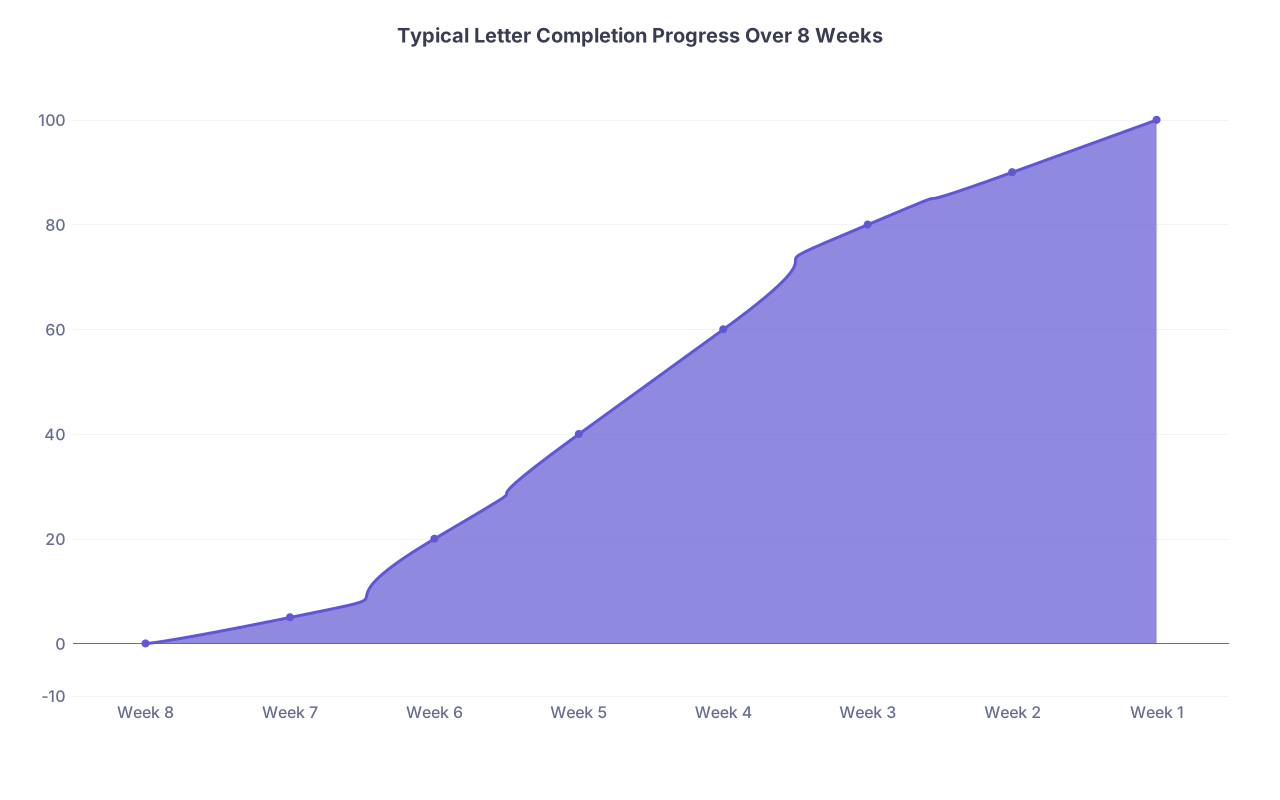
| Category | Value |
|---|---|
| Week 8 | 0 |
| Week 7 | 5 |
| Week 6 | 20 |
| Week 5 | 40 |
| Week 4 | 60 |
| Week 3 | 80 |
| Week 2 | 90 |
| Week 1 | 100 |
1. Distinguish between slow and unreliable writers
At this point you should be brutally realistic.
- A slow but organized professor who emails back promptly = probably fine.
- A brilliant but chaotic PI who loses forms, forgets meetings, and has three grant deadlines = danger.
For any unreliable writer:
- Identify a backup who could write a decent letter quickly if necessary.
- Start warming that backup up now (a coffee, a check‑in, sharing your plans).
You may never need them. But if a primary letter collapses at Week 2, you will not be starting from zero.
2. Use one senior mentor as your “letters quarterback”
Pick the person who understands the full picture of your application (premed advisor, committee chair, trusted PI).
At this point you should:
- Send them a one‑page overview of your letter situation.
- Ask directly: “If you had to rank these letters by likely impact, how would you rank them?”
- Ask if they see any glaring gaps: no long‑term mentor, no one who can speak to personal growth, etc.
If they flag a gap, you still have a bit of time to address it with a short‑term experience supervisor, volunteer coordinator, or lab lead.
Week 3: Final Confirmations and Soft Deadline Week
This is the week your fake deadline hits. Ideally, most of your letters arrive now.
At this point you should:
- Send a polite, appreciative reminder to anyone who has not yet submitted.
- Verify that letters are correctly linked to your application IDs / school list.
- Check for any committee letter or packet deadlines.
1. The reminder email that actually gets read
Keep it short:
- Subject: “Reminder – Letter for [Your Name], target [Date]”
- 3–4 lines:
- Express appreciation.
- Restate the target date.
- Note that their letter is a key part of allowing you to submit on time.
- Offer help if they need any logistical support.
Do not apologize for reminding them. They are adults with busy schedules who forget things. You are doing them a favor.
2. Check portals for technical issues
At this point you should log in and verify:
- All writers are correctly listed (names spelled correctly, roles accurate).
- Each letter has the correct letter type selected (science faculty vs. physician vs. other).
- For Interfolio: all letters are matched to the right application services.
I have seen smart applicants delayed 2–3 weeks because a letter was assigned to the wrong AMCAS ID or the professor uploaded to the wrong cycle. Do not assume the system is correct.
Week 2: Triage and Last‑Resort Fixes
If you are two weeks out and still missing critical letters, you are in triage mode. Time to stop being passive.

At this point you should:
1. Escalate communication channels
Email has not worked? Try:
- A brief, respectful phone call during office hours.
- A short in‑person visit if you are on the same campus.
- A message through their assistant or departmental office if appropriate.
Script yourself ahead of time so you are calm and concise:
“I wanted to check in about the letter because my application submission window is coming up in the next two weeks, and I need to make sure I have all materials ready. Is there anything I can do to support you in getting it completed?”
If they sound overwhelmed or noncommittal, ask directly:
“Do you still feel you will be able to submit a strong letter by [date], or would it be better for me to rely on another writer this cycle?”
You would rather know now than after deadlines pass.
2. Activate backups if necessary
If a key letter is clearly not happening, at this point you should:
- Ask a backup writer for a short‑turnaround letter (7–10 days).
- Provide the most streamlined packet possible:
- One‑page CV.
- One‑page highlight summary of your work with them.
- Clear deadline and submission instructions.
You might feel guilty asking on short notice. Ask anyway. Many supervisors will respect the directness and help you if they can.
3. Coordinate with premed committee timelines
If your institution uses a committee letter:
- Confirm that all individual letters are in by their internal cutoff.
- Confirm that your committee letter meeting / interview is scheduled and will be completed on time.
- Ask explicitly when the committee packet will be released to AMCAS or schools.
Late committee packets can quietly sabotage an otherwise early application.
Week 1: Final Locks, Submission, and Documentation
You are now in the final week before submission. This is not “maybe letters will appear later” week. This is lock‑everything‑in week.
At this point you should:
1. Verify all required letters are received or realistically incoming
Do a final portal check:
- Count how many letters are received.
- Confirm you meet the minimum requirements for your target schools.
- Confirm that the most important letters (science, PI, physician) are present.
If one lower‑priority letter is still missing but you have enough strong ones, you do not hold your entire application hostage waiting for it. Submit.
2. Decide: submit now vs. hold for a critical letter
Rule of thumb:
- If you are waiting on a key science or PI letter that materially strengthens your file, it might be worth holding a few days if your overall submission will still be early (e.g., June 2 vs. June 7).
- If you are already on the later side, you submit with what you have, as long as you meet minimums.
Do not let a marginal letter delay your entire application by weeks.
3. Thank people like an adult, not a panicked applicant
Within 24–48 hours of confirming a letter is in and your application is submitted, you should:
- Send each writer a genuine thank‑you email.
- Consider handwritten notes for your primary mentors (PI, long‑term physician, advisor).
- Briefly update them on your timeline: “Primaries submitted; secondaries should start rolling in July; I will keep you posted.”
Long term, these people are your network. Treat them that way.
Daily Micro‑Checklist for the Final 10 Days
When your brain is fried from final edits, having a small daily touchpoint list helps.
In the last 10 days, at this point you should aim to do one small LOR‑related task per day:
- Day 10: Portal check + mark which letters are still missing.
- Day 9: Send 1–2 individualized reminder emails.
- Day 8: Confirm committee letter timing with your premed office.
- Day 7: Call or visit 1 high‑risk writer’s office hours if needed.
- Day 6: Review school‑specific letter requirements; make sure your mix covers them.
- Day 5: Double‑check writer names, titles, and roles are correct in systems.
- Day 4: Send thank‑you emails to any writers who have already submitted.
- Day 3: Decide on your exact submission day and time; put it on your calendar.
- Day 2: Last portal check; verify nothing changed or disappeared.
- Day 1: Submit. Then immediately document which letters went where and who helped you.
The difference between a forgettable letter file and a powerful one is not “luck with mentors.” It is how you use the last 8 weeks before submission.
Do one concrete thing right now: open a new document and build your letter audit table with every current and potential writer, their role, and status. If you cannot fill that table cleanly in 10 minutes, you have your first week’s assignment.