
It’s January of your sophomore year. You’ve been in a lab for about six weeks, mostly pipetting buffer and labeling tubes. Your friends keep saying, “You need a strong research letter for med school,” and your PI barely knows your name. You’re wondering: am I already behind? How early do you have to commit to a mentor if you actually want a serious, specific letter—not the generic “they showed up and did their tasks” special?
Let me walk you through this chronologically, the way you should actually plan it.
Big Picture: The Timeline Backwards
Start from the end. A serious research letter for med school needs three things:
- The writer knows you well (your work habits, your thinking, your character).
- You’ve done something substantial (not necessarily published, but real responsibility).
- There’s enough time for them to write a thoughtful letter (not a rushed two-day job).
For most students, that means:
- Commitment to one main research mentor: at least 12–18 months before you submit your primary application.
- Consistent work with that mentor: ~5–10 hours/week over that period, with at least one “peak” period (full-time summer, big project, poster, or manuscript).
- Letter request: 2–3 months before your application deadline.
If you’re premed, you’re living on a different clock than your classmates who just “want to try research.” You do not have infinite semesters. You’re playing for letters.
Year-by-Year: When You Should Lock in a Mentor
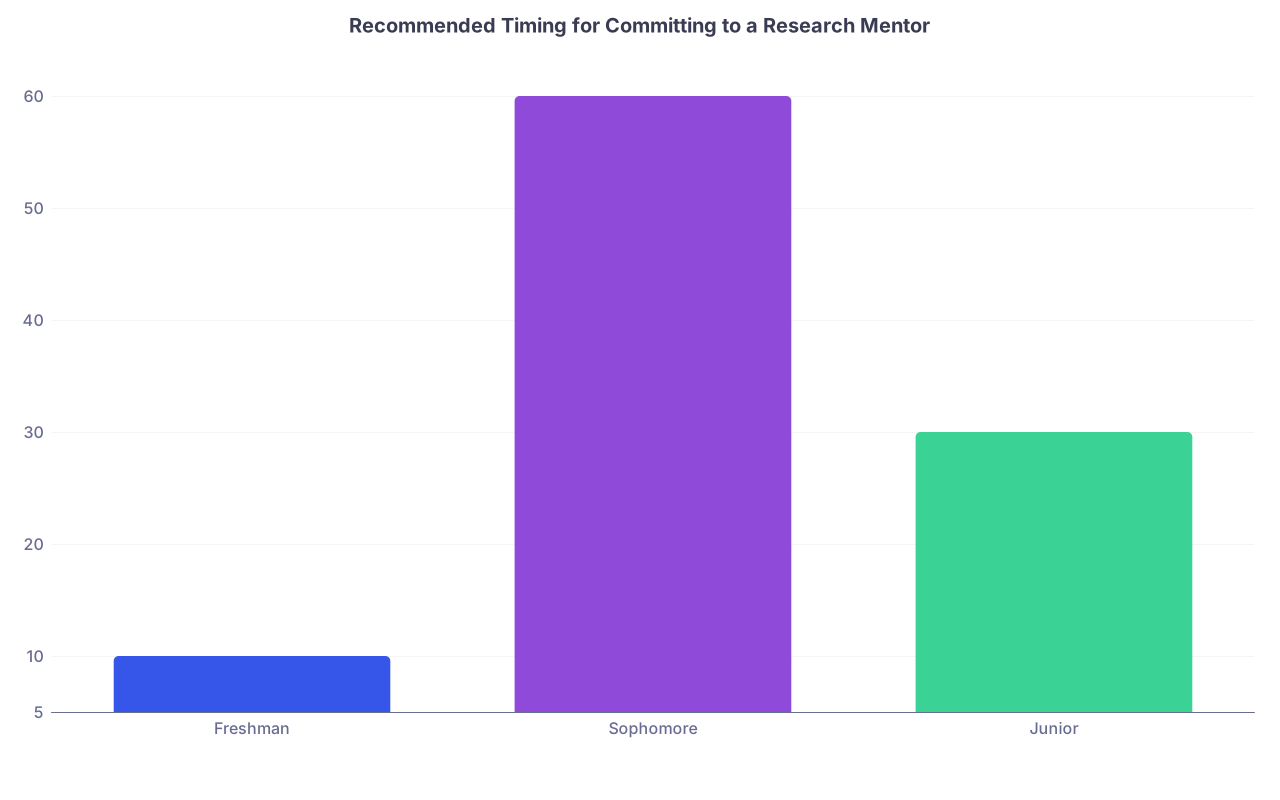
| Category | Value |
|---|---|
| Freshman | 10 |
| Sophomore | 60 |
| Junior | 30 |
Freshman Year (or First Year, if on a different system)
You’re not committing yet. You’re sampling.
Fall–Early Spring (Months 1–8 of college)
At this point, you should:
- Get your feet under you academically. A trash GPA kills you faster than a late research start.
- Attend departmental seminars or undergraduate research fairs.
- Talk to older students who actually do research. Ask who is good to work with and who never writes letters.
If you join a lab this early, it’s a bonus, not a requirement. You’re not “behind” if you’re not in a lab yet.
Late Spring–Summer after Freshman Year
Now you can start thinking strategically. If you’re already clear you want med school and potentially a research-heavy career (MD/PhD, academic medicine), then:
- Start emailing labs about starting in sophomore fall.
- Aim to land in a lab where:
- The PI has a track record of mentoring undergrads or early medical students.
- There’s a senior grad student/postdoc who can supervise you.
- People actually publish and present (dead labs don’t help you learn or write about your experience compellingly).
At this point, you should not be promising anyone a three-year commitment. You’re exploring fit.
Sophomore Year: The Decision Year
This is where most serious letters are born. If you wait until junior spring to get serious, your letter will feel rushed.
Sophomore Fall (Months 13–16 of college)
At this point, you should:
- Be in a lab. Even if it’s not your forever home, you’re getting experience and data for your future applications.
- Show up consistently. No disappearing during midterms.
- Pay attention to:
- Does the PI interact with you at all?
- Does anyone care about your development as a scientist or clinician?
- Would you feel comfortable asking this person for a future letter?
Red flag labs (I’ve seen these sink people):
- You never meet the PI. You only report to a grad student who clearly runs 8 undergrads as cheap labor.
- High drama, high turnover. Every semester, three people “quiet quit” or get sidelined.
- Nobody asks about your goals. Great mentors will ask, “Are you thinking MD? MD/PhD? Something else?”
By the end of sophomore fall, you should have a clear sense of whether this lab/PI could be your serious letter writer.
This is the first real checkpoint:
- If the answer is yes → you’re about to commit.
- If the answer is no → you should quietly start looking for a new lab for sophomore spring or summer.
Sophomore Spring (Months 17–20)
This semester is key.
At this point, you should:
- Decide whether to invest heavily in this mentor. This is where “I’m just trying research” turns into “I’m staying and building something real.”
- Talk to the PI or your primary supervisor about a more defined role. Something like:
- Taking over a sub-project
- Owning data collection on a specific protocol
- Preparing a poster for a local conference
- Have at least one 1:1 meeting with the PI where you talk about:
- Your career goals (med school)
- Your timeline (when you’ll apply)
- Your interest in taking on more responsibility
This is usually the ideal time to mentally “commit” to a mentor for the long haul—about 15–18 months before your primary application goes out.
No, you don’t walk in and say, “I hereby commit to you as my letter writer.” But you do act like someone who plans to stay:
- You volunteer for the summer.
- You ask what skills you should build for more independence.
- You let them know you’re interested in presenting or writing.
Summer After Sophomore Year: Your First Big Block
This summer can make or break whether your PI sees you as “my student” versus “one of the undergrads I barely remember.”
At this point, you should:
- Be in the same lab, ideally full-time (30–40 hours/week) for 8–10 weeks.
- Ask to:
- Design or run a small independent experiment.
- Take on a data analysis project.
- Draft parts of a figure, abstract, or methods section.
This is when your PI sees you:
- Early in the morning
- Late in the evening
- Troubleshooting when something fails
- Reacting when data is ugly and unexpected
Those are the stories that end up in strong letters.
If you’re not getting any intellectual responsibility by mid-summer, and all you do is wash glassware or prep buffers, that’s a problem. Not fatal, but you may need to adjust for junior year.
Premed Application Clock: Counting Backward From Submission
Let’s get brutally specific about dates.
Most students apply to medical school summer after junior year (traditional timeline). Move the years accordingly if you’re non-traditional or taking a gap year.
Traditional Applicant: Submitting June After Junior Year
- June (Application Year 0): You submit your AMCAS primary.
- Your research letter writer will usually be asked to upload letters between May–July of that year.
Work backward:
- Letter request: March–April of Application Year 0.
- PI needs to know you well by: Start of that spring at the latest.
- You need at least 12–18 months of consistent work before that: So you want to have committed to your main mentor somewhere between January–June of sophomore year.
That’s why I said earlier: committing 12–18 months before you apply is ideal. Less than that and your letter starts sounding like a Yelp review after a single meal.
Month-by-Month: A Concrete Example Timeline
Let’s map out a “good” path for someone entering college in Fall 2022 and applying in June 2025.
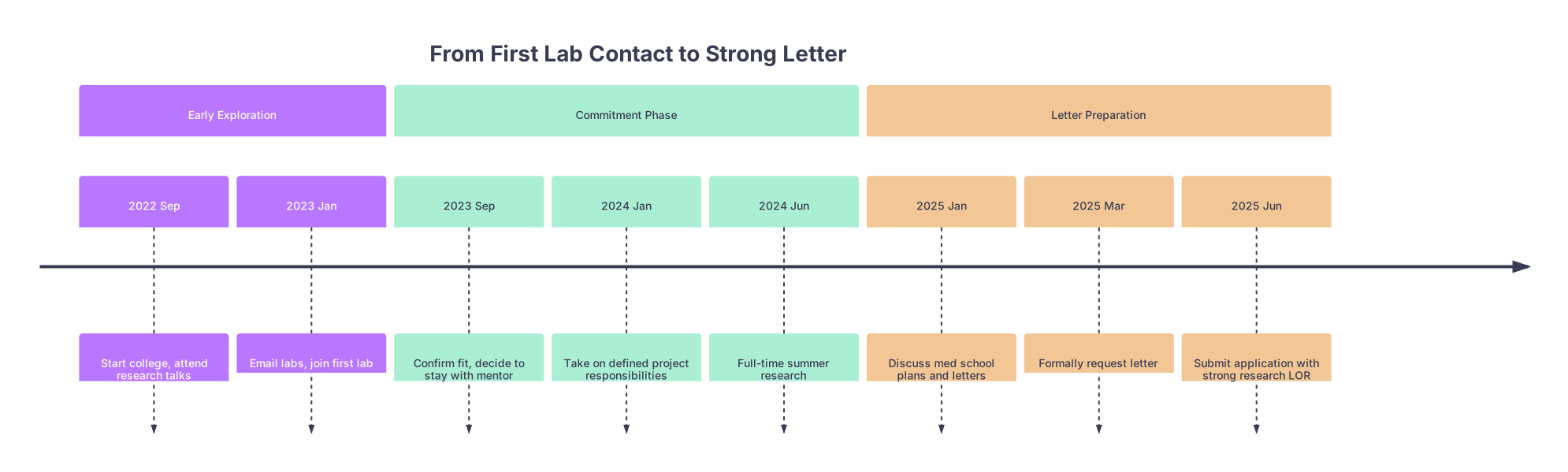
| Period | Event |
|---|---|
| Early Exploration - 2022 Sep | Start college, attend research talks |
| Early Exploration - 2023 Jan | Email labs, join first lab |
| Commitment Phase - 2023 Sep | Confirm fit, decide to stay with mentor |
| Commitment Phase - 2024 Jan | Take on defined project responsibilities |
| Commitment Phase - 2024 Jun | Full-time summer research |
| Letter Preparation - 2025 Jan | Discuss med school plans and letters |
| Letter Preparation - 2025 Mar | Formally request letter |
| Letter Preparation - 2025 Jun | Submit application with strong research LOR |
Fall 2022 (Freshman Fall)
You’re not in a lab yet. You go to a couple of biology/chemistry department seminars, talk to older premeds in your pre-health advising cohort.
Spring 2023 (Freshman Spring)
February: You start emailing labs.
March: You join Dr. Nguyen’s immunology lab. The first 6–8 weeks? You’re mostly shadowing a senior undergrad and a postdoc, learning very basic tasks.
Summer 2023 (After Freshman Year)
You’re not full time yet, maybe you’re home or doing a non-research job. You read a few papers your lab group recommended. You stay lightly in touch.
Fall 2023 (Sophomore Fall)
Now it counts.
- You’re in the lab 6–8 hours/week.
- By October, you’ve:
- Met with Dr. Nguyen 1:1 twice.
- Talked about med school vs MD/PhD.
- Asked, “If I want to contribute meaningfully, what should I try to learn this year?”
You’re evaluating: Do I want to invest here?
End of Fall 2023
You decide yes. The environment is good, PI knows your name, postdoc is actually teaching you.
At this point, you should mentally commit to this lab through at least junior spring. That’s your ~18 months before application mark.
Spring 2024 (Sophomore Spring)
This is your ramp-up semester.
- You’re up to 8–10 hours/week.
- You’re responsible for a subset of experiments on a T cell activation project.
- You attend lab meeting regularly and present a short update once.
By May, your PI has seen you work through problems and respond to critical feedback. You’re no longer just “new undergrad.”
Summer 2024 (Between Sophomore and Junior Years)
Full-time in the same lab. Now you’re:
- Running your portion of the experiment mostly independently.
- Troubleshooting protocols with the postdoc, then reporting solutions at lab meeting.
- Helping write an abstract for a local conference.
This is where your future letter will pull its best material from.
Fall 2024 (Junior Fall)
You’ve been around long enough that newer undergrads ask you questions first. You mentor one of them on basic techniques. You continue your project and maybe help with data analysis.
At this point, you’ve been in the lab ~18 months with real intensity for at least 6–9 months. Perfect.
January–March 2025 (Junior Spring)
At this point, you should:
- Meet with Dr. Nguyen specifically about med school.
- “I’m planning to apply this upcoming cycle.”
- “Would you feel comfortable writing a strong letter of recommendation for my medical school applications?”
- Ask this 2–3 months before you actually need the letter uploaded.
If they say yes with enthusiasm (“Of course, you’ve been a huge part of this project”), you’ve timed this right. If they hesitate? That’s data, and at least you still have a bit of time to adjust your letter strategy.
How Long Is Too Late to Commit?
Let me be blunt.
- Joining a lab junior fall and expecting a serious letter by next June? Very tight. Possible if:
- You’re full-time in that lab over winter break and spring.
- You’ve got a small, defined project.
- The PI is extremely hands-on and gets to know you quickly.
- Joining in junior spring and applying in June? Unrealistic for a strong, specific research letter. You might get a generic one, but not the kind I’d call “serious.”
If you’re late:
- You can still get a letter, but it will probably emphasize:
- Reliability
- Quick learning
- Short-term contributions
What it will lack: depth of observation over time. Committees can smell that.
What “Commitment” Actually Looks Like (Beyond Just Time)
Committing to a mentor is not only about calendar months. It’s about how you behave once you decide “This is my person.”
At this point, you should:
- Keep them updated on your timeline:
- “I’m planning to take the MCAT spring of junior year.”
- “I expect to submit primaries in June.”
- Ask for feedback about your performance:
- “What skills do you think I still need to work on?”
- “How do you think I’m progressing compared to other students at my level?”
- Seek concrete milestones:
- Poster at a campus research day
- Abstract to a regional conference
- Acknowledgment in a paper, or if you’re lucky, co-authorship
The more specific your role, the richer their letter.
Premed vs Med Student Timing (Quick Comparison)
If you’re already in med school and aiming for a serious research letter for residency, the logic is the same—but the clock is even nastier.
| Stage | When to Commit to Mentor | Typical Application Time | Ideal Continuous Work Before Application |
|---|---|---|---|
| Premed | Sophomore year | June after junior year | 12–18 months |
| Med Student | Early MS1 or MS2 | Fall of MS4 (ERAS) | 12–24 months |
| Late Premed | Junior year | Gap year apps | 12–18 months (extends into gap year) |
| Career Chg | Post-bacc year | After post-bacc | 12–24 months, often part-time |
Red Flags That a “Committed” Mentor Won’t Give a Strong Letter
Committing early only works if you picked someone who actually writes.
Watch for these early:
- They never talk about your future. Years with them, no single convo about your goals.
- They offload all undergrad mentoring to a grad student and stay invisible.
- Older students quietly warn you: “They’re brilliant, but their letters are… bland.”
- You see them recycle the same one-paragraph letter for multiple students (this happens more than you think).
If you see this by the end of your first committed semester (sophomore spring or similar), you’re not stuck. You can:
- Keep the lab for experience, but…
- Start cultivating a second mentor:
- Co-mentor in the same lab who is more invested.
- Clinical or volunteering supervisor who sees you regularly.
- PI of a smaller project you pick up later.
The timeline works best if you decide who your primary research letter writer is no later than 12 months before your application. But if that primary turns out weak, you pivot and prioritize other strong letters.
Visual: How Much Time Actually Builds a Strong Letter?
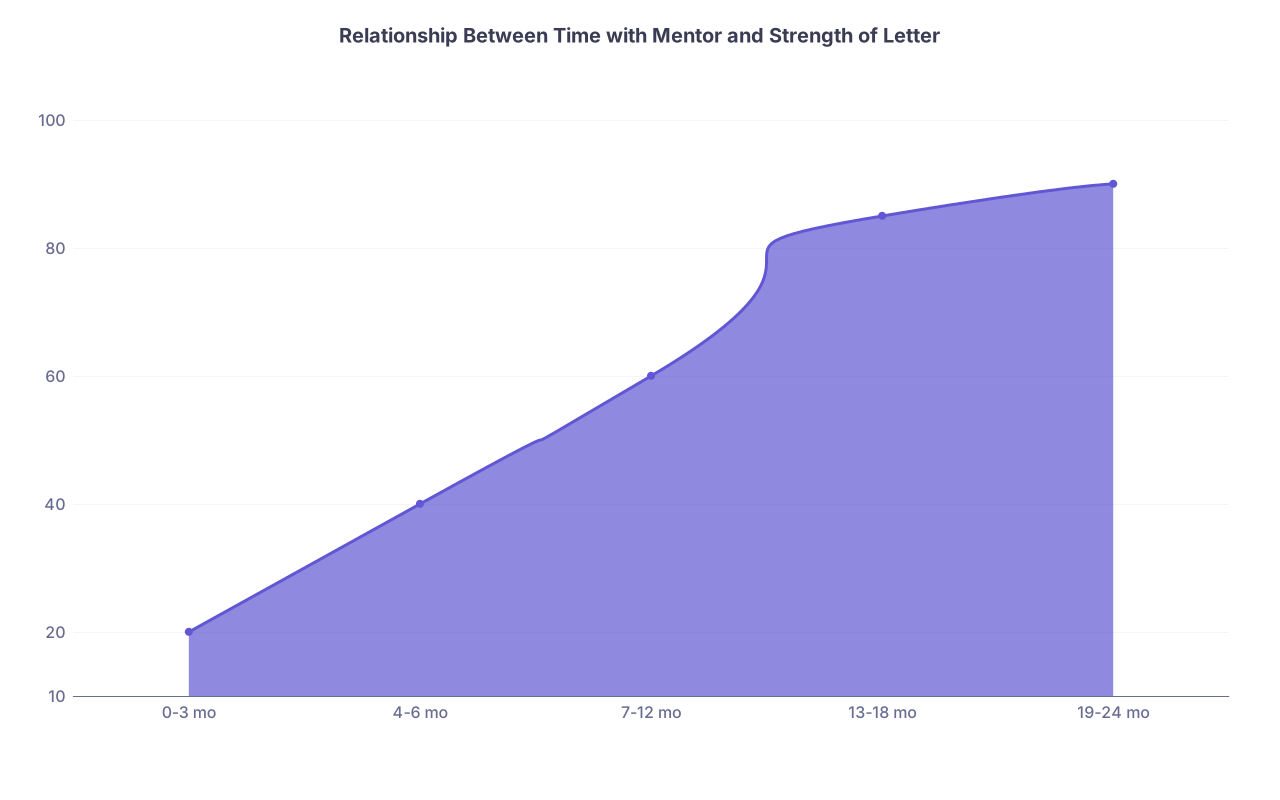
| Category | Value |
|---|---|
| 0-3 mo | 20 |
| 4-6 mo | 40 |
| 7-12 mo | 60 |
| 13-18 mo | 85 |
| 19-24 mo | 90 |
You can get:
- 0–3 months: “They are punctual and enthusiastic.” Translation: I barely know them.
- 4–6 months: “They are reliable and capable of basic tasks.” Still generic.
- 7–12 months: Starting to see judgment, resilience, ability to learn from failure.
- 13–18 months: This is where you get detailed stories. That’s the sweet spot for premeds.
- 19–24+ months: Even better, especially if you’ve advanced roles (training others, co-author on something).
FAQ (Exactly 4 Questions)
1. Do I have to stay in the same lab for multiple years to get a strong research letter?
No, but it helps. What you really need is continuity with one mentor who sees your growth. That can happen across different but related projects or even different institutions (e.g., staying in touch remotely with an old mentor). Bouncing between three labs for one semester each almost never yields a serious letter.
2. What if my project doesn’t lead to a publication before I apply?
You can still get an excellent letter. Committees know timelines are brutal. A strong letter will focus on how you think, how you handle problems, how you work in a team, and your potential as a future physician-scientist. Having a poster or abstract is nice. A first-author paper before med school is a luxury, not a requirement.
3. Is it better to start early in a mediocre lab or later in a fantastic mentoring lab?
I’d pick the better mentor almost every time, even if it means starting a bit later—within reason. A PI who knows you well and cares about your development will write a far stronger letter after 12–18 months than a checked-out PI after 3 years. The ideal is early and good. But if you have to choose, prioritize quality of mentorship.
4. How do I actually phrase the “commitment” conversation with a mentor?
Keep it simple and honest. Around sophomore spring or early junior year, say something like: “I’ve really enjoyed working in your lab and I’d like to stay long term. I’m planning to apply to medical school in [month/year], and my hope is to develop enough here that you’d feel comfortable writing a strong letter for me by then. What would you recommend I focus on to grow into that level of responsibility?” That signals commitment and gives them a chance to guide you.
Key points to leave with:
- If you want a serious research letter for med school, you should lock in your primary mentor about 12–18 months before you submit your application—for most, that’s sophomore year.
- Time alone doesn’t do it; use those months to take on real responsibility, show up consistently, and communicate your goals and timeline clearly.