
Most students choose mentors the way people choose restaurants on DoorDash—whatever looks good in the moment, without checking what actually happens in the kitchen. That is how you end up with weak letters, stalled projects, and two years of work that never sees a publication.
You can avoid that. You can systematically vet mentors in the first 2–4 weeks at a new school or lab and dramatically increase your odds of strong letters of recommendation and tangible outcomes.
Here is how.
Step 1: Get Clear on What You Actually Need From a Mentor
Before judging mentors, you need a rubric. Your rubric. Not some generic “supportive, inspiring, great teacher” nonsense.
If you are premed or early in medical school, your mentor needs to deliver on three very practical outcomes:
A strong, specific letter of recommendation.
Not “hard-working and pleasant.” You want: “top 5% of students I have worked with in 15 years,” plus concrete examples.Tangible output that shows up on your CV.
Abstracts, posters, manuscripts, QI projects, leadership roles. Something you can point to.Credible sponsorship or advocacy.
Someone who will answer emails from programs, call a PD if needed, or introduce you to people in your target field.
To get that, you should evaluate mentors along these dimensions:
- Access and time
- Track record with students
- Writing habits (for letters and papers)
- Integrity and professionalism
- Alignment with your timeline and goals
Write this down. Literally. A one-page checklist. Because otherwise you will default to “this person seems nice” and that is how you get stuck.
Step 2: Do a Fast Background Check Before You Ever Email Them
Most students skip this and go straight to cold-emailing. Mistake. Spend 30–45 minutes researching each potential mentor before you initiate contact.
A. Check Their Publication and Trainee Track Record
Go to PubMed, Google Scholar, or your institution’s faculty page. Look at:
- How many papers in the last 3–5 years?
- First/last author publications?
- Do you see student or trainee co-authors?
- Are those students on multiple papers with them or just one?
| Factor | Good Sign | Red Flag |
|---|---|---|
| Recent publications | 2–5+ / year | 0–1 in last 2 years |
| Student co-authors | Repeated student names | None or only 1, years apart |
| Author position | Last + some first/corresponding | Only middle authors |
Patterns you want to see:
- Same student names appearing over several papers → they invest in mentees.
- A mix of last-author and first-author papers → they lead projects and can put you first on something smaller.
Patterns that should make you cautious:
- No trainees listed. Means they may not involve students or do everything themselves.
- Last paper with a student was 7+ years ago. They may be checked out, too busy, or politically radioactive.
B. Ask Around—Quietly
Your best data will not be on PubMed. It will be in the hallway, Slack channels, and back-corner library tables.
Talk to:
- Senior students in your interest group (IM, surgery, EM, etc.)
- Lab managers and senior techs
- Chief residents or upper-level residents on that service
You do not need a long investigation. Ask 3 very targeted questions:
- “Do they actually get students on papers, or does it tend to drag on?”
- “How are they with letters—detailed and strong, or more generic?”
- “If I am serious about X specialty, would you work with them again?”
You are listening for patterns, not one-off complaints. If three different people say, “Great person, but everything takes years,” believe them.
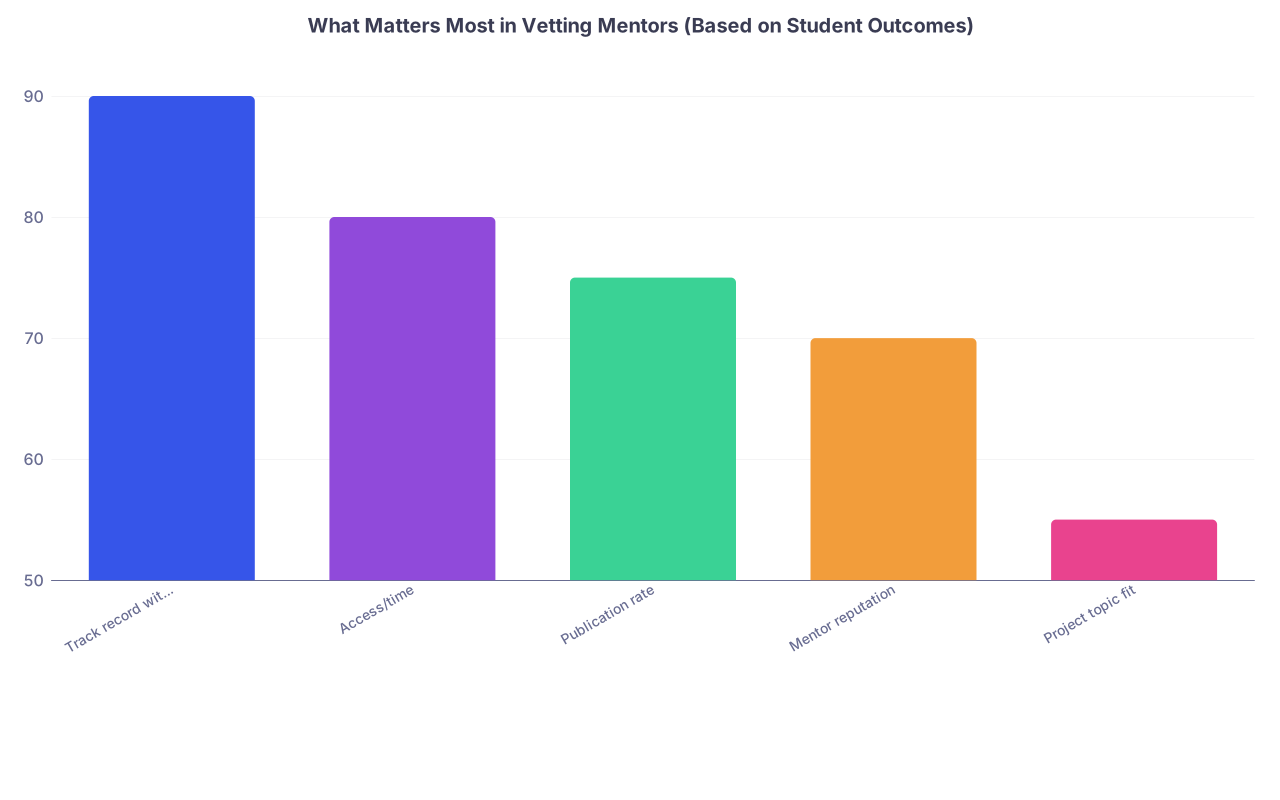
| Category | Value |
|---|---|
| Track record with students | 90 |
| Access/time | 80 |
| Publication rate | 75 |
| Mentor reputation | 70 |
| Project topic fit | 55 |
Step 3: Structure the First Meeting To Test Them (Not Impress Them)
Most students walk into the first mentor meeting trying to “sell themselves.” Wrong objective. Your goal is to assess fit.
A. Go In With a Mini-Agenda
Keep it short but intentional:
- Your background in 2–3 sentences
- Your concrete goals for the next 6–18 months
- Targeted questions about their expectations and style
- A clear ask: “What would be a realistic first project?”
This does two things:
- Signals you are serious and organized.
- Forces them to show you how they think about mentoring.
B. Questions That Reveal Who They Really Are
Here is a script you can adapt. The wording matters.
Ask:
“What types of projects have worked best for students with my schedule?”
→ You want them to translate their workflow into your constraints.“In the past, what have successful students accomplished working with you for about a year?”
→ Forces them to reveal their track record in practical terms: posters, papers, letters.“How do you usually communicate with students—email, scheduled meetings, messaging?”
→ Vagueness here is a red flag.“If a project is going slowly, how do you typically handle that with students?”
→ Are they direct? Avoidant? Do they abandon things easily?“When you write letters for students, what kind of experiences do you feel allow you to write really strong, detailed letters?”
→ You want them to tell you what they need from you for a top-tier letter.
You are not interrogating them. You are auditing the system you may be entering.
Step 4: Use a 30-Day Trial Period—Silently
You do not announce “I am evaluating you as a mentor.” You just treat the first month as a test of responsiveness, clarity, and follow-through.
Here is what you do in those 30 days.
A. Get One Concrete Deliverable Started
Push to define a real, bounded task. Not “shadow the lab” or “read background papers” forever.
Examples of good starter tasks:
- Extract data from a specific number of charts (e.g., 20–30) with a clear deadline.
- Draft a short intro or methods section based on prior similar projects.
- Build a spreadsheet template for a QI project and pilot it on 5–10 patients.
- Create a figure or table from existing data.
If, after two meetings, you still do not have a concrete task with:
- Deadline
- Expected output format
- Who reviews it
…that is an early warning sign.
B. Track Their Responsiveness
You are not a customer, but you are also not a ghost.
For emails like “Here is the draft we discussed” or “I completed the 30 charts,” a functional mentor should:
- Acknowledge within 3–5 business days.
- Give actionable feedback within ~1–2 weeks for small tasks.
If you send two polite follow-ups over 2–3 weeks and get nothing substantial back, you have your answer: this mentor is too busy or too disorganized for you to bet your letters on.

| Step | Description |
|---|---|
| Step 1 | Identify Potential Mentor |
| Step 2 | Background Check |
| Step 3 | First Meeting |
| Step 4 | Define Starter Project |
| Step 5 | Send First Deliverable |
| Step 6 | Continue Working |
| Step 7 | Downgrade to Secondary Mentor |
| Step 8 | Seek Additional Mentor Options |
| Step 9 | Timely, Useful Feedback? |
Step 5: Red Flags and Green Flags You Can See Early
You do not need six months to figure this out. Most of the signal appears in the first 2–4 interactions.
Major Red Flags
If you see more than one of these, treat this mentor as “nice person, not my primary letter writer.”
Chronic unresponsiveness.
Multiple emails, minimal replies, constant delays without explanation.No clear authorship or recognition structure.
Evasive answers to “How is authorship decided?” or “How have previous students been credited?”Triangulation or gossip.
They badmouth other students or faculty to you in the first or second meeting. If they trash-talk them to you, they will trash-talk you to others.Boundary issues.
Late-night texts about non-urgent work, inappropriate personal questions, pushing you to overcommit.“Everything is amazing” with no specifics.
They promise papers, national presentations, leadership titles—quickly—but cannot map out concrete steps.
Strong Green Flags
If you see these, you have someone worth investing in.
They ask about your constraints first.
“What is your schedule like?” “What are your exam dates?” That is a mentor who thinks long-term.They talk about prior mentees by name and outcome.
“Jasmine presented at ATS,” “Sanjay matched derm with this project.” That means they keep track and care.They define scope and expectations clearly.
“You can probably handle 5–7 hours/week; here is what that looks like.”They give you feedback in writing.
Edits on drafts, comments on your data sheet, specific suggestions. Not just “Looks good.”They are honest about risk.
“This project may not publish by the time you apply, but it will give you X and Y for your CV.” That is integrity.
Step 6: Decide: Primary Letter Mentor vs Supporting Mentor
Not every mentor has to be your “primary.” You can have:
- 1–2 primary mentors → likely to write major LORs.
- 2–4 supporting mentors → smaller projects, secondary letters, networking.
After 4–8 weeks, sort them into buckets.
A. Criteria for a Primary Letter Mentor
I would expect most of these to be true:
- You have recurring, scheduled contact (even if monthly).
- They have seen you perform real work: data collection, writing, presenting, teaching.
- They have a history of writing detailed letters for students who contribute at your level.
- They can describe you in specific, comparative language (“top 10%,” “most independent student this year”).
- They are known and respected in the area you care about (specialty, research type, leadership).
If you cannot imagine them convincingly answering “Why should I pick this student over others?”—they are not your primary.
B. Criteria for a Supporting Mentor
Still useful, just different:
- Limited time, but high reputation.
- Good project, but not seeing you often.
- Great person, slightly chaotic workflow.
- You contribute in a narrow way (single figure, brief elective).
These mentors can still:
- Add one more line on your CV.
- Provide a brief, positive letter to round out your application.
- Introduce you to someone who could become a primary mentor.
The mistake is assuming supporting mentors will magically become primary. That usually does not happen without time, output, and proximity.

Step 7: Protect Yourself From Mentor Failure Scenarios
You are not just picking mentors. You are managing risk. There are common failure patterns. You should preempt them.
Scenario 1: The Charismatic But Overcommitted Star
Profile:
- Big name, many grants, constant travel.
- Everyone tells you “work with them, they are huge in the field.”
- First meeting is exciting, but then… nothing moves.
Risk:
- You become the 12th student in a stack of “promising” projects that never finish.
- Letter ends up generic because they never saw you actually do anything.
Mitigation:
- Insist on a specific, small, time-bounded project with a clear #2 person (fellow/postdoc) who actually runs it.
- Treat the famous PI as a senior sponsor, not your direct line manager.
- Get a secondary mentor in the same area who can observe your daily work and write the detailed letter.
Scenario 2: The Kind but Ineffective Junior Faculty
Profile:
- Newly hired, very nice, not much infrastructure.
- Few or no publications as senior author.
- Wants to help students but is still learning the system.
Risk:
- You both learn how research works—slowly.
- Great personal relationship, weak CV outcome by the time you need letters.
Mitigation:
- Pair them with a more established co-mentor for your main project.
- Limit your exposure: 1–2 defined projects instead of “I’ll join everything you do.”
- Understand they might write a beautiful, heartfelt letter—but with limited perceived weight if they are unknown.
Scenario 3: The Disorganized but Brilliant Scientist
Profile:
- Deeply knowledgeable, lots of ideas, messy everything.
- Emails at 1 AM, forgets what they assigned you, constantly pivots projects.
Risk:
- Burnout. Endless revisions. Half-finished work.
- Letter may emphasize “independent, persistent” in a way that screams: “Survived my chaos.”
Mitigation:
- You become the project manager. Summaries after every meeting. Written timelines. Version control.
- Push for projects with shorter cycles (case series, brief reports) rather than giant datasets.
- Decide early: are you willing to manage them, or should they be a side project only?
Step 8: Engineer Letter-Worthy Interactions on Purpose
Even with a solid mentor, you have to give them content for a powerful letter. That does not just happen.
Here is what you need them to witness:
- Your reliability: meeting deadlines, owning errors, improving after feedback.
- Your initiative: proposing ideas, troubleshooting problems independently.
- Your interpersonal skills: working with teams, residents, other students.
- Your communication: written drafts, presentations, emails with collaborators.
To make that visible:
Volunteer for at least one “public” task.
Present a work-in-progress at lab meeting, give a short talk at a student research day, or walk the mentor through your analysis.Summarize your contributions in writing every 3–4 months.
Short email: “Here is what I have completed so far, and here is what I am working on next.”
You are building material they will later recycle into your letter.Ask for feedback explicitly.
“Are there specific skills you think I should work on?” That shows maturity and gives them something to comment on in your letter.
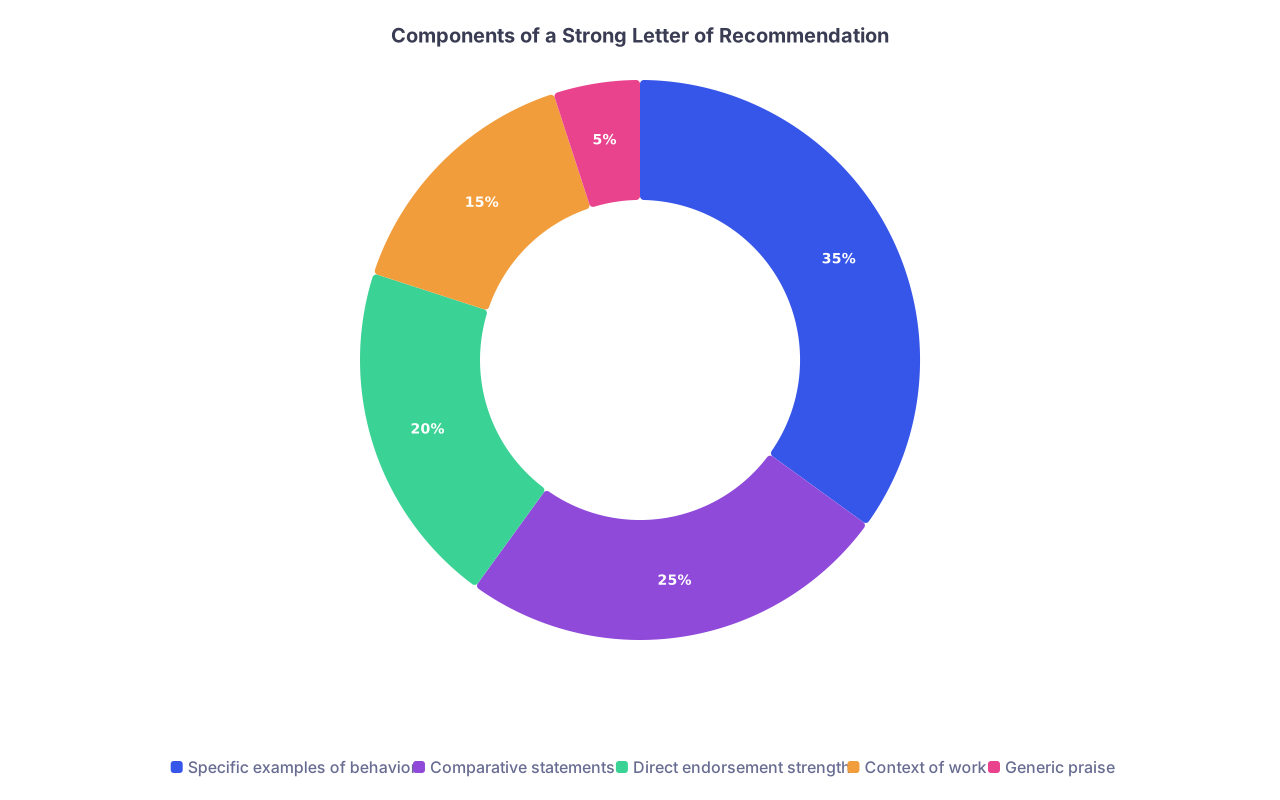
| Category | Value |
|---|---|
| Specific examples of behavior | 35 |
| Comparative statements | 25 |
| Direct endorsement strength | 20 |
| Context of work | 15 |
| Generic praise | 5 |
Step 9: Exit or Reposition Gracefully When a Mentor Is Not Working
You will misjudge someone occasionally. That is fine. The mistake is staying locked in out of guilt.
You do not need drama. You need a clean pivot.
A. Downgrade, Do Not Detonate
If a mentor is decent but not giving you what you need for a primary letter:
- Finish any existing commitments to a minimally acceptable standard.
- Do not volunteer for new long-term projects.
- Shift your time to other mentors while maintaining polite contact.
Language you can use:
- “I have realized I need to consolidate my projects and focus more on X as I approach my application year, so I will have to limit new commitments, but I will of course wrap up Y properly.”
- “I am going to be focusing most of my research time in [other area] for the next year, but I am happy to help close the loop on [current project].”
No accusations. No long explanations. Just boundaries.
B. Hard Exit for Problematic Situations
If there is:
- Repeated disrespect or boundary crossing
- Dishonesty about data or authorship
- Harassment or clear unprofessional behavior
You escalate. Document everything. Save emails. Then:
- Talk to a trusted senior student/resident for advice and names of safe faculty.
- Reach out to an ombudsperson, program director, or dean’s office as needed.
- If you need to leave abruptly, frame it around safety, ethics, or untenable expectations.
You are not obligated to sacrifice your career or wellbeing to keep one mentor happy.
Step 10: Build a Small, Intentional Mentor Portfolio
The endgame is not “find the perfect mentor.” That person usually does not exist. The endgame is a small, robust portfolio.
For a typical premed or med student aiming at a competitive application:
1–2 research/academic mentors
At least one with a clear track record of strong letters and student success.1 clinical mentor
Someone who has seen you consistently with patients and can speak to bedside skills.1 character/longitudinal mentor
Could be volunteering, teaching, or leadership—anyone who has known you >1 year.
You vet each of them using the same principles:
- Track record
- Responsiveness
- Clarity
- Integrity
- Ability to see you in action repeatedly
Done well, you end up with not just letter writers, but advocates.
What You Should Do Today
Do not overcomplicate this. Take 20 minutes and do three things:
List 3–5 potential mentors at your new school or lab.
Names only. Gut instinct is fine.Run a quick background check on each.
PubMed/Google Scholar + one conversation with a senior student or resident.Draft a first-meeting agenda and 3–4 vetting questions.
Save it as a template. Use it with every new mentor you meet this semester.
Then schedule one meeting this week with the most promising candidate on your list. Your letters and your CV will be downstream of that decision. Start vetting like it matters—because it does.