Commuter Students With Limited Campus Time: Maximizing Few Interactions for LORs
How are you supposed to get strong letters of recommendation when you park, go to class, and leave 90 minutes later because you’ve got a job, a long drive, or family responsibilities?
This is the commuter problem. You are not hanging around in labs. You are not in three clubs. You are not “dropping by” professors’ offices just to chat about Plato or protein folding. And yet med schools still expect “meaningful” letters from faculty who know you well.
Let me be blunt: if you treat campus like a drive-through, your letters will be garbage. Not because you’re not smart, but because no one will know you. The good news is you can fix this without living in the library. It just requires you to manage the few in-person touches you do have like they’re gold.
Here is how to do that, step by step, as a commuter with limited campus time.
Step 1: Get Real About Your Constraints (And Stop Imitating Dorm Kids)
First thing: stop comparing yourself to the student who lives two minutes from the science building and spends 12 hours a day on campus.
Your reality:
- You might have only 3–4 contact hours a week with a given professor
- You may have zero evenings on campus
- Office hours can be at terrible times for you
- You might work 20–40 hours, or have caregiving duties, or a brutal commute
So you play a different game.
Your questions should not be:
- “How do I become super involved in everything?”
Your questions should be:
- “Which 2–3 people on this campus can realistically get to know me over a semester or year?”
- “How do I turn 10–15 short interactions into a coherent story in that person’s head?”
If you do that, you can absolutely get strong letters. I’ve seen commuters pull 2 science + 1 non-science letter that were better than anything written for the kid who sat in the front row and never spoke.
But it won’t happen by accident. You need a deliberate interaction strategy.
Step 2: Choose Your “LOR Targets” Early and On Purpose
Most commuters make the same mistake: they get to the end of junior year, realize they need letters, and then panic-email three professors they barely talked to.
Do not do this.
As soon as you know you’re premed (or at the start of any semester where you have time), pick 2–3 courses where you’ll “anchor” yourself for potential letters.
Prioritize:
- Science courses with smaller enrollment (upper-division if you can handle it): e.g., Cell Bio with 40 students beats Gen Chem with 250.
- Professors who actually interact with students: the ones who know names by week 3, walk around during problem-solving, or hold real office hours.
- Instructors who will see you over time: sequences like Organic I & II, Anatomy I & II, or psych professor you can take again for research methods.
Treat these as your “relationship courses.”
If you’re mapping this out:
| Semester | Course | LOR Potential | Plan |
|---|---|---|---|
| Fall 2 | Cell Biology | High | Front row + office hours |
| Spring 2 | Cell Biology Lab | High | Stay after lab weekly |
| Fall 3 | Biochemistry | Medium | Exam reviews |
| Spring 3 | Social Psychology | High | Project + office visit |
You’re not trying to collect 10 maybes. You’re aiming for 3–4 solid options that know you well by the time you apply.
Step 3: Engineer High-Yield Moments In Class
You’re not hanging around campus for hours, so the class period itself has to work harder for you.
This doesn’t mean becoming “that person” who talks nonstop. It means being strategically visible and memorable.
Here’s what that looks like:
Sit in the same seat, near the front or middle
Not to be a teacher’s pet. So your face connects with your name on their roster.Ask 1–2 thoughtful questions per week
Not “will this be on the test?”
Example:- In physiology: “So if someone has long-standing hypertension, would their baroreceptor response adapt, and how does that show up clinically?”
- In psych: “You mentioned confirmation bias. Is that part of why misdiagnoses persist even after new information?”
Answer when they throw questions to the room
They remember the students who help move class along. You don’t need perfect answers, just engaged attempts.Use small “after class” touchpoints
Spend 30–60 seconds at the end of class:- “Professor, I liked your example about heart failure and kidney perfusion. I’m a commuter, work evenings, so office hours are tough, but could I email you a question about the reading later this week?”
- “I’m really interested in how this connects to emergency medicine (or psych, or public health) because of my work/volunteering. Any reading you like on that?”
Notice what you’re doing there: you’re inserting context about being a commuter, plus showing genuine interest, plus creating permission to follow up.
Over a semester, those 30–60 second check-ins add up.
Step 4: Use Office Hours Without Living There
You might only be able to attend office hours 2–4 times all semester. That’s fine—if you use them properly.
Here’s the rule: never show up just to “say hi.” Show up with something real.
Good reasons to go, even briefly:
Before or after an exam:
- Before: “Can I run two practice questions by you and see if my reasoning tracks what you’re looking for?”
- After: “Here’s one question I missed. Can I walk you through how I thought about it and you tell me where I went wrong?”
To connect coursework to your path:
- “I’m a commuter, work as a CNA on weekends. I saw a patient with [X]. Could I ask how that relates to what we covered about [Y]?”
To get feedback on a specific skill:
- “Could I get feedback on my lab report writing? I want to be ready for research opportunities but I don’t have much time on campus.”
If your schedule makes standard office hours impossible, you don’t just shrug and give up. You send a short, respectful email early in the semester.
Example script:
Subject: Brief meeting possible outside office hours?
Dear Professor [Name],
I’m in your [Course, Section, Time]. I’m a commuter student and work [X hours] at [job] to support school, which unfortunately conflicts with your posted office hours.
Would it be possible to schedule a brief 10–15 minute meeting before/after class or at another time once this month? I’d like to introduce myself properly and get your advice on how to do well in the course and connect it to my path in [medicine/healthcare].
I understand if your schedule is tight and really appreciate any time you can offer.
Best,
[Name]
[Course, Section]
Most human professors will find some slot for a student who writes that. Not all, but enough.
Step 5: Make Email Work Like “Extra Office Hours” (Without Being Annoying)
Commuters underuse email, or they use it badly.
Done well, email is how you turn 4 physical interactions into 10 total touchpoints.
Ground rules:
- No rambling walls of text
- One clear purpose per email
- Always connect to coursework or your growth as a student/future physician
- Don’t email weekly. Think 2–4 meaningful emails per semester, per professor.
High-yield uses:
Follow-up on a class/office hours question
“Thank you for your explanation today about [topic]. I found this article about [related thing]—does this reflect what you meant about [concept]?”Progress check-in mid-semester
“I wanted to ask a quick question about how I’m doing in your course and if there’s anything specific I can improve based on [exam/assignment]. Given my commute and work schedule, I try to make the most of my time on campus, so any targeted advice would help.”End-of-semester reflection
This one is big. Two weeks before the class ends:- Thank them briefly
- Mention 1–2 specific things you learned or changed
- Connect it to your path
For example:
Dear Professor [Name],
As we’re wrapping up [Course], I wanted to say I’ve appreciated how you [specific teaching thing]. As a commuter who balances classes with [job/family], I sometimes feel disconnected, but your approach made the material feel very applied.
This course in particular helped me understand [specific concept] which I’ve already seen show up in my [clinical volunteering/job]. It’s reinforced my interest in [field/aspect of medicine].
Thank you again for a great semester.
Best,
[Name]
You’ve just put a storyline in their head. Six months later, when you ask for a letter, that email is sitting in their inbox as a memory anchor.
Step 6: Use Group Work, Labs, and Projects As Visibility Multipliers
You might not be able to hang around after every lab, but labs and group projects are already “built-in” time. Use them.
In lab courses:
- Show up prepared. Nothing makes a TA or professor remember you like “the student who actually read the protocol.”
- Be the person who volunteers to explain your group’s findings briefly to the class.
- After lab, 30 seconds: “I liked how today’s lab showed [concept]. If I wanted to see this in a more advanced setting, is there a related upper-level course or opportunity here?”
For project-based courses:
Send one short email mid-project:
- “Our group is doing [topic]. I’m particularly interested in [subtopic X] because of my work/volunteering with [Y]. Any key papers or angles you recommend we don’t miss?”
At the end, a 60-second chat:
- “I learned a lot from this project about [specific skill—data analysis, teamwork, oral presentation]. I’m hoping to develop these more because I’m planning a career in medicine. Anything you’d suggest focusing on next?”
What you’re doing: showing growth, curiosity, and alignment with your goals. Professors remember that.
Step 7: When And How To Actually Ask For The Letter
If you’ve followed the steps above, by the time you’re ready to apply to medical school, here’s what should be true for at least 2–3 professors:
- They recognize your name and face immediately.
- They know you’re a commuter and working hard outside school.
- They’ve seen you ask thoughtful questions and respond to feedback.
- They’ve had at least one conversation about your interest in medicine.
Now you ask. Not with a mass email. Individually.
Timeline:
- If you’re applying in June, start asking between January and April at the latest.
Message structure:
- Reminder of who you are and when you took their course(s)
- Specific references to your interactions
- Clear statement of your goal (medical school)
- Direct question: can they write a strong letter
- Offer supporting materials and flexible deadline
Example:
Subject: Request for medical school recommendation letter
Dear Professor [Name],
I hope you’re doing well. I was a student in your [Course, Semester] and [Course 2, if applicable]. I’m the commuter student who [brief identifier: often asked about clinical connections / discussed [topic] during office hours / worked on the [X] project].
I’m applying to medical school this upcoming cycle and am hoping to secure 2–3 strong letters from faculty who can speak to my academic abilities, work ethic, and growth. I learned a great deal in your course, particularly about [specific concept/skill], and I felt that our conversations about [topic] reflected who I am as a student and future physician.
Would you feel comfortable writing a strong letter of recommendation for my medical school applications? If so, I can send my CV, a brief summary of my experiences as a commuter premed, a draft of my personal statement, and a reminder of specific assignments from your course that might be helpful.
The earliest deadlines would be around [date], but I’m happy to work with whatever timeline is realistic for you.
Thank you for considering this.
Best regards,
[Name]
[Major, Graduation year]
That word “strong” matters. If they hedge—“I can write you a letter but…”—you thank them and do not use it.
Step 8: If You’ve Already “Wasted” Semesters As A Ghost
Maybe you’re reading this late. You’re a senior commuter, and you never did any of this. You feel invisible.
You’re not doomed. You just need an aggressive but focused plan for your remaining time.
Here’s what I’d do in that situation:
- Identify 1–2 current professors who are at least neutral-positive toward you (you’re doing fine, they’ve seen your name, you’re not a problem).
- For the rest of the term:
- Show up early or stay 1–2 minutes after class once a week.
- Ask one real question about content, exams, or applications.
- Email them once mid-semester with a brief progress update and ask for targeted advice.
- If possible, take a second course with your best “prospect” professor next term.
You can compress a lot of relationship-building into a single semester if you are consistent and visible.
And if you truly have no faculty who know you?
Then you lean harder on:
- Clinical supervisors (for non-science or “additional” letters)
- Research PIs if you can get even short-term work
- Post-bacc or community college professors if you’ll take more science later
But don’t skip the fix: even in your last semester, treat one course like a “relationship course.” It may save you for a future application or post-bacc.
Step 9: Use Your Commuter Reality As Part Of Your Story, Not An Excuse
One of the best letters I’ve seen for a commuter student literally started like this:
“While I don’t see this student on campus outside scheduled class and exam times, I know more about their discipline and time management than I do about students who live on campus.”
Why? Because the student:
- Was upfront early: “I commute an hour each way and work 25 hours a week at a nursing home.”
- Never used that as a reason for poor performance.
- Showed improvement from B-range exam 1 to A on the final.
- Took feedback seriously and made visible changes.
You can absolutely have letters that say, essentially: “This student did more with 6 hours on campus a week than some do with 60.”
But that only works if you’ve actually told your professors your context. Not as a sob story. As factual background.
You might say:
- “If I’m ever emailing instead of attending office hours, it’s because my work schedule overlaps. I still want to engage—you may just see me more in your inbox than in the hallway.”
- “I may not be in clubs because I head home to care for [family member], but I care about this material and my path to medicine just as much as the students who live here.”
You’re seeding the narrative. So when they write, they can contextualize your limited on-campus presence without assuming you’re disengaged.
Step 10: Quick Reality Check – What Strong LORs Actually Need
To keep you focused, here’s what your limited interactions must add up to.
A strong med school letter usually covers:
- Academic ability (how you perform in demanding coursework)
- Work ethic and reliability
- Intellectual curiosity (you ask “why,” not just “what’s on the test”)
- Professionalism and maturity
- Growth over time
As a commuter, you don’t have time to perform some fake “I live in office hours” version of yourself. You need your few touches to clearly show those five things.
If you’re unsure whether you’re on track, ask a professor before you ask for the letter:
“From what you’ve seen so far, do you feel you have a good sense of me as a student—my abilities, work ethic, and engagement?”
Sometimes they’ll say, “Honestly, not yet.” That’s your signal to turn up the engagement for the rest of the term. Not on quantity of time, but on quality of interaction.
A Brief Visual of How Your Touchpoints Add Up
Here’s roughly how a commuter’s “relationship building” can look over one semester with a single professor:
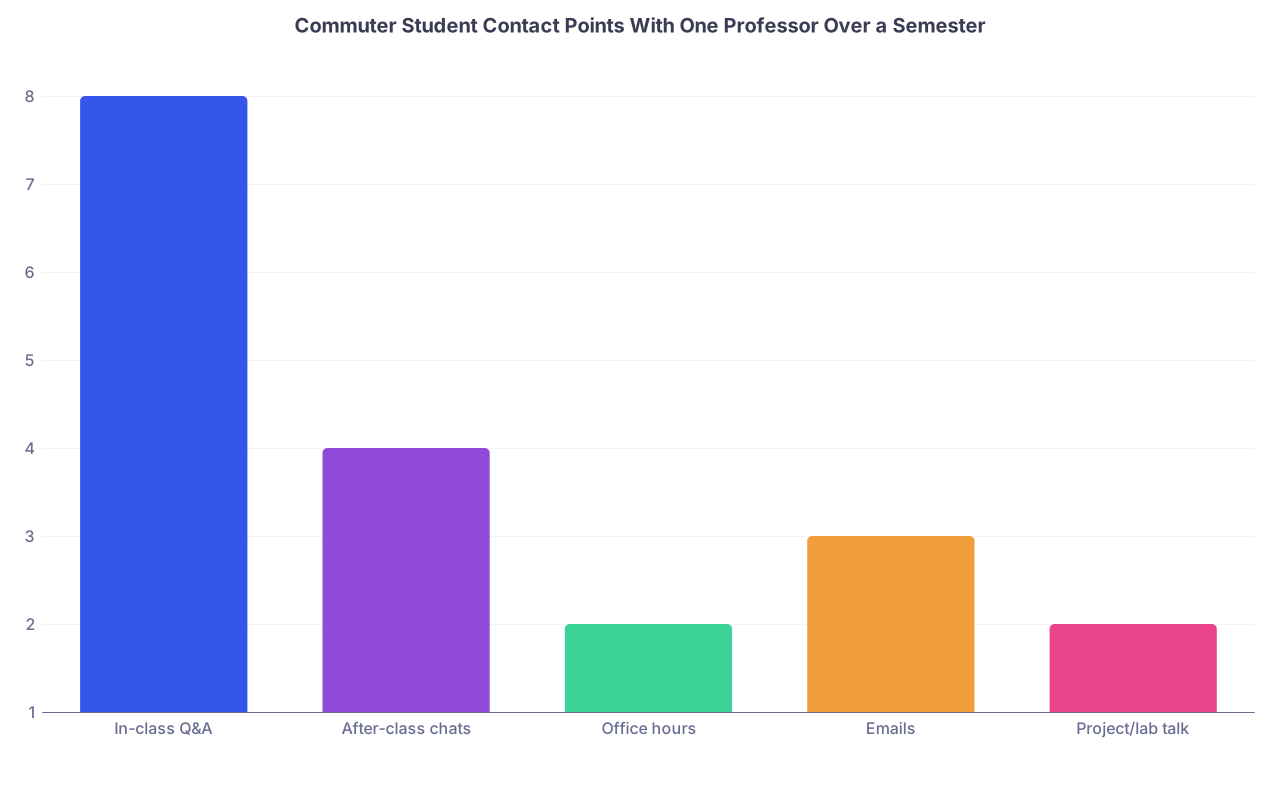
| Category | Value |
|---|---|
| In-class Q&A | 8 |
| After-class chats | 4 |
| Office hours | 2 |
| Emails | 3 |
| Project/lab talk | 2 |
You’re not aiming for 50 interactions. Fifteen to twenty meaningful ones—spread across formats—is plenty to build a real impression.
And if you coordinate this with 2–3 professors over 1–2 years, you have more than enough foundation for strong LORs.
Putting It All Together Without Burning Out
Let me tie this up in a practical, week-in-the-life way.
Say you’re a commuter taking:
- Cell Biology
- Organic Chemistry
- Social Psychology
- Plus you work 25 hours/week and commute 45 minutes each way.
A sustainable, LOR-focused approach:
- Pick Cell Bio + Social Psych as your primary “relationship courses.”
- Commit to:
- Asking/answering 1–2 questions per week in each
- A 30–60 second after-class chat every other week in each
- One office hour visit per month (total, not per class)
- One meaningful email per month per “target professor”
That’s maybe an extra 30–45 minutes of mental energy per week. Not hours of extra campus time. But over a semester, it completely changes how well people know you.
Add one more layer: track it.
Keep a quick log on your phone or in a note:
- 1/23 – Asked Dr. Lee about beta-blockers and exercise intolerance, stayed after class.
- 2/2 – Office hours: went over exam 1, discussed reasoning errors.
- 3/5 – Email: asked for article recs on synaptic plasticity, mentioned CNA job example.
Later, when you ask for the letter, that log becomes the bullet-point recap you send them, jogging their memory and making your letter stronger.
You’re not going to suddenly become the student who lives in the library. You don’t need to. You just need to stop being invisible during the few hours you are on campus.
Choose your professors deliberately. Make class time work harder. Use short, intentional interactions instead of hours of loitering. Turn email into your “extra” office hours. And ask for letters from the people who have actually seen you think, struggle, improve, and persist.
Do that across a year or two, and you’ll walk into your application cycle with real advocates—not just signatures on letterhead.
With those relationships forming, your next move is using those letters strategically in your overall premed story—lining them up with your personal statement, activities, and school list. But that’s another situation for another day.