
Do Top Schools Only Value Academic Mentors? What Acceptance Patterns Actually Show
Why did the kid with the famous PhD PI letter get rejected from three top-10 schools while the EMT with letters from a community doc, a coach, and a non–tenure-track lecturer got into one of them?
Let’s kill the myth up front: No, top medical schools do not “only value” academic mentors. But they also do not treat all non-academic letters as equal. The pattern is a lot more specific than the Reddit folklore suggests.
You’re not competing for “academic vs non-academic letters.”
You’re competing for credibility and signal strength.
And that can come from a Harvard PI, a community internist, or the director of the free clinic on the bad side of town. Or none of them—if they write you a bland, content-free letter.
Where This Myth Comes From (And Why It’s Wrong)
The script you’ve heard:
- “Top schools want letters from big-name researchers.”
- “If your main mentor isn’t at a university, it doesn’t ‘count’.”
- “A community doctor letter is fine for mid-tier, but top-20 schools want academic letters.”
This story survives for one reason: applicants confuse who signs the letter with what the letter actually does.
Here’s what admissions committees are actually doing with your letters: they’re trying to reduce risk. Who looks like a safe bet to thrive in a high-intensity, academic environment without melting down or turning into a problem?
So they’re asking:
- Who has seen you work over time?
- Who can compare you to a serious peer group?
- Who has a track record for accurately judging students?
Academic mentors often check those boxes. But they don’t have a monopoly on them.
I’ve seen applicants with three “perfect” academic letters—tenure-track PI, department chair, honors program director—get passed over because every letter said the same thing: “smart, quiet, did what was asked.” No push, no leadership, no initiative.
The ones who got in? Often had a mix: a solid but not flashy PI letter, plus a community clinic director detailing how they rebuilt a broken workflow, or a long-term employer describing them handling conflict, stress, and responsibility without drama.
The committees notice that.
What The Data and Patterns Actually Show
No, there isn’t a giant public dataset labeled “academic vs non-academic letter yield by school.” But there’s plenty of indirect data and consistent patterns across cycles.
Let’s ground this in reality instead of vibes.
What schools actually ask for
Most top schools spell out their letter expectations pretty clearly. They almost never say “must be from academic researchers.” They say versions of:
- A committee letter OR
- Two science faculty + one non-science faculty
and often add “we welcome additional letters from supervisors, research mentors, or physicians you’ve worked closely with.”
Notice what’s missing? Any requirement that your “primary” mentor be an academic PI.
Here’s how different letter types tend to function once they land on the adcom table:
| Letter Type | What It Usually Signals |
|---|---|
| Science faculty | Can handle rigorous coursework, compares well to peers |
| Non-science faculty | Communication, maturity, engagement in class |
| [Research PI](https://residencyadvisor.com/resources/letters-of-recommendation/myth-any-research-pi-is-an-asset-reality-how-some-letters-hurt-your-file) | Intellectual curiosity, persistence, potential for scholarship |
| Clinical supervisor | Work ethic, patient interaction, professionalism |
| Community/service mentor | Character, reliability, initiative |
Top schools care about all of those domains. They’re not an “academic research only” factory, no matter how much the branding leans that way.
The academic letter advantage — and its limit
Here’s the uncomfortable truth: a strong academic letter can be very powerful at research-heavy schools because it carries predictive value. A PI who has seen dozens of students and says, “She’s in the top 5% I’ve worked with in the last decade” is giving a clear, comparable signal.
But that power comes from comparison and specificity, not from the letters being “academic.”
If your PI barely knows you, never saw you take ownership of anything, and writes:
“She is punctual, intelligent, and completes tasks assigned to her in the lab. I expect she will succeed in medical school.”
That’s almost a net negative at a top school. It reads like they had nothing real to say.
Now compare that to a community physician you’ve worked with 2 years in a busy clinic:
“He handled a full day of shadowing and rooming patients every Saturday after working Friday nights as an EMT. When our MA was out for three weeks, he quietly stepped in, learned the EMR, and kept my clinic flow from collapsing. Families asked for him by name.”
That’s gold. It shows stamina, adaptability, initiative, team functioning. The committee will remember that.
What little data we do have
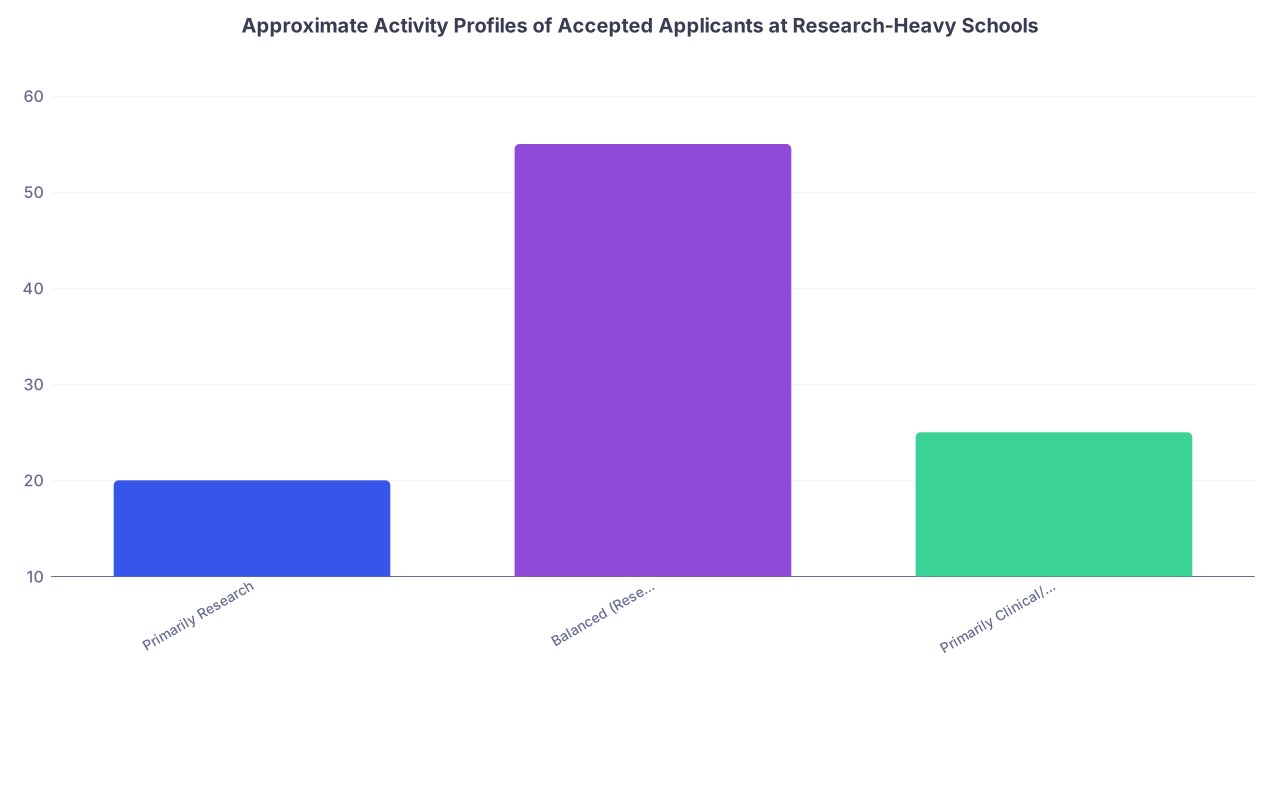
When schools or advisors actually publish breakdowns of accepted students’ activities, a clear pattern shows up: most accepted applicants don’t look like mini-PhDs. They look like people who did a solid mix of academics, clinical work, and service.
| Category | Value |
|---|---|
| Primarily Research | 20 |
| Balanced (Research + Clinical + Service) | 55 |
| Primarily Clinical/Service | 25 |
That 20% “primarily research” group is where the classic “all academic mentors” profile lives. The majority, however, are balanced or clinical/service heavy. Their strongest letters often aren’t from tenure-track faculty. They’re from the people who actually saw them working long-term.
Adcom members talk about this explicitly. A very research-heavy school might say on interview day, “We want people who are scholars, but we’re not building a PhD cohort. We need people who work with patients and teams.” Then they go back to their committee room and give real weight to a clinic director’s letter that proves those traits.
What Makes a Letter Powerful (Academic or Not)
Focus less on job title. Focus more on what the writer can legitimately and concretely say about you.
The best letters, academic or non-academic, share the same elements:
- Longitudinal exposure: They’ve known you for months to years, not a 4-week summer experience.
- Meaningful responsibility: You weren’t just sitting in the back of the lab meeting or shadowing silently.
- Clear comparisons: “Top 5% of students I’ve mentored in 10 years,” “best MA-level helper I’ve had in clinic,” “stood out among 30 volunteers.”
- Concrete stories: Not adjectives. Stories that show behavior under stress, change over time, initiative.
A weak letter is weak in the same way whether it’s from a Nobel laureate or a community dentist:
- Vague praise, no specifics
- No comparison to others
- No clear sense of what you actually did
- Sounds like they read your CV instead of working with you
Admissions committees don’t sit around saying, “This letter is blah, but at least the writer has an endowed chair.”
They say, “This writer clearly barely knows the applicant. Next.”
How Different Mentor Types Actually Play at Top Schools
Let’s walk through the specific players and how they’re really read.
1. Big-name academic PI
Upside:
If they actually know you and you carried a project, this can be devastatingly strong. Especially if they’re blunt and say, “I have no hesitation placing her in the top 1–2 of all undergrads I’ve mentored.”
Downside:
This is also where some of the worst letters come from. Busy PIs who barely know you, who write generic templates, or who only interacted through a postdoc. The title raises expectations. If the content is thin, it hurts.
2. Mid-level academic (lecturer, assistant professor, non–tenure track)
These are underrated. They often know their students better than the big names do. They see your work every week, track your growth, and can compare you against hundreds of students over several years.
A well-written letter from a no-status-but-engaged instructor is far more powerful than a famous PI who barely remembers you.
3. Community physician or clinical supervisor
This is where the myth really fails.
At top schools, these letters often carry heavy weight if the writer:
- Has supervised a lot of trainees (MAs, scribes, students)
- Clearly understands what “above average” means
- Describes your performance in specific clinical contexts
The adcom doesn’t care that the physician isn’t faculty. They care that this person has watched you deal with patients, systems, and stress for a year and is willing to stake their professional reputation on you.
4. Non-clinical employer / coach / service director
People love to dismiss these. That’s a mistake.
For borderline or “spiky” academic profiles, a letter from a long-term job or service role can be what flips a file from “risky” to “this person will grind and show up.”
I’ve seen this: candidate with a 3.4 upward trend, modest MCAT, no famous mentors, but a letter from a food bank director explaining how they redesigned the entire volunteer scheduling system and trained 40+ new volunteers. That’s maturity. That’s leadership. Top schools actually need those people.
Are these letters enough by themselves without any academic validation? Usually no. But in combination, they can change how your whole file reads.
Putting It Together: What Your Letter Mix Should Actually Look Like
You don’t need to “collect academic names.” You need to cover key domains with people who can actually vouch for you.
Think in buckets, not titles:
- Can someone credible speak to your ability in rigorous science coursework?
- Can someone credible speak to your behavior and growth in a research or scholarly setting? (This doesn’t have to be bench research.)
- Can someone credible speak to your clinical behavior—reliability, communication, professionalism with patients and staff?
- Can someone credible speak to your character over time—how you handle setbacks, conflict, responsibility?
Those might be the same person in multiple domains. Or four different people.
The right mix often looks something like this for top schools:
| Role | Domain Covered |
|---|---|
| Science faculty | Academic rigor, comparison |
| Research mentor (any level) | Inquiry, persistence, growth |
| Clinical supervisor | Professionalism, patient care |
| Long-term service/employer | Character, reliability |
Notice there’s nothing in there about “must hold a university title” or “must be at an R1 institution.”
How to Choose When You Have Both Academic and Non-Academic Options
If you’re stuck choosing between, say, a fancy PI and a community doc, don’t ask, “Who is more academic?”
Ask three brutal questions:
- Who has seen me struggle and improve, not just perform comfortably?
- Who could plausibly rank me among dozens of students or staff they’ve worked with?
- Who would be genuinely annoyed if I failed because they feel personally invested in me winning?
That last one matters more than people admit. Letters written out of real investment are different. They’re more specific, more forceful, more believable.
If the big-name academic fails those tests and the community mentor passes them, you choose the community mentor and don’t look back. Then you make sure your other letters cover the academic box.
To plan this, it helps to map out who covers what and where your gaps are.

| Step | Description |
|---|---|
| Step 1 | List Potential Letter Writers |
| Step 2 | Academic Rigor |
| Step 3 | Research/Inquiry |
| Step 4 | Clinical Behavior |
| Step 5 | Character/Service |
| Step 6 | Select 1-2 strongest |
| Step 7 | What can each speak to? |
You’re building a portfolio of signals, not assembling a hierarchy of titles.
A Quick Word About Institutional Culture
There are a few ultra research-obsessed programs where not having any research letter at all is a handicap. That’s not because they “only value academic mentors.” It’s because they actually expect you to have acted like a junior scholar.
But even at those places, the conversation in committee is not “academic letter good, non-academic letter bad.” It’s:
- “This person has no one saying they’ve handled long-term work with patients or service. That’s a risk.”
- Or: “This person has no one saying they can handle advanced science.”
The risk they fear often isn’t where applicants think it is.
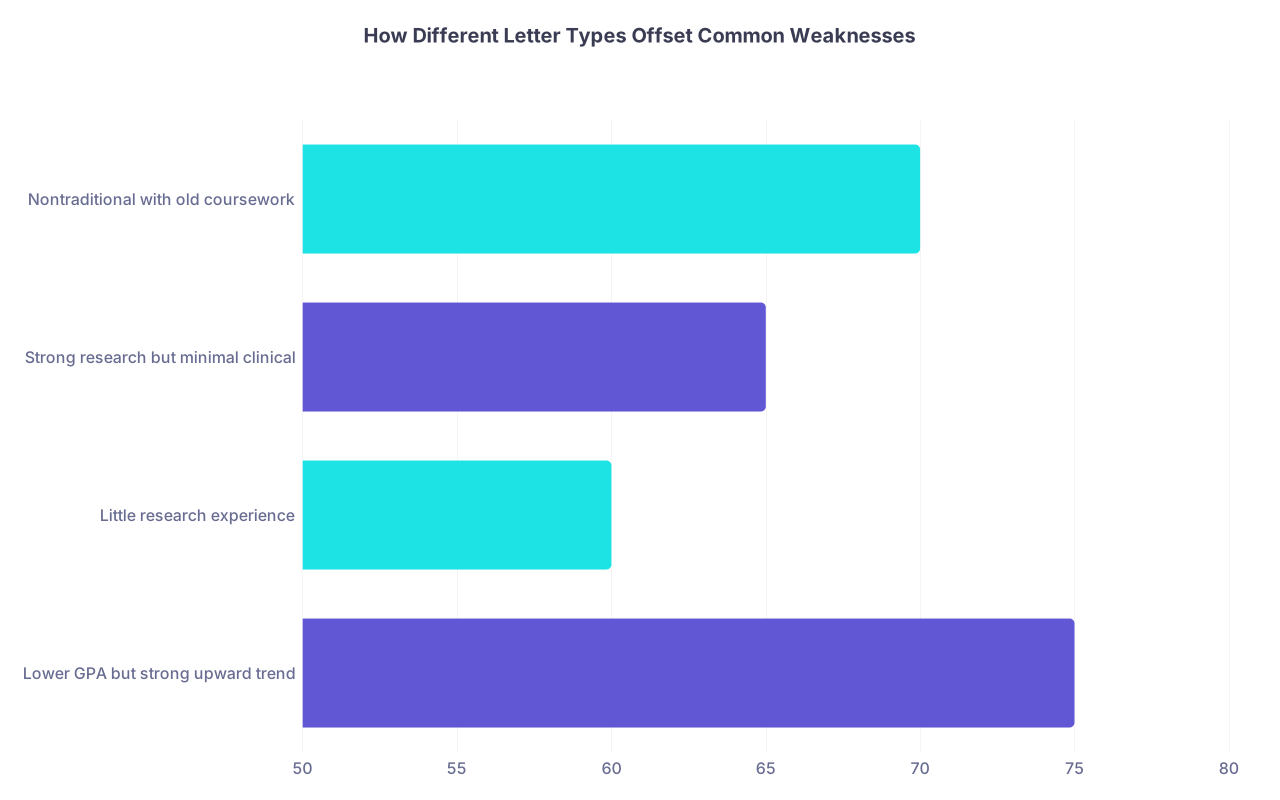
To see how different letters can balance weaknesses, think about a typical file:
| Category | Value |
|---|---|
| Lower GPA but strong upward trend | 75 |
| Little research experience | 60 |
| Strong research but minimal clinical | 65 |
| Nontraditional with old coursework | 70 |
That “value” here is conceptual: how often a truly strong letter from that domain can partially offset that weakness. For example, a brutally honest science faculty letter saying you’ve completely changed how you work over the last two years does a lot more for that 3.2→3.6 trend than one more generic lab PI letter.
So, Do Top Schools Only Value Academic Mentors?
No. They value people who can accurately predict your future behavior in a demanding medical and academic environment. Academic mentors sometimes do that well. So do community physicians, service directors, and long-term employers.
The mistake is chasing titles instead of substance.
If you remember nothing else, keep these three points:
- A specific, comparative, story-filled letter from a non-academic mentor beats a vague, name-brand academic letter every single time.
- Top schools care about domain coverage—academic rigor, inquiry, clinical behavior, and character—not about whether all your letters come from people with university titles.
- Choose writers who know you deeply, have seen you over time, and would actually fight for you on paper. That’s the “top school” move, not collecting prestigious signatures.