
The obsession with department chair letters is misplaced—and often harmful. A strong, specific letter from a junior faculty member who actually knows you will beat a generic chair letter 9 times out of 10.
Let me be blunt: programs are drowning in bland, copy‑pasted, “it is my pleasure to recommend this outstanding student” letters from big‑name people who barely remember the applicant’s face. Everyone thinks the title sells. It does not—at least not by itself.
If you’re premed or early in med school and you’re scheming how to “get in front of the chair” just to secure a letter, you’re playing the wrong game.
Let’s dismantle this myth properly.
What Program Directors Actually Say (Not What Students Think)
Students talk about chair letters like they’re golden tickets. “I have a letter from the Chair of Surgery.” You can almost hear the imaginary trumpets.
Program directors? Very different tone.
Surveys of program directors across specialties tell the same story: the most valued letters are:
- Detailed
- Comparative
- Concrete
- Written by someone who has directly supervised the applicant
Not “written by the highest-ranking person in the department.”
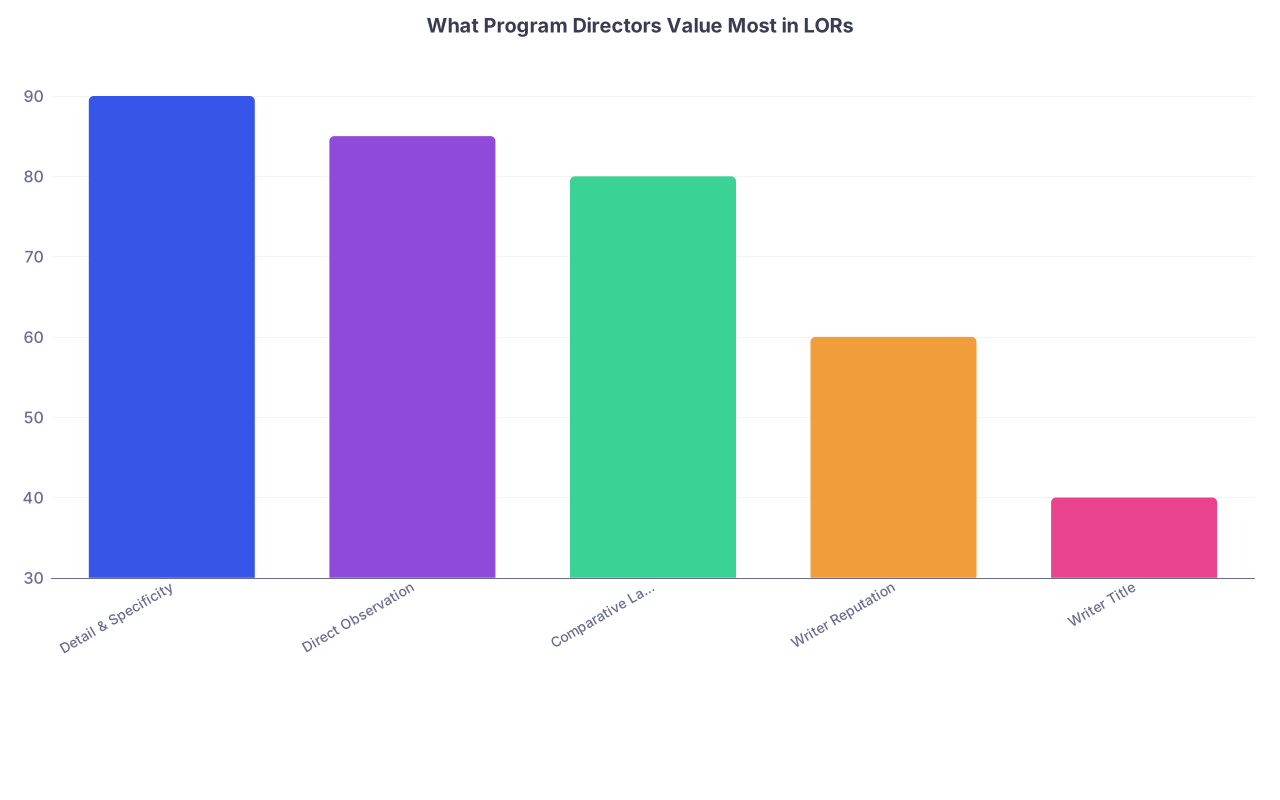
| Category | Value |
|---|---|
| Detail & Specificity | 90 |
| Direct Observation | 85 |
| Comparative Language | 80 |
| Writer Reputation | 60 |
| Writer Title | 40 |
These numbers are representative, not from a single dataset—but they reflect what you’ll see across NRMP, AAMC, and specialty-specific surveys:
Detail crushes title. Every time.
A few patterns I’ve seen sitting in rooms with faculty screening applications:
People visibly perk up when a letter opens with something like:
“I supervised Alex directly for 8 weeks on our inpatient cardiology service and observed her in high-acuity patient care, family meetings, and interdisciplinary rounds.”Eyes glaze over at:
“As Chair of the Department of Medicine, I am pleased to recommend…”
because everyone knows what’s coming: vague adjectives, zero specifics.
The dirty secret: many chairs crank out dozens of letters a year based on a file and a 15‑minute meeting. Sometimes not even that. They’re doing you a favor, but not necessarily doing you good.
A junior faculty who’s worked directly with you for weeks or months can talk about what you actually did. Which is what matters.
The Power of Proximity: Who Actually Saw You Work?
Most students ask the wrong first question: “Who is the most important person I can get a letter from?”
The better question: “Who has the deepest, most direct experience with my work, my growth, and my reliability?”
That is usually:
- An attending who worked with you closely on a rotation
- A junior faculty PI you did real work with
- A hospitalist who saw you grind through nights and still show up sharp
Not the person whose office you sat in once for 20 minutes while they skimmed your CV.
Let me sketch two real‑world style letters. I’ve seen versions of both.
Chair letter (weak, very common):
“I am pleased to recommend John Smith for residency in internal medicine. He is an excellent student who has performed well in his clinical rotations and has demonstrated strong professionalism and communication skills. Faculty have consistently praised his work ethic. I am confident he will be an asset to your program.”
What did you learn? Nothing. You could swap the name and send it for 200 students.
Junior faculty letter (strong, typical of good junior attendings):
“I worked with John for four weeks on our MICU service, where I directly supervised his patient presentations, procedures, and interactions with families. On his second day, we admitted a decompensated cirrhotic patient in multi-organ failure. John stayed three hours past the end of his shift to help stabilize the patient, anticipate lab follow‑up, and call the family with a clear and compassionate update.
Compared with other MS3s I’ve supervised (~60 over the past three years), John is in the top 5% for clinical reasoning and the top 10% for work ethic. When I moved him from presenting one patient to four, he adjusted within 24 hours and maintained accurate, concise presentations with thoughtful assessment plans.”
Title loses. Proximity and specifics win.
Why Junior Faculty Often Write Better Letters
Junior faculty have three structural advantages that students consistently underestimate.
1. They actually remember you
Chairs divide their time between:
- Administration
- Politics
- Budget
- Faculty issues
- Meetings about meetings about meetings
They often barely work clinically with students. Occasionally you’ll find a unicorn chair who still teaches on the wards every week and legitimately knows you. Great. Use that person—if they truly know you.
Junior faculty?
They’re in the trenches. On the wards. In the OR. In clinic. They’re the ones staying late with you to redo your note, walking you through how not to sound lost on rounds, or editing your abstract at 11:30 p.m.
Memory = detail. Detail = credibility.
2. They’re still building their own reputations
A surprising upside: junior faculty are frequently more invested in writing a good letter because it reflects on them too.
I’ve seen newer faculty say things like:
- “If I’m putting my name on this, I want it to be accurate.”
- “I’m not going to call someone top 5% unless I’d actually fight for them.”
That caution produces less fluff and more calibration. Program directors learn quickly: “When Dr. X says top 10%, it means something,” even if Dr. X is an assistant professor, not a chair.
Chairs, protected by their position and sheer letter volume, sometimes fall into “everyone’s amazing” mode. Which makes their letters meaningless.
3. They can describe actual behaviors, not generic virtues
Strong letters are behavior-heavy. Weak letters are adjective-heavy.
Junior faculty who supervised you can say:
- “She independently called the consultant and adjusted the plan appropriately without prompting.”
- “He came in on his day off to see a patient he’d followed through a long ICU stay.”
- “She accepted critical feedback about her notes and within two days they were shorter, sharper, and more accurate than many interns’.”
Those lines tell selection committees exactly what they want to know: How will this person behave at 2 a.m. with three admissions and a crashing patient?
A chair who never saw you on the wards cannot honestly write those specifics. So they default to safe, fluffy language.
When a Chair Letter Actually Helps—and When It Hurts You
Let’s be fair. The myth did not appear from nowhere. There are situations where a chair letter has real value.
The problem is students extrapolate those limited situations into a universal rule.
When a chair letter is genuinely useful
Specialty-required “chair” or “departmental” letter
Some residency programs or specialties (like certain surgical fields) explicitly require a departmental letter or a “chair’s letter.” In that case, you need it. But even those are usually summaries compiled from other faculty evaluations, not personal endorsements based on close contact.
You’ve worked closely with the chair, and they know you well
Rare but it happens. Maybe you did 2 years of research in their lab or consistently rounded with them. If they can write you the kind of specific, behavior‑rich letter I described above, then you hit the jackpot: proximity + title.
The chair is a known straight‑shooter with calibrated letters
Some chairs have reputations among PDs for being honest and stingy with praise. When they say “outstanding,” it means something. This is less about rank and more about the writer’s personal reputation as a reliable signal.
When chair letters are neutral or actively harmful
They barely know you and write a generic letter
This is the most common scenario. It doesn’t “kill” your application, but it wastes a slot that could have been filled by someone who actually knows your work.
The letter is obviously templated
PDs notice identical paragraphs across multiple applicants from the same school. Yes, really. Once they see that, your “special” endorsement becomes background noise.
The chair sounds lukewarm because they’re hedging
Some chairs are cautious about overpraising. So the letter ends up with phrases like “adequate,” “solid,” or “will do well with appropriate supervision.” That’s code. And not the good kind.
In other words: title amplifies what’s already in the letter. It does not replace substance. A strong, detailed letter from a chair is great. A bland one is not “saved” by the title.
Evidence from Application Outcomes: What Actually Moves the Needle
Direct, controlled studies saying “junior faculty letter vs chair letter outcome” are rare, because life is messy. But we do have patterns.
From big surveys of program directors (NRMP PD surveys, specialty‑specific data) and what I’ve seen sitting on selection committees, you see consistent themes:
| Letter Feature | Impact on Applicant | Notes |
|---|---|---|
| Specific behavioral examples | Very High | Strong predictor of interview offers |
| Clear comparative ranking | Very High | “Top 5%” beats “excellent” |
| Direct observation | High | Rotations, research, close work |
| Writer’s known reliability | Moderate-High | Reputation built over years |
| Writer’s academic title | Low-Moderate | Only helps when other boxes checked |
Notice what’s not on top: title.
Then there’s the informal but very real test we used reading letters:
- If the writer mentions 2–3 specific situations with the applicant, we lean in.
- If the letter could apply to any competent student, we move on.
Who’s more likely to pass that test? The junior faculty who saw you struggle through a steep learning curve, adjust, and then excel.
How Premeds and Early Med Students Misplay the Letter Game
If you’re premed or in preclinical years, this is where you’re likely screwing yourself without realizing it.
Mistake 1: Chasing status instead of substance
I’ve watched students bend themselves into knots to “network” with the chair, the program director, the division chief—anyone with a big title—while half-ignoring the young attending who’s actually supervising them day to day.
Bad trade.
The faculty watching you show up early, stay late, own your patients, and handle feedback are the ones whose letters will sound real.
Stop trying to get “seen” by the chair for 15 minutes. Get seen by your primary supervisor for 4 weeks.
Mistake 2: Treating letters as last‑minute transactions
The worst timing pattern is this:
Student works with a junior attending for weeks. Gets great informal feedback. Then decides: “I should ask the chair instead because that will look better.”
So they corner a high‑ranking person who’s met them once or twice and ask for a letter with a 2–3 week deadline. The chair prints the CV, glances at the transcript, and dictates a generic page of boilerplate.
You just downgraded your application.
Mistake 3: Underestimating the credibility of assistant professors
I’ve heard students say, dead serious: “But she’s just an assistant professor.”
Program directors aren’t stupid. They know who actually runs the teams. They know which assistant professors are workhorses on the wards and whose opinions you can trust.
Frankly, a detailed, calibrated letter from a clinically respected assistant prof is more useful than a vague letter from a politically powerful chair.
How to Choose (and Cultivate) the Right Letter Writers
So what should you actually do, starting now?
First, pick writers based on:
- Who has directly supervised you for a meaningful period (≥4 weeks is good, more is better).
- Who has seen you in high‑stakes or challenging situations: sick patients, time pressure, hard feedback.
- Who is detail‑oriented and takes teaching seriously. These people write better letters almost by personality.
Second, give those people something to write about. That means:
- Take feedback seriously and act on it fast; then they can say “improved rapidly after feedback.”
- Volunteer for the unsexy work—writing notes, following up results, calling families. That’s gold in a letter.
- Let them see your thinking. Don’t hide and just “do tasks.” Talk through your reasoning. That’s what PDs care about.
Third, if you’re in a setting where a chair or departmental letter is required, think of it as an aggregate letter, not your primary selling point. Feed that letter via:
- Strong evaluations from junior faculty and attendings
- Concrete narratives that can be pulled into the summary
You don’t win by impressing the chair for 10 minutes. You win by accumulating months of good work that multiple people could honestly vouch for.
A Simple Flow for Deciding Chair vs Junior Faculty
Here’s how I’d think about it, if you like flows more than theory.

| Step | Description |
|---|---|
| Step 1 | Need Letter |
| Step 2 | Get Required Chair/Dept Letter |
| Step 3 | Great - Strong Chair Letter |
| Step 4 | Accept Its a Summary Letter |
| Step 5 | Junior Faculty/Attending Who Supervised You |
| Step 6 | Ask Them First for a Detailed Letter |
| Step 7 | Is a Chair/Dept Letter Required? |
| Step 8 | Did Chair Work Closely With You? |
| Step 9 | Who Knows Your Work Best? |
The key branch is simple: “Who knows your work best?” That’s your priority writer. Not the person whose office has the nicest furniture.
The Counterintuitive Truth
The myth says: “You need the most powerful person possible vouching for you.”
The reality: You need the most credible, specific, and honest person vouching for you.
Often, that’s a junior faculty member who:
- Watched you on call at 1 a.m.
- Read your notes and fixed them with you
- Saw you faceplant on Day 1, recover on Day 3, and excel by Week 3
That person can write: “I have no hesitation ranking this student among the very best I’ve worked with, and I would be thrilled to have them as a resident.” And mean it.
That line, from an assistant professor who clearly knows you, is more powerful than three paragraphs of generic praise from someone whose main qualification is a big title.
The Bottom Line
Three takeaways and you’re done:
- Title is a weak signal; specific, behavior‑rich, comparative letters from people who actually supervised you matter far more than “Chair” on the signature line.
- Junior faculty are often in the best position to write strong, credible letters because they remember you, saw you work, and care about their own reputation for honesty.
- Stop chasing chair letters as trophies. Invest your time in doing real work with people who can describe what you actually did—and let the hierarchy take care of itself.