
The obsession with a single “person who knows you best” writer is massively overhyped—and the data backs that up.
Committees are not sitting around asking, “Who knows this applicant’s soul the deepest?” They’re asking: “Can this person function in medical training, with real patients, under real pressure—and do multiple credible adults agree on that?”
Let’s dismantle the myth and look at what actually moves the needle.
What Committees Really Use Letters For
Most premeds think letters of recommendation (LORs) are about emotional depth. “My PI really knows me” or “This doctor has seen my whole journey.”
That’s not what selection committees are doing.
When I look at how med schools and preclinical committees talk about letters internally, they use them for four blunt purposes:
- Screening for red flags
- Verifying traits that are hard to quantify (professionalism, teamwork, reliability, integrity)
- Corroborating the story your application already tells
- Differentiating at the margins when everyone has similar stats
None of those require one person who knows everything about you. They require:
- Specific examples
- Clear comparisons to peers
- A sense that multiple independent observers see the same strengths
One deeply personal, glowing letter plus two weak, generic ones? That reads as: “One person loves this applicant; others are unconvinced or don’t know them well.” Not the signal you want.
The Myth: “One Deep Relationship Beats Multiple Moderate Ones”
You’ve heard this speech: “Don’t chase several surface-level letters. Focus on one or two people who know you very well. Quality over quantity.”
Half true. The “quality” part is right. The rest is sloppy advice.
Here’s what actually matters based on what we see in admissions reports, program guidance, and the growing (but imperfect) research literature on selection tools:
- Letters are moderately predictive of later professionalism issues and performance, when they’re behavior-focused and comparative
- Letters are weakly predictive when they’re generic (“hard-working, nice student”)
- Having more independent sources saying the same thing about you improves reliability of those inferences
In selection science, this is basic: multiple raters beat one rater, as long as each rating is at least somewhat informed. A single “knows me best” rater is vulnerable to bias, halo effect, and pure randomness.
You are not applying to be that one professor’s grad student. You are applying to train in a high-risk, team-based profession. Committees want to see that you behave consistently across settings and supervisors.
What the Evidence and Practice Actually Say About LOR Mix
Let’s anchor this to how schools actually structure requirements.
| School Type/Example | Stated LOR Preference |
|---|---|
| Harvard/Top-tier private | 2 science faculty, [1 non-science](https://residencyadvisor.com/resources/letters-of-recommendation/are-nonscience-mentors-worth-it-for-med-school-the-data-and-nuance), committee letter if available |
| Large public (e.g., UC system) | Mix of academic and non-academic; strongly prefer multiple instructors |
| Community-focused schools | Emphasize clinical/community supervisor letters |
| DO schools (many) | Strongly prefer at least [1 physician (often DO) letter](https://residencyadvisor.com/resources/letters-of-recommendation/do-you-need-a-physician-letter-for-every-application-sorting-fact-from-fear) |
| BS/MD or early assurance | Often rigid: specific science + counselor/committee letter |
Notice the pattern: they almost never say “Find the one person who knows you best.” They say, in effect: “We want multiple vantage points.”
The “best” LOR mix for most premeds is not:
- 1 insanely detailed PI letter
- 2 obligatory, flat course letters from people who barely remember you
Better is:
- Several letters from people who each know a chunk of you well
- Collectively painting a coherent picture of your academic strength, character, and readiness
What committees repeatedly emphasize
From internal rubrics and published guidelines, strong letter sets tend to have:
- At least 2 writers who directly taught or supervised your academic work
- At least 1 writer who saw you in a clinical or community context with patients or vulnerable populations
- Clear, behavior-based examples of how you deal with stress, conflict, feedback, and responsibility
- Some converging themes: multiple people independently say “reliable, mature, takes initiative”
That doesn’t require one omniscient recommender. It requires thoughtful coverage.
The Real Question: Depth vs Breadth vs Redundancy
The smarter question is not “one vs many who know me best.” It’s:
“How do I balance depth (detail) with breadth (multiple contexts) without diluting quality?”
Here’s the rough hierarchy committees actually respond to.
1. Specific, example-rich letters beat “knows me deeply” claims
“I know this student well” is meaningless if it isn’t backed up.
“I supervised Alex for 18 months in a neuroscience lab, and I watched them calmly manage a data collection crisis when our main equipment failed one week before a deadline” is gold.
A deeply personal but vague letter—“I’ve watched their growth, I know their character, they’re special”—reads sentimental, not rigorous.
2. Independent convergence is powerful
When 3–4 people, who don’t work together, describe you in similar terms—“unusually responsible, self-directed, mature”—that’s strong evidence you’re actually like that.
When:
- Your PI says: brilliant and driven
- Your volunteer coordinator says: often late and sometimes unreliable
- Your professor says: quiet, hard to gauge
That tells a different story. And no, your “closest” recommender does not override the others.
3. One super-strong letter cannot compensate for two obviously weak ones
I’ve seen applicants cling to: “But my PI LOVES me.” Great. That buys you something. But if the other two letters are:
- 8-sentence, generic “A- student, attended class, polite” letters
- Or lukewarm, code-phrased concerns (“with appropriate supervision, the student can contribute meaningfully”)
Programs interpret the set, not just the best one. They ask: “If this student is so strong, why didn’t other supervisors write like this?”
When One “Knows-Me-Best” Letter Does Matter
There is a legitimate role for that one heavyweight letter. Just not the way Instagram premed influencers sell it.
A single deep letter is most valuable when:
- You’ve worked with that person for a long time (≥1 year of consistent contact)
- They’ve seen you in multiple roles (student → RA → teaching assistant; volunteer → project lead, etc.)
- They can comment on trajectory—how you grew when given feedback, responsibility, stress
That type of letter can:
- Explain context behind a rough semester or pivot in your path
- Make a persuasive case for resilience and growth, not just static traits
- Anchor your whole file with a longitudinal perspective
But you still need other people to confirm the picture.
Think of it this way: one longitudinal “knows me best” letter is a spine. The rest of your letters are ribs. Without the ribs, the spine is just hanging there in space.
How Admissions Rubrics Actually Score Letters
Committees are not reading your letters the way you imagine.
Most systems use some version of structured scoring—numeric or categorical—based on:
- Strength of endorsement
- Specificity of examples
- Comparison to peers (“top 5%,” “average,” “below average”)
- Professionalism/ethics flags
- Academic/clinical readiness
And they’re looking across all letters to answer:
- Are there concerns?
- Is there evidence of exceptional strength?
- Is there consistent alignment with the rest of the file?
Let me show you how different LOR mixes typically play out under that lens.
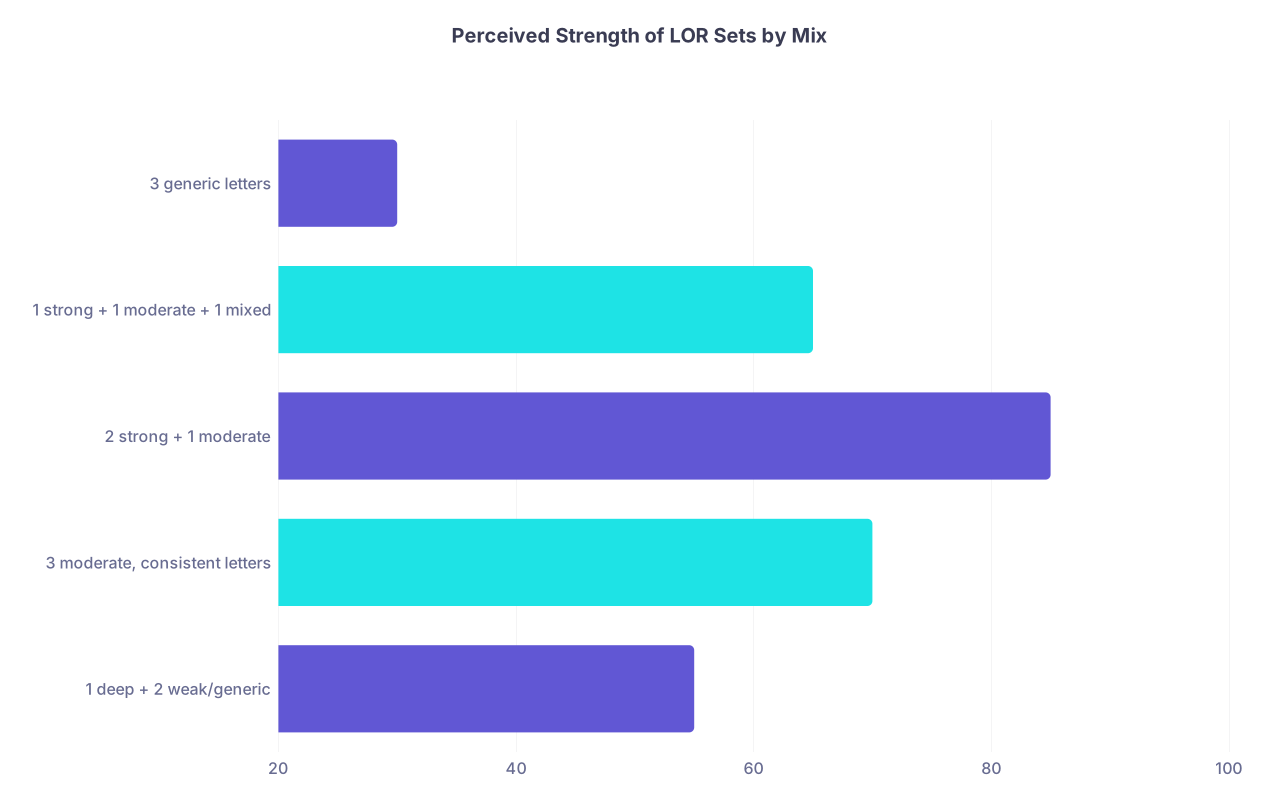
| Category | Value |
|---|---|
| 1 deep + 2 weak/generic | 55 |
| 3 moderate, consistent letters | 70 |
| 2 strong + 1 moderate | 85 |
| 1 strong + 1 moderate + 1 mixed | 65 |
| 3 generic letters | 30 |
Rough interpretation (out of 100 perceived strength):
- 1 deep + 2 weak/generic: ~55 → decent but raises questions
- 3 moderate, consistent: ~70 → solidly reassuring
- 2 strong + 1 moderate: ~85 → standout territory
- 1 strong + 1 moderate + 1 mixed: ~65 → fine but a bit noisy
- 3 generic: ~30 → you’re giving the committee nothing
Those numbers are conceptual, but the pattern reflects how committees talk.
Notice: “several reasonably strong, consistent letters” reliably beat “one amazing plus two forgettable.”
Picking Your Mix: A Rational Strategy
Stop chasing a mythical “one person who knows me best” and start engineering signal.
Your goal: 3–4 letters where each writer can do at least two of these:
- Describe direct observation of your work for ≥3–4 months
- Provide specific behavior-based examples
- Compare you to peers in meaningful terms
- Speak to professionalism, reliability, and response to feedback
Then balance contexts:
- 1–2 science faculty who taught and evaluated you
- 1 long-term mentor (often research PI, advisor, or major community/clinical supervisor)
- 1 clinical or service environment letter (especially for schools that emphasize this)

| Step | Description |
|---|---|
| Step 1 | Identify all potential writers |
| Step 2 | Deprioritize |
| Step 3 | Backup or supplemental |
| Step 4 | Risk of generic letter |
| Step 5 | Strong candidate for core LOR |
| Step 6 | Did they directly supervise you? |
| Step 7 | >=3-4 months contact? |
| Step 8 | Can they give examples & compare you? |
If someone “knows you best” but cannot:
- Articulate concrete examples, or
- Compare you credibly to other premeds/trainees
they’re not your anchor writer. They’re nostalgia, not evidence.
Common Dumb Mistakes With “Knows Me Best”
I’ve watched more than a few applicants sabotage a good file with romantic ideas about letters.
Here are the repeat offenders:
Overweighting personal closeness
“My high school coach knows my character better than anyone.” Great life mentor. Weak med school recommender. Committees want observers from adult, academic, or professional contexts relevant to medicine. Not your 9th grade track season.Ignoring institutional preferences
Some schools are explicit: they want faculty, not just research mentors. If you submit only lab and volunteering letters because “those are my closest relationships,” you look like you can’t follow instructions or succeed in traditional academic settings.Trusting someone who “promises a great letter” but writes badly
A glowing but incoherent letter from a lovely but inarticulate supervisor hurts you. The bar is: can they write clearly, concretely, and professionally? If their emails to you are a train wreck, that won’t magically change.Stacking all letters from one setting
Three letters from the same lab or the same free clinic, because “that’s where everyone really knows me.” That screams: narrow exposure, echo chamber. Also looks suspiciously curated.Using a “knows me best” letter to explain away red flags—alone
A PI explaining a bad semester is helpful. But committees want to see that subsequent supervisors agree you improved. One defender doesn’t erase a pattern.
Practical Way to Decide: A Simple Matrix
If you want something concrete, rank potential writers in two dimensions:
- Depth: How well do they know your work and growth? (1–5)
- Breadth/credibility: How much will committees value their vantage point? (1–5)
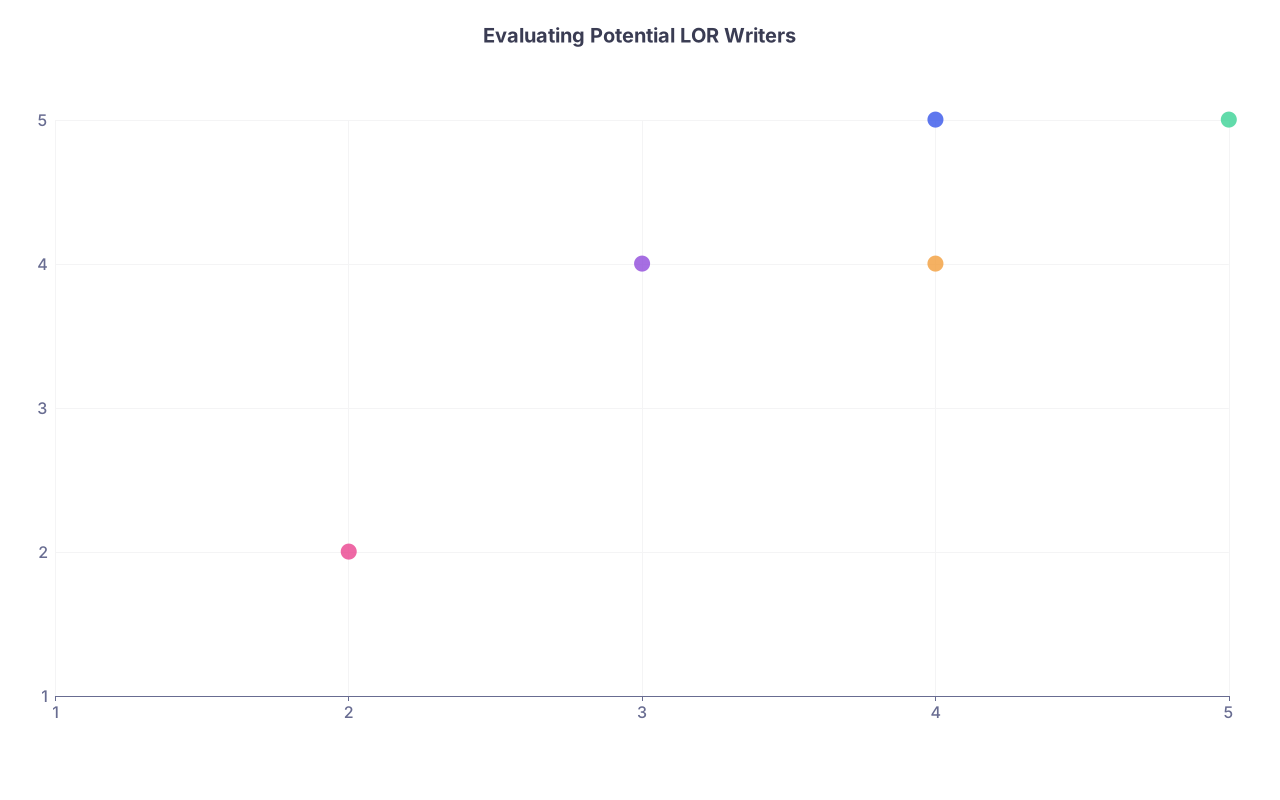
| Category | Value |
|---|---|
| Science Prof A | 4,5 |
| Science Prof B | 3,4 |
| PI | 5,5 |
| Clinic Supervisor | 4,4 |
| Random MD Shadowed | 2,2 |
The targets for your core 3–4 letters are people in the upper-right quadrant: high depth, high credibility.
Your “knows me best” person should be there. If they’re high depth but low credibility (e.g., high school teacher, non-academic employer unrelated to service/healthcare), they’re optional at best, harmful at worst if they displace a stronger option.
How to Actually Get Multiple Strong Letters (Without Being Fake)
Since you’re probably thinking, “Okay, but how do I get more than one strong letter if only one person really knows me?” here’s the uncomfortable answer: you start earlier and act like someone who will need letters.
Things that predict strong letters later:
- Sit in the front third of the room and ask thoughtful, non-performative questions
- Go to office hours a few times before you need anything
- Volunteer to present, lead, or take on a small responsibility
- Follow through on commitments consistently—on time, without drama
- Ask for feedback, then visibly apply it
You don’t need intense emotional intimacy with each writer. You need them to see you in action often enough that, six months later, they can say:
“I remember this student. Here is how they handled X, Y, and Z. Here’s how they stacked up against 200 other students I’ve seen.”
That is far more valuable than “I’ve known them forever and they’re like family.”
Visualizing a Strong vs Weak Letter Set
Let’s compare two applicants with the same GPA/MCAT.

Applicant A: “One person who knows me best”
- PI: detailed, glowing, 2-page letter with multiple examples
- Org chem professor: generic, clearly template-based course letter
- Volunteer supervisor at the hospital: brief, polite, little specificity
Applicant B: “Multi-angle, consistent”
- Biochem professor: specific examples of class participation, top 5% comparison
- PI (shorter relationship): solid, example-based endorsement, calls student “top 10% among RAs over 5 years”
- Clinic supervisor: detailed about reliability, patient interaction, taking initiative
Applicant A is betting on the committee giving huge weight to the PI and discounting the others. In reality, Applicant B usually comes across as the safer, stronger bet: multiple independent adults, in different settings, all describing a high-functioning, reliable trainee.
So, What Should You Actually Do?
Let me give you the blunt version.
- Do not chase a single “knows me best” letter at the expense of having multiple solid, example-rich letters from different contexts.
- Do invest in one or two longer-term relationships where someone can speak to growth and trajectory—but treat those as anchors, not the whole structure.
- Select writers based on observed behavior and writing ability, not emotional closeness or vague promises.
That’s how you stop playing the fantasy game and start giving admissions committees what they’re actually looking for: converging, credible evidence that you will not crumble, flake, or implode when medicine gets hard.
The myth: one person who knows you best will carry you.
The reality: several people who know you well enough, in different settings, and can prove it on paper—that’s what carries you.