
The mentor you choose can quietly sabotage your entire application—and you usually will not realize it until the recommendation letter is late, weak, or both.
I’ve watched strong applicants get kneecapped by one thing: a red flag letter writer. Not a bad student. Not a low score. A mentor who should never have been given that responsibility in the first place.
You’re taught to “just ask people who know you well” or “pick the biggest name.” That advice is incomplete. Sometimes dangerously so. You need to be screening mentors like you’d screen a surgeon operating on your spine.
Let’s go through the behaviors that predict a bad or late recommendation letter—so you can avoid them before your application is on fire.
The Myth of the “Big Name” and Why It Burns You
The biggest trap premeds and med students fall into: assuming a famous or powerful person automatically equals a strong letter.
No. Sometimes it equals a disaster.
Here’s the pattern I see over and over:
Student chases a “prestige” recommender—department chair, program director, NIH-famous PI—who barely knows them, has no time, and treats letters as a chore to be punted to the last minute or to a template.
You end up with:
- A generic, non-specific letter
- Submitted dangerously close to the deadline
- Sometimes never submitted at all
If you see these behaviors in a big-name mentor, treat them as red flags, not perks of being “busy and important.”
| Type of Recommender | Common Outcome |
|---|---|
| Famous, barely knows you | Generic and late |
| Mid-level, knows you well | Strong and on time |
| Research PI only by email | Weak and vague |
| Clinician you worked with closely | Specific and credible |
Red flags specific to “big names”
They misremember who you are. Repeatedly.
If after several interactions they still mix you up with another student or can’t recall what you worked on, they are not positioned to write a strong letter. Prestige does not fix amnesia.They openly complain about writing letters.
I’ve heard attendings say, “I get 40 letter requests a year, I just copy and paste them,” right in front of a student. That’s not a quirky personality trait. That’s a warning.Their inbox and office are visibly chaotic.
You see piles of unprocessed forms, hundreds of unread emails, residents hovering with “just a quick thing” they’ve been waiting a week for. You think your letter will be the exception? It will not.
Do not sacrifice reliability for prestige. A smaller name who truly knows you, respects deadlines, and cares about teaching will beat a distracted department chair every time where it counts: in the content and timing of your letter.
Chronic Disorganization: The Silent Deadline Killer
The single most reliable predictor of a late letter is not whether someone likes you. It’s whether they’re chronically disorganized.
You’ve probably already seen the signs. You just told yourself: “They’re busy, medicine is chaotic, that’s normal.” Busy and disorganized are not the same thing.
Here are the disorganization flags you must not ignore:
They regularly miss or reschedule meetings with you.
Not once. Repeatedly. They forget, double-book, or show up 20 minutes late and shrug it off. That is exactly how your letter deadline will be treated.They respond to emails after weeks—if at all.
I don’t care how “important” they are. If you consistently wait 10–14 days for replies to simple questions, your time-sensitive letter is at risk.They’ve already told you they’re bad with admin tasks.
When someone laughs and says, “I’m terrible with paperwork, just keep bugging me,” believe them. That’s not a joke. That’s an admission.They scramble with other students’ letters.
You overhear: “Can you extend the deadline?” or “I’ll get this in tonight, I promise.” Those are not isolated anecdotes. That is their pattern.
Here’s the harsh truth: you cannot “remind” someone into being organized. If their system is chaos, your polite reminders will float in that same chaos.
Vague, Lukewarm Support: The “Nice” Mentor Who Sinks You
Some mentors are kind, friendly, approachable—and absolutely the wrong person to write your letter.
The problem isn’t malice. It’s lukewarm support that turns into a generic, middle-of-the-road letter. Those letters hurt. A bland letter is read as a negative one in competitive fields.
Watch for these behaviors when you hint or ask about a letter:
They won’t clearly say “strong letter.”
If you ask, “Would you feel comfortable writing me a strong letter of recommendation?” and they say:- “I can write you a letter”
- “Sure, I’d be happy to write something”
- “I can mention that you were on the team”
That “something” is not what you need. That is carefully chosen non-committal language.
They mostly know you superficially.
Maybe you shadowed them once a week and never did real work. Maybe you were one of twenty students in a clinic and had minimal one-on-one interaction. That’s not enough for a detailed letter.They never saw you struggle and improve.
The best letters show growth. If they only saw you on your best, pre-polished behavior a handful of times, all they can say is “pleasant, punctual, professional.” Which is basically saying “average” in admissions-speak.They avoid specifics when praising you.
Pay attention to how they talk about you in real time. If they say “You’re great” but never, ever anchor it with real examples—specific patients, projects, improvements—that’s exactly how their letter will read: vague and forgettable.
You need advocates, not just acquaintances who think you’re “nice.”
Power Imbalance and Boundary Problems
Some mentors should be disqualified from letter duty not because of timing or writing, but because their behavior is ethically risky and can backfire on you.
I’ve seen this more than I’d like: a student stuck with a letter writer who also:
- Flirts or makes comments about appearance
- Texts about non-professional topics at odd hours
- Makes them feel indebted for opportunities
Even if they do submit your letter, you now depend on someone whose boundaries are questionable at best. This can become a problem if:
- They retaliate if you set limits or decline their requests
- Their reputation is poor, and their endorsement is quietly discounted
- Their email and behavior put you in a position you don’t want to explain later
Red flag behaviors in this category:
They blur professional lines early.
Offering a ride home alone, pushing social hangouts, adding you on personal social media quickly—especially when there’s a power difference. This is not “mentorship style.” It’s risk.They make you feel guilty for asking for structure.
You ask for clearer expectations, they respond with irritation or sarcasm. That attitude can show up in how seriously they treat your letter.They hint that you “owe” them.
Comments like, “After all I’ve done for you,” or, “You know I went to bat for you,” when you haven’t asked them for anything that unusual. That’s a bad foundation for giving them more power over your future.
If someone makes you feel uneasy or obligated now, do not hand them control over a critical part of your application.
The “Ghosting” Mentor: Delayed, Dodgy, and Non-Responsive
The most stressful letter disaster is simple: the person never uploads it. Not by the first deadline. Sometimes not at all.
Almost every time this happens, the warning signs were there months earlier.
Look for:
Early silence after you ask.
You send a detailed, polite request. They don’t respond for 10–14 days. You follow up. They say something vague like, “Sure, I’ll try,” without discussing timelines. That’s your preview.They avoid concrete dates.
You say, “The preferred deadline is June 1st—would that work for you?” and they sidestep: “I’ll do my best,” or “Just send me a reminder.” They never affirm: “Yes, I can get it done by then.”They asked you for materials and then disappeared.
They request your CV, personal statement, grades. You send them promptly. Then… nothing. No acknowledgment, no follow-up questions, no schedule.They have a history (you’ve heard stories).
If residents or other students quietly tell you, “I’d pick someone else; they submit late,” do not test the universe thinking you’ll be the exception.
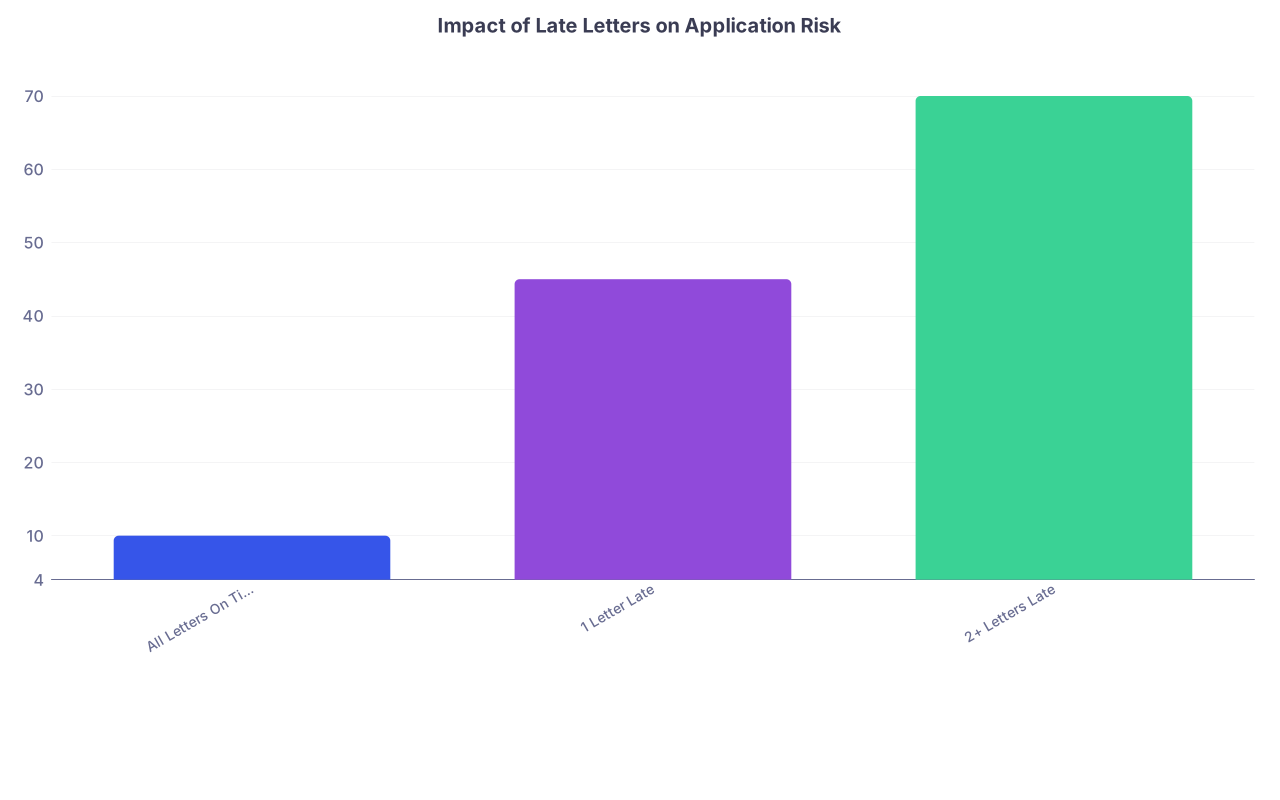
| Category | Value |
|---|---|
| All Letters On Time | 10 |
| 1 Letter Late | 45 |
| 2+ Letters Late | 70 |
That bar chart is reality: one late letter can massively increase your stress and perceived disorganization. Two or more and you start to look like the common denominator, even if you did everything right.
Overcommitted Mentors: Too Many Trainees, Too Little Attention
A mentor can be well-intentioned, kind, and fundamentally incapable of giving you what you need because they’re spread too thin.
Typical profile:
Highly involved faculty member. Runs a clinic, leads a course, manages a research lab, sits on multiple committees, writes grants, has a packed OR schedule. Also “mentors” 12 students, 5 residents, and 2 fellows.
On paper, they look amazing. In practice, they are barely holding it together.
Warning signs:
You constantly see them rushing out of conversations.
You start to ask a question, they’re already halfway down the hall: “Email me!” Except they never answer that email.Other mentees are frustrated.
Listen when you hear things like: “I’ve been waiting months for feedback,” or “My draft has been in their inbox since last year.” Your letter will be fighting for oxygen in that same inbox.They brag about how many students they mentor.
That isn’t always admirable. Sometimes it’s ego. Quality mentorship doesn’t scale infinitely.They only know your surface-level details.
If they never ask about your goals, your story, or your specific path, they have nothing substantial to write about you that isn’t generic. Overcommitted mentors often default to templates.
Overcommitment doesn’t always equal malicious neglect. But it reliably equals risk for anything time-sensitive and individualized—like your recommendation letter.
Sloppy Communication: How They Write to You Is How They’ll Write About You
You’re trying to predict how they’ll write your letter. You don’t have to guess. You already have a sample: their emails and feedback to you.
Pay attention to:
Tone and professionalism.
Are their emails coherent, reasonably proofread, and respectful—even when they’re busy? Or are they full of typos, half sentences, and confusing instructions? That’s their writing baseline.Do they ever give detailed feedback?
Someone who routinely gives one-liner feedback (“Looks fine,” “Good job”) is not suddenly going to write a rich, narrative evaluation of your strengths and growth.Responsiveness to clarifying questions.
When you ask for clarification or help, do they take the time to respond thoughtfully—or do you feel like you’re annoying them? Reluctant communicators don’t magically turn into enthusiastic advocates on paper.Their grip on facts.
If they constantly misremember deadlines, mix up details, or confuse your project with someone else’s, expect factual sloppiness in your letter. Wrong dates, wrong rotation, wrong role—it happens more than you’d think, and it reflects poorly on you, not on them.
A poorly written or inaccurate letter doesn’t just fail to help. It can actively plant doubts about your attention to detail and judgment in choosing recommenders.
Ethical and Professional Red Flags You Can’t “Work Around”
Some mentors have reputations or behaviors that quietly taint their letters, even if the content is positive and on time.
You are judged partly by the people who vouch for you. Like it or not.
These are the harder-to-see but critical red flags:
They have a reputation for unprofessionalism.
Chronic gossip, yelling at staff, inappropriate jokes in front of patients—if this is the person speaking for your professionalism, committees may discount their endorsement.They cut corners. And tell you about it.
Bragging about “creative” billing, writing notes they didn’t actually do, or signing off on work they didn’t check. Do you want that person certifying your integrity?They throw other students or residents under the bus.
Watch how they talk about previous trainees. If they casually trash people who disappointed them, imagine what happens if they ever change their mind about you—after your letter is submitted.They pressure you to exaggerate or misrepresent.
If a mentor ever suggests you “just say you did X” when you didn’t, that’s a hard stop. Under no circumstances should you let them be your official voice to an admissions or selection committee.
You’re not just assessing whether they can write. You’re assessing whether having their name attached to your application is an asset or a liability.
How to Screen a Mentor Before You Ask for a Letter
You can’t control everything—but you can stop walking blindly into predictable messes.
Here’s a clean screening process you can actually use. Quietly, in your head, long before the formal ask.

| Step | Description |
|---|---|
| Step 1 | Identify Potential Mentor |
| Step 2 | Do not ask for letter |
| Step 3 | Request strong, timely letter |
| Step 4 | Do they know your work well? |
| Step 5 | Are they responsive & organized? |
| Step 6 | Any ethical/boundary concerns? |
Practical steps:
Test communication early.
Email them a specific, minor question. See how long it takes to get a coherent response. This is a low-stakes predictor of high-stakes behavior.Ask residents or senior students—off the record.
“Would you trust Dr. X with your letters?” is a very different question than “Is Dr. X nice?” Listen to the hesitation, not just the words.Watch how they treat administrative deadlines.
Forms for the department. Evaluations for the clerkship. If they’re consistently late on those, your letter is not special.Clarify up front: “strong” and “on time.”
When you finally ask, be explicit:
“Would you feel comfortable writing me a strong letter of recommendation for medical school / residency, and would you be able to submit it by [date]?”
Their response—both words and tone—is your decision point.
If there’s any hesitation, vague agreement, or visible discomfort, thank them and do not use them. You are not obligated to, even if they once said “Sure, I can write something.”
What to Do If You Already Picked a Red Flag Mentor
Sometimes you only realize the mistake when the deadline is approaching and the letter isn’t in.
Here’s what not to do: freeze and hope. Hope is not a strategy.
If you’re seeing warning signs now:
- Slow or no responses to your reminders
- Repeated “I’ll do it this weekend” with no follow-through
- Vague apologies without new, specific commitments
You need a backup plan.
Set a personal cutoff date.
Not the official deadline. Your own. For example:
“If this letter is not uploaded two weeks before the real deadline, I will pivot to another recommender.”Quietly line up an alternate.
Reach out to another mentor who genuinely knows your work. Be honest without drama:
“I’m worried one of my letters may be delayed due to the writer’s schedule. Would you be willing to write a strong letter for me as a backup if needed?”Give your current writer one last, very clear reminder.
With specifics:- Exact due date
- Where to upload
- What the letter is for
- Why their perspective matters
And then stop chasing after your cutoff date. Shift to the backup.
You are not betraying anyone. You are protecting years of work.
The One Thing You Should Do Today
Open a blank page and list your potential letter writers—by name.
For each one, write down:
- How well they actually know your work (0–10)
- How organized/responsive they’ve been with you (0–10)
- Any ethical/boundary concerns (yes/no)
- Whether they have clearly supported you with specifics before
Then, circle anyone with low scores or any “yes” under concerns.
Those are your red flag mentors. Do not wait until application season to find out the hard way.
Start with that list today. If someone you were counting on looks risky on paper, you have time—right now—to build stronger, safer relationships with better recommenders.