
I Transferred Colleges: Will My Split Mentors Make My Letters Look Disjointed?
What if the committee looks at your letters, sees two different schools, and thinks, “This kid can’t commit to anything”?
That’s the fear, right?
You transferred. You’ve got people from your old school who know you well, and people from your new school who sort of know you, but not deeply. And now you’re scared your letters of recommendation are going to read like two different versions of you. Or worse—like a fragmented, red-flag story.
Let me say this bluntly: transferring by itself is not a problem. Disjointed letters can be. Those are not the same thing.
We just have to make sure you land in the first category: “Coherent story, transferred student” and not the second: “What the hell is going on with this applicant?”
Let’s untangle this.
What Adcoms Actually See When You’ve Transferred
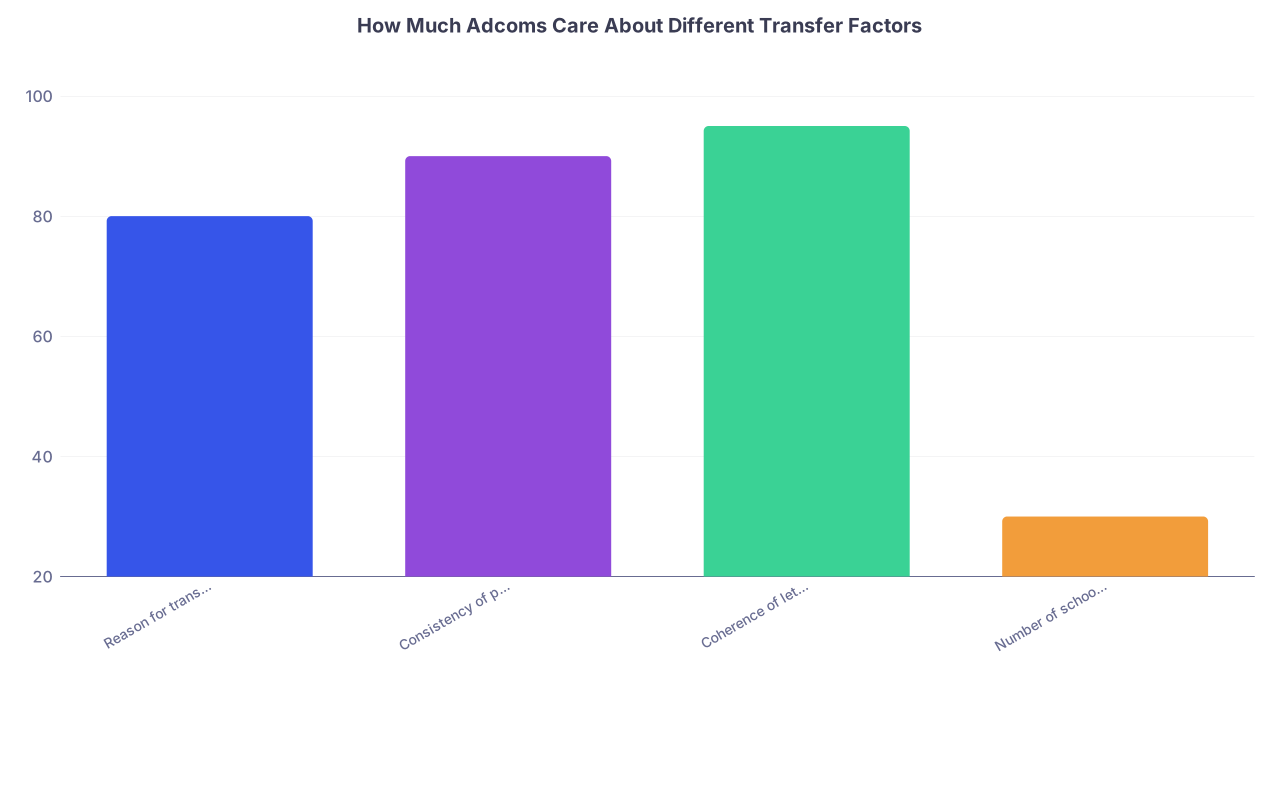
| Category | Value |
|---|---|
| Reason for transfer | 80 |
| Consistency of performance | 90 |
| Coherence of letters | 95 |
| Number of schools attended | 30 |
Here’s what your brain is telling you:
- “They’ll think I got pushed out.”
- “They’ll assume I can’t handle change.”
- “Two different schools = unstable, messy, drama.”
Here’s what committee members actually do when they see a transfer:
They notice it. Then they look for a pattern.
Do your grades tank or improve after the transfer?
Do your letters from both places describe the same core person?
Does your personal statement or activities quietly make sense of the move?
If yes, they move on. They’re not sitting in the room going, “We must reject all transfer students.” That conspiracy is in your head, not in the committee room.
I’ve seen this play out on actual review days:
- File comes up. Two schools. Someone says, “Transferred after sophomore year.”
- Quick scroll: GPA steady or improved? Good.
- Letters: any red flags, weirdness, contradictions? If no, they barely talk about the transfer again.
The transfer only becomes a “thing” when:
- There’s a big GPA drop and nobody explains why.
- Letters sound like they’re describing two totally different people.
- Or one letter subtly trashes you, and the others don’t match it.
So your real problem isn’t “split mentors.” It’s disconnected story. And that, fortunately, you can control.
Will Having Letters From Two Schools Make Me Look Scattered?
Short answer: not if you’re smart about who writes them and how you frame everything.
The nightmare scenario you’re picturing is something like:
- Old school letter: “Top 5% of my class, deeply engaged, came to every office hour.”
- New school letter: “Showed up. Turned in work. Quiet student. No idea who they are as a person.”
- Committee: “So they used to be stellar, then… shut down? Why? What happened?”
Or the reverse:
- Old school: “Solid but not outstanding.”
- New school: “Absolutely phenomenal, most impressive student I’ve taught in years.”
That second one actually isn’t bad. That looks like growth. Adcoms like growth.
The trouble is when there’s no clear through-line. You want the same version of you showing up in both places.
Same core traits, different settings.
Things like:
- “Hard-working, reliable, follows through.”
- “Asks thoughtful questions and seeks feedback.”
- “Goes beyond what’s required for the sake of learning or service.”
You want both sets of mentors pointing to that same internal engine, just with different examples.
What makes letters look disjointed is not the school names; it’s mixed signals:
- One says you’re very outgoing; another calls you very withdrawn.
- One raves about leadership; another never mentions initiative at all.
- One talks about your intense curiosity about research; another barely knows you were in a lab.
So the real move isn’t “avoid letters from Old School vs New School.” It’s: coordinate the story.
How To Choose Between Old-School vs New-School Letter Writers
Here’s where your anxiety gets loud:
“If I use mostly old-school mentors, they’ll think I’m not integrated at my new place.”
“If I use mostly new-school mentors, they won’t know me well enough to write anything strong.”
You’re stuck in that awful lose-lose headspace.
Let’s cut through it. Use this order of priority:
- Strong, detailed letter > Same-school letter
- Long-term relationship > “Prestige” or fancy title
- Coherent story > Perfect symmetry between schools
If your best, most detailed letter is from a professor at your old school who taught you twice, mentored you in office hours, and supervised your research? That letter is gold. Use it.
If at your new school you’ve got someone who barely knows your name from a giant 300-person class? That letter is a waste, even if it’s “more recent.”
That said, you don’t want a file that looks like you’ve been at your new school for 2 years and nobody there can vouch for you. That does make people raise an eyebrow.
Aim for a mix. Something like:
| Letter Type | Source School |
|---|---|
| Science faculty | Old or New (best fit) |
| Another science / math | New school if possible |
| Non-science / humanities | Either, strongest writer |
| Research / clinical mentor | Wherever you did the work |
| Optional extra letter | Whichever adds new depth |
The question you should constantly ask is: “If someone read only this letter, would they understand something real and specific about me?”
If the answer is no, I don’t care which school it’s from – it’s not helping.
Making Split Mentors Sound Like They Know the Same Person
This is the part nobody tells you: you can quietly steer what your letters emphasize.
Not by writing them yourself. Not by being weird and controlling. But by giving your recommenders good material.
Here’s what you do with both old and new mentors:
Send them:
- A short, honest paragraph about why you transferred. Not a novel. 4–5 sentences. Non-dramatic.
- A quick academic timeline: where you started, when you moved, what changed academically or personally.
- A 1-page “brag sheet” with concrete examples they might remember: projects, labs, times you asked for feedback, emails you sent, etc.
Very gently point them toward the themes you hope they’ll highlight. For example:
- “I’m hoping my letters overall will show my growth in resilience and consistent work ethic across both schools.”
- “Since I transferred, it’s important that committees see that my work stayed strong in both environments.”
Most good letter writers will appreciate that. They’re busy. They don’t have time to reconstruct your entire life story from memory.
You’re not forcing them; you’re helping them connect dots.
What you’re aiming for is this kind of vibe when the adcom reads across letters:
- Old school: “They took initiative in a smaller environment, sought mentorship, and dug deeply into material.”
- New school: “They adapted to a larger, more rigorous environment, maintained that same initiative, and kept pushing themselves.”
Same person. Different walls, same engine.
How To Explain Your Transfer Without Sounding Like a Walking Red Flag
Here’s the fear:
“If I mention transferring, I’ll sound unstable. If I don’t mention it, they’ll assume the worst.”
You don’t need a 3-page trauma essay about your transfer. You just need a straightforward, non-dramatic explanation that makes your trajectory make sense.
Good reasons that read cleanly:
- Academic fit: “I realized I wanted stronger research opportunities / a different major / a school with XYZ program.”
- Financial / family: “I transferred to be closer to family / for financial reasons / for in-state tuition.”
- Personal growth: “Initially chose a school for the wrong reasons, reassessed, and made a more aligned choice.”
Messy, defensive, or suspicious explanations:
- Blaming: “The professors were all horrible and unfair.”
- Vague drama: “It just wasn’t the right place for me,” with no concrete reason.
- Dodging: Never addressing the transfer at all when you switched suddenly, had a GPA drop, or changed paths abruptly.
You can drop this explanation in a couple of places:
- A sentence or two in your personal statement if it’s genuinely key to your journey.
- A brief mention in the “education” or “additional info” section.
- Quietly in your secondaries if you’re asked about academic transitions.
You don’t need every letter writer to harp on the transfer. Honestly, most shouldn’t. They just need to reflect stability and continuity in how they describe you.
What If My New-School Mentors Don’t Know Me Well Enough?
This is the one that keeps people staring at the ceiling at 2 a.m.
You have this:
- One or two amazing old-school mentors
- At the new place: giant classes, no one-on-one time, no deep relationships yet
And your head is screaming, “I MESSED UP, THERE’S NO TIME.”
You’re not screwed. But you do need to be very intentional right now.
If you still have time before letters are due (even 3–6 months), do this:
- Pick 1–2 professors at your new school whose classes you actually care about or did well in.
- Start going to office hours every week. Not fake office hours where you pretend to have one question. Real ones where you discuss material, ask about their work, show them you actually think.
- If possible, join a small project, discussion group, or research with them.
People drastically underestimate how quickly a professor can get to know you if you show up consistently and genuinely.
If you’re already near the deadline and they don’t know you that well, here’s the harsh truth: a lukewarm, generic new-school letter will not save you. A strong old-school one will do more for you.
So you may end up with:
- 1–2 very strong old-school letters
- 1 decent (not spectacular) new-school letter
- 1 from a non-academic mentor (research PI, physician, volunteer supervisor) who’s known you longer
That’s fine. Not perfect. But fine.
The key is you don’t ignore this and just hope “it’ll work itself out.” It won’t. You have to actively cultivate at least one new-school person who can say, “Yes, they didn’t just float through here anonymously.”
Common Transfer Letter Patterns (And How They Read)

Here’s how certain combinations tend to land with committees:
Strong old-school + strong new-school + strong mentor (research/clinical)
Reads as: stable, adaptable, well-supported. Transfer’s a non-issue.Strong old-school + okay new-school + solid mentor
Reads as: had deeper roots at first school, still did fine after. Reasonable, especially if your story explains it.Only old-school letters, nothing from new school after 1–2 years there
Reads as: “Why does no one at the current place know this person?” This can be a problem.Weak, generic letters from both schools
This is the actual nightmare. Not the split. The emptiness.
Your target is scenario #1 or #2. Scenario #3 can be survivable if you 1) apply broadly, 2) have strong metrics and experiences, and 3) give context. Scenario #4… you fix that by acting now, not by obsessing later.
A Simple Way To Sanity-Check Your Letter Strategy
Do this mental exercise. Imagine a stranger reading your entire file:
- Your transcript (with the transfer).
- Your activities.
- Your personal statement.
- Your letters.
Now answer honestly:
- Would they understand why you transferred without needing a soap opera backstory?
- Would they see consistent academic engagement before and after the move?
- Would your letters from both places feel like they’re describing the same core person?
- Would someone at your current school clearly be able to say, “Yes, I’ve actually worked with this person”?
If you’re hitting 3 out of 4, you’re probably in decent shape. If you’re at 1 out of 4, that’s your sign: don’t obsess, adjust.
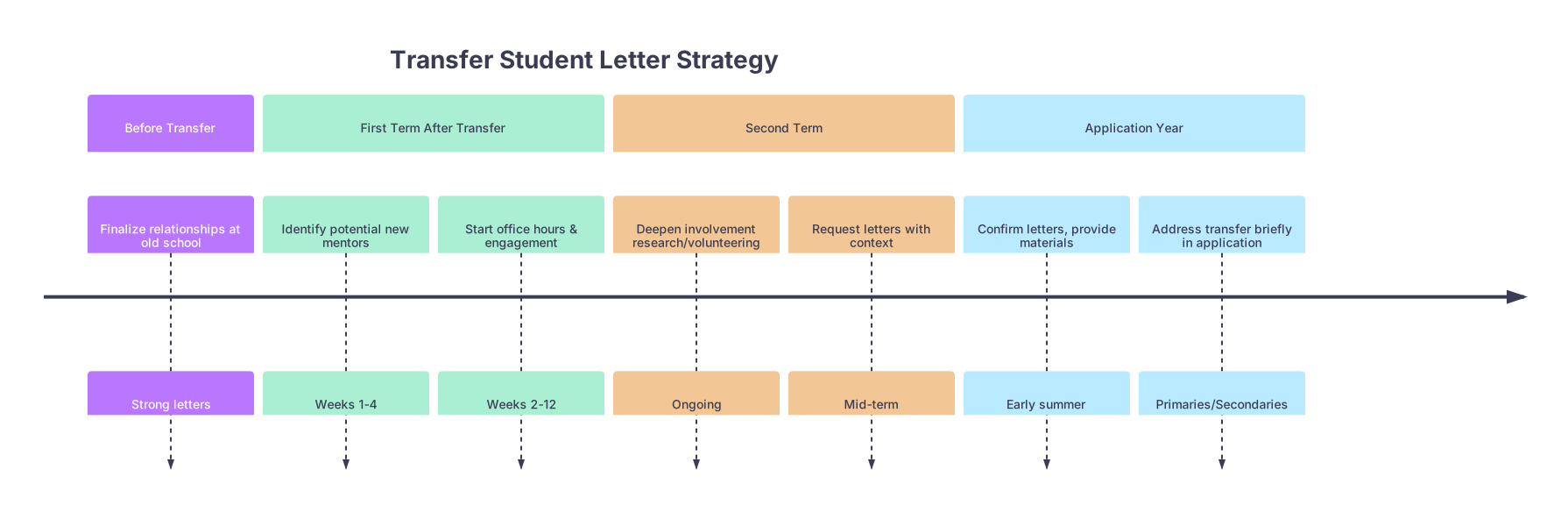
| Period | Event |
|---|---|
| Before Transfer - Finalize relationships at old school | Strong letters |
| First Term After Transfer - Identify potential new mentors | Weeks 1-4 |
| First Term After Transfer - Start office hours & engagement | Weeks 2-12 |
| Second Term - Deepen involvement research/volunteering | Ongoing |
| Second Term - Request letters with context | Mid-term |
| Application Year - Confirm letters, provide materials | Early summer |
| Application Year - Address transfer briefly in application | Primaries/Secondaries |

FAQs
1. Do I have to get a letter from my new school if my old-school mentors know me way better?
You don’t absolutely have to, but skipping your new school entirely is risky if you’ve been there a while. It reads like you floated through anonymously or had issues integrating. I’d push hard to get at least one person at your current institution who can speak to your work. If you’re really stuck, consider a smaller class, a lab PI, or an advisor who’s seen you regularly.
2. Will adcoms assume I transferred because I did something wrong?
Not automatically. People transfer for thousands of reasons. They’ll only assume something bad if the story looks off: GPA crash with no context, weird gaps, no one at your new school vouching for you, or super defensive vibes if you mention it. A simple, calm explanation plus stable performance is usually enough to shut down their suspicion.
3. Should I tell my letter writers that I transferred and why?
Yes, briefly. You don’t need to trauma-dump. But a few sentences about why you moved and how things changed helps them frame your story. It also signals maturity: you understood what you needed, made a decision, and kept working hard. That’s way better than them guessing, or worse, ignoring it entirely.
4. What if my old-school letter is from a small, less “prestigious” college and my new school is more well-known?
Adcoms care way more about content than brand name on a letter. A detailed, specific letter from a community college or regional state school beats a bland letter from a fancy university every single time. Prestige doesn’t save a generic “they did well in my class” letter. If your old-school professor knows you deeply, that letter is valuable no matter where they teach.
5. My new school only has huge lectures. How do I build a relationship fast enough for a letter?
You have to be intentional. Show up to office hours regularly. Sit near the front, engage in class, send 1–2 thoughtful follow-up emails over the term. If possible, take a smaller upper-level class with that professor the next term or ask about joining a project. It feels late, but I’ve seen solid relationships form in a single semester when a student consistently showed up and cared.
6. What’s one red flag that actually will make my letters look disjointed as a transfer?
When one letter hints at problems—poor communication, unreliability, lack of professionalism—and the others say nothing that counters or contextualizes it. That’s when committees start asking, “What else aren’t we seeing?” If you sense a mentor doesn’t fully respect you or had real issues with you, don’t use them out of guilt or obligation. A neutral letter is better than a subtly negative one.
Open a blank document right now and draft a one-paragraph explanation of your transfer and a one-page bullet-style brag sheet for your recommenders. If you had to send those two things tomorrow, could you? If not, start writing them today.