
Last cycle I watched a committee member flip to an applicant’s letters, see the names, mutter “oh no,” and physically push the file away for later. The applicant’s GPA was a 3.9, MCAT in the 520s, great research. But the choice of recommenders telegraphed all the wrong things before a single sentence was read.
That’s the part no one tells you. You think the content of the letter is everything. Behind closed doors, we’re already judging you the second we see who you chose.
What We See Before We Read a Single Word
On a typical review day, here’s the sequence. We open your file. We scroll to your letters. And before reading a line, people around the table are doing a fast mental calculus based entirely on letterhead, title, and relationship.
Some of the unspoken questions:
- Does this student understand what a credible academic letter looks like?
- Do they know how this process works, or are they clueless?
- Did anyone with real responsibility actually supervise this person?
- Does this set of letters tell a coherent story about who they are?
We notice:
- The mix of recommenders (science vs non-science, research vs clinical, “famous” vs actually knows you)
- The level of each recommender (PI vs postdoc, professor vs grad student, attending vs fellow)
- The appropriateness of each person relative to what they’re speaking about
- The pattern – do your letters reinforce the same strengths, or do they look random and opportunistic?
Here’s the part applicants never believe until they’re on the other side: the choice of recommenders often matters almost as much as the content of the letters themselves. Because it reveals judgment. And judgment is what we’re selecting for.
The “Hierarchy” No One Explains to You
Let me lay out the pecking order the way committee members actually think about it, not the sanitized version you see in premed advising handouts.
For academic/science letters, roughly:
| Rank (Strongest to Weakest) | Recommender Type |
|---|---|
| 1 | Course director / full professor |
| 2 | Associate professor (primary) |
| 3 | Assistant professor (primary) |
| 4 | Research PI who *directly* supervised you |
| 5 | Teaching faculty / lecturer |
| 6 | Postdoc / fellow writing “on behalf of” PI |
Now clinical:
| Rank (Strongest to Weakest) | Recommender Type |
|---|---|
| 1 | Attending physician |
| 2 | Residency program director |
| 3 | Clerkship/course director |
| 4 | Fellow (if direct supervisor) |
| 5 | Senior resident |
| 6 | Junior resident / intern |
Do letters from non-physicians matter? They can. But they live in a different bucket: they are context letters, not core competency letters. Strong as an extra data point; weak as your main foundation.
So when we see:
- Three letters from TAs and no actual faculty
- A letter from a “Dr.” who turns out to be a chiropractor writing your “clinical” LOR
- A “strong” recommendation from your family friend who’s a partner at a law firm
…it doesn’t matter how glowing the prose is. The choice itself tells us you either didn’t have better options (red flag about your academic/clinical engagement) or didn’t understand how this works (red flag about judgment and professionalism).
What Different Types of Recommenders Really Signal
Let me break down how typical committee members read the choice of each type of recommender.
Science faculty
When you use a science course professor or course director, that signals:
- You understand that med schools care about academic rigor
- You were visible enough in a class for a real professor to remember you
- You’re willing to be evaluated by someone with standards
We’re not naïve; we know a lot of these class-based letters are generic. But if the recommender is legit, the mere fact that you went to that person tells us you played the game correctly.
The opposite is also true. If all your “science letters” are from:
- Lab instructors who are grad students
- Adjuncts who taught your easiest non-major science course
- TAs “co-writing” (we can tell from the signature lines and email domains)
…we immediately ask, “Why didn’t any major faculty know this student?”
Research PIs
This is where applicants misplay their hand constantly.
From the committee side, here’s what they think when they see PI letters:
- From a known PI at a research-heavy institution: “Okay, if this person bothers to write, I’ll read closely.” Even if the letter is short.
- From a non-famous but clearly senior PI describing concrete work: “This person actually did something. Strong.”
- From someone who signs as “postdoctoral fellow, Dept of X, writing on behalf of Dr. BigName”: “So the PI barely knows them. Discount by 50%.”
The dirty secret: a detailed letter from a mid-tier, no-name PI who actually supervised you day-to-day carries more weight in real discussion than a one-paragraph letter from a celebrity who barely remembers you.
But you’ll still get judged for bypassing the PI completely. A letter only from a postdoc, with no PI co-sign or mention, often leads to this kind of hallway comment: “If they were that strong, why didn’t the PI write or at least co-sign?”
Clinicians
For premeds, clinical letters are often a trap.
Shadowing letters from a physician you followed for 12 hours over two days? Those earn an eye-roll in a lot of rooms. We know what those look like:
- “X was punctual and professional”
- “X showed interest in medicine”
- “I believe X will make a fine physician”
That’s fluff. The only time a clinician letter really carries weight is when:
- They supervised you in a meaningful longitudinal role (scribe, MA, EMT, research assistant in a clinical project, free clinic with actual responsibility)
- They directly observed your interaction with patients or team over weeks to months
- They can speak to your behavior under pressure, reliability, and growth
When you choose a clinician who barely knows you, you’re telling us you care more about the prestige of the MD after their name than the authenticity of the evaluation.
And yes, some committee members explicitly say that in the room.
Non-academic “character” letters
Now for the messy category: coaches, pastors, volunteer coordinators, bosses.
Used well, these are valuable. They give us a sense of the human being outside the GPA and MCAT score.
Used poorly, they scream “padding.”
What helps:
- A long-term supervisor (2+ years) who has watched you struggle, fail, improve
- Someone who can describe your work ethic, integrity, and how you treat people
- A context we value: leadership roles, service to underserved communities, serious employment while in school
What hurts:
- Family friends, neighbors, or “I’ve known them since they were born” letters
- People more impressed by your medical aspirations than your actual behavior
- Short-term supervisors from a random summer job with no real insight
The judgment is harsh but simple: if you spend one of your limited letter slots on someone who can’t speak to high-stakes performance, we wonder what stronger voices you chose not to include.
The Patterns That Make Committees Wary
Some patterns raise eyebrows every single year.
The “All Famous, No Substance” File
You’ve seen this student:
- Shadowed the department chair for three afternoons
- Did “research” in the lab of a big-name PI but mostly washed dishes and did data entry
- Has a letter from the medical school dean because their parents are donors
The letters themselves often sound like this: “I have known X for a brief time but was impressed by their enthusiasm.”
We notice that phrase – “for a brief time” – like a flashing warning light.
Behind closed doors, the comments are unfiltered:
- “They chased names instead of mentors.”
- “No one here actually supervised their work.”
- “This is a networking resume, not a track record.”
Applicants think big names impress us. In reality, vague praise from high-status people is often viewed as a compensation strategy for lack of real mentorship.
The “Safe but Generic” Set
Then there’s the other pattern: every recommender is appropriate but distant.
- Two science professors from huge lectures where you never spoke
- A research PI who barely interacted with you
- A clinical supervisor you shadowed for a couple of days
The letters are all perfectly fine. No red flags. Also no specifics.
We end up saying things like: “They did what they were supposed to do, but there’s no evidence anyone really knows them.”
That matters. Because we’re not just selecting for intellect; we’re selecting for people who build relationships with mentors, ask for feedback, and are memorable for the right reasons.
The Random Mix With No Story
Another quietly fatal pattern: a scattered set of recommenders that don’t support a clear narrative.
You tell us in your personal statement that research is your “central passion,” but:
- Only one weak research letter
- Two letters from non-science professors
- A pastor letter
Or you present yourself as deeply committed to underserved communities, but:
- None of your letters come from those clinical/community settings
- All are from academic settings where you were a quiet A student
We absolutely notice that disconnect. And we talk about it.
On committee I heard, more than once: “If this was really a core part of their identity, someone in that world would be writing for them.”
How We Quietly Score Your Judgment
Here’s the mental grid many experienced reviewers use, though they’d never phrase it this bluntly.
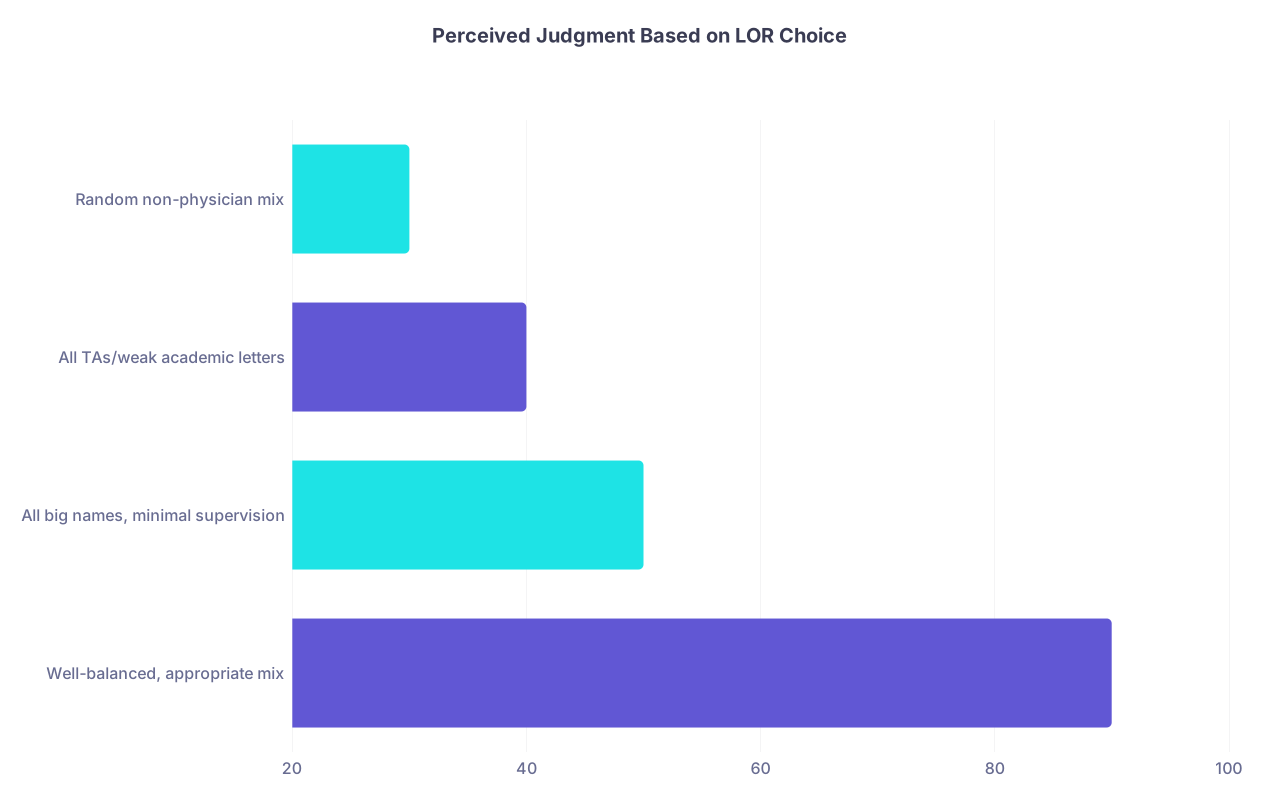
| Category | Value |
|---|---|
| Well-balanced, appropriate mix | 90 |
| All big names, minimal supervision | 50 |
| All TAs/weak academic letters | 40 |
| Random non-physician mix | 30 |
That’s not a formal score. But it’s the vibe. And vibe matters when we have to decide which “borderline but promising” applicants get bumped up – or quietly down.
A “well-balanced, appropriate mix” usually means:
- Core expectations are met (required science/non-science letters as per school)
- At least one person has clearly seen you working hard over time
- The set together makes sense with your story (research-focused, service-focused, etc.)
- No letters that feel like obvious padding or favors
When your choices look random or desperate, we assume that’s how you approach other professional situations too.
How to Think Like a Committee Member When Choosing Recommenders
Let’s translate all this into something actionable, without dumbing it down.
Step 1: Cover your non-negotiables with credible people
Every school has minimums. Science faculty. Non-science or humanities. Sometimes a committee letter. Do not get cute here.
You want your boxes checked by:
- Real faculty for academics (even if the letters end up a bit generic)
- Legit clinical supervisors if a school “recommends” clinical letters
- People who can safely say you are reliable, honest, and not a problem
That’s your floor.
Step 2: Make sure at least one person can vouch for your core identity
Ask yourself: “If this application had a headline, what would it be?”
- Future physician-scientist
- Non-traditional student with serious work experience
- Deeply service-oriented, community-grounded
- Humanities brain with strong science foundations
Someone in your letter set needs to be able to say, credibly: “I’ve watched this person behave like that future version of themselves.”
If you say you’re research-focused but your strongest letter is from your choir director, that’s a mismatch.
Step 3: Prefer depth over status
You should be willing, deliberately, to sacrifice name recognition for real supervision.
Between:
- A department chair who saw you twice
- An assistant professor who watched you wrestle with a difficult project for a year
You pick the assistant professor, every time.
And if the chair actually did supervise you deeply? Fine. But the bar is depth, not title.
Step 4: Avoid letters that create more questions than answers
Ask yourself what a cynical committee member might say when they scan your recommender list. For example:
- “Why is their only science letter from a community college adjunct?”
- “Why no letter from their main research PI?”
- “Why is a cousin writing as their ‘supervisor’ for clinical work?”
If you can predict that reaction, you either need a different recommender or you need to be prepared with a very clear explanation in your secondaries or interviews.
Step 5: Do not waste a slot on pure fluff
You get a limited number of letters that people will actually read. Using one on someone who can only offer character adjectives (“hard-working, compassionate, bright”) with no observed context and no stakes is a bad trade.
A mediocre but specific letter from a lab instructor who saw you fail, adjust, and succeed is more helpful than a glowing, vague, three-paragraph sermon from your pastor who never saw you under pressure.
The Stuff Committees Say Out Loud (When You’re Not There)
Let me pull the curtain back a little further.
I’ve heard these phrases in committee:
- “This is clearly their mom’s friend.”
- “If they were really that good, why didn’t the PI sign?”
- “I recognize this dean’s letter template; they don’t know the student.”
- “Another shadowing letter. Completely useless.”
- “This supervisor has no idea what a medical student or resident actually does; this is just personality fluff.”
On the flip side, I’ve also heard:
- “This community clinic director loves them. That’s gold.”
- “Look at how detailed this lab letter is; they clearly did real work.”
- “You can tell the professor actually knows them and isn’t afraid to compare them to peers. That’s credible praise.”
Students assume everyone is just reading for how positive the letter sounds. They’re not. They’re reading for three things: credibility, specificity, and coherence with the rest of your file.
Your choice of recommenders is the first filter for all three.
If Your Options Aren’t Great
Some of you are reading this thinking, “Well, that’s nice, but my school is huge, my profs don’t know me, my PI barely talked to me, and my clinical experience was mostly shadowing. What now?”
Here’s the unvarnished truth: you can’t retroactively fix three years of staying invisible. But you can stop making it worse.
Do this:
- Pick the least-bad set that still looks structurally correct (real faculty, real supervisors, minimal fluff).
- Start now building at least one deep relationship for next cycle, even if that means delaying an application year.
- Be honest with yourself about the tradeoffs: rushing with weak letters vs waiting for stronger, more authentic ones.
Committee members do notice upward trajectories. If your early experiences were shallow but your more recent ones show you actually committing to a lab, a clinic, or a community org, and those people write for you, that contrast can become part of your story.
Not perfect. But better than pretending.
Years from now you won’t remember the exact sentences in any of your letters. But the people who wrote them will remember whether you were the student who showed up, asked for feedback, and earned a real endorsement—or the one who just wanted a signature on letterhead.
Choose your recommenders like you’re showing the committee who you really trusted to judge you. Because that’s exactly what they’re judging in return.