
It’s late January. You just got an email from your PI: “Happy to write you a strong letter. Also, Dr. [Big Name] is willing to co-sign since you worked on her project.”
You sit back thinking you’ve just hit the jackpot. Big-name Harvard MD-PhD. Papers in NEJM. Keynote speaker at every conference. You’re already picturing the adcom seeing that letterhead and practically auto-admitting you.
Let me tell you what really happens when that letter hits the committee table.
Someone opens the PDF, sees the institution at the top, and does a quick 2-second mental bump: “Okay, big place.”
Then they start reading.
If the content is thin, generic, clearly ghostwritten, or obviously “I barely know this student but my name is shiny,” the letter doesn’t just fail to help you. It actively damages you. People around that table absolutely say things like:
“This is all they could get from someone that famous?”
“This reads like she just signed something she didn’t write.”
“I’m more concerned now than before I opened this.”
You wanted a golden ticket. What you might’ve just handed them is evidence that you don’t understand how this game actually works.
Let’s pull back the curtain.
How Committees Actually Read Prestige
You’ve been taught to worship prestige. Harvard. Hopkins. Big NIH R01. Department chair. You think that’s the currency.
At the committee table, prestige is a filter, not a decision. It triggers a question, not a conclusion.
The question: “Does the content live up to the name?”
If yes, that letter carries real weight. If no, the prestige becomes a spotlight on your weaknesses.
Here’s the part you do not see: the people reading your letters work in academia too. They know how letters get written. They know who signs what. They know how much time powerful people actually spend with undergrads or early med students. Spoiler: very little.
They’ve seen:
- Nobel laureates writing three paragraphs that could apply to any of 50 students.
- Department chairs whose “letter” is obviously cobbled together from your CV and personal statement.
- “Famous” clinicians who met you twice and are now describing your “deep commitment to research” in the vaguest possible language.
You think their name alone is the asset. The committee is asking a different question: “Why is this student leaning so hard on a famous name instead of someone who really knows them?”
Sometimes that’s the first red flag.
The Prestige Trap: When Big Names Hurt You
Here’s what most premeds do not understand: a mediocre letter from a famous person is worse than a strong, detailed letter from someone unknown.
Because with a big name, the gap between what the letter should look like and what it actually says becomes data about you.
Common ways famous-name letters backfire
- The “I barely know them” subtext
You see: “Professor of Medicine, Internationally Recognized.”
The committee sees: three generic paragraphs, no specifics, nothing that proves you were more than a name on a spreadsheet.
Phrases that set off alarms:
- “I have had the opportunity to interact with [Student] briefly…”
- “Although my direct contact with [Student] was limited…”
- “I am happy to support their application based on my impression of their work with our group…”
That’s code. It means: someone asked me as a favor; I’m signing this because I was told I should.
Committee reaction: “So the person who really supervised them didn’t write the main letter? Why?”
- The ghostwritten fluff letter
You draft the letter. Your PI or mentor “reviews” it. Big Name signs. You think you hacked the process.
The problem: your draft reads like a personal statement with compliments. It doesn’t sound like an attending or PI who’s supervised dozens or hundreds of trainees. It sounds like a student who doesn’t know how letters really function.
Adcoms can spot this in about ten seconds. Tone, structure, what details are highlighted—ghostwritten letters all start to look the same.
When they suspect ghostwriting, they don’t say, “Impressive initiative.” They say, “I don’t know whose voice this is, so I don’t trust it.” And then they drop the weight of that letter to near zero.
- The “title salad” with no substance
These are the letters that spend an entire paragraph on the writer’s credentials before they ever get to you.
“As the Chief of Cardiology at [Institution], Director of [Center], endowed chair of…”
Then three thin lines on your actual performance.
Internally, people roll their eyes. I’ve watched faculty mutter, “We know who you are, talk about the student.”
If the letterwriter spends more time on themselves than on you, the committee concludes you were not important enough to warrant effort.
- The mismatch with the rest of your file
Big-name LORs create expectations. If your CV and personal statement suggest moderate involvement in research, and then some star PI calls you “one of the top 1–2 students I have ever worked with,” adcoms check:
- First-author pubs?
- Strong research narrative?
- Consistent arc?
If the rest of your file doesn’t match the hype, the letter looks inflated. You look like someone trying to ride reputation instead of reality.
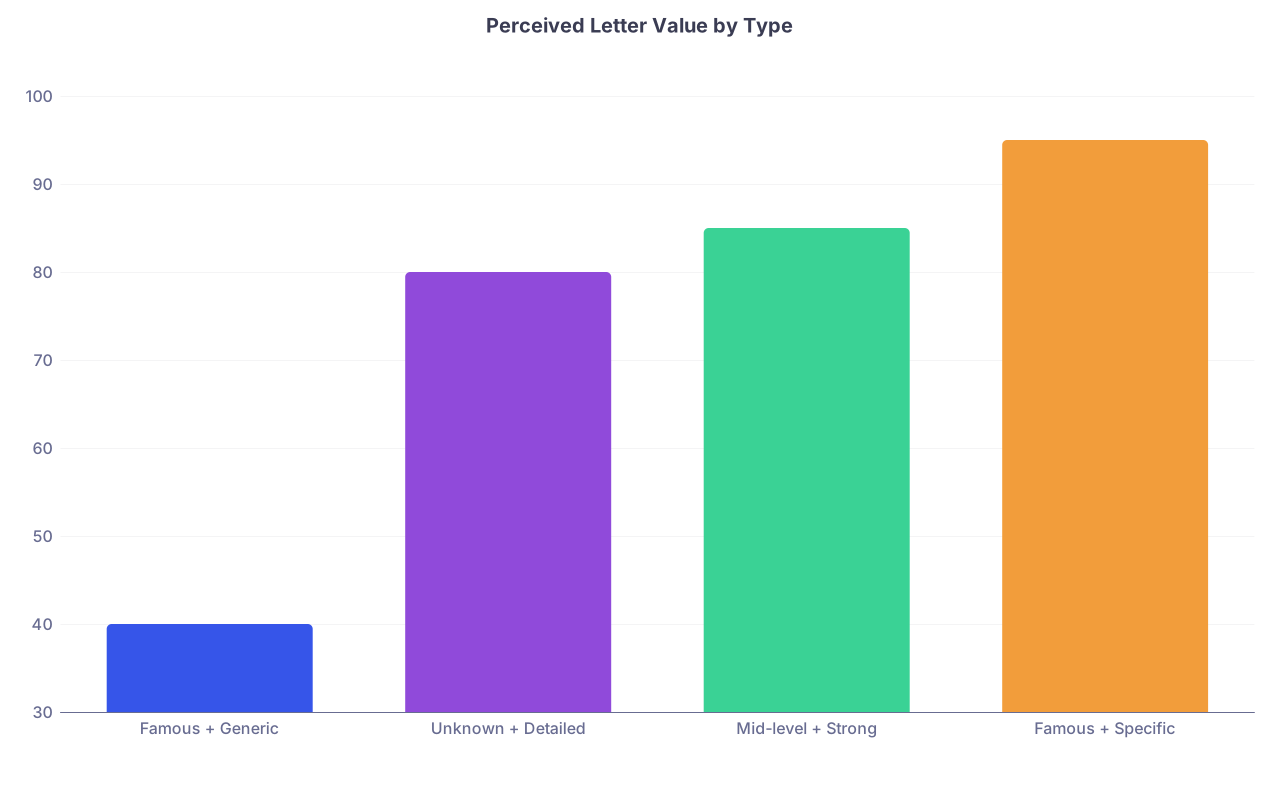
| Category | Value |
|---|---|
| Famous + Generic | 40 |
| Unknown + Detailed | 80 |
| Mid-level + Strong | 85 |
| Famous + Specific | 95 |
I’ve heard this exact comment: “I’d trust this associate professor who clearly knows the student over the world-famous person who wrote three lines.”
What Actually Impresses Committees (It’s Not What You Think)
You want to know what gets people to stop flipping pages and actually pay attention? It’s not the letterhead. It’s specificity.
Concrete, verifiable, boring details. That’s the real flex.
Examples that make people sit up:
- “She independently redesigned our data collection system, reducing error rates from ~15% to under 3% over one semester.”
- “He is the only undergraduate I have ever trusted to directly train new lab members on our assay.”
- “On our inpatient service, I watched him stay two hours late to sit with a family and help explain the plan, without being prompted.”
That’s what gets you comments like, “Okay, this person is the real deal.”
Let me be blunt: an associate professor at a state school who spends three paragraphs describing how you responded the day a patient crashed will absolutely outrank a generic “top 10% of students” from a famous chair.
How adcoms mentally score letters
They don’t write down numbers usually, but the mental calculus looks like this:
| Factor | Rough Impact on Letter Weight |
|---|---|
| Specific behavioral examples | Huge positive |
| Clear comparison group | Strong positive |
| Length + effort (without fluff) | Moderate to strong positive |
| Vague praise (“excellent”) | Neutral or mild positive |
| Name prestige alone | Mild positive at best |
You’re thinking, “But if I can get both—big name and details—shouldn’t I?” Yes. If it’s real. If that person truly knows you well. That’s rare but powerful.
But chasing prestige first, substance second? That’s where you get burned.
The Politics Behind Letters: What You Aren’t Told
Here’s the part nobody explains to you because it makes the system look bad.
Letters are political. Both at your institution and on the receiving end.
At your home institution
- Senior faculty regularly ask junior people, “Draft something and I’ll sign it.”
- Busy names say yes to letters because it’s politically easier than saying no.
- Some departments have unspoken norms: premed office wants “big” signatories to make the school look good.
So you end up with a senior-signature-on-junior-content situation. Committees know this. They recognize when a letter “by” a department chair reads exactly like the assistant professor’s writing style two pages later.
Once that suspicion pops, the letter’s value drops.
On the admissions side
At the adcom table, people have long memories. They recognize repeat offenders:
- The PI who calls every single student “top 1% of my career.”
- The department that has never once submitted a critical or nuanced letter.
- The big-name surgeon whose letters always look like they were pulled from a template.
Over time, those writers are discounted. Not consciously blacklisted, but mentally tagged: “Inflation. Ignore the superlatives.”
I’ve literally heard: “Oh, it’s from [Famous Person]. Discount 30%.”
Your choice of letter writer is not neutral. You’re tying your credibility to theirs.
When a Famous Name Does Help — And What It Looks Like
Let’s talk about the scenario where a big name actually helps you. Because it happens. It’s just rarer than students think.
The famous name helps when:
- They’ve actually seen you work, consistently.
- They can describe your performance with specific stories.
- Their comparison language is anchored (“top 5 of 200 students”) and believable.
- The tone reads like they wrote it, not you.
The best big-name letters sound oddly… unflashy. They’re grounded. They give real anecdotes. They admit small weaknesses and then contextualize them.
Example language that committees respect:
- “In 15 years of mentoring undergraduates, [Student] is among the top three in independent problem-solving.”
- “Unlike many students who simply follow protocols, she identified a design flaw in our assay and proposed a solution that we ended up adopting.”
- “He struggled early with time management on the wards, but by the third week he was functioning at the level of an early third-year student.”
That’s what “prestige done right” looks like.
And yes, when that letter also comes from “Professor of Medicine, Program Director, Big Institution,” your application gets a real bump. Because the hype matches the evidence.
How to Choose Letter Writers Without Getting Burned
Let’s strip this down to something actionable.
Your hierarchy of priorities for letters should be:
- Knows you well
- Can write in detail about your work and behavior
- Has some standing in the field
- Has a big/relevant name or institution
Most premeds flip that order entirely. That’s how you torpedo yourself.
Ask yourself three blunt questions
Before you chase the star letter, ask:
If this person were anonymous, would I still want a letter from them?
If the answer is no, that’s your sign.Can they describe at least two specific situations where they saw me struggle and improve, or lead, or handle something complex?
If you’re not sure, they probably can’t.Who actually watched me work day-to-day?
That’s usually the best primary letter writer. The senior person can sometimes co-sign if they truly know you.

| Step | Description |
|---|---|
| Step 1 | Need Letter |
| Step 2 | Do NOT ask |
| Step 3 | Lower priority writer |
| Step 4 | Strong primary writer |
| Step 5 | Still good, pair with another |
| Step 6 | Knows your work well? |
| Step 7 | Can give specific examples? |
| Step 8 | Has relevant role/title? |
The co-sign trap
Students love the idea of the “co-signed” letter. Junior person writes; big name adds title and signature.
Sometimes that works. Often, it reads like… a junior person’s letter with a random extra name stapled on.
Unless the senior person:
- Adds a paragraph in their own voice, or
- Genuinely knows you and incorporates their observations
…it’s empty calories. Committees see right through it.
If you’re going to do a co-sign, you want clarity:
- Primary writer clearly states their relationship with you and details your work.
- Senior co-signer briefly affirms they’ve also interacted with you and endorse the assessment.
Anything less just looks like prestige paint on a thin wall.
How to Talk to a Big-Name Potential Letter Writer (Without Screwing It Up)
If you still think a well-known person is genuinely your best option, you need to handle the ask correctly.
Here’s what people behind closed doors complain about: “Students ask me for a letter and I barely know who they are.”
So you don’t just say, “Can you write me a strong letter?” and hope.
You say something like:
“I’m applying to medical school this cycle and I’m trying to choose letter writers who know my work well enough to comment in detail. Do you feel you know me and my work well enough to write a strong, specific letter, or would it be better for Dr. X, who supervised me more closely, to be the primary writer?”
That wording does three things:
- Gives them an out if they don’t know you well (which protects you).
- Signals that you understand what a real strong letter requires.
- Shows maturity. And yes, faculty notice.
If they hesitate? If they say, “I’d be happy to write something,” but not “strong, detailed,” that’s a no. They are telling you, politely, they can’t vouch for you at the level you want.
Take the hint.
How Committees Read a “Famous But Weak” Letter in Context
Let’s walk through what happens behind the scenes at an actual review meeting.
Your file is up:
- Solid GPA, good but not insane MCAT.
- Clinical exposure, a bit of research, decent personal statement.
- Letters: one from a course professor who clearly loves you, one from a clinical supervisor with great anecdotes, and one from a giant-name researcher that’s vague and thin.
Someone at the table will say:
- “The course letter is excellent—lots of specifics.”
- “The clinic supervisor clearly trusted this student.”
- “The big-name letter is a little generic. I’m guessing limited direct contact.”
Then, crucially: “The stronger letters are from the people who actually worked with them. That’s what I care about.”
Best case: the weak famous-letter is ignored.
Worst case: someone asks, “Why did they not get a more substantive letter from the PI who actually supervised them? Is there something we’re not seeing?”
You wanted the big name to be your anchor. Instead, the real anchors are the people who could tell stories about you when things weren’t perfect.
Strategic Takeaways: How to Actually Play This Game Well
You’re not trying to win the “biggest flex letterhead” contest. You’re trying to assemble a coherent narrative backed by credible witnesses.
Three ways to stop sabotaging yourself:
Stop thinking “famous” first.
Start thinking: who has watched me do real work, over time, and can describe it?Vet your letter writers with direct questions.
Ask about their ability to write a strong, detailed letter. If they hedge, walk away.Coordinate across letters.
Aim for different angles: one on academics, one on clinical or service behavior, one on research or long-term commitment. You want multiple people independently saying, “This person shows up, does real work, and is trustworthy.”
If one of those happens to be a big name who truly knows you? Great. But that’s a bonus, not the foundation.
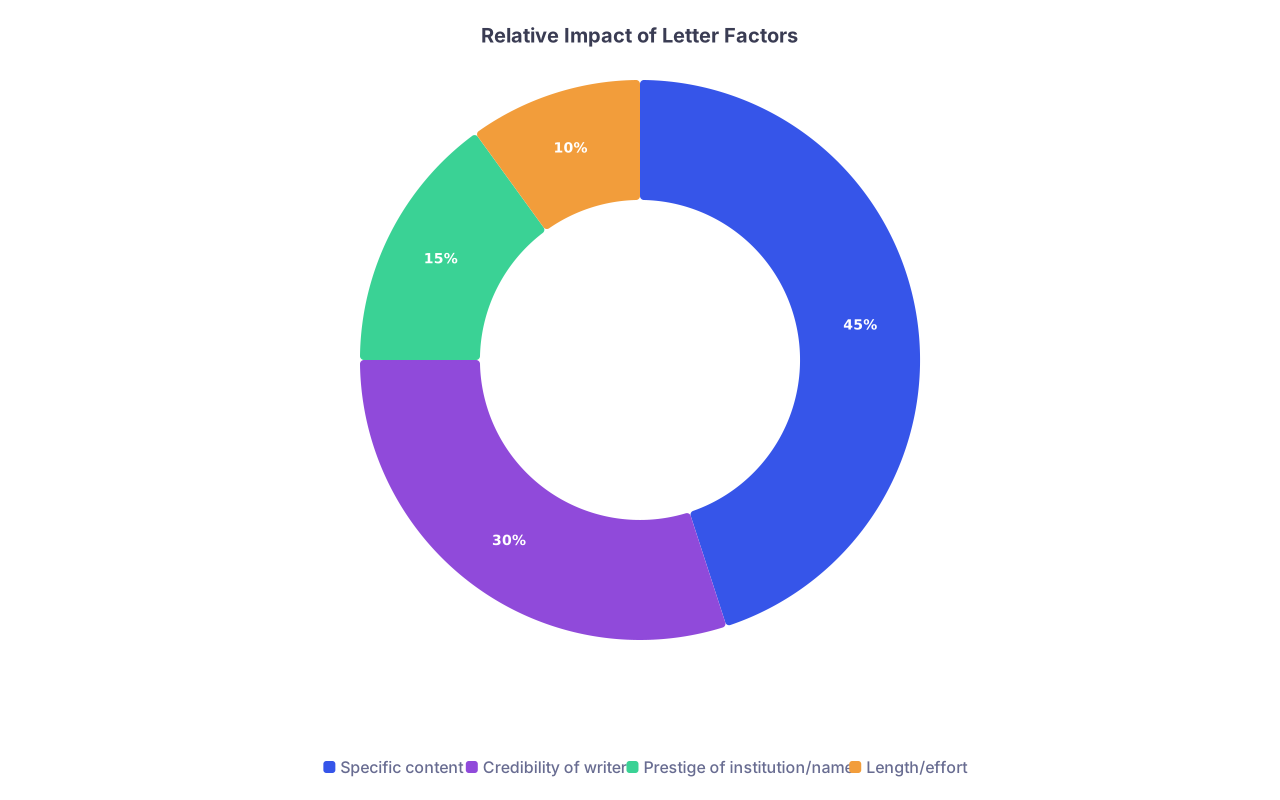
| Category | Value |
|---|---|
| Specific content | 45 |
| Credibility of writer | 30 |
| Prestige of institution/name | 15 |
| Length/effort | 10 |