
The hierarchy of mentors in your recommendation file is real—and most students have it completely backwards.
You’ve been told “get strong letters” like that means anything. What no one spells out is how program directors and admissions faculty silently rank your science, clinical, and research writers the second they open your file. Before they read a single adjective, they’ve already assigned a mental weight to each letter based on who wrote it and what arena they know you from.
I’ve sat in those rooms. I’ve watched PDs flip to the LoR page, glance at the letter writers for maybe three seconds, and go, “Okay, two science faculty, one PI, no real clinical.” Then they close the loop on you right there. Your whole year of “networking” and “building relationships” distilled to a 5-second scan of four names and titles.
Let me walk you through how this actually works.
The Hidden Tier System: Science vs Clinical vs Research
Every program director and admissions dean has an internal tier system for letters, even if they never say it out loud. It’s not written in the handbook. It’s not on the website. But it drives decisions.
Here’s the basic reality for premed and early medical students:
- They are trying to answer three separate questions:
- Can you do the science?
- Can you function around patients and in a team?
- Can you handle higher-level academic work and be productive?
Science letters, clinical letters, and research letters map almost perfectly to those questions. But they don’t carry equal weight across every stage.
At the premed / med school application stage, the rough weighting—how people actually read these—is closer to this:
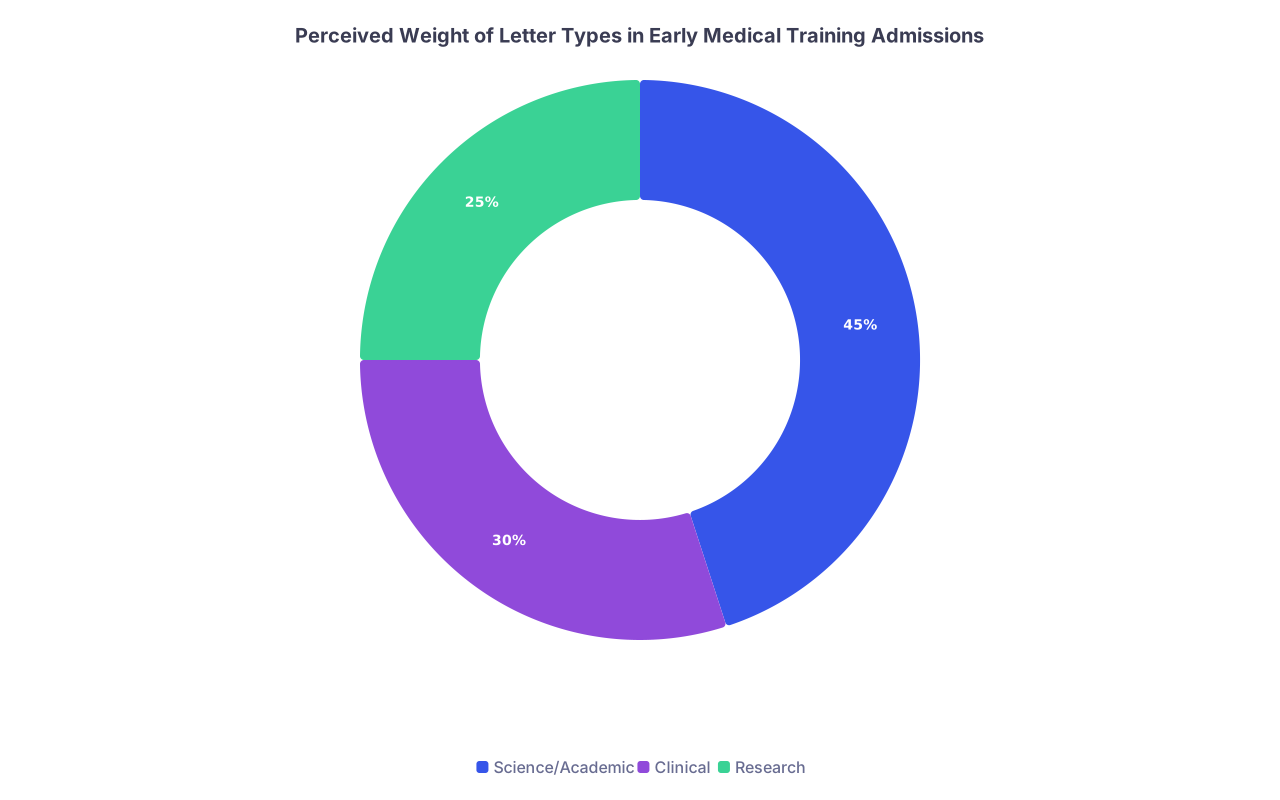
| Category | Value |
|---|---|
| Science/Academic | 45 |
| Clinical | 30 |
| Research | 25 |
Nobody will show you that chart in an official presentation. But it matches how committee discussions sound when we close the door.
Now, that weighting shifts as you move along the pipeline. Early on, science letters dominate more than you think. Later, clinical letters can make or break residency applications. Research letters float up in importance at academic-heavy places and research tracks.
But the key point: PDs and faculty don’t read all letters as interchangeable “three strong recommendations.” They mentally rank the type of mentor and ask, “Does this box get checked, and how solidly?”
How Science Mentors Are Really Used Against You (and For You)
Let me be blunt: science letters are your baseline credibility test. Admissions deans use them to decide whether to trust your GPA and transcripts.
On paper, you have an A in Organic Chemistry. In reality, the committee doesn’t fully believe that until Dr. Biochemistry writes, “This student is in the top 5% of all undergraduates I’ve taught in the last 10 years.”
How PDs and Faculty Read Science Letters
Here’s what they actually look for when they see “Letter from Organic Chem professor” or “Letter from Physiology course director”:
- Does this person teach a hard course or run a key block?
- Do they know this student beyond “took my class and sat in row three”?
- Do they have a reputation on the committee? (We absolutely talk about which faculty chronically overpraise everyone.)
On admissions panels, I’ve heard variations of:
- “Her physics letter is from X—he’s a tough grader. If he says she’s top 10%, that means something.”
- “This microbio letter is all narrative and vibes, no ranking, no comparisons. I don’t trust it.”
What matters to them:
- Comparative statements. “Top 5% of 300 students” hits very differently than “one of the better students.”
- Course rigor. A letter from the biochem course director >>> adjunct for Intro to Nutrition.
- Specific evidence of performance. High exam scores, leadership in group work, ability to explain concepts to peers.
What they largely ignore:
- “She always came prepared and was on time.”
- “He has a passion for science.”
- Generic “I recommend her without reservation” with no teeth behind it.
If your science letters are weak or purely descriptive, the unspoken translation at the table is: the numbers might be inflated or the faculty didn’t care enough to advocate strongly. No one will say that to your face. But they will quietly push your file toward the “maybe” or “no” pile.
Clinical Mentors: The Letters PDs Trust With Their Lives
Clinical letters are where PDs stop thinking like admissions gatekeepers and start thinking like people responsible for patient safety.
When a PD reads a clinical letter, they’re not asking, “Are you smart?” They’re asking, “If I put this person on my wards with my sickest patients and my most irritable nurses, will things function or catch fire?”
This is why—even for early med students—letters from true clinical supervisors are gold.
Who Counts as a “Real” Clinical Mentor
Here’s the part premeds always misunderstand. Shadowing doesn’t produce serious clinical letters. “Observed for 40 hours” tells us nothing about how you act when it’s 3 pm, you haven’t eaten, and the nurse is pissed.
The clinical letters that PDs and faculty actually lean on are from people who have seen you:
- Interact with patients.
- Operate on a team.
- Handle stress, confusion, uncertainty.
At the premed/early stage, that might be:
- A physician you worked with longitudinally as a scribe or MA.
- A clinician you did substantial volunteer work with (months, not afternoons).
- For med students, attendings on core rotations, sub-I supervisors, clerkship directors.
When those letters exist, they’re often ranked above science letters in residency decisions and very competitive med school admissions, because they map directly to, “Will this person function as a trainee?”
The strongest clinical letters say things like:
- “I trusted her to speak with patients independently, then present succinctly and accurately.”
- “He actively sought out feedback, implemented it immediately, and you could see the difference by the end of the rotation.”
- “Nurses and staff asked to work with her again—this is extremely rare for a student at this level.”
What PDs Read Between the Lines
I’ve heard PDs do this in real time:
- “Lots of ‘pleasant to be around,’ not much about clinical judgment. So, nice kid, unknown quantity as a doctor.”
- “If the attending doesn’t once mention how they handled uncertainty or feedback, I worry they didn’t trust them with anything.”
A glowing clinical letter can compensate for a merely solid science letter.
The reverse? Much harder. You can be brilliant on exams and still be a disaster in a hospital. PDs know that. They’ve lived it.
Research Mentors: Overvalued by Students, Understood by PDs
Students chronically misjudge research letters. You either worship them (“It’s from a Harvard PI, this will carry my app”) or ignore them (“I’m not going into academics, who cares?”). Both views miss how PDs actually process these.
Research letters answer one central question: Can this person handle open-ended, complex work without constant hand-holding?
That matters more than you think.
What Makes a Research Letter Powerful
Here’s when a research letter jumps into the top tier:
- The PI is known and respected by the committee or specialty.
- The letter gives concrete evidence of sustained, independent work.
- The student survived real failure, setbacks, and still produced something.
Comments that resonate:
- “She developed her own analytic pipeline after our post-doc left. I now use parts of her code in my other projects.”
- “He took ownership of the project, presented at a regional meeting, and is first author on a manuscript in progress.”
- “I would happily take this student as a resident—I’ve never said that lightly about a medical student.”
Notice that last line. That’s where a research letter crosses over into clinical relevance. When a PI is saying, “I trust this person to be a physician,” they’re stepping into PD territory.
Where Research Letters Fall Flat
What PDs discount heavily:
- “He was always enthusiastic and asked good questions about science.” Translation: showed up, did not move the needle.
- “She contributed to ongoing projects in the lab.” Translation: standard undergrad work.
- “I anticipate they will be successful in medicine.” Translation: I don’t actually know how they will do.
If your research letter says nothing about independence, grit, or long-term follow-through, it gets quietly filed as a “nice supporting letter” but not a driver.
And here’s the ugly truth: a two-summer lab stint with minimal output isn’t rescuing mediocre science and no clinical.
How PDs Rank These Letters Side-by-Side
Let’s put this into how it sounds in the room, because that’s what you actually need to understand.
Imagine three applicants with similar stats.
Applicant A:
- 2 strong science letters (orgo, physiology)
- 1 okay research letter from a local PI
Applicant B:
- 1 good science letter
- 1 stellar clinical letter from a hospitalist who worked with them for months as a scribe
- 1 average research letter
Applicant C:
- 1 science letter that’s generic
- 1 big-name research PI letter (“top 1% research mentee”)
- 1 weak clinical/volunteer letter (“pleasant, on time”)
In committee, the conversation goes something like:
- A: “Solid student, seems reliable academically. Not much info on how they are with people.”
- B: “Science is fine, but this clinical letter is very strong. Sounds like a real team player and safe with patients.”
- C: “Impressive research but I’m not convinced they won’t be difficult or disconnected clinically. And the science letter isn’t fighting for them.”
Who gets the strongest support? B, almost every time in a clinically oriented program. In a research-heavy, academic powerhouse? C starts to look more interesting, but someone will still flag the soft science and weak clinical picture.
Here’s a simplified way PDs mentally “weight” letters when comparing applicants at early med / competitive med school level:
| Context | Science Letter | Clinical Letter | Research Letter |
|---|---|---|---|
| Standard med school admission | High | Medium | Medium-Low |
| Research-heavy med school | High | Medium | Medium-High |
| Clinical-heavy residency | Medium | Very High | Low-Medium |
| Academic residency program | Medium | High | High |
Is it exact? Of course not. But it’s close enough to guide your priorities.
The Sequence You Should Actually Be Planning
Most students collect letters opportunistically: “I did a thing; guess I should ask for a letter.” That’s amateur hour. The way insiders think about it is more like building a portfolio over time.
It looks more like this:
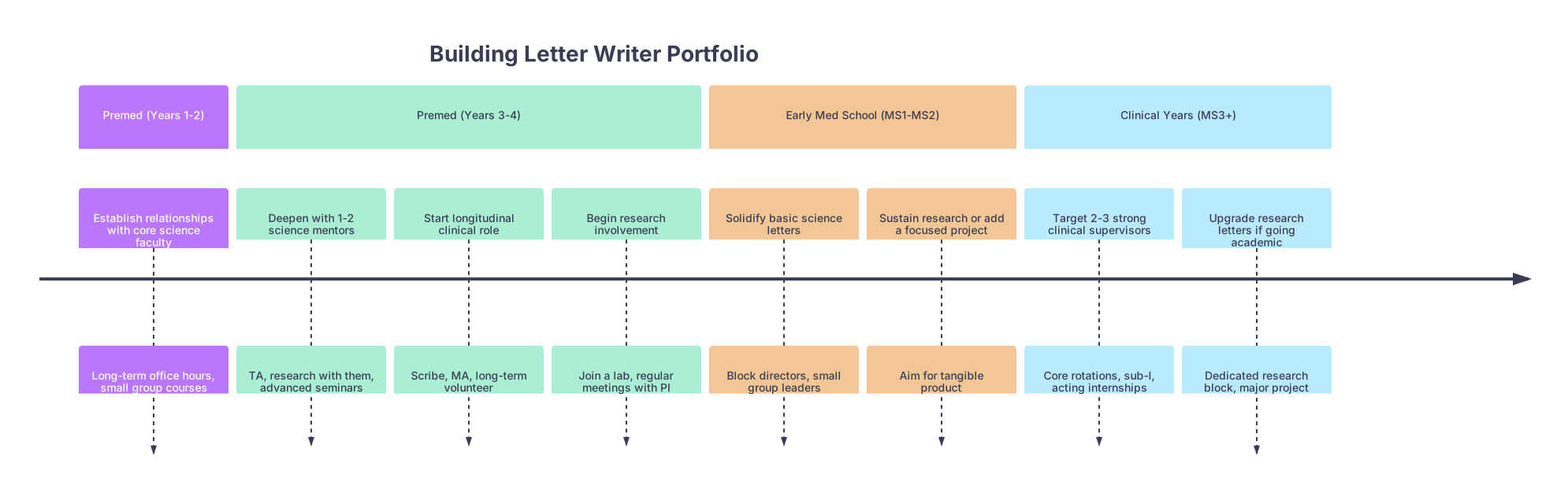
| Period | Event |
|---|---|
| Premed (Years 1-2) - Establish relationships with core science faculty | Long-term office hours, small group courses |
| Premed (Years 3-4) - Deepen with 1-2 science mentors | TA, research with them, advanced seminars |
| Premed (Years 3-4) - Start longitudinal clinical role | Scribe, MA, long-term volunteer |
| Premed (Years 3-4) - Begin research involvement | Join a lab, regular meetings with PI |
| Early Med School (MS1-MS2) - Solidify basic science letters | Block directors, small group leaders |
| Early Med School (MS1-MS2) - Sustain research or add a focused project | Aim for tangible product |
| Clinical Years (MS3+) - Target 2-3 strong clinical supervisors | Core rotations, sub-I, acting internships |
| Clinical Years (MS3+) - Upgrade research letters if going academic | Dedicated research block, major project |
The mistake is waiting until you “need letters” to think about this. By then, the only people who can write you anything are those who barely know you.
What PDs Privately Think About Letter Combinations
Let me pull back the curtain on how faculty react to different “letter packages.” This is rarely spelled out, but I’ve heard versions of this countless times in committee rooms.
Package 1: Heavy Science, Light Clinical, No Real Research
Two very strong science letters. One generic volunteer coordinator letter.
The talk in the room:
- “Clearly strong book learner. Not a lot of evidence they can function in a complex setting.”
- “We’d be taking more of a risk on professionalism and clinical adaptability.”
For med school? Still workable, especially at state schools. For competitive programs? You just made them nervous.
Package 2: Balanced Science + Clinical, Light Research
One strong science letter. One strong clinical letter (real responsibilities). One soft research letter or none.
This combo is quietly loved.
- “Good balance; seems reliable academically and not a social disaster.”
- “We can teach research if needed; we can’t teach them not to be entitled or bizarre.”
You’ll never hear this officially, but between a “research star with questionable people skills” and a “balanced, teachable, decent human,” most PDs pick the second.
Package 3: Big Research, Mediocre Science, No Clinical
One huge-name PI letter. One lukewarm science letter. One meaningless “character” letter.
The split in the room:
- Academic types: “This one could become a real contributor to our department.”
- Clinically focused folks: “Do I want to be on call with them? I have no idea.”
In some programs (top-10 research powerhouses), this can still work well. In most others, this makes them worry about fit and day-to-day functioning.
Package 4: Strong Across All Three
High-quality science, sharp clinical, and substantive research letters.
These are the files that shut people up in meetings. Because there’s no easy angle to argue against.
That doesn’t mean you need three perfect letters, but you should understand why committees are so impressed when someone shows consistency in all three domains. It’s rare.
How to Prioritize Now (Premed and Early Med)
You’re not choosing in a vacuum. You’re limited by who actually knows you well enough to write something real. But you can be strategic.
If you’re premed:
Lock in at least one truly strong science letter. This means:
- Small classes or advanced courses where you actually interact.
- Office hours. Project work. TA positions.
- Someone who can write, “I know this student very well in an academic context.”
Build at least one longitudinal clinical relationship. Not 10 shallow shadowing stints. One or two deep, recurring roles where someone can see you grow and function.
Treat research as a bonus lever, not your foundation—unless:
- You’re applying to MD/PhD, or
- You’re targeting heavy research schools and have genuine, high-level work to show.
If you’re in early med school (pre-clinical):
Make sure your basic science letters (block directors, small group leaders) are covered by actually getting to know a minority of them very well.
Position yourself so that during your clinical years, you can grab:
- One “this person is safe and capable around patients” letter.
- One “this person is outstanding, I’d take them in my own program” letter if you can pull it off.
If you’re even thinking about an academic or competitive path, give your research mentor enough time and depth with you that they can do more than, “They worked hard in my lab.”
Mistakes PDs See Repeated Every Cycle
A few patterns that quietly sink otherwise decent applications:
Three letters from research mentors, no one from a heavy science course or real clinical role. Translation: “Does this person even like patients? Or are they just a lab rat applying to medicine because that’s what people do?”
Letters from “big titles” who clearly barely know you. PDs would much rather read a detailed, specific letter from a mid-level faculty who has seen you struggle and grow than three vague paragraphs from a department chair who met you twice.
Overloading on one category. All science, no clinical. All clinical, no evidence of academic rigor. All research, no human interaction. Committees do not like imbalanced pictures unless you are absurdly exceptional on one axis.
The Quiet Truth: Letters Are About Risk
Strip away the formalities and here’s what letters are doing in a PD’s head:
- Science mentors answer: “Will this person collapse under the academic load?”
- Clinical mentors answer: “Will this person hurt my patients or destroy my team culture?”
- Research mentors answer: “Will this person bring added value and long-term potential to my program?”
PDs don’t have time to psychoanalyze every file. They rely heavily on people they trust—your mentors—to de-risk you.
So when you’re choosing who writes for you, you’re not just picking “nice people who like me.” You’re assembling a risk profile.
Years from now, you won’t remember which exact adjectives showed up in your letters. You’ll remember which mentors you invested in early, who actually knew you well enough to go to bat for you when it mattered—and how those quiet choices shaped which doors opened and which quietly stayed shut.