
The harsh truth: most pre‑med letters of recommendation are background noise.
From the admissions side, maybe 1 in 10 letters actually moves the needle. The rest? Bland, interchangeable, or clearly written by someone who barely knows you. And yes, admissions committees and future program directors can spot the difference in under ten seconds.
You’re being told, “Get three strong letters,” but nobody is telling you what “strong” actually means to the people reading them. Or who they secretly trust. So let me tell you what actually happens behind closed doors when your letters hit the table.
How Committees Really Read LORs
I’ve sat in those rooms. I’ve watched piles of applications fly by with comments like:
- “Letters fine, nothing special.”
- “Generic science prof, no specific examples.”
- “Strong letter from PI – keep this one in mind.”
Letters aren’t read like personal statements. They’re skimmed fast, filtered by two questions:
- Who is writing this?
- Are they putting any real skin in the game?
If the name doesn’t carry meaningful weight in that context, or the content is vague fluff, your letter becomes a check box, not an advantage.
Let me break down the categories of mentors and how their letters are actually perceived, not how your pre‑health office markets them.
The Hidden Hierarchy of Pre‑Med Letter Writers
There is a hierarchy. It’s unspoken, but it’s very real. Not every “strong letter” is created equal. The same glowing adjectives in one letter mean something very different coming from three different people.
| Writer Type | Typical Impact on MD Committees |
|---|---|
| Research PI (known, publishing) | High |
| Science faculty who knows you well | Moderate–High |
| Physician who directly supervised | Moderate |
| Committee/composite letter | Moderate |
| [Shadowing-only physician](https://residencyadvisor.com/resources/letters-of-recommendation/shadowing-vs-longitudinal-mentor-what-faculty-secretly-prefer-in-letters) | Low |
| Random “impressed by” prestige name | Very low |
1. Research PIs – The Quiet Power Brokers
If you want to know who quietly shapes a lot of admissions decisions, it’s productive research mentors who actually know how you work.
I’m talking about:
- A lab PI who’s seen you fail experiments and come back the next weekend.
- Someone who can say, “She thinks like a resident already – takes ownership, anticipates next steps, and teaches the undergrads.”
When committees see a serious PI writing a detailed letter, they lean in. Why?
Because PIs are used to ranking people. They’ve written for fellows, residents, faculty hires, grant reviewers. They know what “best I’ve worked with in 5–10 years” actually means, and they don’t throw that around lightly if they have any academic reputation.
The letters that move the needle from PIs:
- Compare you to a cohort: “Top 5% of more than 80 undergrads I’ve mentored.”
- Give specific behaviors: “She rewrote our data analysis pipeline after noticing an inconsistency in the controls.”
- Show longitudinal involvement: “Over two years, she progressed from learning basic techniques to independently designing and executing a sub‑project.”
The dead PI letters (and I see these a lot):
- “She was a pleasure to have in the lab and was always on time.”
- “He completed his assignments and showed good scientific curiosity.”
- No timeline, no comparison, no concrete examples. Translation: warm body, did not mess up, nothing special.
Here’s the insider part: committees recognize certain institutions and even certain individual PIs. If your PI is an R01‑funded researcher at a major academic center, their strong letter is more powerful than a generic “Dr. Famous” who barely knows you.
2. Science Faculty – The Workhorses Committees Rely On
Admissions committees are usually full of people who’ve taught pre‑clinical and undergraduate science. They know exactly what a typical orgo student looks like. So a smart, specific letter from a course professor is more valuable than students think.
Good faculty letters sound like:
- “She was in the top 3 students in a class of 220, but that’s not why I’m recommending her. In office hours she repeatedly brought in connections to primary literature and helped me lead a small discussion group.”
- “He came to office hours not to haggle for points, but to understand why the mechanism worked that way. By mid‑semester I had him informally tutoring the students who were failing.”
What committees look for:
- Rank or percentile in a large class.
- Evidence you’re more than just a “grade bot.”
- Initiative outside exams: office hours, tutoring, leadership in group work.
The usual mediocre professor letter:
- “X was a student in my Biochemistry 201 course and received an A.”
- “She was on time, turned in assignments, and worked well with peers.”
- Maybe one vague line about “I recommend her highly.”
That’s box‑checking. No one fights for you based on that letter.
3. Physicians – Overrated by Students, Carefully Discounted by PDs
Here’s where most pre‑meds get it wrong.
You think, “If I get a letter from Dr. Bigshot Neurosurgeon at Prestigious Hospital, that’ll impress them.” No. Not unless that person actually supervised you on something real and can describe your behavior in detail.
Shadowing letters are the worst offenders:
- “He shadowed me for 30 hours in clinic and was always on time and professional.”
- “She asked good questions and showed interest in patient care.”
Do you know how many times we’ve read exactly that sentence? Thousands. It may as well be auto‑filled.
Physicians’ letters start to matter when:
- You’ve worked as an MA, scribe, or research assistant directly under them.
- You’ve seen them for months, not two afternoons.
- They’ve watched you interact with patients, staff, and crises.
A strong clinical supervisor letter can make someone on the committee say, “This person has already behaved like an intern in some ways.” That’s gold. But the bar is high.
The red flag we do not say out loud: letters where the physician clearly doesn’t write many academic letters. You can spot them instantly. Overly dramatic, no examples, “I have no doubt he’ll be an excellent physician” after 12 hours of observation. Those carry almost no weight.
4. Committee/Composite Letters – Trusted, But Impersonal
At schools that use pre‑health committee letters, many admissions committees use that as a baseline trust document. It tells them:
- Are you average, above average, or exceptional compared to your school’s typical applicant?
- Did any of your letter writers raise concerns?
- Is there coded language suggesting professionalism issues?
The committee letters that quietly hurt applicants are the ones with subtle hedging language:
- “She will be a solid medical student.”
- “He is suitable for a career in medicine.”
Those phrases are not neutral. They’re lukewarm.
What moves the needle in a committee letter is when the writer clearly filtered and curated your subs’ letters and explicitly states: “Three independent faculty members independently described X as one of the best students they have worked with in the last five years.”
But remember: the composite letter is often more about risk assessment than enthusiasm. It’s good for eliminating red flags. It rarely creates a star impression by itself.
5. Prestige‑Name Letters – The Most Overrated Flex in Pre‑Med
Let me be blunt: a letter from “Famous Dean I Barely Worked With” is a waste of oxygen.
Committees see this move constantly:
- You volunteer for two weeks on a project run by someone with a huge title.
- You get them to sign a generic letter drafted by you or an assistant.
- You think the title will do the work.
Behind the scenes? We discount those heavily unless the content is unusually detailed for someone in that role.
The question we ask quietly when we see a big title: “How well can this person possibly know this student’s day‑to‑day behavior?” If the answer is “not at all,” we skim and move on.
Who PDs and Future Faculty Actually Trust
You’re not just applying to med school. You’re building a reputation that will follow you into residency. Program directors talk about patterns they saw starting all the way back in pre‑med and med school letters.
Here’s who they consistently respect as early validators.
Longitudinal Mentors – The People Who’ve Actually Watched You Grow
The single most powerful pattern in letters across your journey:
Same kind of person, over time, saying the same thing about you.
Example: You have a research PI in undergrad saying, “She takes full ownership of her work, anticipates problems, and keeps the team organized.” Four years later, your third‑year clerkship director writes, “She’s the student I’d let run my service overnight. Organized, anticipates needs, reliable.”
PDs trust that. Because they’ve seen it before: early habits become residency habits.
So if you’re asking “who moves the needle?” it’s not just job title. It’s whoever has:
- Watched you in real responsibility.
- Seen you respond to stress, failure, and feedback.
- Seen you interact with peers and subordinates, not just authority figures.
Mentors Who Themselves Are Embedded in Training Pipelines
This is subtle but crucial. Letters from people who regularly deal with trainees—residents, fellows, students—are interpreted differently. They know what a “good trainee” looks like.
A PI who mentors MD/PhD students. A hospitalist who regularly runs teams with residents and med students. A surgical attending known for chief evaluations. Their calibration matters.
Their strong “I’d take this person on my team anytime” statement is taken far more seriously than a glowing letter from a private community doc who doesn’t teach.
People Known to the Committee (Yes, the Network Matters)
Admissions worlds are small. Residency worlds are even smaller. Trust travels along familiar names.
I’ve seen this play out more than you’d like to admit:
- Faculty on the committee sees a letter from “John Smith, MD” at a program where she trained.
- She says, “If John is going this hard for someone, they’re solid. He doesn’t do that lightly.”
Is that fair? Not always. Is it real? Absolutely.
You can’t manufacture this, but you can stack the deck by:
- Doing research or clinical work at academic centers that train residents and fellows.
- Prioritizing mentors who are known teachers and evaluators, not just clinicians.
What Makes a Letter Actually “Move the Needle”
Forget the adjectives. Every letter says “hardworking,” “bright,” “compassionate.” What changes your file’s trajectory are three things:
1. Specific, Risk‑Bearing Endorsements
The letters that wake committees up contain what I call risk‑bearing lines. Phrases that, if you turn out to be mediocre, will make the writer look bad. That’s what real endorsement sounds like.
Examples:
- “I would rank her in the top 1–2 students I have taught in the last decade.”
- “If my own family needed care, I would trust him without hesitation.”
- “I’ve already told him he has a standing invitation to return as a resident in our program.”
These lines aren’t handed out freely. When a serious mentor writes that, we listen. And we remember.
Weak, non‑committal versions:
- “She will make a good doctor.”
- “I recommend him without reservation” stapled onto a generic paragraph.
We’ve all seen that sentence 5,000 times. It has no weight.
2. Concrete Stories That Show You Under Stress
The best letters don’t just say you’re good. They show you in motion. Hyper‑specific moments:
- “During a late‑night data collection session when the equipment failed, she stayed four extra hours troubleshooting, then volunteered to come in the next morning to repeat the run so we wouldn’t lose a week.”
- “When a patient began to cry in clinic after receiving a new diagnosis, he independently paused the intake, pulled up a chair, and gave her space to talk. I only realized this when the MA later commented that she’d never seen a student handle that conversation so gracefully.”
That level of narrative sticks in reviewers’ minds and further differentiates “good GPA” from “future colleague.”
3. Internal Consistency Across Writers
PDs, like med school committees, are pattern‑hunters. Three letters all saying “organized, takes initiative, incredibly reliable” is much stronger than one glowing outlier and two bland ones.
What they don’t like:
- One effusive research letter and two tepid class letters.
- A committee letter that quietly hedges while a shadowing doc gushes.
That inconsistency makes people nervous. They start asking, “Who actually sees the real version of this person?”
How to Position Yourself for High‑Impact Letters (Starting Now)
You cannot fix letters three weeks before they’re due. The game is decided months or years earlier, based on how you chose mentors and how you showed up.
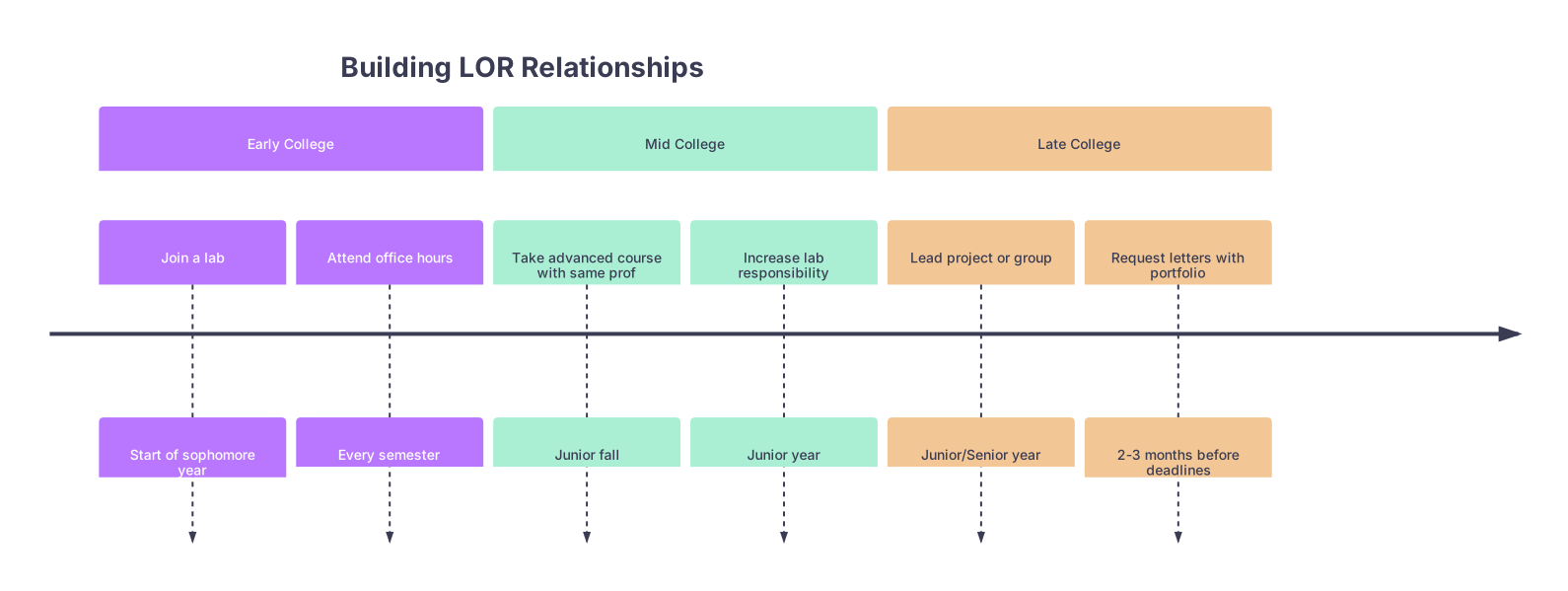
| Period | Event |
|---|---|
| Early College - Join a lab | Start of sophomore year |
| Early College - Attend office hours | Every semester |
| Mid College - Take advanced course with same prof | Junior fall |
| Mid College - Increase lab responsibility | Junior year |
| Late College - Lead project or group | Junior/Senior year |
| Late College - Request letters with portfolio | 2-3 months before deadlines |
Here’s the behind‑the‑scenes playbook people who end up with needle‑moving letters almost always follow:
They pick fewer mentors and go deeper with them.
The students who get killer PI letters usually:
- Stay in the same lab for a year or more.
- Take on ownership of a sub‑project, not just pipetting and data entry.
- Ask for feedback and actually change their behavior based on it.
The students who get strong faculty letters usually:
- Take more than one course with the same professor if possible.
- Show up consistently to office hours with real questions.
- Volunteer to TA, lead review sessions, or help with course materials.
The students who get powerful clinical supervisor letters usually:
- Work real jobs: MA, EMT, scribe, or long‑term volunteer with actual tasks.
- Treat the work like an audition, not “I’m just pre‑med, this is temporary.”
- Make themselves indispensable to the team over time.
You’ll notice none of that relies on “finding a famous person.” It relies on making your work and character incredibly hard to ignore for the people already around you.
Content Mistakes That Quietly Kill Letters
Let’s talk about the stuff mentors don’t tell you, but talk about with each other.
The most common reasons a potential strong writer gives a lukewarm or generic letter:
- You were competent but invisible. Did the work, never caused problems, never stood out.
- You only showed up when you needed something: score regrades, letter requests, resume builders.
- You seemed uninterested in feedback. Defensiveness, excuse‑making, blaming others.
- You treated staff poorly. PIs and attendings listen to their lab managers and MAs. Always.
I’ve seen students with 4.0s get mediocre letters because the unspoken verdict was, “Smart but transactional. Wouldn’t want them on my team at 2 a.m.”
On the flip side, I’ve seen 3.5 GPA applicants get shockingly strong letters because multiple mentors wrote, independently, “Best teammate in the lab,” “Held the group together,” “Everyone wanted to work with her.”
Committees believe the latter more than your GPA.
What Actually Shows Up in a PD’s Head When They Read Your Old Letters
PDs eventually see the med school versions of the same pattern: who advocates for you, how consistently, how concretely. When I talk with PDs about “great residents,” two things always come up:
- “Everyone loved working with them, even early on.”
- “Their letters always said the same thing about their work ethic and reliability.”
That story starts now, in your pre‑med letters.
The mentors whose words PDs and faculty trust across the years are the ones who:
- Have watched you handle real responsibility.
- Have seen your worst days, not just your best.
- Are willing to put their reputation behind you with specific, risky praise.
Your job as a pre‑med is to seek those people out, then earn that level of trust over time.
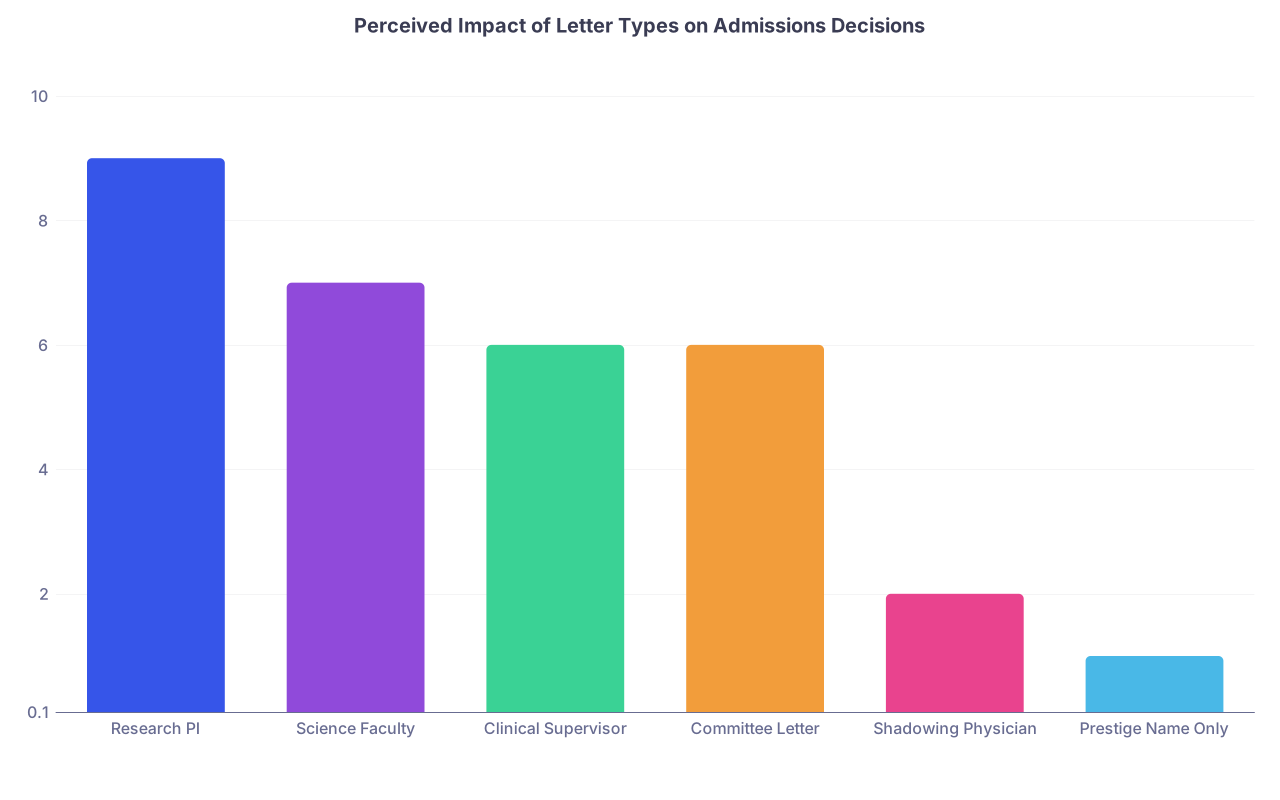
| Category | Value |
|---|---|
| Research PI | 9 |
| Science Faculty | 7 |
| Clinical Supervisor | 6 |
| Committee Letter | 6 |
| Shadowing Physician | 2 |
| Prestige Name Only | 1 |