
The way most premeds approach letters of recommendation is backward. Scrambling for last‑minute mentors sabotages your application more than a single bad grade ever will.
You cannot “shop” for a mentor two weeks before a deadline and expect a strong medical school letter. That is fantasy. And admissions committees can smell it instantly.
Let me walk you through the traps you are walking straight toward if you keep treating letters like a checkbox instead of a relationship.
The Core Problem: You Are Trying To Buy Trust On Credit
Last‑minute mentor shopping is exactly what it sounds like:
- You realize deadlines are close.
- You count how many “required letters” you need.
- You look around for anyone with an MD / PhD / “impressive title.”
- You send a semi‑panicked email asking for a “strong letter.”
- You give them 7–14 days and a copy of your CV and personal statement.
- You pray.
This is not “networking.” It is desperation.
The mistake is simple but deadly: you are trying to extract a high‑stakes, credibility‑based document from someone who has not actually had time to know you, observe you, or care about your success.
That is what admissions committees call a weak letter. And weak letters do not stay neutral. They actively drag you down.
How Weak, Last‑Minute Letters Look From the Committee Side
I have read enough letters and heard enough committee conversations to know how this plays out.
Picture a file review meeting. Three apps on the table with similar stats:
- GPA: all around 3.7
- MCAT: all around 514
- Activities: some research, some clinical
What breaks the tie? Often, letters.
Now look at how different letter types land.
| Feature | Strong Letter | Last‑Minute / Weak Letter |
|---|---|---|
| Specific anecdotes | Multiple, detailed | None or 1 vague example |
| Time known | 1+ semester / 6+ months | 4–8 weeks |
| Enthusiasm | Clear, repeated, unforced | One lukewarm sentence |
| Comparative statements | Top 5–10% of students | Avoids comparisons entirely |
| Alignment with your story | Clearly fits your narrative | Feels random or generic |
The weak letter usually has at least one of the following red flags:
- “I have known ___ for a short time but…”
- “While I have not had the opportunity to work with ___ extensively…”
- “Based on my limited interactions…”
- “I understand that ___ is an accomplished student…”
Translation: I do not really know this person.
That one sentence can neutralize an entire page of generic praise.
The Most Common Last‑Minute Mentor Traps
You probably recognize yourself in at least one of these. Better to fix it now than pretend it is fine.
1. The “Impressive Title, Zero Relationship” Mistake
You chase the department chair, the director of the hospital, the “famous” researcher—because their title looks powerful on paper.
You think:
- “An MD from a big hospital will matter more than a PhD from a small college.”
- “A PI with an R01 will impress the committee.”
- “Name value must count for something.”
Here is the problem. Those people have:
- Less time.
- More requests.
- Less personal interaction with you.
- No incentive to stretch for a student they barely know.
So you get a letter full of:
- Course descriptions instead of performance.
- “He completed his tasks” instead of how you stood out.
- Template sentences you could copy‑paste into anyone’s file.
I have seen department chair letters that were outperformed—easily—by a detailed, heartfelt letter from a community college professor who actually knew the student.
2. The “Professor From Freshman Year” Who Barely Remembers You
Premeds love believing this will work because it feels safe. You got an A. You showed up. They smiled at you.
Two years later, you send the email.
Reality check: that professor has taught hundreds of students since then. If you have not kept a relationship alive, they have to reconstruct you from:
- Old gradebook
- Maybe a dusty email thread
- Your CV
That leads to letters full of:
- “___ earned an A in my course.”
- “___ consistently attended lectures.”
- “___ completed all assignments on time.”
Which tells the committee nothing they did not already know from your transcript.
High grade ≠ strong letter. Stop assuming it does.
, Long-term mentor](https://cdn.residencyadvisor.com/images/articles_svg/chart-impact-of-relationship-depth-on-letter-strength-4380.svg "Impact of Relationship Depth on Letter Strength")
| Category | Value |
|---|---|
| Just took class | 2 |
| Talked after class a few times | 5 |
| Regular [office hours](https://residencyadvisor.com/resources/letters-of-recommendation/no-obvious-mentor-stepbystep-plan-to-build-lor-relationships-from-scratch) | 8 |
| Long-term mentor | 10 |
(Think of this as a 0–10 scale of how much a letter can help you. The “just took class” letter is barely above useless.)
3. The 10‑Day Deadline Email
You know exactly what this looks like. I have seen versions of this subject line too many times:
- “Urgent LOR request (deadline next week)”
- “Last‑minute request for a strong letter of recommendation”
- “Deadline approaching—could you help?”
You are basically saying:
- I did not plan well.
- I want you to fix it.
- On your free time.
- With your professional reputation.
The best mentors will often say no. Politely. Because they understand their letter could either be rushed and mediocre or on time and thoughtful—not both.
The ones who say yes with 5–10 days’ notice usually do one of two things:
- Give you a generic letter that might as well be a template.
- Recycle another student’s structure with your name and details swapped.
Neither of those outcomes makes your application stronger.
How Last‑Minute Mentor Shopping Warps Your Whole Application
The damage is not limited to weak letters. Once you start “shopping” under time pressure, it bleeds into other parts of your file.
1. Your Narrative Becomes Disjointed
Strong applicants have coherence:
- Their personal statement tells one clear story.
- Their activities point in the same general direction.
- Their letters confirm and deepen that picture.
Last‑minute mentor shopping creates random, mismatched letters:
- One letter praises your lab skills.
- One letter vaguely mentions your volunteer work.
- One letter barely knows you but talks about “professionalism.”
None of them tie into your stated career goals or core strengths. It reads scattered. Like you bolted letters on after building the rest of your application.
2. You Lose Control Over What Programs Hear About You
When you rush the process, you stop curating. You just chase available letter writers.
You should be thinking:
- Who has seen me handle difficulty?
- Who has seen me grow?
- Who can compare me to other strong premeds or medical students?
- Who understands the field enough to judge readiness for medicine?
Instead, you think:
- Who answered my email fastest?
- Who said “sure, I can try”?
- Who is still on campus this summer?
That is how you end up with letters emphasizing things that do not matter:
- You “always arrived on time.” (Baseline expectation, not a strength.)
- You “were quiet but did the work.” (This can actually sound negative.)
- You “completed all assignments successfully.”
If the strongest sentence in your letter could apply to half the class, it is not helping you.
The Quiet Red Flag: Damning With Faint Praise
Most bad letters are not obviously negative. They are worse: politely lukewarm.
Admissions committees are extremely good at reading between the lines. They know that many faculty will refuse to write a negative letter outright. So they look for absence:
- No superlatives.
- No comparisons.
- No anecdotes.
- No “I would gladly have this student as a colleague.”
This is where last‑minute mentor shopping really kills you. People who barely know you have nothing to work with. So they keep it bland.
Common faint‑praise phrases:
- “___ is a nice young person.”
- “___ completed the required work.”
- “I expect ___ will be successful in whatever they choose.”
- “___ would do well with continued training and mentorship.”
The committee reads that as: I do not endorse this person strongly for medicine.
They will not tell you that. They will just move your file to the lower pile.
What You Should Do Instead (And Why Waiting Is The Wrong Strategy)
You cannot undo the fact that letters require history. But you can stop compounding the mistake.
Step 1: Stop Thinking of Mentors as “Letter Dispensers”
The worst mindset: “I need X science letters, Y non‑science, Z physician. Let me collect them.”
This leads to transactional relationships, which faculty and physicians hate.
Better mindset: “Over the next 1–2 years, I want 2–4 people who know my work, my character, and my growth.”
So you stop asking, “Who can write me a letter?” and you start asking, “Who can watch me become the kind of person who deserves one?”
That shift alone will keep you from emailing random attendings you shadowed for 6 hours.
Step 2: Identify REAL Potential Mentors Early
Not every professor or physician can become a strong letter writer for you. Some will never see your best work. Some will never notice you.
Look for:
- People who already seem to pay attention.
- People who ask follow‑up questions about your plans.
- People with whom you have more than one setting of interaction (class + office hours, lab + conference, clinic + debriefs).

And then you actually:
- Go to office hours more than once.
- Ask for feedback on something you wrote or presented.
- Follow up on their suggestions and show the results.
Strong letters grow out of repeated, intentional contact. Not a single “thank you for the great class” email.
Step 3: Build a Track Record That Is Easy To Remember
Do not make your future letter writer work to remember what you did.
Give them:
- A concrete project.
- Visible improvement.
- Memorable interactions.
Examples:
- In research: take ownership of a small sub‑project, write a draft figure legend, or present at a lab meeting.
- In class: lead a discussion section, create a mini‑review, or ask thoughtful, specific questions linked to your reading.
- In clinical volunteering: take on a slightly more responsible role and ask for feedback on communication or professionalism.
When you do this, your mentors do not have to “invent” content for your letter. They will have stories, which is what committees remember.
Timing: How Early Is “Early Enough”?
You should be thinking about letters far earlier than most advisors tell you. Not panicking. Just quietly planning.
Here is a realistic timeline that avoids the last‑minute trap.
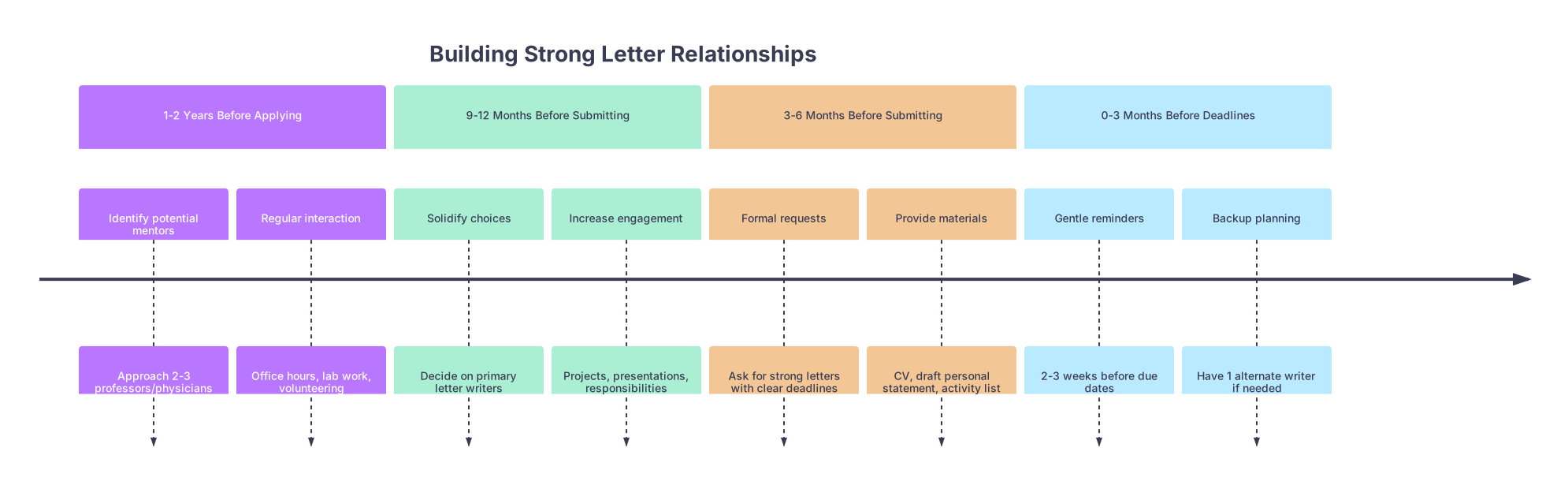
| Period | Event |
|---|---|
| 1-2 Years Before Applying - Identify potential mentors | Approach 2-3 professors/physicians |
| 1-2 Years Before Applying - Regular interaction | Office hours, lab work, volunteering |
| 9-12 Months Before Submitting - Solidify choices | Decide on primary letter writers |
| 9-12 Months Before Submitting - Increase engagement | Projects, presentations, responsibilities |
| 3-6 Months Before Submitting - Formal requests | Ask for strong letters with clear deadlines |
| 3-6 Months Before Submitting - Provide materials | CV, draft personal statement, activity list |
| 0-3 Months Before Deadlines - Gentle reminders | 2-3 weeks before due dates |
| 0-3 Months Before Deadlines - Backup planning | Have 1 alternate writer if needed |
Notice what is missing:
- No “two weeks before” panic.
- No “I barely know you but…” emails.
- No shopping for brand‑name letterheads in the final month.
If you are already inside that 3–6 month window and you have no solid relationships, you cannot magically create a 2‑year mentorship. But you can still avoid making it worse.
If You Are Already Late: Damage Control, Not Fantasy
At this point, you need honesty, not false reassurance.
If:
- You are 3–6 weeks from a major deadline, and
- You do not have strong, long‑term mentors lined up,
then your goal shifts from “perfect letters” to “not actively harmful letters.”
Here is how to avoid making a bad situation catastrophic.
Priority 1: Choose Depth Over Status
Pick the person who:
- Has actually seen you struggle and improve.
- Has talked to you more than twice.
- Can recall a specific interaction without checking notes.
Even if they are:
- A lecturer, not a tenured professor.
- A DO, not an MD.
- A community physician, not a big‑name specialist.
A specific, modest letter beats a generic “impressive” one every time.
Priority 2: Be Direct About the “Strong Letter” Question
Do not skip this. You will regret it if you do.
When you ask, say something like:
“I am applying to medical school this cycle and would value a strong letter of recommendation from someone who knows my work. Based on your experience with me, do you feel you could write a strong, positive letter?”
If they hesitate, waffle, or say anything like “I can write a letter” without the word “strong” or “enthusiastic,” back out gracefully.
Last‑minute mentor shopping thrives on vague yeses. Do not accept them.
Priority 3: Give Them Tools, But Do Not Expect Miracles
Provide:
- A 1–2 page “brag sheet” with specific examples of your work in their setting.
- Your CV.
- A short paragraph on what you hope the letter will highlight (e.g., resilience, curiosity, teamwork), tied to what they have actually seen.
But understand: this does not substitute for time. It just helps them do the best they can with what they have.
The Subtle Social Cost You Are Ignoring
There is one more thing most students do not think about.
When you routinely treat mentors as last‑minute fixers, you:
- Damage your reputation with them.
- Close doors for future opportunities (research, jobs, post‑baccs).
- Show a pattern of poor planning that professionals absolutely notice.
I have heard versions of this in faculty rooms:
- “She is bright, but everything with her is last‑minute.”
- “He always comes in with urgent requests.”
- “I wish he had come to me a month earlier; I could have really helped.”
You are not just asking for a letter. You are asking someone to attach their name to your judgment and professionalism. If the first serious interaction they have with you is an urgent request, that sets a tone you do not want.

How To Recognize You Are Slipping Into “Shopping” Mode
You will know you are in the danger zone when your inner monologue sounds like this:
- “I just need one more science letter; any professor will do.”
- “She has an MD, that should count even though she barely knows me.”
- “The deadline is in two weeks, so I will ask three people and hope someone says yes.”
- “I can always send them my CV; that should be enough.”
If you catch yourself there, stop. Take one hour. Actually map:
- Who knows me best?
- Who has seen my growth?
- Who cares if I succeed?
Then build from there, even if the “title” looks less impressive.
The Long Game: Turn One Cycle of Letters Into a Career Habit
The real win is not just getting decent letters for med school. It is learning not to treat relationships as transactional emergencies for the rest of your training.
Strong letter writers today become:
- Research collaborators in med school.
- Advocates for scholarships and honors.
- Call‑in favors when you are applying to residency.
- People who quietly say your name in the right room when opportunities come up.
That only happens if you stop shopping for mentors and start investing in them.
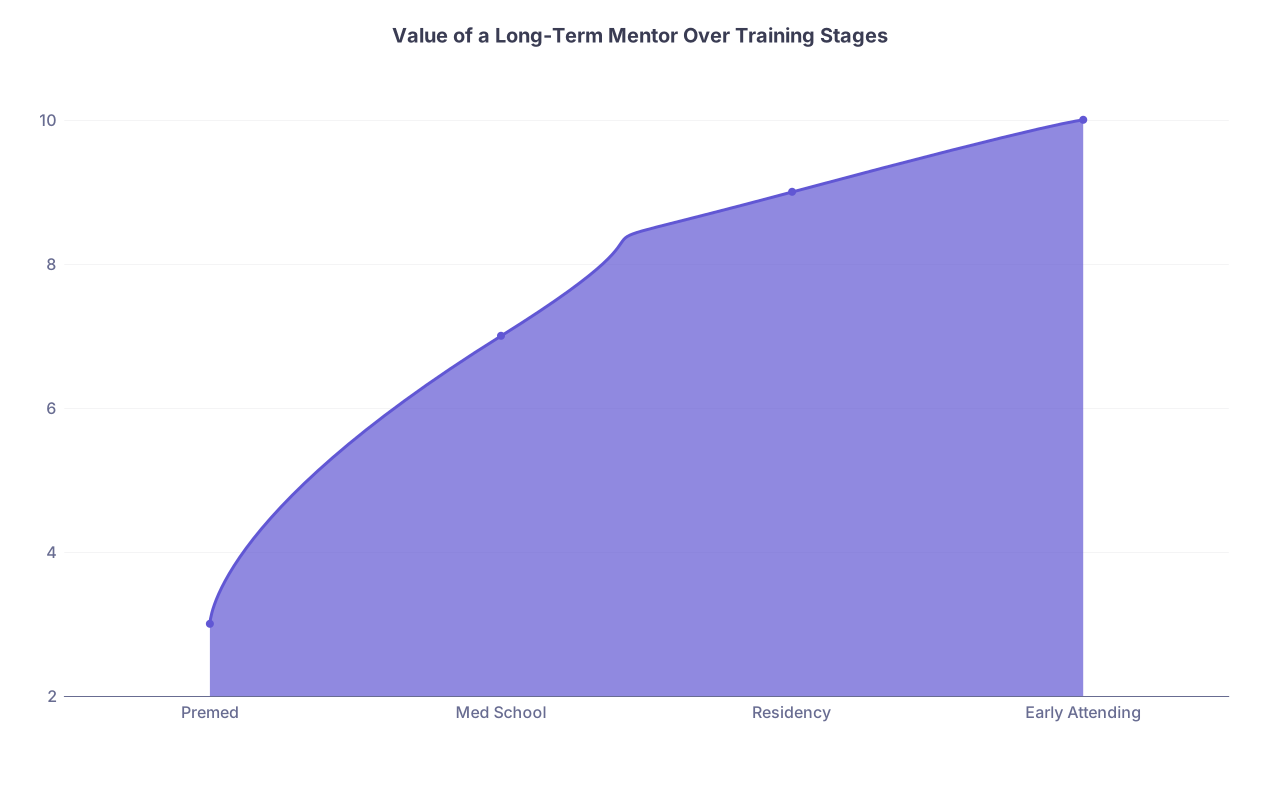
| Category | Value |
|---|---|
| Premed | 3 |
| Med School | 7 |
| Residency | 9 |
| Early Attending | 10 |
The value of one solid mentor compounds. The value of five last‑minute letter writers drops to zero as soon as your application is submitted.
Final Warnings: Do Not Make These Three Mistakes
Let me end bluntly. If you remember nothing else:
Do not confuse title with strength.
A detailed letter from a modestly known mentor who truly knows you is far more powerful than a one‑paragraph generic note from a big name.Do not wait until you “need” a letter to build the relationship.
By the time there is a deadline, you are mostly stuck with whatever relationships you already have. The shopping you do then is almost always weak and obvious.Do not accept lukewarm yeses.
If someone cannot confidently commit to a strong letter, thank them and move on. A neutral or faint‑praise letter is not neutral. It is a quiet red flag in a competitive pool.
Stop treating letters like forms to be completed. Start treating them like what they actually are: a public, written vote of confidence from people who have watched you become the kind of person medicine can trust.