
Your letters of recommendation must fix your transcript before admissions ever sees you.
If you have a fragmented record—withdrawals, post-bacc work, community college credits, a rough freshman year, gap terms—then sending generic letters is malpractice. You do not need “strong letters.” You need strategic letters that reconstruct you into one coherent, credible academic story.
That is fixable. But only if you stop thinking “Who likes me?” and start thinking “Who completes the narrative?”
Let me walk you through how to do this like an adult, not a panicked applicant.
Step 1: Diagnose Exactly How Your Transcript Looks to Adcoms
You cannot fix what you have not named. Your first task: read your own transcript the way a slightly skeptical committee member would.
Pull every relevant record:
- College transcript(s)
- Post-bacc / graduate work
- Community college / summer courses
- Official AMCAS/AACOMAS grade breakdown if you have it
Now, label the problems and the strengths. Be specific.
Common “fragmentation patterns” I see all the time:
The Ugly Start, Pretty Finish
- Freshman or sophomore year: C’s, maybe a D or F
- Later years: A/A- heavy, especially in upper division
- Looks like: Maturity arc, but they will still wonder, “Which version is real?”
The Multi-Campus / Transfer Patchwork
- Community college → university
- Or multiple universities
- Or a mess of summer school credits all over town
- Looks like: Did this person chase easier classes? Why all the moving around?
The Post-Bacc or Master’s Rescue
- Undergrad: mixed or weak science performance
- Later: post-bacc or SMP with much stronger grades
- Looks like: Possible upward trend, but they still question whether the improvement is stable and whether the earlier weakness matters
The Gap / Disruption Story
- Semesters off
- W’s clustered in certain terms
- Medical, family, financial issues
- Looks like: “Is this person reliable under pressure? Are those issues resolved?”
The Spiky Transcript
- Strong overall, but a few weird outliers:
- A’s in organic, but C in intro bio
- Great GPA, bombed one semester
- Looks like: “What happened here, and is it still happening?”
- Strong overall, but a few weird outliers:
Now create a blunt, one-page Transcript Reality Summary for yourself:
- Cumulative GPA:
- Science GPA:
- Upward or downward trend? (1–2 sentences)
- Biggest problems (3 bullets max)
- Biggest strengths (3 bullets max)
- One-sentence “diagnosis” of your academic story
Example:
Cumulative GPA 3.42, science 3.35, strong upward trend. First 3 semesters: multiple B-/C+ grades in core sciences while working 30 hrs/week. Last 4 semesters: mostly A/A- in advanced biology and biochemistry with reduced work hours. Completed formal post-bacc, 3.8 GPA.
Problems: weak early sciences, transfer from CC, one W-heavy semester.
Strengths: clear upward trend, strong recent science performance, sustained full-time course load.
Diagnosis: Late academic bloomer who improved once financial stress dropped and study skills matured.
That sentence is what your letters need to reinforce, from different angles.
Step 2: Map What Each Type of Letter Must Do for You
Stop obsessing about prestige. Stop chasing famous names who barely know you. For a fragmented transcript, letters are not decorative—they are structural supports.
You need each letter writer to perform a specific job.
At minimum, you should think in roles:
- Science Validator
- Academic Historian / Context Provider
- Character and Professionalism Witness
- Optional: Research / Clinical Depth Letter
You will not always have four separate people. One writer can cover two roles. The point is coverage, not headcount.
1. Science Validator
Purpose: Prove that your current academic performance in rigorous science is exactly what it appears to be—real, durable, and predictive of success in medical school.
Best choices:
- Upper-level biology, biochemistry, physiology, or chemistry professor
- Post-bacc or SMP instructor who teaches med-school-style courses
- Someone who has seen you on exams that require synthesis, not just memorization
What this letter should do:
- Confirm you are in the top tier of a solid cohort:
- “Top 10% of 120 students” is better than “did well”
- Specify the level of rigor:
- Curved course, high failure rate, premed heavy, etc.
- Describe concrete behaviors:
- How you handled dense material, sought help, improved between tests
- Directly counter any early weak science grades by anchoring to the present:
- “Any earlier academic inconsistency does not reflect the student I taught.”
2. Academic Historian / Context Provider
Purpose: Explain the “why” behind the messy parts of your record without sounding like excuse-making.
Best choices:
- Longitudinal mentor (advisor, program director, post-bacc director, PI who has known you 1–2+ years)
- Faculty who has watched your development across courses or roles
- Sometimes a premed advisor if they truly know your file and you personally
What this letter should do:
- Acknowledge the specific problems (not vague “challenges”)
- Provide short, credible context:
- Work hours
- Family responsibilities
- Health issues (only what you are comfortable sharing)
- Transition shock after transfer
- Emphasize resolution and trajectory:
- “These issues are in the past, and here is the evidence.”
- Highlight repeated growth:
- “Each year, she took on harder coursework and performed better.”
3. Character and Professionalism Witness
Purpose: Answer the silent question: “If we admit this person with a bumpy record, will they be reliable, teachable, and safe in a clinical environment?”
Best choices:
- Clinician you have shadowed consistently
- Volunteer coordinator or clinical supervisor (free clinic, hospice, EMT, scribe manager)
- Work supervisor in a demanding environment (if medically adjacent, even better)
What this letter should do:
- Speak to:
- Reliability (on time, follows through, owns mistakes)
- Emotional maturity (handles feedback, difficult patients, stress)
- Team behavior
- Where possible, link back to academics:
- “The same persistence I saw in clinic is reflected in the way she returned to her studies and excelled.”
4. Research / Clinical Depth Letter (Optional but Useful)
Purpose: Round out your narrative: you are not just repairing the past; you are operating at a high level now.
Best choices:
- Research PI
- Long-term lab mentor
- Clinical program director
What this letter should do:
- Show intellectual curiosity
- Demonstrate you can handle complexity over time
- Reinforce that the current version of you is high-performing and consistent
Step 3: Build a “Letter Coverage Map” for Your Transcript
You are going to design your letter set like a coverage plan, not a popularity contest.
Take your Transcript Reality Summary, and build a simple table:
| Role | Writer Candidate | Primary Job |
|---|---|---|
| Science Validator | Dr. Nguyen (Biochem) | Prove high-level science ability now |
| Academic Historian | Dr. Patel (Post-bacc) | Explain early grades and upward trend |
| Character/Professionalism | Ms. Lopez (Clinic) | Validate reliability and maturity |
| Research/Depth (optional) | Dr. Chen (Neuro Lab) | Show sustained, complex cognitive work |
Look for gaps:
- No one can speak to your recent science performance? That is a problem. Fix it.
- No one understands your full academic arc? You need someone who at least knows the story and can honestly vouch for growth.
- All letters are from one year or one setting? That can look narrow.
Where there is a gap, ask yourself bluntly:
Do I need a new letter writer, or can I retrofit an existing relationship by meeting with them and giving them a structured narrative?
Often, you will combine roles. Example:
- Post-bacc director who also taught you advanced physiology = Science Validator + Academic Historian in one.
That is fine. Just make sure every function is covered somewhere.
Step 4: Approach Mentors the Right Way (With a Script and a Packet)
If you have a fragmented transcript, you cannot afford vague asks like “Could you write me a strong letter?” You need to frame the ask in terms of specific contribution to a known problem.
The Ask Script (Adjust to Your Style)
Use email to set up a meeting. In the email, be clear and professional.
Example:
Subject: Request for medical school recommendation letter
Dear Dr. Nguyen,
I am applying to medical school this upcoming cycle, and I am hoping you would be willing to write a strong letter of recommendation on my behalf.
I greatly valued your Biochemistry II course, and it was one of the first advanced science classes where I felt I was performing at the level I am now capable of. Because my earlier academic record is uneven, I am intentionally asking a small number of faculty who can speak in detail about my recent performance in rigorous science courses.
If you are comfortable supporting my application, I would be happy to send a brief packet with my CV, personal statement draft, transcript summary, and a one-page overview of how your perspective fits into my overall application story.
I would also appreciate 15–20 minutes to meet (in person or via Zoom) so that I can answer any questions you may have.
Thank you for considering this,
[Name]
[Student ID if relevant]
Then you follow through with that “brief packet.”
Your Letter Packet: Non-Negotiable Components
For each writer, customize slightly, but keep these core elements:
- Updated CV
- Personal statement draft, even if not final
- Unofficial transcript
- Transcript Reality Summary (the one you wrote for yourself, lightly polished)
- Writer-Specific One-Pager
That one-pager is where the magic happens. It should answer three questions for them:
- What are you applying for and when?
- Why did you choose them specifically?
- What 2–3 concrete points would be most helpful for them to address?
Sample structure for a Science Validator one-pager:
- Brief intro (2–3 sentences):
- “I am applying to MD/DO programs in the 2025–2026 cycle. My academic trajectory has a weak start but a strong recent upward trend. Your course is one of the clearest indicators of my current capabilities.”
- Bullet points:
- “If you feel it is accurate, the most helpful things you could address are:
- My performance relative to peers in Biochemistry II
- My ability to integrate material from multiple courses
- Any examples of persistence, preparation, or improvement you observed”
- “If you feel it is accurate, the most helpful things you could address are:
- Honest note about early record:
- “As you will see in my transcript, my earlier science grades (freshman/sophomore year) were weaker. This was during a period of [short context]. My recent work in your course and my post-bacc reflects the student I am now.”
You are not putting words in their mouth. You are giving them a lens and letting them write genuinely.
Step 5: Use Letters to Directly Address Specific Transcript Weaknesses
Let us go case by case. If you recognize yourself, steal the structure.
Case A: Weak First Two Years, Strong Finish
Your goals:
- Show that the current high performer is the real version
- Provide a credible explanation that is now resolved
- Demonstrate that you can thrive under med-school-like load
Who you need:
- Science Validator from late coursework or post-bacc
- Academic Historian who can contextualize early struggle
How you coordinate:
For the Academic Historian (advisor, post-bacc director), you might flag:
- Acknowledge early grades:
- “It would be helpful if you feel comfortable acknowledging that my first four semesters show multiple B-/C+ grades in core science and then briefly commenting on factors you are aware of (work hours, adjustment, etc.).”
- Emphasize change:
- “If accurate, any comments on how my habits and performance changed over the last two years would help committees see this as a stable improvement, not a fluke.”
For the Science Validator:
- “If you are comfortable, stating where I ranked relative to the class and any observations you have on my preparation and engagement would be very helpful to show that my recent performance is genuine and sustainable.”
Case B: Heavy Community College + Transfer + University
Your goals:
- Avoid the impression that you cherry-picked easy courses
- Show that you handled the transition upward in rigor
- Demonstrate that your performance improved or at least held steady
Who you need:
- University-level science professor
- Possibly a CC professor if that is where you really turned things around, but you must still show you can handle university rigor
How you coordinate:
University professor:
- Ask them to:
- Describe rigor of the course
- Compare you to previous cohorts
- Highlight that you handled upper-division material well
CC professor (if used):
- Have them focus on:
- Early work ethic
- Study skill foundation
- Your seriousness about transferring and taking on more advanced work
You might explicitly mention in your packet:
- “Because a significant portion of my earlier coursework was at community college, I am relying on your letter to demonstrate that I have succeeded in upper-level science courses at a four-year university.”
Case C: Post-Bacc or SMP “Repair” After a Weak Undergrad
Your goals:
- Prove that your performance in the advanced program is directly relevant to medical school
- Show that the early undergrad is no longer predictive
- Signal that the post-bacc/SMP was not “grade tourism” but hard-earned
Who you need:
- Post-bacc/SMP faculty or director (non-negotiable)
- Possibly your research PI or another high-rigor environment supervisor
How you coordinate:
Post-bacc director:
- Ask them to:
- Comment explicitly on your undergrad vs post-bacc performance
- Describe the structure of the program (med-school style exams, grading, etc.)
- Place you in the context of other students who also went on to medical school
You can be direct in your summary:
- “It would be very helpful if you could comment on how my performance in this program compares to my earlier undergraduate record, as this is a central question committees will have.”
Case D: Significant Gaps, Withdrawals, or a Bad Term
Your goals:
- Prevent committees from filling in the worst possible story
- Show stability now
- Demonstrate that when life hit you, you responded, learned, and recovered
Who you need:
- Someone who knows the backstory and your current status:
- Advisor
- Dean
- Long-term mentor
How you coordinate:
You are deciding how much to disclose—that is your call. But once you choose, the letter must:
- Acknowledge the disruption:
- “In spring 2022, she withdrew from several courses”
- Provide minimal, honest context (no drama, no overshare)
- Emphasize resolution and current functioning
Your one-pager might say:
- “Because of W’s and a poor semester during [timeframe], committees may question my reliability and current stability. If you feel it is appropriate, a brief comment that:
- You are aware of the circumstances
- Those circumstances have been addressed
- My current performance and reliability are strong
would be extremely helpful.”
Step 6: Coordinate, But Do Not Script, Your Letters
You are aiming for alignment, not cloned essays.
Practical steps:
Stagger your asks.
Start with the person who understands your overall narrative best (often the Academic Historian). Their letter clarifies the core story. That story then frames how you talk to others.Send a common “Core Narrative” paragraph in each packet.
For example:“Across my application, I am trying to help committees see that although my early academic record is uneven, my more recent performance and experiences more accurately reflect my capabilities and readiness for medical school.”
That one paragraph encourages their letters to rhyme, even if the details differ.
Track who has submitted what and when.
Treat this like a clinical task list, not a wish. Use a simple tracker:
| Writer | Role | Requested | Confirmed | Submitted | Notes |
|---|---|---|---|---|---|
| Dr. Nguyen | Science Validator | 3/1 | 3/3 | 4/10 | Biochem II, Spring 2024 |
| Dr. Patel | Academic Historian | 3/1 | 3/4 | 4/15 | Post-bacc director |
| Ms. Lopez | Professionalism | 3/5 | 3/7 | 4/20 | Free clinic supervisor |
- Send one reminder, professionally, before deadlines.
No guilt-tripping, no panic. Short, polite, clear.
Step 7: Align Your Own Written Materials With the Letters
Your personal statement and secondaries must not contradict what your letters are saying.
Two big rules:
If a letter explains a rough patch, do not omit it from your own writing.
- You do not need a full memoir. But a concise, consistent explanation in your disadvantaged essay, “academic difficulties” question, or a short paragraph in a secondary keeps everything aligned.
Your statement should show who you are now, not re-litigate every old grade.
- Your letters and your “Academic Difficulties” sections handle the repair.
- Your personal statement should make committees want to fight for you despite the earlier mess.
Think of it like this:
- Letters: “Here is why you can trust this person academically and professionally, despite the noise.”
- You: “Here is why I want to do medicine and how I have acted on that conviction.”
To visualize how this timeline fits together, see this simple flow:

| Step | Description |
|---|---|
| Step 1 | Diagnose Transcript |
| Step 2 | Map Letter Roles |
| Step 3 | Approach Mentors |
| Step 4 | Provide Packets |
| Step 5 | Draft Personal Statement |
| Step 6 | Secondary Essays |
| Step 7 | Submit Application |
Notice letters come early. They shape how you write about yourself.
Step 8: Know When a “Name Brand” Letter Hurts You
I have seen this more than once: student chases a famous PI or dean, gets a lukewarm, generic letter, and it drags the whole file down.
For a fragmented transcript, this is lethal.
Red flags you should not ignore:
- The person says, “I can write you a letter” but never says “strong.”
- They cannot remember specific details about your work without heavy prompting.
- You were in a 300-person lecture and never spoke to them.
- They hint that your earlier academic issues make them “a bit concerned.”
If you are hearing any of that, walk away. Politely.
You want:
- Detail over prestige
- Evidence over adjectives
- Coherence over random praise
Here is the simple sanity check:
If this person were grilled by an adcom member on the phone with zero notes, could they talk about you in detail for 5–10 minutes?
If not, do not use them.
Step 9: Use Data, Not Vibes, to Decide When You Are “Letter-Ready”
Your letters can only sell what actually exists. If your most recent term is average or worse, you are asking writers to defend a still-fragile trajectory.
If you are early in a repair phase (first semester of post-bacc, for example), consider this:
- You want at least 1–2 full terms of strong, consistent performance from the same environment your letter writers know.
- Ideally, you want at least one letter based on a term where you took:
- ≥12 credits (or program-equivalent load)
- ≥2 challenging science courses
- And you did very well
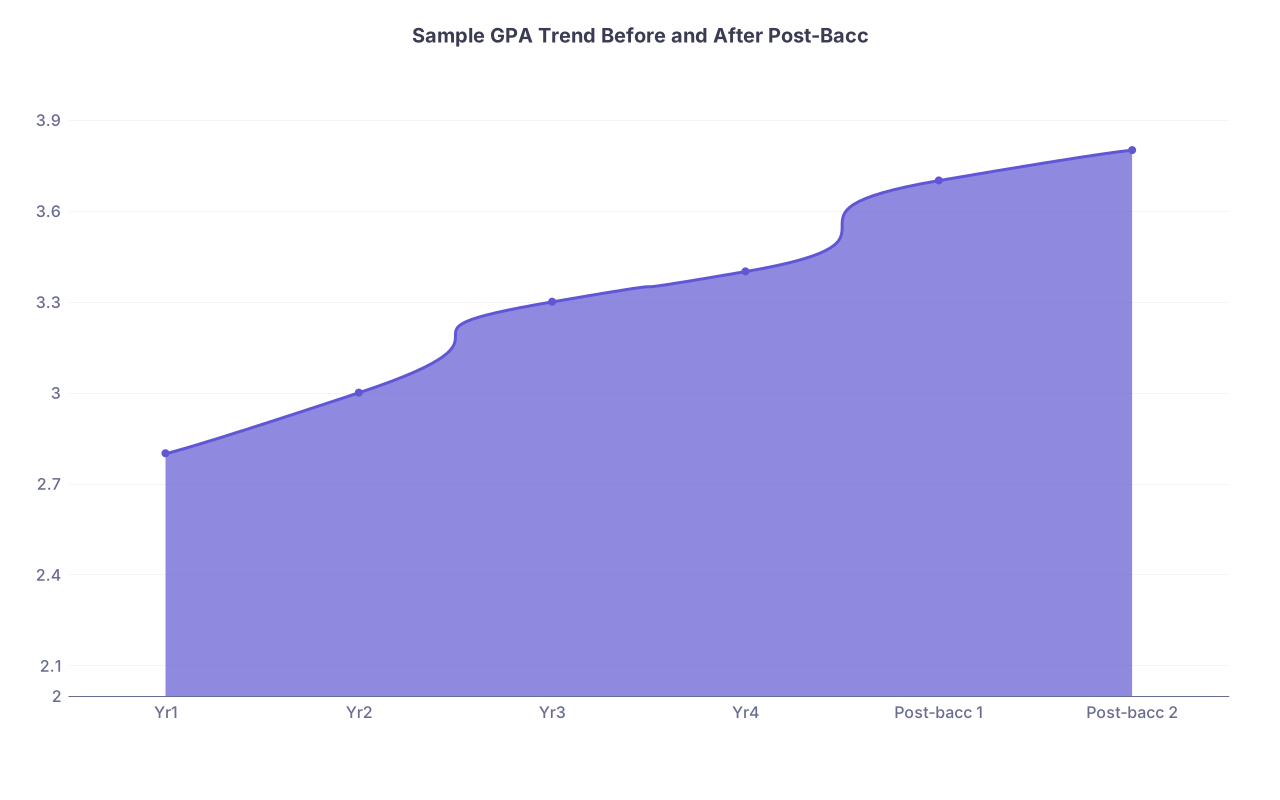
Think in trends, not isolated A’s. This quick visual is what committees care about:
| Category | Value |
|---|---|
| Yr1 | 2.8 |
| Yr2 | 3 |
| Yr3 | 3.3 |
| Yr4 | 3.4 |
| Post-bacc 1 | 3.7 |
| Post-bacc 2 | 3.8 |
If your graph looks like this—or is clearly heading that way—you are in a good position to have letters “lock in” the upward trend.
If your graph looks like a roller coaster, pause. Fix the trend before you ask people to certify your stability.
Step 10: Do Not Hide. Own Your Story and Let Mentors Amplify It
The impulse to hide your weaknesses from letter writers is understandable. It is also a mistake.
Strong mentors are not shocked by messy transcripts. They have seen:
- Students from low-resource backgrounds starting behind
- Illness derailing a semester
- Students working 40 hours a week to survive
- International students adjusting to a new system
What they rarely see is a student who:
- Knows their own record with clarity
- Can explain it without melodrama
- Has actually fixed the underlying problems
- Comes with a concrete plan for the next phase
Be that student.
You can say, in a meeting:
“My early record is not what I am capable of. I have worked hard to change how I study and how I structure my life, and I believe my performance in your course reflects that. I am not asking you to ignore my weaknesses—I am asking whether, from your vantage point, the person you taught is ready for the academic demands of medical school.”
That is honest. It is direct. It gives them a clear yes/no.
If the answer is anything less than a confident yes, they are not your writer.
The Bottom Line
Three things I want you to walk away with:
Your transcript needs a narrative, not a cover-up.
Identify your specific weaknesses and strengths. Treat each letter as a structural support to that narrative, not just a generic compliment.Choose mentors for what they can demonstrate, not how famous they are.
Science Validator, Academic Historian, Character Witness, and optional Research/Depth—make sure those functions are covered by people who actually know you and can speak in detail.Coordinate like a professional, then let them do their jobs.
Use packets, clear one-pagers, and aligned language across your letters and essays. Give your recommenders the context and direction they need, then step back and let their credibility repair the gaps your transcript alone cannot.
Do this right, and your fragmented record stops looking like a liability and starts looking like a story of growth that serious people are willing to vouch for.