
The fastest way to ruin strong letters of recommendation is to let every mentor write “whatever you think is best.”
If you have multiple interests and no clear story, that vague approach is exactly how you end up with a scattered, confusing application that makes committees shrug instead of fight for you.
You are not the first premed or medical student with “too many” interests. Research, global health, surgery, primary care, advocacy, education. I have seen students try to jam everything into every letter and end up with six pages of generic praise that could describe any reasonably competent human being.
You are not going to do that.
This is about one thing: assigning each mentor a clear narrative role so your letters work together as a coordinated, deliberate package instead of a random pile of PDFs.
Step 1: Stop Chasing a Single Perfect “Story”
First fix your mindset.
Admissions committees are not looking for a one-dimensional cartoon character: “I have always wanted to be a pediatric neurosurgeon since age 5.” They know that is nonsense 95% of the time.
What they need is:
- A coherent pattern of behavior
- Clear, credible evidence of your strengths
- A believable direction (or a small set of directions) that match your record
Your problem is not that you have multiple interests. Your problem is that you are trying to make every component of your application cover all of them. That is what makes things muddy.
You do not need one story. You need:
- One primary application theme (your personal statement and activities list)
- Several supporting narrative threads, each anchored to a specific mentor
Think about it this way:
Your application = a case presentation.
Your letters = consult notes from different services.
If everyone documents everything, no one knows who is actually responsible for what. Same disaster here.
So the goal is to assign each mentor a specific lane.
Step 2: Map Your “Narrative Assets” Before You Touch Your Mentors
You cannot assign roles intelligently if you do not know what you already have.
Grab a sheet of paper or a blank doc. You are going to make a quick audit.
2.1 List your interests
On the left, bullet:
- Clinical interests (e.g., internal medicine, surgery, EM, pediatrics, psych)
- Nonclinical interests (research, teaching, advocacy, global health, quality improvement, leadership, etc.)
Be specific. “Helping people” does nothing here.
Example:
- IM / cardiology
- Global health
- Health policy and advocacy
- Medical education / teaching
- Bench research in immunology
2.2 List your mentors and what they really know about you
On the right, list all potential letter writers:
- PI from immunology lab
- Attending from IM sub-internship
- Volunteer free clinic director
- Health policy professor
- Peer-tutor program coordinator
Under each name, jot:
- How long you have known them
- Context (lab, clinic, class, project)
- 2–3 concrete things they have seen you do well
Example for your IM attending:
- Known 8 weeks during sub-I
- Context: inpatient cardiology service
- Has seen: work ethic, presentations, patient communication, response to feedback
Now you can see your assets: who can actually prove what.
2.3 Identify the gaps
Look at your left list (interests) and your right list (mentors). Ask:
- Which of my core interests have strong, credible backup from a mentor?
- Which interests are mostly just aspirational with little concrete support?
If “global health” is a huge part of your self-image but your only experience is a 1-week medical mission where you took blood pressures and selfies, that should not be the centerpiece of your letter strategy.
Value reality over aspiration. Letters must be evidence-based.
Step 3: Define 3–4 Core Narrative Pillars
Now you pick what your application is actually going to say about you. Not 12 things. Four max.
Common useful pillars for premeds and med students:
- Clinical excellence and professionalism
- Intellectual curiosity / research rigor
- Commitment to underserved / advocacy
- Teaching and mentorship
- Leadership and systems thinking
- Resilience and growth through adversity
Pick 3–4 that:
- You genuinely embody, and
- You have mentors who could back up with stories
Then match them:
| Narrative Pillar | Primary Mentor |
|---|---|
| Clinical excellence in IM | [IM sub-I attending](https://residencyadvisor.com/resources/letters-of-recommendation/rotating-attending-every-week-how-to-still-secure-a-strong-clinical-letter) |
| Research rigor in immunology | Immunology PI |
| Commitment to underserved patients | Free clinic medical director |
| Teaching and mentorship | Peer-tutor program coordinator |
Notice what is missing: 10 other things you also kind of care about. That is fine. We are building a clear picture, not a complete autobiography.
Step 4: Assign Each Mentor a Clear Narrative Role
Now the actual fix: you stop asking for “a strong letter” and start asking for “a strong letter that focuses on X.”
You are not scripting their letter. You are giving them a role in your story.
4.1 Role types that actually help you
Here are a few very high‑yield roles. You will probably use a mix.
Clinical competency anchor
- Who: Attendings from core rotations, preceptors from longitudinal clinics
- Focus: Reliability, patient care, teamwork, professionalism
- Use: Essential for both med school and residency applications
Research and intellectual rigor anchor
- Who: PIs, thesis advisors, research mentors
- Focus: Problem-solving, persistence in the face of failed experiments, ownership of projects
Advocacy / service anchor
- Who: Directors of clinics, service organizations, community partners
- Focus: Commitment to underserved, longitudinal engagement, impact
Teaching / leadership anchor
- Who: Course directors, club advisors, tutoring coordinators, chiefs
- Focus: Communication, leadership, initiative, improving systems or programs
Character + growth anchor
- Who: Longitudinal mentors who have seen your arc
- Focus: Maturity, resilience, response to setbacks, professionalism over time
Do not assign two mentors the exact same role unless they are showing different contexts of the same trait (e.g., clinical excellence in IM and in surgery).
4.2 Concrete example of role assignment
Let’s say you are a premed applying with:
- Strong research in immunology
- Heavy involvement in a free clinic
- Solid but not flashy clinical volunteering
- Some peer tutoring
You could assign:
- Immunology PI → Research rigor + intellectual curiosity
- Free clinic director → Commitment to underserved + reliability + patient rapport
- Biology professor (small advanced seminar) → Classroom excellence + analytical thinking
- Peer-tutor coordinator → Teaching and communication skills
See the pattern? Each letter protects a different flank of your application.
Step 5: Design a One-Page “Mentor Brief” for Each Recommender
Instead of sending everyone the same bland email and CV, you are going to send customized packets that nudge them toward their role.
Do not overcomplicate this. Each mentor gets:
- A short, direct email request
- A one-page “Mentor Brief” (PDF or doc)
- Your CV and personal statement draft
5.1 The request email (how you actually phrase this)
You do not say, “Please write whatever you can.” That is how you get generic mush.
You say something like (for the free clinic director):
Dr. Shah,
I am applying to medical school this cycle and would be honored if you would write a letter of recommendation on my behalf.
I am hoping your letter could particularly highlight my work with underserved patients at the free clinic and how I function in our interprofessional team, since that has been a central part of my development.
I have attached a one-page summary with a few specific encounters and projects from the clinic that were especially meaningful to me, along with my CV and personal statement draft.
Would you feel comfortable writing a strong letter with that focus?
Direct. Focused. Respectful. No scripts, but clear direction.
5.2 What goes in the one-page Mentor Brief
Keep it structured and short. A simple layout:
Top: Basic info
- Your name, application type (MD, DO, residency in X), cycle year
- How long you have known them and in what capacity
Middle: 2–3 key themes you hope their letter can address
Phrase them in a way that invites their judgment, not commands it.
Example for research PI:
- “Independence and ownership of my project on [topic]”
- “Ability to interpret data critically and redesign experiments after negative results”
- “Persistence and reliability in the lab over [time period]”
Bottom: 3–5 specific examples / stories
Bulleted, concrete events they may recall but have half-forgotten:
- “Summer 2023: Took over full responsibility for running the [X] assay, including troubleshooting the [Y] issue that had delayed the project.”
- “Fall 2023: Presented our preliminary data at the department research day; you mentioned my ability to handle questions from faculty.”
- “Winter 2024: Came in over break to complete the final set of replicates before grant deadline; this helped us meet the submission timeline.”
You are not putting words in their mouth. You are tying down real events they can reference instead of guessing.
Step 6: Align Your Personal Statement With the Letter Roles
Your personal statement is the “attending’s note.” The letters are consults. They should not all restate the HPI. They confirm and deepen different parts of it.
So:
Re‑read your personal statement draft. Highlight:
- Core themes
- Specific experiences you mention
For each mentor role, decide:
- Which part of your statement they are reinforcing
- Whether there is a specific anecdote they could realistically reference
Example:
- Personal statement theme: “Curiosity at the intersection of immunology and patient care, grounded in service to underserved communities.”
- Roles:
- PI → Deepen immunology curiosity + research skill
- Free clinic director → Prove service to underserved is longitudinal and real
- IM attending (shadowing or sub-I as med student) → Show curiosity translates into bedside behavior
You want the reader to see a pattern:
- “She talks about X in her essay.”
- “Her PI independently describes X through concrete research behavior.”
- “Her clinic director independently describes X through patient care and follow through.”
That is how you get from “sounds nice” to “this is who this person is.”
Step 7: Handle Multiple Interests Without Looking Scattered
Here is the tricky part. You are interested in, say, surgery, EM, and global health. Or three different specialties as a third-year.
If you try to get one mentor to justify all three, you will look unfocused. But if each mentor naturally touches a different interest linked by one underlying trait, you look multidimensional but coherent.
7.1 Pick an underlying through-line
Examples of through-lines that work:
- “High-acuity, team-based care” (EM + critical care + surgery)
- “Longitudinal relationships with complex patients” (IM + psych + primary care)
- “Systems-level thinking about access and equity” (global health + policy + community medicine)
Your specialty label can be flexible. Your underlying driver should be consistent.
7.2 Tell mentors the through-line
You do not have to hide that you have multiple interests. You just do not force them to endorse a specific specialty label.
Example you might write in a Mentor Brief:
I am currently most drawn to fields that combine longitudinal relationships with complex medical decision-making (such as internal medicine and psychiatry). I am still exploring, but a consistent theme for me has been working with patients over time and understanding how their medical, psychological, and social factors connect.
Then their letter can say:
“Although she is still refining her ultimate specialty choice, a clear theme has been her interest in complex patients over time…”
Committees are comfortable with that. What they hate is pure randomness.
Step 8: Timeline and Coordination (So This Does Not Blow Up)
You can do everything above and still get burned if you wait too long or fail to follow up.
8.1 Recommended timeline (premed)
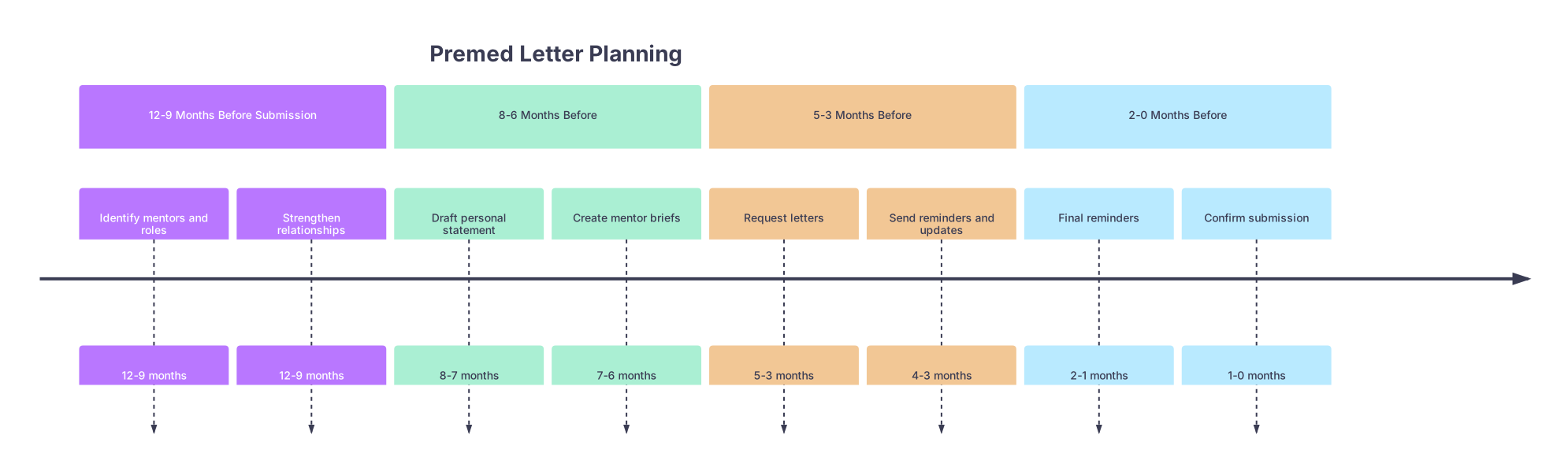
| Period | Event |
|---|---|
| 12-9 Months Before Submission - Identify mentors and roles | 12-9 months |
| 12-9 Months Before Submission - Strengthen relationships | 12-9 months |
| 8-6 Months Before - Draft personal statement | 8-7 months |
| 8-6 Months Before - Create mentor briefs | 7-6 months |
| 5-3 Months Before - Request letters | 5-3 months |
| 5-3 Months Before - Send reminders and updates | 4-3 months |
| 2-0 Months Before - Final reminders | 2-1 months |
| 2-0 Months Before - Confirm submission | 1-0 months |
For medical students applying to residency, shift everything ~6–9 months earlier relative to ERAS opening.
8.2 Concrete coordination steps
Create a simple spreadsheet:
- Mentor name
- Role (clinical / research / advocacy / etc.)
- Date requested
- Date Mentor Brief sent
- Stated deadline
- Actual upload date
Stagger requests:
- Ask your most critical mentors first (e.g., PI, core clinical attending)
- Once they agree, you know which roles are locked in
- Adjust remaining mentor roles if someone refuses or is noncommittal
Use soft but specific reminders:
- 4 weeks before deadline
- 2 weeks before
- 5–7 days before
Never assume “I will get it done” means “I will get it done on time.”
Step 9: Beware of These Common, Preventable Mistakes
I have watched strong applicants tank their letter strategy by doing dumb, avoidable things.
9.1 Letting weak letters sit in key roles
Red flags:
- “I do not know you well enough”
- “I can write you a letter, but it might be a bit generic”
That means: Do not use this person. At least not in a core role.
If this is a big-name PI or department chair, ask yourself: is a lukewarm, generic letter from a famous person better than a detailed, glowing letter from a mid-level faculty member who actually knows me?
Most of the time, no.
9.2 Duplicating roles
If all three letters emphasize “hardworking, on time, good team player,” you look like a very nice, very replaceable cog.
Fix: use your roles. If you notice two mentors are likely to say the same things, tilt one:
- Ask one to focus on your initiative and leadership
- Ask the other to emphasize your analytic reasoning and problem-solving
9.3 Overstuffing your own message
You want to be research‑oriented, global-health‑driven, surgical-but-maybe-psychiatry-with-some-entrepreneurship-on-the-side.
Pick. A. Lane.
You can have multiple interests, but your application needs a clear center of gravity.
Let the letters add dimension, not chaos.
Step 10: What This Looks Like When Done Right
Let me show you a compact before/after.
10.1 Before (disorganized)
Applicant: “I am interested in surgery, EM, and health disparities.”
Letters:
- Surgery attending: “Great student. Hard worker. Will be a good doctor.”
- EM attending: “Pleasure to work with. Very knowledgeable. Good team player.”
- Volunteer supervisor: “Very committed. Showed up every week. Patients liked her.”
Result: Generic positivity. No clear identity. Reads like 500 other “good” applicants.
10.2 After (intentional)
Applicant: Same interests, but through-line chosen: “Thrives in acute care roles where underserved patients are overrepresented; sees medicine as both bedside care and systems problem-solving.”
Assigned roles:
- Surgery attending → “High-acuity, procedural, team-based clinical performance”
- EM attending → “Calm under pressure, quick reasoning, adaptability”
- Community clinic supervisor → “Systems-minded approach to underserved care; finds creative ways to improve access and transitions”
Emails + Mentor Briefs sent accordingly.
Letters now say, in different words, something like:
- “When faced with a crashing patient, she…”
- “On a busy shift when multiple new patients arrived, she prioritized by…”
- “Noticed that our Spanish-speaking patients often missed follow-up, and helped pilot…”
Now the committee does not just know she is good. They know what kind of good she is.
Step 11: If You Are Still Early (Premed or M1/M2), Engineer Your Future Letters Now
If you are not requesting letters yet, you are in a stronger position than you think.
Use your “narrative roles” to drive which opportunities you say yes to:
- Want a robust advocacy/service pillar?
- Commit longitudinally to one clinic or community organization where a leader will see you over time.
- Want a real research pillar?
- Aim for at least one year in a lab with increasing responsibility, not three short unrelated projects.
- Want a teaching pillar?
- Take on a formal role (TA, small group leader, tutor) where someone supervises and can later vouch for your impact.
You are not just collecting experiences; you are cultivating future letter writers with clear lanes.
Step 12: Quick Reality Check: What If You Have Weak Options?
If your mentors mostly know you superficially or you switched institutions, you still have options.
- Prioritize who has seen your work up close, even if they are not “fancy.” A detailed letter from a community physician beats a vague letter from a world-famous professor who barely remembers you.
- Reconnect before asking:
- Email: “Can we meet to discuss my future plans and get your advice?”
- Use that meeting to remind them of specific things you did, share updated CV, build rapport.
- If you truly lack anyone for a key role:
- Accept that this application cycle is partly about rebuilding your foundation.
- Choose a primary theme that you can support now, and build toward the others for later (e.g., residency, fellowship).
You do not fix a weak foundation in two weeks with clever emails. You fix it over months with deliberate choices.
Your Next Step Today
Open a blank page and do three things right now:
- List your top 3–4 narrative pillars (clinical excellence, research, service, teaching, etc.).
- Under each pillar, write the name of one mentor who could best anchor it with real stories.
- For just one of those mentors, draft a one-page Mentor Brief with:
- How you know them
- 2–3 themes for their letter
- 3–5 concrete examples they have seen
Do that for one mentor today. Not all of them. Just one.
Once you see how much clearer and more focused that one letter request becomes, you will know exactly how to handle the rest.