Most students waste their mentor meetings—and then wonder why their letters of recommendation are vague and forgettable.
You are not going to do that.
If you want strong letters of recommendation for medical school or future programs, you cannot rely on “being a good student” and hoping attendings or professors magically internalize your greatness. You need a deliberate system of structured meetings that:
- Make it easy for mentors to see your strengths.
- Give them concrete stories to use in letters.
- Keep you on their radar months or years later.
I am going to walk you through that system.
Step 1: Choose the Right Mentors for Structured Meetings
You do not need structured meetings with everyone. That is pointless and exhausting. You need them with people who are likely to write serious letters for you.
You are aiming for a small “core mentor set”:
- Premed: 2–3 people
- Med school (pre-clinical): 2–3 people
- Med school (clinical): 3–4 people
Who belongs in your core mentor set
Target mentors who meet at least two of these:
They see your work repeatedly
- Course director or professor you have more than one semester with
- PI in a lab where you work at least 6–8 hours per week
- Longitudinal clinic preceptor or advising physician
They write letters often
- Clerkship directors
- Research PIs with multiple trainees
- Pre-health / academic advisors with formal advisory roles
They are reasonably accessible
- Responds to email within a week
- Has office hours or stated availability
- Has already shown some interest in you (feedback, questions, invites)
| Type of Potential Mentor | Strong Core Mentor Candidate? | Why |
|---|---|---|
| Longitudinal research PI | Yes | Sees your work over time, used to writing letters |
| Large lecture professor you spoke to once | No | Does not know you, too generic |
| Regular clinical preceptor (10+ days) | Yes | Can give concrete clinical examples |
| [Resident you worked with for 1 week](https://residencyadvisor.com/resources/letters-of-recommendation/rotating-attending-every-week-how-to-still-secure-a-strong-clinical-letter) | No | Usually not primary letter writer |
| Premed advisor who oversees committee letters | Yes | Often central to evaluation |
If you read that table and realize you currently have zero good targets, that is your first problem to fix. You need to intentionally build ongoing relationships with at least a couple of people in each phase.
Step 2: The Core Rule – Every Meeting Needs a Written Agenda
Unstructured meetings produce unstructured letters.
The single most powerful habit you can build:
Never walk into a mentor meeting without a written, one-page agenda.
It does not have to be fancy. It does have to exist. And you should email it 24–48 hours before the meeting.
Your agenda should do three things:
- Respect their time (shows professionalism).
- Direct the conversation toward specific stories and growth.
- Quietly give them language and evidence they can reuse in letters.
Simple agenda template (copy this)
You can adapt this template for nearly any mentor meeting:
Subject line for email:
“Agenda for our meeting on [DATE]”
Body:
Dr. [Name],
Thank you for taking the time to meet with me on [Day]. I attached a brief agenda so we can use our time efficiently. Looking forward to your feedback.
Best,
[Your Name]
Attached / pasted agenda:
[Your Name] – Meeting with Dr. [Name] – [Date]
Quick updates (5 minutes)
- Recent coursework / rotations
- Research / clinical activities
- Any notable challenges or wins
Short-term goals (10 minutes)
- [Goal 1 – e.g., improve clinical reasoning on IM rotation]
- [Goal 2 – e.g., prepare for MCAT / Step exam / application cycle]
Feedback request (10–15 minutes)
- Strengths you have observed in me
- Areas where I can improve in the next 3–6 months
- Specific situations where you saw me do well or struggle that I can learn from
Future planning (5–10 minutes)
- Timing for letters of recommendation
- Experiences I should seek to strengthen my application
- How best to keep you updated
Action items / next steps (5 minutes)
- What I will work on
- What I will send you / by when
- Possible time frame for our next meeting
Print that. Bring it. Or have it open on your laptop. Then stick to it.
Step 3: Meeting Cadence – How Often and With Whom
You do not need monthly meetings with every mentor. That is overkill and looks forced. But you also cannot appear out of nowhere three years later with, “Hi Dr. Smith, can you write a strong letter?”
Use a deliberate cadence instead.
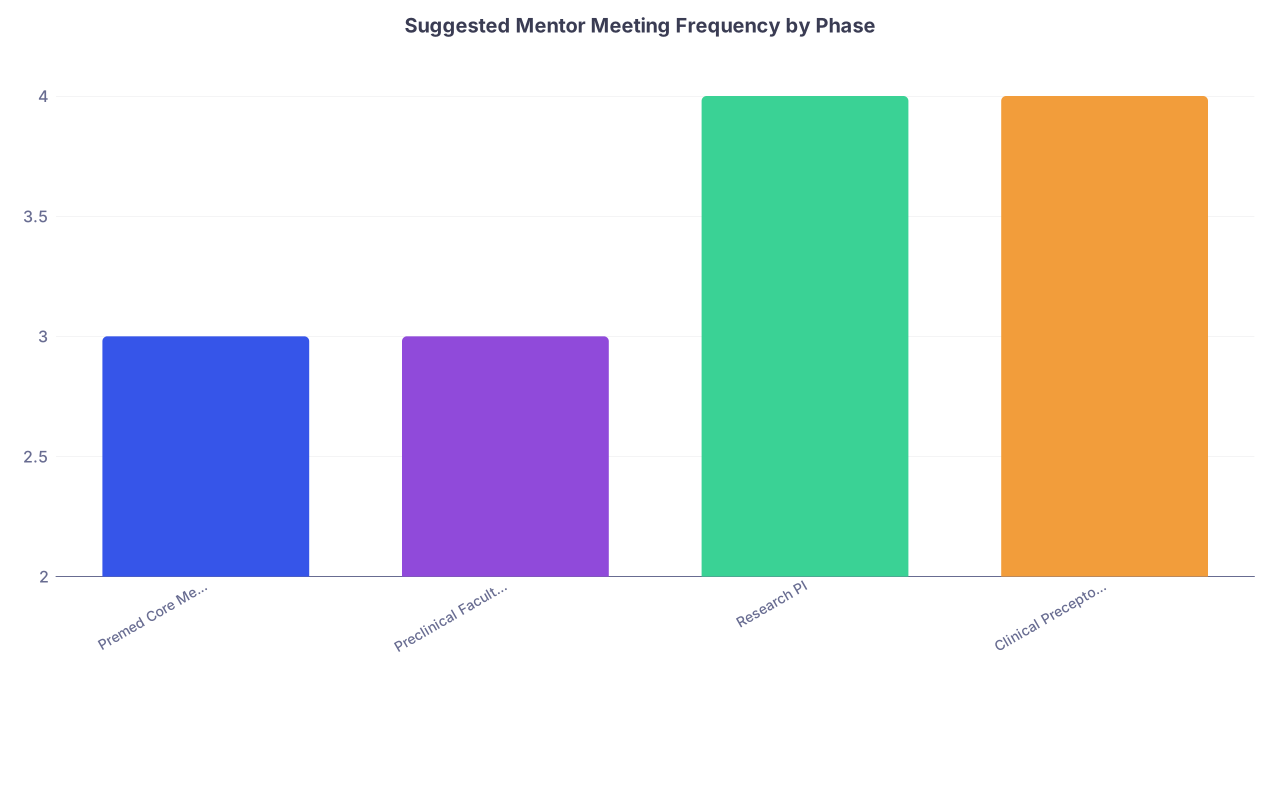
| Category | Value |
|---|---|
| Premed Core Mentor | 3 |
| Preclinical Faculty Mentor | 3 |
| Research PI | 4 |
| Clinical Preceptor (Longitudinal) | 4 |
The values above are approximate meetings per year.
Premed phase
Premed advisor / committee letter writer
- Frequency: 2–3 times per year
- Focus: Academic trajectory, activities, MCAT prep, eventual school list
- Goal: They feel like they have watched you grow, not met you once
Research PI or clinical supervisor
- Frequency: Every 2–3 months if long-term involvement
- Focus: Project progress, new responsibilities, presentations, skills developed
Key professor (small class, knows you well)
- Frequency: Once per term while you are in their course, maybe 1 follow-up a year later
- Focus: Academic performance, intellectual curiosity, future plans in medicine
Medical school – preclinical
Assigned faculty mentor / college advisor
- Frequency: 2–3 times per year
- Focus: Academic adjustment, early specialty interests, research or projects
Research PI
- Frequency: Every 1–2 months while actively working in the lab
- Focus: Data, presentations, abstracts, your growing independence
Medical school – clinical
Clerkship directors / course directors
- Frequency: One meeting during or just after the rotation, one follow-up if you consider the specialty
- Focus: Clinical performance, narrative examples of patient care situations
Longitudinal preceptor
- Frequency: 2–3 times across the year
- Focus: Your evolution in clinical reasoning, patient communication, professionalism
You are trying to be “familiar and memorable,” not “constantly in their inbox.”
Step 4: Meeting Agendas That Feed Directly into Letters
Let me be explicit: your job in these meetings is to supply your mentor with:
- Specific examples of you demonstrating key competencies.
- A clear trajectory: where you started, where you are now, where you are going.
- Language they can reuse when they sit down to write.
You do this through the structure of your agenda and the prompts you give them.
Agenda variation 1: Progress and growth focus (great for long-term mentors)
Use this when you have already met a few times.
1. Brief recap since last meeting (5 minutes)
- Courses / rotations completed
- Major tasks completed (poster, presentation, big exam)
- One challenge, one win
2. Growth reflection (10–15 minutes)
- “Compared with [date/rotation/semester], I think I have improved in:
- [skill 1 – e.g., handling difficult patient conversations]
- [skill 2 – e.g., time management on busy days]
- I would value your honest assessment—where do you see that growth, and where is it still lacking?”
This question is gold. When a mentor answers it, they often generate exactly the kind of specific comparison phrases letter writers need:
- “At the beginning of the year, she struggled to prioritize tasks on rounds. By the end, she was independently managing complex patient lists.”
- “He used to avoid speaking up in class discussions, but now leads small group problem sessions.”
3. Concrete scenario discussion (10–15 minutes)
Bring 1–2 cases or situations:
- “There was a patient with [brief scenario]. Here is how I handled it, what I struggled with, and what I learned. How would you have approached it? Anything you would critique in my approach?”
Why this works:
When your mentor later writes, “I watched him navigate a complex situation involving a non-adherent patient with remarkable empathy…,” that memory often started as a conversation you initiated like this.
4. Future positioning (10 minutes)
- “I am considering [X paths – e.g., internal medicine vs pediatrics]. Given what you have seen, where do you think I am a strong fit, and what should I work on in the next 6–12 months to be competitive?”
Agenda variation 2: Letter-of-recommendation preparation meeting
Use this 2–4 months before you request a letter. Not a week before.
1. Context and goals (5 minutes)
- “I am planning to apply to [med school / summer research program / residency] in [month/year]. I would be honored if you would consider writing a strong letter for me. Before I make that request formally, I want your candid assessment of where I stand.”
You are giving them an easy exit if they cannot write a strong letter.
2. Performance review (10–15 minutes)
Prompt them clearly:
- “If you were describing me to an admissions committee, what specific strengths and weaknesses would you mention?”
- “Are there particular interactions or projects we have worked on together that stand out to you?”
Write down what they say. Those are the stories that will end up in the letter.
3. Gaps and improvement plan (10–15 minutes)
- “Before you would feel comfortable writing a strong letter, are there areas where you would like to see more from me? For example, more leadership on projects, more independent work, better communication?”
Then you propose how to close the gap:
- “If I take the lead on [specific task] over the next two months, would that give you enough to comment on my initiative and leadership?”
4. Logistics for the letter (5–10 minutes)
- Rough timeline for when you will send:
- CV
- Draft personal statement
- Transcript
- Bullet list of activities with impact
- Any specific instructions or forms
You are making their life easier, which increases the odds of a thoughtful, timely letter.
Step 5: Documents You Always Bring (and Update)
If your mentor has to dig to remember what you did, your letter will be superficial. So you do the digging for them.
There are three documents you should keep updated and bring (or email) before major meetings:
One-page CV snapshot
- Not a 5-page CV. A tight one-pager.
- Sections: Education, Key Experiences (research / clinical / leadership), Selected Honors.
- Updated every 3–6 months.
Running “impact log”
- This is the most underrated tool.
- One document where you track:
- Projects you led or contributed to
- Difficult patient encounters
- Times you solved a systems problem
- Feedback you received and then acted on
- One or two lines per item, with dates.
Goal sheet (6–12 month horizon)
- 3–5 specific goals (not fuzzy “be better at medicine”).
- Example:
- “Present a poster at a regional or national conference by [month].”
- “Increase my role in clinic from mostly observing to independently seeing patients and presenting plans.”
- “Raise my practice exam scores from [X] to [Y] by [date].”
You do not read these out loud. You let them sit in the mentor’s inbox or on the table and become reference material.
When they eventually write, “She is one of only a few students in the last five years to present a first-author poster at a regional conference,” that detail came from your CV snapshot and impact log.
Step 6: How to Ask Questions That Generate Letter Material
Most students ask terrible questions:
- “Any advice?”
- “How am I doing?”
- “Do you think I’ll be competitive?”
These questions are vague and invite vague responses. You want specific, behavior-based questions that pull out stories and comparisons.
Here are better options you can drop directly into your agendas:
“Compared to other students at my level, where do I stand in:
- Clinical reasoning
- Professionalism
- Communication with patients
- Teamwork?”
“Can you recall any time you saw me handle a situation particularly well, or particularly poorly? I want to analyze those to improve.”
“If you were writing a letter about me today, what 2–3 stories would you use to illustrate my strengths? Does that feel like enough material yet?”
“What would it take for you to feel confident calling me ‘one of the top students you have worked with’ in a letter? What would I need to show you, concretely?”
That last one is uncomfortable. It is also where you get the clearest roadmap.
Step 7: Structure for Remote or Brief Encounters (Yes, You Still Need Agendas)
Not all mentors are sitting across from you in a calm office. Sometimes you get:
- 15 minutes on Zoom between their clinic sessions
- A quick chat after lab meeting
- Email-only relationships with PIs at other institutions
You still use structure. You just compress it.
For a 15–20 minute Zoom meeting
Send a short agenda beforehand:
- 2 minutes: Quick update and context
- 5–7 minutes: Two focused questions
- 5–7 minutes: Feedback / performance comparison
- 2–3 minutes: Next steps and letter logistics
For a “walking down the hallway” conversation
Do not try to dump your life story. Pick one:
- “Dr. Lee, I would love to schedule a 20-minute meeting to get your feedback on my progress on this rotation and future planning. Can I email you a brief agenda and some times that work for me?”
Then follow the same playbook: email, agenda, clear purpose.
Step 8: Converting Meetings into Recommendation Power
Meetings are only half of the system. The other half is what you do after them.
Immediately after the meeting: the two things you send
Within 24 hours:
Thank-you email with a concise recap
Example:
Dr. Patel,
Thank you for meeting with me today. I appreciated your feedback about my strengths in patient communication and the suggestion to take on a more active role in presenting plans during rounds.
As we discussed, I will:
– Take the lead on 1–2 patient presentations per day this week and ask for brief feedback.
– Email you an updated CV and draft personal statement by May 15 so you have context for my residency applications.I will follow up in a couple of months to update you on my progress.
Best,
[Your Name]That paragraph about strengths? They may literally copy-paste it into the letter later.
Updated document(s) if promised
- CV snapshot
- Impact log or bullet list of achievements
- Draft personal statement
1–2 months later: structured update email
You are not spamming them. You are closing the loop on what they told you.
Subject: “Update on [rotation / project] and next steps”
Body structure:
Brief reminder of last meeting:
- “We met in March to discuss my performance on the medicine clerkship and plans for internal medicine residency.”
2–4 bullet updates linked directly to their advice:
- “Since then, I have:
- Taken the lead on presenting patients daily; my attending commented that my assessments have become more concise and organized.
- Completed a case report with Dr. X; it has been accepted for presentation at [conference].
- Continued volunteering at [clinic], now in a more independent role managing follow-up plans.”
- “Since then, I have:
Clear forward plan:
- “I will be submitting ERAS in September and will reach out in July with formal letter request materials, if you are still comfortable writing on my behalf.”
You are guiding their memory, not leaving it to chance.
Step 9: Common Mistakes That Kill Strong Letters
I have seen students sabotage themselves over and over. Avoid these.
The “ghost then reappear” move
- Vanish for a year, then send a desperate email:
- “Hi Dr. Smith, I was in your class two years ago. You may not remember me, but can you write a strong letter?”
- That is how you get generic, lukewarm letters.
- Vanish for a year, then send a desperate email:
No agenda, wandering meetings
- You show up, chat vaguely, leave with no action items.
- Your mentor does not remember anything specific about you.
Only showing wins, never showing growth
- You present yourself as flawless. No weaknesses, no evolution.
- Strong letters emphasize trajectory: “She improved rapidly once she received feedback.”
Not asking for honest comparison
- You are afraid to hear where you stand.
- So you never get the line everyone wants in a letter: “He is in the top 5% of students I have worked with in the last decade.”
Forgetting logistics
- You do not provide your CV, personal statement, or deadlines clearly.
- Your letter gets rushed, late, or based on vague impressions.
Step 10: Putting It All Together – A Sample 6-Month Plan
To make this concrete, here is what a 6-month structured-mentor approach might look like for a premed junior aiming for med school applications.
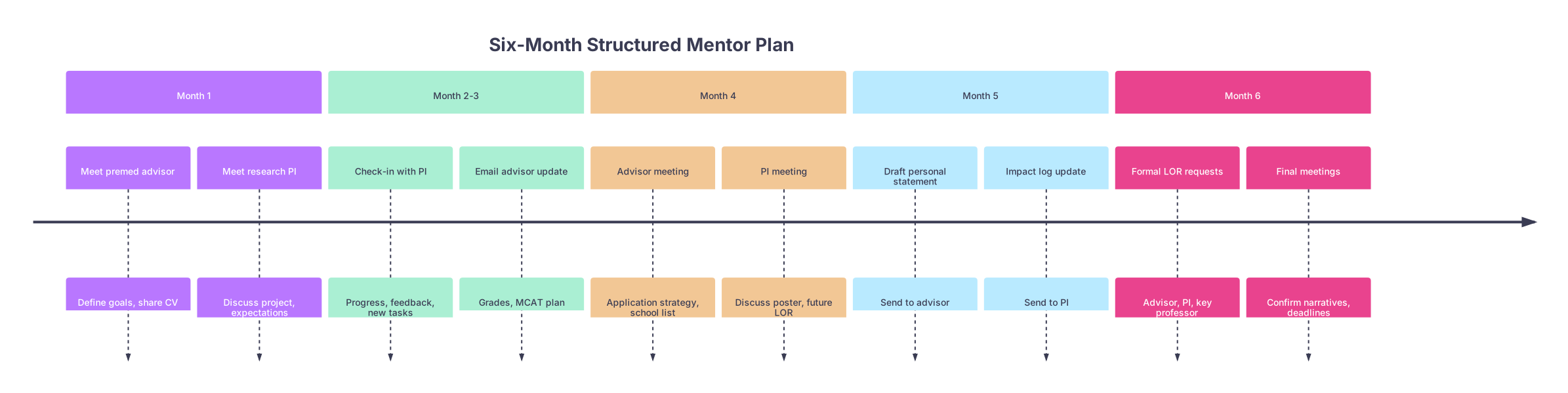
| Period | Event |
|---|---|
| Month 1 - Meet premed advisor | Define goals, share CV |
| Month 1 - Meet research PI | Discuss project, expectations |
| Month 2-3 - Check-in with PI | Progress, feedback, new tasks |
| Month 2-3 - Email advisor update | Grades, MCAT plan |
| Month 4 - Advisor meeting | Application strategy, school list |
| Month 4 - PI meeting | Discuss poster, future LOR |
| Month 5 - Draft personal statement | Send to advisor |
| Month 5 - Impact log update | Send to PI |
| Month 6 - Formal LOR requests | Advisor, PI, key professor |
| Month 6 - Final meetings | Confirm narratives, deadlines |
During each of those meetings, you are using the agenda frameworks above:
- Clear goals.
- Specific feedback prompts.
- Explicit discussion of future plans and letters.
This is the opposite of “hope they remember me.”
Final Thoughts: What Actually Moves the Needle
Strip away all the fluff and here is what matters.
Structured, recurring contact beats last-minute scrambling.
A mentor who has seen you grow over months or years, through meetings you guided with clear agendas, will write a very different letter from someone you ambush by email at the last second.You must supply the stories and the language.
Your agendas, impact log, and follow-up emails are not bureaucratic busywork. They are where your future letter writers get the specific examples and phrases committees care about.Honest, sometimes uncomfortable feedback is your edge.
If you are willing to ask, “What would it take for you to call me one of your top students?” and then do the work, your letters will reflect that seriousness. Most of your competition will never do this.
Build the system now. Set the meetings. Write the agendas. Make it easy for your mentors to remember you clearly and speak about you powerfully when it counts.