
You’re a junior (or worse, a first‑semester senior). You just switched into biology, neuroscience, or some other premed‑friendly major. Your old department knew you. You had one or two professors who got you. Now you’re sitting in a 200‑person lecture hall where the professor does not even know you exist.
And you’re supposed to produce strong, personal letters of recommendation for medical school in… what, 12–18 months?
This is exactly the kind of corner students back themselves into without realizing it. The good news: you can dig out. In 2–3 semesters, you can build a credible mentor network from near zero—if you treat it like an urgent project, not a vague hope.
Let’s walk through what to do, in order, so you actually have real people who can write real letters, not “This student got an A and sat in row 7” fluff.
Step 1: Get Clear on What Letters You Actually Need
Before you panic about mentors, you need to know what you’re solving for.
Medical schools do not just want “some letters.” They want particular types:
- Science faculty (usually 1–2)
- Non‑science or “other” faculty (often 1)
- Clinical or research supervisor (optional but strongly recommended, especially for more competitive schools)
- Committee or composite letter (if your school has a pre‑health committee)
You’ve changed majors late, so your risk zones are:
- No science faculty who know you well in your new department
- No long‑term research or clinical supervisor
- No one who can say, “I’ve watched this student grow over time”
You’re not going to fix this by “being a good student” quietly. You fix it by being intentional.
Here’s your target, in the next 2–3 semesters:
| Letter Type | Ideal Count | Backup Count |
|---|---|---|
| Science Faculty | 2 | 1 |
| Non-Science Faculty | 1 | 1 |
| Research/Clinical | 1 | 1 |
| Committee Letter | 1 | — |
You do not need 10 mentors. You need 3–4 people who know you really well. That’s the whole game.
Step 2: Map Your Remaining Time Like a Project
You’ve got 2–3 semesters. Treat them like a compressed timeline, not “plenty of time.”
Let’s assume two scenarios and be honest about them.
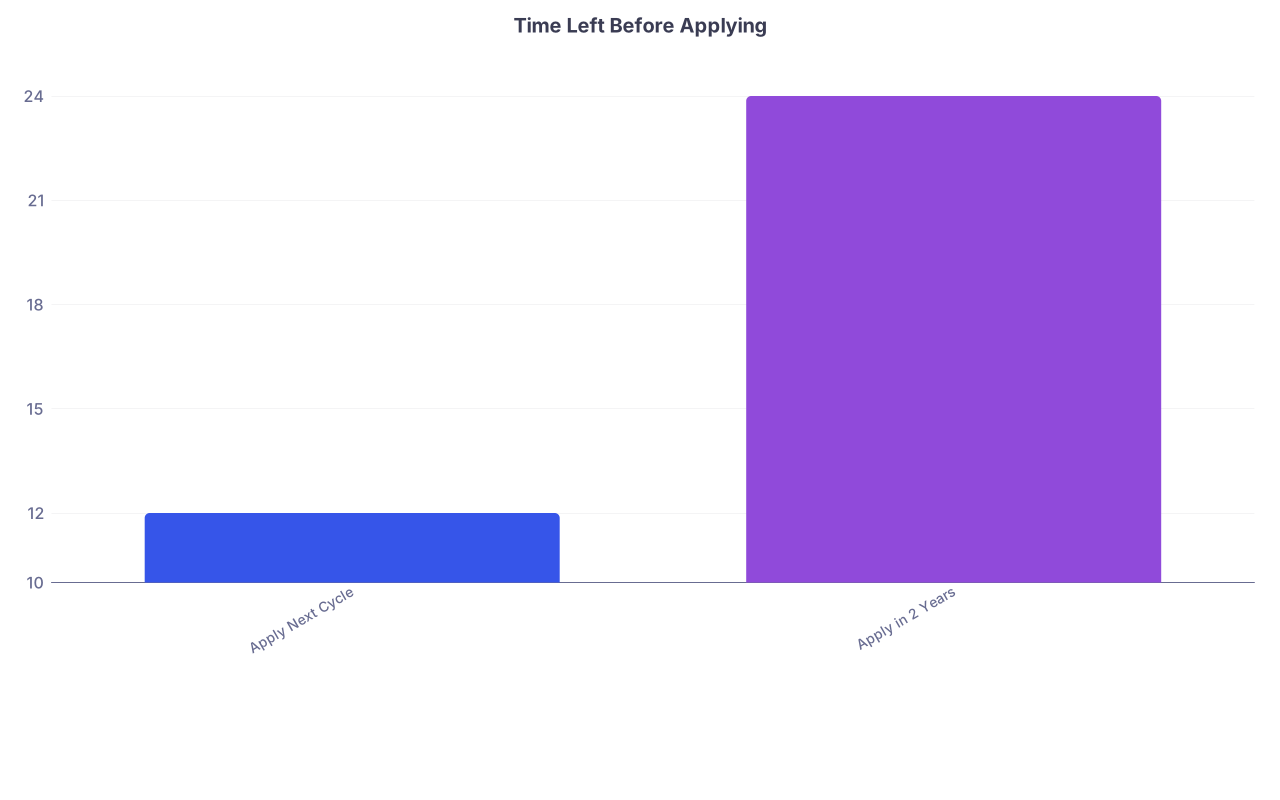
| Category | Value |
|---|---|
| Apply Next Cycle | 12 |
| Apply in 2 Years | 24 |
- Apply next cycle → ~12–15 months until applications go in
- Apply in 2 years → ~24–27 months
If you’re in the first group, you can’t waste a single semester. If you’re in the second, you have a bit more breathing room, but you should still move fast.
Do this right now:
- List every course and activity you’re in this semester and next
- Circle the ones where you actually have access to potential mentors:
- Smaller classes (<60–80 students)
- Lab courses
- Seminars
- Research for credit
- Clinics, volunteering, scribes, etc. with consistent supervisors
If your schedule is all 300‑person lectures and anonymous volunteering, that’s a problem. You need at least two structured settings where a human sees you regularly and can evaluate you.
If that’s not true, you adjust now: add a seminar, join a lab, or shift your clinical work to a more longitudinal role.
Step 3: Engineer Visibility in Your New Major (Fast)
Your biggest disadvantage is that your new department doesn’t know you. So you compress “getting known” into a semester or two.
Here’s how, in practical terms.
In Large Lectures
Yes, even in giant classes you can make yourself visible if you stop acting like a ghost.
Pick one or two professors you want as potential letter writers. Then:
- Sit in roughly the same area each class—front third of the room
- Ask 1–2 thoughtful questions each week (not performative, actually about the material)
- Go to office hours every 1–2 weeks, consistently
- Use your name when you show up:
- “Hi Dr. Kim, I’m Jordan Lee from your MWF 9am section. I had a question about the last exam.”
Your office hour goals for the first 4–6 weeks:
Week 1–2:
Introduce yourself, give a very short version of your situation:
“I recently switched into biology from economics because I realized I want to pursue medicine. I’m trying to really build strong foundations in this field. Is there anything you recommend I especially focus on in this course?”
Week 3–4:
Come back with specific content questions, and one “bigger picture” question:
“I was reading the paper you mentioned about CRISPR in class—do you think undergrads get involved in that kind of work here?”
Week 5–8:
Start connecting your work ethic and growth to something they can remember:
“I struggled with the first quiz but I tried the practice problems you suggested and came to TA review. My score jumped on exam 1. If you see other patterns in my work, I’d appreciate the feedback.”
This is how a letter writer later ends up saying:
“I have observed this student deliberately seek feedback and implement it, with clear improvement over the semester.”
You’re feeding them the story now.
In Smaller Classes and Labs
This is where you should be fighting for a spot. Lab and seminar instructors are undervalued gold for letters.
In these settings, do three things:
Be the person who is predictably prepared
Not the loudest. The one who clearly did the reading, has the pre‑lab done, shows up on time.Volunteer for slightly above‑baseline contributions
- Offer to share your lab notebook template with the group
- Take the lead on organizing data
- Write the first draft of the group email to the professor
After 4–5 weeks, explicitly name your long‑term interest:
“I’m planning to apply to medical school in a year or two. I know I switched into this major late, but I’m really trying to build strong relationships and learn the material thoroughly.”
This plants the idea. Later, when you ask for a letter, it’s not coming out of nowhere.
Step 4: Build at Least One Longitudinal Relationship Outside Class
Med schools love letters that say some version of: “I’ve watched this person over time, in a clinically or scientifically relevant setting.”
So you need one anchor relationship. In 2–3 semesters, your best bets:
- Research PI or postdoc/grad mentor
- Clinical supervisor (clinic manager, physician, PA, RN, volunteer coordinator)
- Non‑profit or service site supervisor
If you have zero right now, then your next move is not “read more SDN.” It’s: get into one setting where you’ll be around the same humans for 6–12+ months.
Research: How to Integrate Quickly After a Late Major Switch
I’ve seen students switch into biology as juniors, join a lab that same semester, and generate a meaningful letter by the following summer. Not because they’re geniuses. Because they treat the lab like a serious commitment.
Your approach:
When emailing PIs, don’t write generic “I love science!” emails. Write this:
- 1–2 lines: who you are, that you switched majors, your timeline for med school
- 1–2 lines: why their specific work interests you (mention a paper or topic)
- 1–2 lines: your availability (2–3 consistent blocks per week)
Once in a lab:
- Be obsessively reliable for 3–4 months (show up on time, stay engaged, take notes)
- Ask to take on slightly more responsibility as you master basics
- Show you’re thinking: “Could I try plotting X vs Y to check for Z?”
Around month 4–6, schedule a quick meeting with your direct mentor or PI:
“I wanted to check in. I’m planning to apply to medical school in [year]. Since I switched majors late, it’s really important to me to learn as much as I can here and contribute meaningfully. Are there ways you’d suggest I grow in the next few months?”
That does two things: signals your seriousness, and reminds them you exist as a long‑term trainee, not just Free Labor #7.
Clinical or Service Work: Make One Person Know You Well
If you’re volunteering at three different places for 2 hours each, stop. Consolidate.
You want something like:
- 4–6 hours weekly in a single clinic/hospital/organization
- Same supervisor or small group of supervisors seeing you for months
Your behavior there should look like:
- Show up. On time. Every week.
- Verbally check in with your supervisor:
- “Is there anything I can be doing better?”
- “Do you feel like I’m helpful to the team?”
Eventually, maybe mid‑semester, you say:
“I just want to let you know, I switched into premed late and I’m planning to apply to medical school in [year]. If there are any opportunities to take on more responsibility or learn more about how the clinic runs, I’d really appreciate it.”
Now you’ve set them up to see you as a developing premed, not just a transient volunteer.
Step 5: Turn “Acquaintance” Professors into Real Mentors in One Semester
Here’s the part most students screw up. They think time alone creates mentorship. It does not. Intentional contact does.
In each targeted class, your goal over one semester is to move this relationship along a simple path:
Anonymous → Recognized → Known → Advocating
A rough “playbook” for one professor over 14–15 weeks:
- Weeks 1–2: Introduce yourself briefly after class or at office hours
- Weeks 3–5: Attend office hours 2–3 times with real questions (not “How do I get an A?”)
- Weeks 6–8: Ask for feedback on your performance or thinking
- Weeks 9–12: Share a small “story” of your academic shift and long‑term goals
- Weeks 13–15: Ask for advice about med school prep, not a letter yet

| Step | Description |
|---|---|
| Step 1 | Anonymous Student |
| Step 2 | Recognized Face |
| Step 3 | Known by Name |
| Step 4 | Understands Your Story |
| Step 5 | Potential Letter Writer |
Example phrases that move this along:
- “I’ve been thinking about how this concept relates to my prior major in X…”
- “I switched majors recently and I’m re‑learning how to study for science courses. Here’s what I’m trying; does that make sense to you?”
- “I’m planning long term for med school, and I’m trying to get serious about understanding the material, not just grades.”
You’re giving them texture. So that when you eventually ask for a letter, they have something to write about.
Step 6: Decide Your Application Timing Honestly
Some of you reading this want to apply “on time” because your friends are. But if you’ve just switched majors and have weak relationships, applying one year later can turn a mediocre application into a strong one.
Rough reality check:
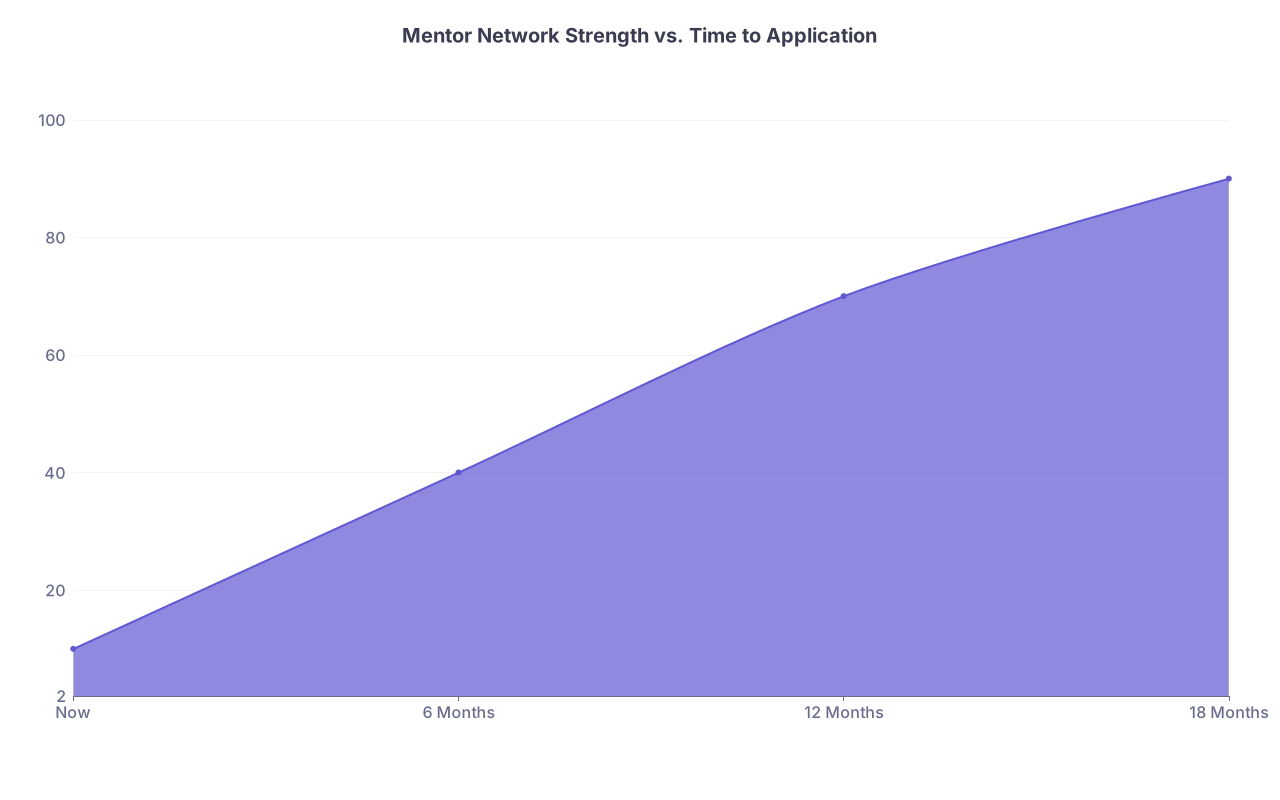
| Category | Value |
|---|---|
| Now | 10 |
| 6 Months | 40 |
| 12 Months | 70 |
| 18 Months | 90 |
If:
- You have zero strong science letters right now
- No long‑term clinical/research mentor
- You just switched majors this semester or last
Then forcing an application in <12 months usually produces letters full of generic lines like “hard‑working, punctual, did well in class.” Those do not move the needle.
If you push your application back one cycle:
- You get 3–4 semesters in the new major
- Your PI or supervisor knows you for 12–18 months instead of 3–4
- You can take on more leadership and responsibility
Not everyone can or should delay. But if your entire network is made up of people who would need to look up your face, delaying a year to build real relationships is often the smarter play.
Step 7: Asking for Letters Strategically (Given Your Short Timeline)
By the time you ask, you should have:
- Met with this person multiple times
- Shown clear growth or consistent effort
- Shared your goals and story in some form
Here’s exactly how to ask in your situation.
How to Ask a Professor You’ve Known One Semester
In person is ideal; email is acceptable if needed.
“Dr. Smith, I’ve really appreciated your class and the feedback you’ve given me this semester. As you know, I switched into biology recently and I’m applying to medical school in [year].
I was wondering if you’d feel comfortable writing a strong, personalized letter of recommendation for me that speaks to my work in your course and my growth this semester. I know our time working together has been somewhat short, so I understand if you’d prefer not to, but I’ve valued your perspective a lot.”
That phrase “strong, personalized letter” is deliberate. It gives them the chance to say no if they can only write something generic.
If they say yes, immediately follow up with:
- CV or resume
- Unofficial transcript
- Draft of your personal statement (if you have it, or at least a short summary of your path to medicine and major switch)
- Bullet list of 3–5 specific things you did in their class or lab that show who you are
You are not “telling them what to write.” You’re reminding them of evidence they already saw.
How to Strengthen a Short Relationship Before the Letter Is Due
If you’re asking someone after just one semester, you should stay in their orbit the following term:
- Take another course with them if possible
- Be a TA/grader/peer tutor for their course
- Drop by office hours a few times with updated questions or updates on your journey
That way, by the time they actually hit “submit” on your letter, they’ve known you more than the bare minimum.
Step 8: Coordinate Letters With a Pre‑Health Committee (If You Have One)
If your school has a pre‑health committee, they may require specific types and numbers of letters and might bundle them into a composite letter.
Do not find this out two weeks before the deadline.
Do this now:
Check your pre‑health office website for:
- Required number of faculty letters
- Science vs non‑science requirements
- Deadlines for opening a file or completing an interview
Count what you have and what you’re on track to have:
- “By end of spring, I’ll have 1 strong science from Dr. X, 1 potential from Dr. Y, and 1 non‑science from my philosophy professor.”
If you’re coming up short, adjust your next semester schedule:
- Add a small writing/ethics seminar for a potential non‑science mentor
- Prioritize one more science course taught by a full‑time faculty member (not 100% adjunct‑run, if avoidable)
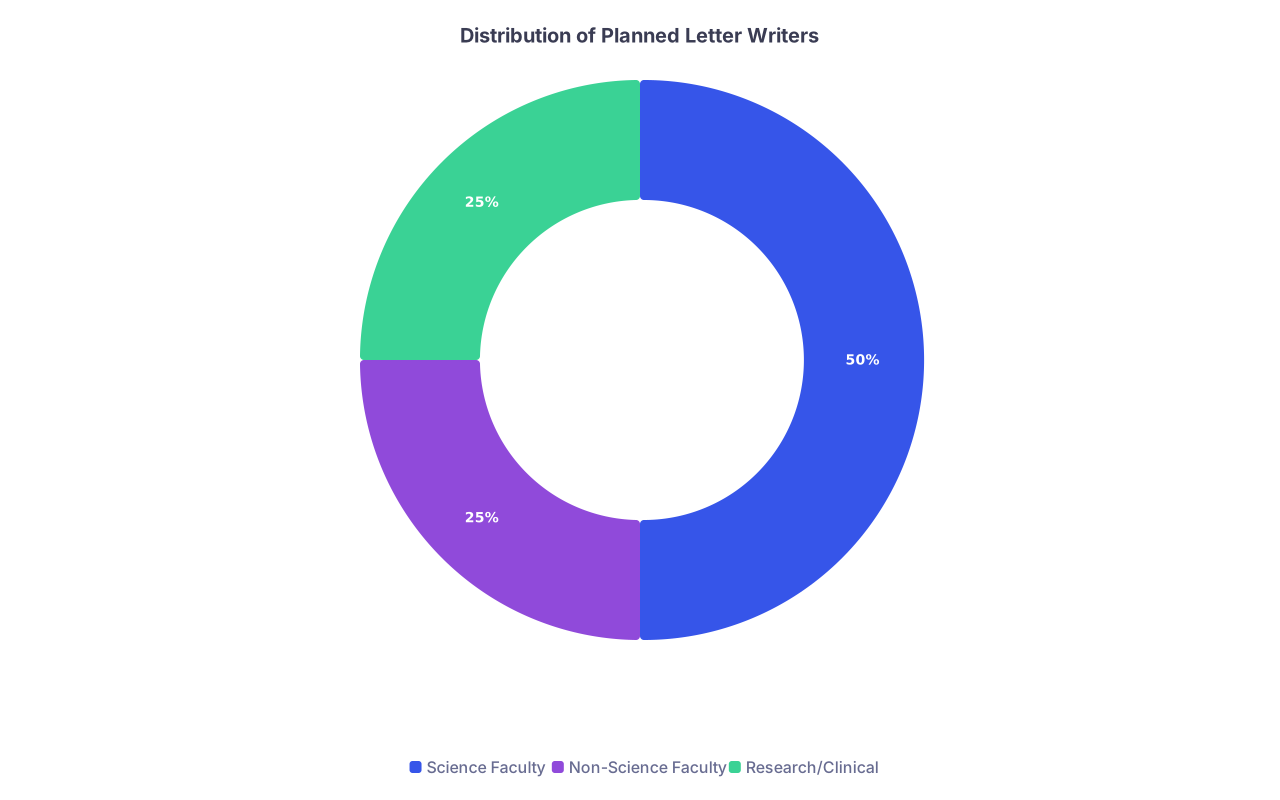
| Category | Value |
|---|---|
| Science Faculty | 2 |
| Non-Science Faculty | 1 |
| Research/Clinical | 1 |
You want to avoid scrambling for some random person you barely know just to hit a checkbox.
Step 9: Use Reflection as Glue Between Scattered Experiences
When you switch majors late, your file often looks choppy: a little econ, suddenly a lot of biology, some scattered volunteering. Mentors can help connect the dots if you show them the through‑line.
So, every 4–6 weeks, write a short reflection for yourself:
- What have you actually learned in your new major so far?
- How have your study habits changed?
- Any concrete moments where you handled something hard (exam, lab mistake, patient interaction) differently than you would have two years ago?
Then occasionally bring bits of this into your conversations with mentors:
“I realized that in my old major, I could cram for exams and do fine. In your class, I had to spread things out and actually engage with the problem sets. It’s forced me to change how I learn, and I’m grateful for that.”
That sounds like a throwaway comment. It’s not. That’s the kind of detail letter writers use: growth, self‑awareness, and evidence you can adapt.
Step 10: Handle the “Why Did You Switch So Late?” Question Head‑On
Every decent mentor, and later every med school, will think: why did you bail on your old major?
You should give your mentors a clean, honest, non‑dramatic explanation they can understand and, if needed, echo.
Bad version:
“I hated econ and bio just seemed more interesting and I want to help people.”
Better version:
“I came into college thinking I wanted to do X because of [short reason]. As I got deeper into those courses, I realized I was more drawn to [some aspect of science, people, problem‑solving]. I took [key course or experience] and it clicked. I switched late because I needed enough exposure to be sure I wasn’t just reacting impulsively. Now I’m doubling down on getting the right preparation.”
Your mentors don’t need a TED Talk. They need a coherent story that makes you sound thoughtful, not flaky.
If they have that, then when they write your letter, they can say something like:
“Although Jordan switched into biology in the latter half of college, this decision followed deliberate reflection and aligned strongly with the way Jordan engaged in my course. Once committed, Jordan threw themselves fully into the discipline…”
Which is exactly the framing you want.
Quick Reality Check: Common Dumb Moves to Avoid
Since you do not have time to waste, dodge these:
- Relying on old‑major professors who barely remember you just because “they know me longer”
- Thinking “I’ll just ask for letters at the end” without building any relationship now
- Splitting your time between five different shallow clinical sites
- Emailing a PI and then ghosting because you’re “too busy this semester”
- Assuming a TA’s praise equals a professor knowing who you are (they often don’t)
You’ve got limited time. Put it where it will produce humans who can vouch for you meaningfully.
Final Tight Summary
- In 2–3 semesters, your job is to build 3–4 deep relationships, not 10 shallow ones—especially 1–2 science faculty and 1 longitudinal supervisor.
- Engineer visibility: show up, use office hours, verbalize your story and growth so letter writers have real material to work with, not just your grade.
- Be ruthless about your timeline: if your mentor network is thin and rushed, strongly consider delaying your application by a year to turn weak, generic letters into strong, specific ones.