
You’re at a college no one has heard of at AMCAS workshops. No official pre‑med committee, no dedicated health professions advisor, maybe a generic career center that knows more about Deloitte than dermatology.
Your friends at State U are bragging about their “committee letter” and “pre‑health advising team.” You have…a biology professor who mispronounces “AMCAS” and a registrar who hands you PDFs.
And looming over all of this: you need strong letters of recommendation that can compete with people who have formal pre‑med offices backing them.
If that’s you, this is your playbook. You’re going to build your own informal “pre‑med office” by constructing a mentor network and a system for generating strong, specific letters—without institutional hand‑holding.
Step 1: Admit Your Reality and Define What You Actually Need
First, be blunt with yourself: you do not have structural help. That means:
- No committee letter
- No centralized letter storage
- No built‑in system to connect you to “pre‑med friendly” faculty
- No one chasing you about timelines and letter etiquette
So you have to replace those functions on your own. Not with vibes. With structure.
Here’s what you actually need to replicate:
- People who know you well enough to write detailed, positive letters.
- A documented track record they can reference (grades, projects, responsibilities).
- Someone who understands (even minimally) what med schools want to see.
- A system for:
- choosing letter writers,
- asking correctly,
- giving them what they need,
- following up,
- and storing/submitting letters.
You are not just “finding letter writers.” You are building a small, personal advisory board.
Step 2: Build Your DIY “Pre‑Med Board” (3–5 People, On Purpose)
Do not wait until the semester you apply. You start this 12–24 months before you need letters.
You’re aiming for 3–5 “board members” who play different roles:
| Role | Target Number |
|---|---|
| Science Faculty | 1–2 |
| Non-Science Faculty | 1 |
| Clinical / Physician | 1 |
| Research / PI (if any) | 0–1 |
If you don’t have all these now, fine. You build toward it.
How to Identify Candidates
Look for:
Faculty who:
- know your name without checking the roster,
- comment on your work, not just your grade,
- stay after class for questions,
- don’t look visibly annoyed at undergrad humans.
Supervisors who:
- have seen you handle responsibility (tutoring, lab TA, work-study, EMS, scribing),
- can see you regularly, not once a month.
Clinicians who:
- have seen you with patients (shadowing where you actually interact, volunteering),
- comment on your reliability, empathy, initiative.
Do not chase big names. A famous PI who barely remembers you is a weak letter. A mid‑career associate professor who’s watched you grind through office hours is far better.
Converting Them Into “Board Members”
You do not say, “Will you be on my pre‑med board?” That sounds ridiculous. But you act like it exists.
You say things like:
- “I’m planning on applying to medical school in about two years, and I don’t have a formal pre‑med advisor here. Would you be open to meeting once a semester so I can get your advice and keep you updated on my progress?”
Most reasonable faculty will say yes. If they hesitate, fine—better to know now than trust them with a letter later.
Step 3: Start Early: Relationship‑Building Before Letter‑Asking
If you’re more than a year away from applying, your job is relationship‑building and performance. Letters are the side effect.
Here’s how you actually do that, week by week, not in vague “be involved” language.
In Class
You’re backing up your future letter with evidence.
- Sit in the front third. Not dead center staring them down, just visibly engaged.
- Ask 1–2 substantive questions per week. Not “is this on the exam?” Questions that show you’re actually thinking.
- Go to office hours 2–3 times early in the term, not just before exams. Talk about:
- things you found interesting,
- how to improve your understanding,
- possible related readings or projects.
Most memorable students are not the ones with 100% on the exam. They’re the ones who show their brain in office hours.
Outside Class
With potential mentors:
- Send 2–3 update emails per semester:
- short,
- concrete,
- easy to skim.
Example:
Subject: Quick update – MCAT + volunteering
Hi Dr. Kim,
I wanted to quickly update you:
• I started volunteering 4 hrs/week at Mercy Hospital on the med‑surg floor.
• I’m planning to take the MCAT next June and just began a prep course.
• Your physiology class has been really helpful for understanding what I’m seeing on the floor (especially heart failure patients).Hope your semester is going well,
Alex
You’re training them to see your arc. Later, when they sit down to write a letter, they’re not guessing—they have a story.
Step 4: Learn What a Strong Letter Actually Looks Like
You need the target in your head, because your school is not going to teach this.
A strong med school letter is:
- Enthusiastically positive (not “damning with faint praise”).
- Specific about:
- situations,
- behaviors,
- comparisons to peers.
- Anchored in direct observation (not “I’ve heard…”).
- Aligned with core competencies: reliability, communication, teamwork, ethics, resilience, growth.
Weak letter red flags:
- Generic adjectives (“hardworking, nice, intelligent” with no examples).
- Short (one paragraph).
- No concrete stories.
- Backhanded comparisons (“One of the better students I have taught” with no context).
Your mentor framework exists to give people enough raw material and context to write a strong letter without you telling them what to say.
Step 5: Create Your “Letter Packet” System (Because You Don’t Have a Committee)
You’re going to replace the committee packet with a personal packet that you hand to every potential letter writer.
Components:
- One‑page CV or resume
- Unofficial transcript
- Draft of your personal statement (or at least a one‑page “why medicine” + main themes if early)
- One‑page “Brag Sheet” tailored to them
- A clear list of:
- where the letter goes,
- how to upload it,
- when it’s due.

The Brag Sheet: Your Secret Weapon
This is where you do what a pre‑med office would do: give the writer structured input.
For each writer, make a 1‑page document with:
- How you know them (course, semester, role)
- Specific things you did with them:
- projects,
- papers,
- labs,
- improvements.
- 3–5 bullet points of things you hope the letter can speak to, all based on reality.
Example for a physiology professor:
- Took your Advanced Physiology (Spring 2024), earned an A.
- Met weekly during office hours for the second half of the course to go over practice problems.
- Led a 3‑person group on the final presentation about renal physiology and blood pressure regulation.
- You commented that my final exam showed “excellent grasp of integrative physiology.”
Then:
If you feel able, I’d be grateful if you could comment on:
• My ability to master difficult scientific concepts
• My preparation and engagement in your class and office hours
• My growth from the first exam to the final
You’re not putting words in their mouth. You’re reminding them what they saw.
Step 6: Where to Store Letters Without a Committee
You still need a central letter collection system. Use what med schools actually recognize.
Best approach if your school lacks a formal pre‑med office:
| Option | Good For |
|---|---|
| Interfolio | Collecting and reusing letters safely |
| AMCAS Letter Sys | Directly linked to MD schools |
| AACOMAS Letters | DO school applications |
Interfolio is the closest thing you’ll get to a “committee file” if your school won’t help. You:
- Create an account.
- Generate letter request forms with unique IDs.
- Send those to writers so they can upload once.
- Then you forward letters to AMCAS/AACOMAS as needed.
If you want simplicity and are only applying once and only to MD schools, you can skip Interfolio and use AMCAS’s own letter service—but Interfolio is safer if timelines slip or you might apply in multiple cycles.
Step 7: How to Ask for a Letter (Exact Words)
Timing:
Ask 8–12 weeks before you need it submitted, especially for busy people (physicians, PIs).
In person is best. Email is acceptable if you regularly communicate that way.
Key phrase you must use:
“Would you feel comfortable writing me a strong letter of recommendation for medical school?”
The word “strong” gives them an exit if they can’t do it. You want people who lean in, not “I guess…”
Sample in‑person script:
“Dr. Patel, I’m planning to apply to medical school this coming June, and I’m putting together my letters of recommendation. I really valued your organic chemistry course and the feedback you gave me on my exams.
Based on your experience with me, would you feel comfortable writing a strong letter of recommendation for my medical school applications?”
If they say yes:
“Thank you, I really appreciate it. I’ll email you a packet with my resume, transcript, draft personal statement, and a short summary of my work in your course, plus the upload instructions and deadline.”
If they hesitate or say something like, “I’m not sure I know you well enough”:
You say:
“I understand, thank you for being honest. I appreciate your time.”
And you do not push. A reluctant writer is dangerous.
Step 8: Your Follow‑up and Reminder System (Because No One Else Is Tracking This)
Without a pre‑med office, no one is chasing letter writers for you. You need a simple tracking system.
Use a spreadsheet or note with:
- Writer name
- Role (science, non‑science, clinical, research)
- Date you asked
- Date they agreed
- Official deadline
- Reminder dates
- Date received
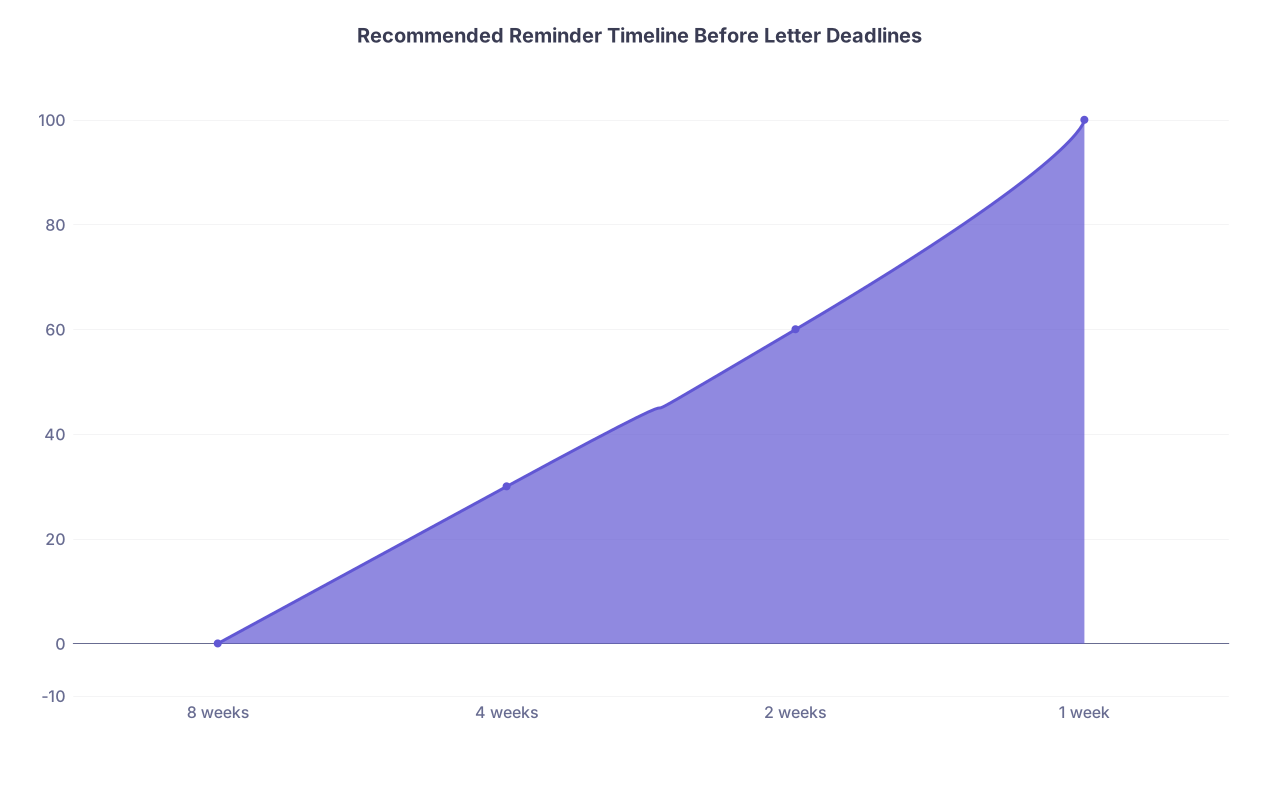
| Category | Value |
|---|---|
| 8 weeks | 0 |
| 4 weeks | 30 |
| 2 weeks | 60 |
| 1 week | 100 |
(Remember: that chart’s “values” is conceptual—think of it as how much you should start worrying; 0% at 8 weeks, 100% at 1 week.)
Reminder cadence that doesn’t make you annoying:
- At the time they agree: send packet + clear deadline.
- 4 weeks before deadline: gentle check‑in if not yet confirmed.
- 2 weeks before deadline: shorter reminder.
- 5–7 days before: final polite nudge only if it’s still missing.
Sample initial email after they agree:
Subject: Med school letter – materials + deadline
Dear Dr. Patel,
Thank you again for agreeing to write a strong letter of recommendation for my medical school applications.
As promised, I’ve attached:
• My resume (1 page)
• Unofficial transcript
• Draft of my personal statement
• A brief summary of my work in your course and areas you might comment onThe letter can be uploaded directly using the attached Interfolio/AMCAS request form. The priority deadline is June 10, though earlier is always helpful.
Please let me know if there’s any other information that would be useful.
Best,
Alex
Four‑week reminder:
Dear Dr. Patel,
I hope your semester is going well. This is just a quick reminder that my medical school letter of recommendation is due around June 10. Please let me know if you need any additional information from me.
Thank you again for your support.
Best,
Alex
Do not send daily neurotic emails. If someone repeatedly doesn’t respond, that’s a data point for the future: you don’t use them again.
Step 9: Compensating for No Committee Letter in Your Application
Some schools ask: “Does your institution provide a committee letter or pre‑med advisor?” If yours doesn’t, say so plainly.
On secondaries or in interviews, if it comes up:
You do not whine about your school. You frame it like this:
- “My college doesn’t have a pre‑med committee or dedicated health professions office, so I created my own small advisory group of faculty and mentors who know me well. I meet with them regularly and they’ve written individual letters based on long‑term experiences with me.”
That shows initiative, not victimhood.
And if a secondary explicitly asks why you don’t have a committee letter (when your school usually provides one), different story—but you’re not in that group. Your school literally doesn’t have one, so end of discussion.
Step 10: Use Non‑Faculty Mentors Strategically (Without Overweighting Them)
If you lack traditional research or big‑name faculty, you lean on the strengths you do have: long‑term, close‑range observers.
Non‑faculty letters that can be powerful:
- Long‑term clinical supervisor (volunteer coordinator, charge nurse, clinic manager)
- Physician you’ve shadowed extensively who let you interact with patients
- Supervisor from significant non‑clinical work (EMS, crisis hotline, teaching, management)
Weak non‑faculty letters:
- “Alex volunteered here 20 hours. They were always on time.”
- “Alex is a kind person.” (With no specifics.)
Your job is to engineer the former. How?
- Commit to one or two activities for 1+ years, not 6 different clinics for 10 hours each.
- Ask for feedback along the way:
- “Is there anything I could be doing better when I’m with patients?”
- “Are there additional responsibilities I could take on?”
- Take ownership: show them you care about growth, not just hours.
When you request letters from these people, you tailor the brag sheet to highlight:
- Longevity.
- Increasing responsibility.
- Specific patient interactions or situations.
Step 11: If You’re Late in the Game (Applying This Cycle, No Relationships Yet)
You’re behind, but not dead.
Harsh truth: you cannot magic three years of mentorship into existence in three months. But you can:
Identify the 2–3 faculty who know you best relative to others:
- Small classes,
- Courses where you improved,
- Professors who actually talk to you.
Book short meetings:
- “I’m planning to apply to medical school this summer and don’t have a pre‑med office here. I’d like to ask your advice about my path so far and see if you might be comfortable writing a strong letter for me.”
Use your best non‑faculty mentors:
- EMS captain you worked with for 2 years,
- Clinic supervisor from 300+ hours,
- PI from your one serious research project, even if remote.
Over‑deliver your letter packet. Give them something to work with.
Then, be realistic: your letters may not be as polished as the kid with a full committee apparatus. Fine. You tighten every other part of your app and, if necessary, be mentally prepared for a re‑app with stronger long‑term mentorship next time.
Step 12: Maintain Relationships After the Letter
You’re not done after the upload.
When your application cycle moves:
- When primaries are in: brief thank‑you + update.
- When you get interviews: email your writers again.
- When you get an acceptance: write them a real thank‑you note. Physical, if possible.

| Step | Description |
|---|---|
| Step 1 | Identify Potential Mentors |
| Step 2 | Build Relationship in Class/Work |
| Step 3 | Ask for Strong Letter |
| Step 4 | Provide Letter Packet |
| Step 5 | Send Reminders |
| Step 6 | Letters Submitted |
| Step 7 | Update & Thank Mentors |
This is not just politeness. You’re building a network for:
- Future letters (scholarships, residency, jobs)
- Future advice (gap years, specialty choices)
People remember who circles back.
FAQ (Exactly 5 Questions)
1. How many letters of recommendation do I actually need for medical school?
Most MD schools want 3–5 letters. The typical safe setup:
- 2 science faculty
- 1 non‑science faculty
- 1–2 “other” (clinical, research, significant supervisor)
Check each school’s requirements. You do not send eight letters just because you have them. Four to five strong letters beat a stack of mediocre ones.
2. What if my professors barely know me because my classes are huge?
Then you need to create smaller arenas where they can know you:
- Go to office hours regularly for the rest of the term.
- Ask about department seminars, small projects, or independent study.
- Become a grader/TA in later terms if possible.
If that still fails, prioritize:
- Smaller upper‑level courses where faculty can see you,
- Non‑faculty mentors with long‑term, close contact.
Huge‑lecture prof who vaguely recognizes your face is a weak letter. Choose someone who can tell stories, even if they’re not in a “fancy” department.
3. Is it okay to use a non‑science professor as one of my main letters?
Yes—and many schools want that. A strong humanities or social science letter can show your writing, critical thinking, and communication skills. The trick is making sure they:
- Taught you in a substantive class,
- Saw your written work and class participation,
- Can compare you to other students meaningfully.
Just do not replace all science letters with non‑science ones. You still need people who can vouch for your performance in rigorous scientific coursework.
4. My school technically has a “career center” but no pre‑med office. Should I mention that?
You don’t need to make a big deal of it. When asked about committee letters, you simply state:
- “My institution doesn’t provide a pre‑medical committee letter or centralized health professions advising. Instead, I’ve obtained individual letters from faculty and mentors who know me well.”
You’re not required to justify why your school doesn’t offer something it never claimed to have.
5. Can I see the letters my writers submit?
Usually no, and you should waive your right to see them (FERPA waiver) on AMCAS/AACOMAS or in Interfolio. Medical schools expect that. Waiving tells schools the letters are candid, not edited by you. If you don’t trust someone enough to write an honest letter you won’t read, they should not be writing one for you.
Open a blank document right now and build your first version of a “Letter Packet” folder: resume draft, unofficial transcript, and a rough brag sheet for one professor who knows you best. Then, pick a date this week to go to their office hours and start that mentor relationship on purpose.