
What happens when your strongest professor is a poet who’s never read a CBC, and you need letters that convince med schools you’re actually ready for science?
You’re exactly in that tension as a humanities major aiming for medicine. Your best work, often your best relationships, are outside the sciences. Yet every med school you’re looking at has some version of: “We need letters that speak to your readiness for rigorous scientific training.”
Let me walk you through who actually protects your credibility—and who quietly hurts it—when you’re coming from philosophy, English, history, linguistics, or similar.
The Core Reality: You Need Two Things at Once
You don’t just need “strong letters.” You need a balanced set that does two jobs:
- Prove you can handle hardcore science
- Show you’re not a one-dimensional GPA machine, but a thoughtful human who actually belongs in medicine
Humanities majors often overcorrect in either direction:
- Version A: All science letters, no one who knows them as a person
- Version B: Glowing humanities letters, weak or generic science support
Both are a problem. Med schools are thinking:
“Is this person academically safe and are they the kind of thinker/communicator we want with patients?”
So the question becomes: who, specifically, do you choose to write from each side?
Non‑Negotiable: Science Letters That Anchor Your Application
If you’re a humanities major, your science letters are life or death for credibility.
Most MD schools want at least 2 science faculty letters (biology, chemistry, physics, sometimes math/stats). DO schools often want a physician letter as well. Some schools explicitly say “BCPM” (biology, chemistry, physics, math).
Here’s how you prioritize science mentors, in order of power:
| Priority | Type of Writer | When to Choose Them |
|---|---|---|
| 1 | Science professor (took 2+ classes) | You did well and they know you personally |
| 2 | Science professor (1 class) | You stood out, went to office hours |
| 3 | Research PI in a lab | Can speak to scientific thinking |
| 4 | Course director / small-group leader | Knows your work ethic and growth |
| 5 | Generic big-lecture prof | Only if you have no better options |
Let’s break that down.
1. The Ideal: Science Professor Who Actually Knows You
If you have, say, an organic chemistry professor who:
- Taught you in a tough course
- Saw you handle difficulty (exams, problem sets, maybe a rough midterm you recovered from)
- Has interacted with you in office hours, email, or review sessions
That person is gold. Especially if they can credibly write:
“Many students from traditional science majors struggle with the conceptual rigor in my course. [Your Name], a humanities major, performed in the top X% and consistently asked the sort of integrative questions I see from my best premeds.”
That protects you from: “Can this English major survive our curriculum?”
2. One‑Class Science Professors—If Used Correctly
Plenty of you are in 250-person lectures where you barely exist on paper.
That’s fixable, but you need to manufacture a relationship:
- Go to office hours with real questions (not ‘how do I get an A?’)
- Do or redo problems and bring them in
- Ask about how concepts connect to clinical or research questions
- Engage on any optional assignment or extra-credit that shows effort
Then, when you ask for a letter, be honest:
“I know this was one large class, but I tried to engage and I’m applying as a humanities major. Your letter about my performance in a rigorous science course would really help demonstrate I’m prepared for med school-level science.”
If your only interaction is your name on a roster and an A in the gradebook, that’s not “strengthening credibility.” It’s a soft spot.
3. Research Mentors: Strong, But Only If They’re Real Mentors
If you’ve been in a lab for more than a semester and your PI or post-doc:
- Watched you struggle through protocols
- Knows how you problem-solve when things fail
- Let you present at lab meetings
- Saw you revise work based on feedback
That letter helps a ton.
Especially if they can say things like:
“Despite coming from a humanities background, [Your Name] quickly picked up complex techniques, interpreted data independently, and wrote portions of our manuscript in scientifically precise language.”
That last part is key. You want someone to explicitly bridge your humanities and science abilities.
If your “research mentor” barely remembers your name, skip them. A generic “hard worker, showed up on time” letter is worthless. Or worse, it highlights that no one in a lab actually knows you.
Where Humanities Letters Fit—and Where They Backfire
Let me be very clear: your humanities letters can absolutely be a strength.
If they’re the right type.
The Humanities Letter That Helps
The ideal humanities recommender is someone who:
- Taught you in multiple courses or a seminar-level class
- Has seen serious writing or a thesis project from you
- Can describe your thinking process, not just your grades
- Understands you’re premed and can connect your skills to medicine
They should be able to write things like:
“In my upper-division ethics seminar, [Your Name] consistently pushed beyond the reading, raising questions about informed consent and structural inequity I usually only see from graduate students.”
Or:
“Their senior thesis on narratives of illness in 20th-century literature showed a level of empathy, nuance, and curiosity about patient experience that would directly translate into thoughtful clinical care.”
This kind of letter helps admissions see:
- You’re not just memorizing science; you think deeply
- You can read and write at a high level (huge for med school)
- You have mature perspectives on human beings, not just molecules
The Humanities Letter That Hurts You
Here’s where humanities letters go wrong:
- Writer never mentions science or your ability to learn complex material
- Letter makes you sound purely abstract/theoretical, detached from real people
- Tone is “they’re brilliant at analyzing texts” but says nothing about reliability, follow-through, or working with others
- Writer clearly has no idea what med school expects
If your favorite professor says things like “Ugh, science, I don’t understand why you’d throw away your talent for medicine,” they’re not your letter writer. They’ll probably write a love letter to your intellect that leaves adcoms wondering if you’re running from science, not toward medicine.
You want the humanities mentor who respects medicine, even if it’s not their world.
Clinical and Physician Letters: Use Them Strategically
You’re a humanities major. Your “is this person actually serious about medicine?” risk is higher.
So clinical or physician letters can protect you here—if you use them correctly.
Good Physician / Clinical Letters
Strong choices:
- A physician you’ve shadowed a lot (20–40+ hours), who actually talked with you
- A clinic supervisor from a scribe/MA/volunteer role who has seen you show up consistently
- A nurse/NP/PA supervisor if they directly oversaw your clinical work
They should be able to write about:
- Reliability: “Never late, stayed late when needed, handled unpleasant tasks”
- Emotional maturity: how you responded to tough cases, upset patients
- Communication: how you spoke with vulnerable or confused people
- Reflection: that you asked thoughtful questions, not just “What specialty makes the most money?”
Those letters say: this is not just an English major cosplaying as premed. This is a person grounded in real clinical exposure.
Weak Clinical Letters (Avoid These)
Skip letters that sound like:
“They volunteered for 25 hours and were always pleasant.”
Or:
“I don’t know them very well but they seem interested in medicine.”
These make you look like a tourist. As a humanities major, you can’t afford that.
Which Combinations Actually Work for Humanities Premeds?
Let’s talk actual letter sets. Assume most schools want 3 letters, some 4–5. You’ll build a core set that satisfies the strictest schools, then selectively assign via AMCAS/secondary portals.
Here are realistic combos:
| Combo Type | Letter 1 | Letter 2 | Letter 3 | Optional 4th |
|---|---|---|---|---|
| Classic Strong | Science professor | Science professor | Humanities professor | Physician or PI |
| Research Heavy | Science professor | Research PI | Humanities professor | Clinical supervisor |
| Low Research | Science professor | Science professor | Clinical supervisor | Humanities professor |
If you’re asking “Where does my favorite philosophy prof fit?”—they’re almost always Letter 3 or 4, not the anchor.
You protect your credibility with:
- Anchor: strong science letters
- Character and depth: your best humanities mentor
- Reality check: clinical or physician letter that proves you’ve left campus
If You’re Early: Build Mentor Relationships on Purpose
If you’re still in freshman/sophomore years, you can absolutely engineer a stronger mentor bench. Do not just “wait and see.”
Step-by-Step: How to Create Letter-Worthy Relationships
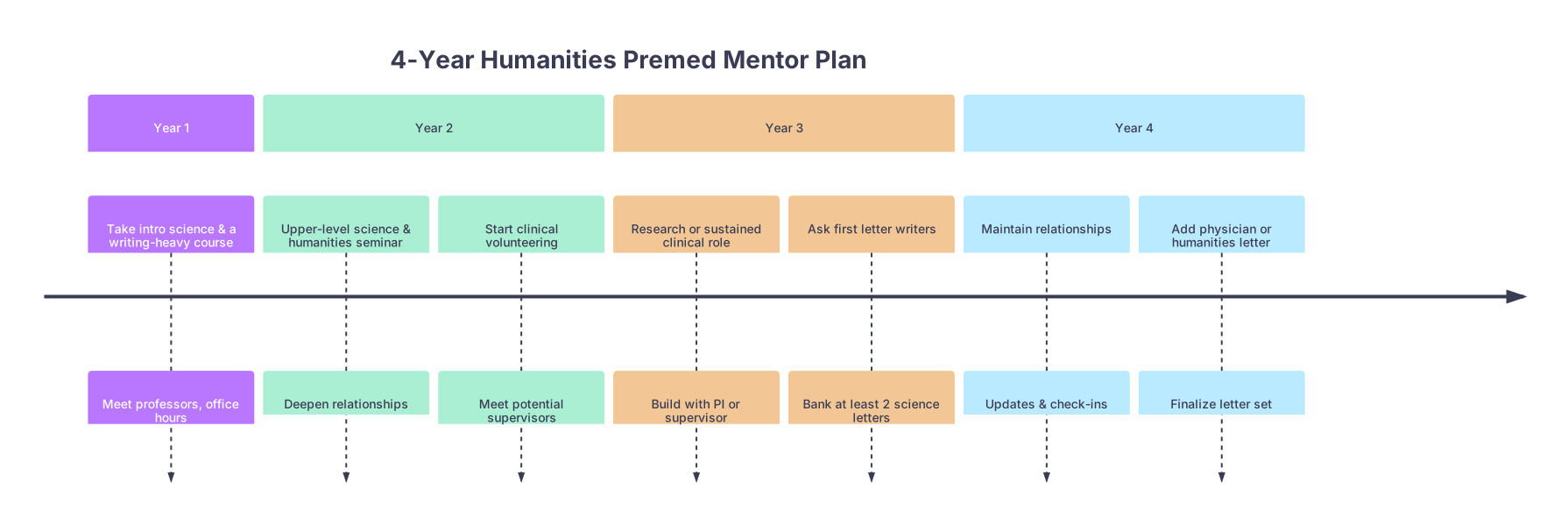
| Period | Event |
|---|---|
| Year 1 - Take intro science & a writing-heavy course | Meet professors, office hours |
| Year 2 - Upper-level science & humanities seminar | Deepen relationships |
| Year 2 - Start clinical volunteering | Meet potential supervisors |
| Year 3 - Research or sustained clinical role | Build with PI or supervisor |
| Year 3 - Ask first letter writers | Bank at least 2 science letters |
| Year 4 - Maintain relationships | Updates & check-ins |
| Year 4 - Add physician or humanities letter | Finalize letter set |
Year 1–2:
- Pick at least one science professor and one humanities professor to treat as potential mentors
- Go to office hours 3–4 times over a term
- Ask about their work, not just problem sets
- Submit something you’re proud of (paper, extra work) and ask for feedback
Year 2–3:
- Join a lab or a consistent clinical role (not just a one-off project)
- Decide early who could be your eventual “this person actually knows me” mentor
- Tell them explicitly you’re premed, not just floating
Year 3–4:
- Ask for letters at least 2–3 months before you need them
- Provide a CV, draft personal statement, and a short “here’s what I hope you can speak to” paragraph
- Keep them updated on your progress—that’s how you get better letters next cycle if you have to reapply
What If Your Science Relationships Are Weak Right Now?
You might already be late in the game:
- Rising senior
- Took all the prereqs in giant lectures
- No real relationship with a science prof
- Strong humanities mentors, good clinical exposure, but your science side is faceless
You’re not doomed, but you need to move deliberately.
Here’s what to do over the next 4–8 months:
- Take (or audit) one more upper-level science course where participation and small group work matter
- Be that student who sits near the front, speaks up, and goes to office hours
- Tell the professor up front:
“I’m a humanities major applying to med school next cycle and I would really like to earn a strong letter in this class. What can I do to really push myself here?” - Follow through. Do the optional readings. Ask deeper questions. Turn in high-effort work.
- Halfway through the term, check in:
“Do you feel you’d be able to write me a strong letter if I keep working at this level?”
If they say yes, lock that in.
If they hedge or say no, adjust quickly—seek a research role or another science course ASAP.
How Many Letters Total Should You Actually Have?
Don’t collect 9 mediocre letters. That doesn’t make you look impressive; it makes you look insecure.
For a humanities major, a tight set of 4–5 strong letters is usually enough to cover all schools and scenarios:
- 2 science faculty (required by many schools)
- 1 humanities / non-science faculty
- 1 clinical/physician or research mentor (depending on your profile)
- 1 flex (whichever side of your application feels weaker—science or clinical)
Then you selectively assign them based on what each school wants.
Visual: Where Each Type of Letter Helps Your Case
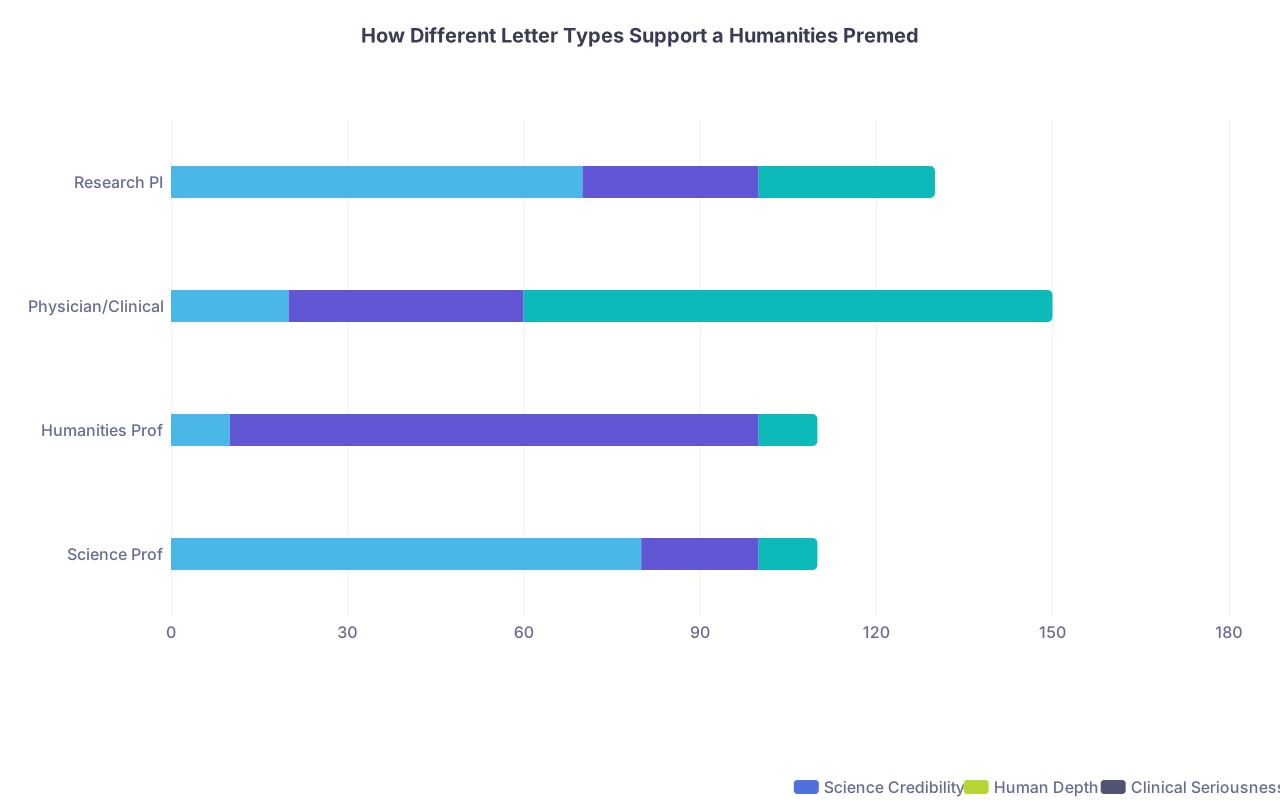
| Category | Science Credibility | Human Depth | Clinical Seriousness |
|---|---|---|---|
| Science Prof | 80 | 20 | 10 |
| Humanities Prof | 10 | 90 | 10 |
| Physician/Clinical | 20 | 40 | 90 |
| Research PI | 70 | 30 | 30 |
You want coverage across all three: science credibility, human depth, and clinical seriousness. As a humanities major, your natural strength is “human depth.” Don’t ignore the other two.
How to Ask in a Way That Protects Your Credibility
Do not just send a one-line email:
“Can you write me a letter of recommendation for medical school?”
You’re giving the writer no guidance, and you’re not signalling that you understand what med schools care about.
When you ask, say something like:
“Because I’m a humanities major, I want to make sure schools see evidence that I can handle rigorous science and that I take medicine seriously. If you feel you know my work well enough, I’d be grateful for a strong letter that speaks to [specific points].”
Then list:
- For science profs: your performance relative to peers, work ethic, ability to learn complex material
- For humanities profs: writing, critical thinking, ethical reasoning, communication
- For clinicians: reliability, patient interaction, maturity, how you reflect on clinical experiences
You’re not writing the letter for them; you’re giving them the right frame.
Common Pain Points for Humanities Premeds (And What To Do)
Pain Point 1: “Every science prof just knows me as the quiet kid with an A”
You can fix that this semester:
- Visit office hours and talk about your trajectory: “I’m an English major going into medicine; here’s why.”
- Bring a previous exam or assignment. Ask how to push from “good” to “outstanding.”
- Ask about their own research and how it connects to patient care or disease.
- Then when you ask for the letter, they at least have a narrative: quiet, thoughtful, intentional student with initiative.
Pain Point 2: “My best connection is with a non-science prof who doesn’t ‘get’ medicine”
If they fundamentally disrespect medicine or think you’re making a mistake, don’t use them. Full stop.
If they just don’t understand the process, you can still use them—with education:
- Share a brief 1-page explanation: what med schools look for, what letters are used for
- Tell them you value that they see you as a thinker and human being, not just a premed
- Ask if they’re willing to connect your strengths to traits like empathy, communication, ethical reasoning, and resilience
Pain Point 3: “A physician offered a letter after 1–2 days of shadowing”
Decline politely, unless there’s no one else. Something like:
“Thank you so much—that means a lot. Right now I’m trying to prioritize letters from people who know my work over a longer period, but I’d love to keep learning from you.”
One or two shadowing days rarely produce a credible, detailed letter.
One More Thing: Committee Letters vs. Individual Letters
If your school has a premed committee letter system, that becomes your umbrella. Use it.
Your job then is:
- Make sure the committee has access to your best science + humanities + clinical letters
- Understand which individual letters get forwarded to schools and which stay internal
- Treat your committee advisor as another “mentor” you need to impress with preparation and maturity
If your school does not have a committee letter, your individual letter choices matter even more. No safety net.
Quick Visual: 4-Year Arc of a Strong Humanities Premed

| Step | Description |
|---|---|
| Step 1 | Year 1: Intro science + humanities |
| Step 2 | Year 2: Upper-level courses |
| Step 3 | Year 2-3: Clinical + Research |
| Step 4 | Year 3: Ask first science + humanities letters |
| Step 5 | Year 3-4: Add clinical/physician letter |
| Step 6 | Application Year: Assign best 4-5 letters by school |
You’re not behind if you’re not on this perfect timeline. But this is what “clean” looks like.
FAQ (Exactly 4 Questions)
1. If I can only get one strong science letter, am I sunk as a humanities major?
Not automatically. But you’re definitely vulnerable. I’d delay applying a year and intentionally fix that gap: take or retake an upper-level science course, or commit to a research or postbac program where a scientist can watch you work. One truly strong, detailed science letter plus a PI letter that really speaks to your scientific growth can cover the requirement at many schools—but if a school explicitly wants two science faculty, you must meet that, or you should not apply there yet.
2. Is it better to have a generic letter from a famous science professor or a strong letter from a lesser-known humanities professor?
For credibility as a humanities major, the strong humanities letter beats the weak celebrity letter almost every time. Adcoms have seen plenty of “I do not really know this person but they did fine in my class” letters on fancy letterhead. Those are dead on arrival. Your best mix is: strong, specific science letter from a non-famous but serious faculty member, plus a powerful humanities letter from someone who knows you deeply. Prestige helps only when the content is already strong.
3. Can a non-faculty mentor (coach, employer, community leader) substitute for a science or humanities professor?
No. They can only supplement, not replace. If a school says “2 letters from science faculty,” that means exactly that—employer or coach letters do not count. BUT if you already have your science and humanities bases covered, a letter from a long-term supervisor (multi-year job, significant responsibility) can be an excellent 4th or 5th letter, especially if it shows reliability, leadership, and dealing with difficult people. Just don’t sacrifice a required academic letter for it.
4. How do I know if a professor’s letter will actually be ‘strong’ and not lukewarm?
You ask directly. Say: “Would you feel comfortable writing me a strong letter of recommendation for medical school?” That word—strong—matters. If they hesitate, mention lack of time, or say something like “I can write you a letter” (without the word “strong”), that’s a no. You want the people who immediately say yes, mention specific things they remember about you, and maybe start brainstorming on the spot. Those are the writers who will protect your credibility.
Key points to leave with:
- As a humanities major, your credibility lives or dies on at least two detailed, positive science letters plus evidence you’re serious about clinical work.
- Your best humanities mentor is a powerful third or fourth voice—use them to show depth, not to cover for lack of science support.
- Don’t collect letters randomly. Build relationships on purpose, then choose 4–5 writers who together prove: strong in science, thoughtful as a human, grounded in real medicine.