You’re in your second week of General Chemistry I. The lecture hall has 250 students, the professor is a tiny figure at the front, and you’re thinking, “How on earth is this person ever going to know me well enough to write a strong letter?”
That’s the right question. Because by the time you’re actually requesting letters, it’s mostly too late to fix weak relationships. The real work happens semester by semester, long before AMCAS opens.
Let’s walk your timeline.
Big Picture: Your Multi‑Semester Strategy
At this point you need to understand the goal clearly: you’re not just “getting to know professors.” You’re building a small, intentional group of science faculty who can truly vouch for you:
- They’ve seen you struggle and improve
- They know how you respond to feedback
- They can compare you to other strong students they’ve taught
- They can put their name under yours without hesitation
Across your premed years, you’re aiming for 2–3 rock‑solid science faculty (chem, bio, physics, math, engineering, etc.) who know you well. Anything less and your letters will sound generic.
Here’s the semester‑by‑semester plan.
Semester 1 (Freshman Fall): Laying the Groundwork
You’re just arriving on campus. You don’t need letters yet. But you do need raw material.
At this point, you should:
Week 1–2
- Pick one main science course where you’ll actually try to be known (Gen Chem, Bio, Calculus, etc.)
- Look up:
- Instructor’s research area
- Office hours schedule
- Course policies on participation and help sessions
Week 2–4: Establish visibility (without being annoying)
In that primary course:
- Sit in the same area every class (front third helps)
- Ask 1–2 thoughtful questions per week—not performative, not “can you repeat that?”
- Go to office hours once by Week 4 with:
- A specific content question
- A short question about how to succeed in the course
Concrete script in office hours:
“I really want to build strong foundations early—I’m premed and I know this material comes back. Is there anything students who end up doing particularly well usually do differently from others?”
You’re not trying to be memorable as “the premed gunner.” You’re trying to be remembered as “the student who takes learning seriously and asks good questions.”
Week 5–8: Show patterns, not one‑offs
Every week, aim for:
- 1 office hours visit (even if brief)
- 1–2 meaningful interactions (before/after class or via email)
At this point, you should:
- Turn in every assignment on time
- Respond to feedback (e.g., if they note sloppy work, next assignment should be tight)
You’re building a reputation for:
- Reliability
- Steady improvement
- Professional, brief communication
Week 9–15: Close the loop
By late semester, stop being just “Random Student in Row 4.” Ask something higher‑level, for example:
- “What made you decide to teach this course?”
- “Are there opportunities for undergrads to get involved in your research or in your department?”
You’re not asking for a letter. You’re signaling you’re in this long‑term.
Semester 2 (Freshman Spring): Deepening One Relationship, Starting Another
Now you’re not brand‑new. You’re building continuity.
At this point, you should:
If you can, take another course with the same professor or in the same department.
- If same professor: perfect. They’ll see you in a new context.
- If not: intentionally choose another science course where:
- Class size is <120 if possible
- The instructor actually teaches (not just TAs)
Week 1–4
- With returning professor:
- Say hello after class: “I took your Chem 101 last semester—happy to be back.”
- Mention one thing you remember or used from last term.
- With new professor:
- Repeat what you did in Semester 1:
- Office hours by Week 3
- Sit consistently
- Act like a pro, not a tourist
- Repeat what you did in Semester 1:
Week 5–10: Start to show your story
By mid‑spring, pick one professor as your “primary long‑term science contact.”
With that person:
- Go to office hours at least every other week
- Bring:
- Questions that show extra thinking (“I read an article about X—does that relate to what we covered?”)
- Occasional brief updates: “I’m applying for a summer research program; do you have any advice?”
You’re not asking them to write for you yet. But you’re training them to see you as serious and consistent.
End of Semester 2: A light touch
Before finals or just after:
- Send a short email or speak briefly:
- “Thank you for the semester—I really appreciated [specific thing]. I’m planning on continuing in [related area] and would love to take another course with you or stay in touch.”
You’re bookmarking the relationship in their brain.
Summer After Freshman Year: Optional But Valuable
If you’re on campus or at home taking classes, you still play the game.
At this point, you should:
- If in a summer science course:
- Use the small size to your advantage—summer instructors remember people
- Office hours at least once every 1–2 weeks
- If working/volunteering:
- Stay in light contact with your key professor:
- One email mid‑summer: short update + 1 question:
- “I’m shadowing in a clinic this summer and noticed ___; it reminded me of what we discussed in class about ___.”
- One email mid‑summer: short update + 1 question:
- Stay in light contact with your key professor:
You’re not spamming. You’re reminding.
Semester 3 (Sophomore Fall): Begin Seriously Cultivating Letter Writers
Now it’s time to think “future letter writer” explicitly.
You should be identifying 2–3 realistic candidates for science letters.
| Type of Faculty | Ideal Count | Priority Level |
|---|---|---|
| Lower-division science | 1 | High |
| Upper-division science | 1–2 | Very High |
| Research mentor (science) | 1 | High |
At this point, you should:
Week 1–3
- Register for at least one course with:
- A professor you’ve had before or
- A faculty member involved in undergrad research or mentoring
- For each likely candidate:
- Go to office hours early
- Briefly introduce or re‑introduce yourself:
- “I’m hoping to go to medical school eventually and I’m really trying to build stronger foundations in [subject].”
Week 4–8: Demonstrate your “letter material”
Strong letters do not come from grades alone. They come from stories. You want your behavior to give them stories.
In class and office hours, you want them to see you:
- Make a mistake
- Get feedback
- Fix it
- Come back with better work
Concrete examples:
- After a rough exam:
- Go to office hours with your exam, not to complain but to analyze:
- “Can we go over where I lost points? I want to understand where my thinking went wrong.”
- Go to office hours with your exam, not to complain but to analyze:
- After a lab where something failed:
- Ask for help troubleshooting and then follow up with what you changed next time
Faculty remember that arc: “She bombed the first midterm, then restructured how she studied, and ended up in the top 10% of the class.”
Week 9–15: Plant the seed (lightly)
Late sophomore fall is usually too early to request letters. But it’s not too early to signal:
- Quick conversation after class or in office hours:
- “Down the line when I’m applying to programs, I’d really value your perspective on my academic growth. I’ve learned a lot in this course.”
You’re basically saying: “I see you as someone whose opinion matters,” without making an ask.
Semester 4 (Sophomore Spring): Locking in 1–2 Strong Science Faculty
This is where a lot of students blow it by vanishing or coasting. Don’t.
At this point, you should:
Week 1–4
- Take at least one upper‑division or more rigorous science course
- Prioritize continuity:
- Same department
- Ideally same professor or those your previous professor respects (they talk; they know who’s good)
Week 5–10: Show longitudinal growth
You want your developing faculty advocates to see you over time, not just in a single 15‑week window.
How to show this:
- Reference prior courses:
- “When we covered acid‑base in Gen Chem, I really struggled. This time I tried doing X differently, and it helped.”
- Demonstrate self‑correction:
- If they gave you feedback last semester (e.g., on writing, participation, professionalism), explicitly show you’ve acted on it.
Week 11–15: Start having “future planning” conversations
For 1–2 key science faculty, book a short meeting (office hours is fine):
You say something like:
“I’m starting to look ahead to med school applications in the next couple of years. I know strong letters from science faculty will matter. I’d really appreciate any feedback from you on where I’m doing well and what I should work on if I hope to be competitive.”
You’re doing two things:
- Getting actual feedback
- Planting in their mind: “This student is the real deal; med school is their trajectory”
Take notes. Then act on what they say.
Summer After Sophomore Year: Research and Real Mentorship
This is your big opportunity to get a science mentor who can really vouch for you.
At this point, you should:
If you’re in research (on campus or elsewhere):
- Show up early. Every day.
- Take notes like a fanatic.
- Ask to understand why, not just how:
- “Why are we using this assay instead of that one?”
- Offer to take ownership of some piece of the project that fits your skills.
With your research PI or direct supervisor:
- Schedule one mid‑summer check‑in:
- “I want to make sure I’m doing what’s most useful to the lab and also growing. Is there anything I can be doing better?”
If you keep this up all summer, this person often becomes a top‑tier letter writer.
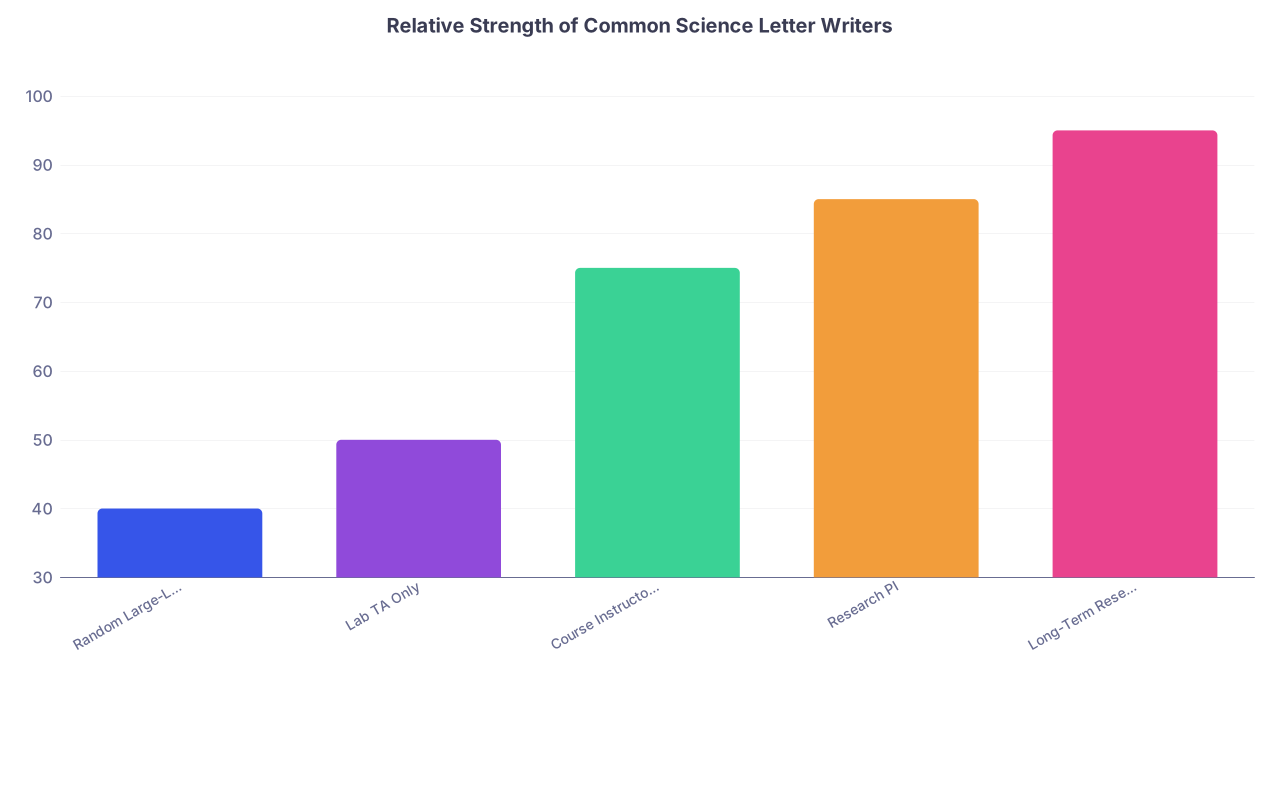
| Category | Value |
|---|---|
| Random Large-Lecture Prof | 40 |
| Lab TA Only | 50 |
| Course Instructor You Knew 2 Semesters | 75 |
| Research PI | 85 |
| Long-Term Research Mentor + Course Prof | 95 |
The right‑side bars are where you want to be.
Semester 5 (Junior Fall): Start Locking Letters in Their Heads
Now your timeline is tight. If you’re applying straight through, your AMCAS will open in late spring of junior year. Time to move from “impression‑building” to “letter‑building.”
At this point, you should:
Week 1–4
- Confirm at least two science faculty who:
- Know you by name, without prompting
- Have seen you in more than one context (course + research, or multiple courses, etc.)
If you do not have two by now, you need to prioritize:
- Take another class with someone you know
- Or start going regularly to office hours for your best remaining candidate
Week 5–8: Give them material
You want them to see:
- Leadership (within group projects, labs)
- Professionalism (never ghost on a commitment; email if you’re sick; follow up on tasks)
- Intellectual curiosity (ask questions that go beyond “will this be on the exam?”)
Practical move:
- Ask one or two professors if you can do a small extra project, presentation, or paper that aligns with their interests.
- Faculty love having more to say than “got an A in my class.”
Week 9–15: Early soft ask (for those applying straight through)
Late fall / early winter of junior year, you can do a soft check with your top 1–2 science faculty.
Example email:
Dear Dr. ___,
I’ve really valued your courses and mentorship over the past [X semesters/summer]. I plan to apply to medical school in the upcoming cycle and wanted to ask if you’d feel comfortable potentially writing a strong letter of recommendation for me when the time comes.
If so, I’d be happy to send along my CV and a short summary of my goals.
Best,
[Name]
You specifically say “strong.” If they hesitate, that’s a data point. You want people who respond with something like, “Yes, I’d be happy to” or “Absolutely.”
Semester 6 (Junior Spring): Formal Letter Season
This is when you move from “potential” to “actual” letters, especially if you’re applying June after junior year.
At this point, you should:
Week 1–4: Prep your materials
For each science faculty letter writer, prepare:
- CV or resume
- Draft of your personal statement (even if rough)
- A brief “LOR packet” (one page) with:
- How/when you met them
- Courses or projects you did with them
- 3–5 bullet points of things you hope they might highlight (skills, traits, examples)
Week 4–8: Officially request letters
Ask in person if feasible, then follow up via email.
In person script:
“I’m applying to medical school this coming cycle, and I’d be honored if you would write me a strong letter of recommendation. I’ve really appreciated your mentorship in [course/research], and I think you’ve seen how I [specific growth]. Would you feel comfortable doing that?”
If they say yes:
- Thank them
- Ask what they need from you and by when
- Confirm the submission system (school committee, Interfolio, AMCAS letter ID, etc.)
Then send your packet within 24 hours.
Week 8–15: Keep giving them reasons to feel good about saying yes
After they’ve agreed:
- Do not vanish from their life
- Occasional updates:
- “I submitted my primary application last week—thank you again for supporting me.”
- “We just finished our group project; I learned a lot about X, which reinforced what we discussed in your office hours about Y.”
You want their last interaction with you before writing to say: “This student is still solid. Still hungry. Still reliable.”
If You’re on a Gap Year Timeline
If you’re not applying until after graduation, shift everything one year later in terms of formal asking, but keep the relationship‑building on the same calendar.
Senior year then becomes “formal request” time instead of junior year. Same playbook, just shifted.
Quick Red Flags and Course‑Corrections
Let me be blunt about what does not work:
- Trying to get letters from:
- Professors who don’t recognize your name
- People who only ever saw your grade in a spreadsheet
- Waiting until 2–3 weeks before the deadline to ask
- Never showing up to office hours and then expecting a “top 1–2%” letter
If you’re reading this late (say, already junior spring) and you have no strong science‑faculty relationships:
- Immediately pick your best‑available science professor this semester
- Go to office hours every week from now on
- Be transparent:
- “I know I’m getting to this later than ideal, but I’d like to build a stronger academic relationship with at least one science faculty before I apply to medical school. I’ve really enjoyed your course and would appreciate any advice on how to do that well.”
It’s not perfect. But it’s salvageable if you start now.
Visualizing the Whole Multi‑Year Plan
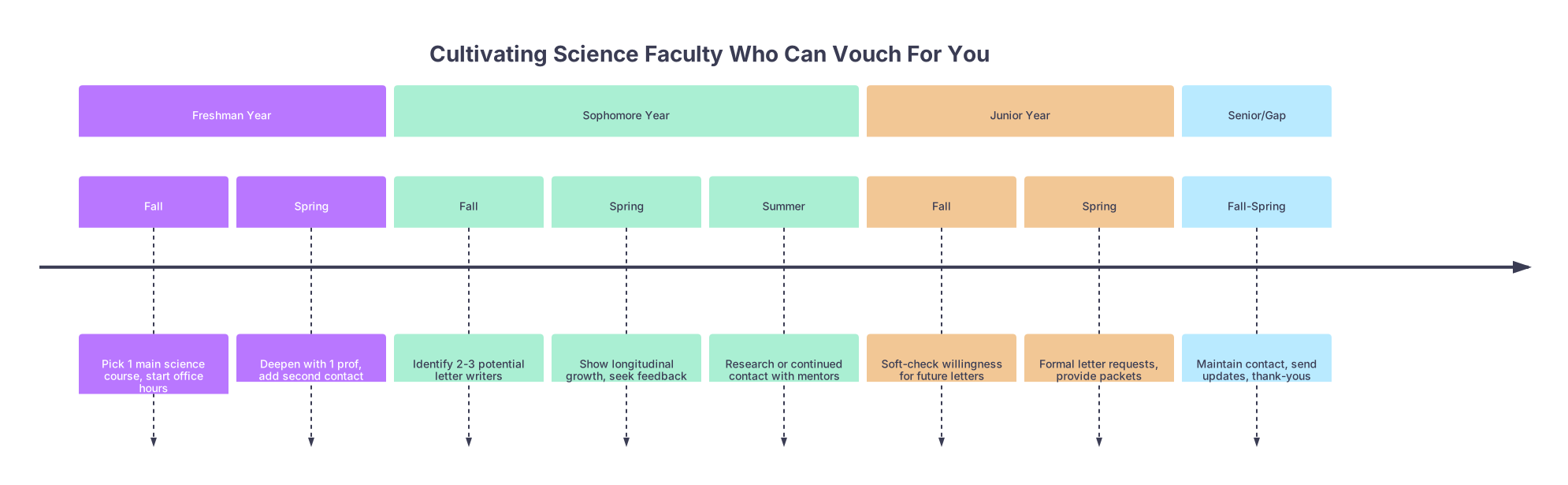
| Period | Event |
|---|---|
| Freshman Year - Fall | Pick 1 main science course, start office hours |
| Freshman Year - Spring | Deepen with 1 prof, add second contact |
| Sophomore Year - Fall | Identify 2-3 potential letter writers |
| Sophomore Year - Spring | Show longitudinal growth, seek feedback |
| Sophomore Year - Summer | Research or continued contact with mentors |
| Junior Year - Fall | Soft-check willingness for future letters |
| Junior Year - Spring | Formal letter requests, provide packets |
| Senior/Gap - Fall-Spring | Maintain contact, send updates, thank-yous |
One Concrete Step You Can Take Today
Open your current or most recent science course syllabus. Find your professor’s office hours. Right now, pick a day this week and block 30 minutes on your calendar labeled:
“Office hours – start building a real relationship”
Then draft one specific question about the course material and one brief question about how strong students in this course usually work. Show up. That’s where this whole timeline actually starts.