It’s June 1. You’ve decided: you’re taking a gap year. Your GPA is fine, your story is… okay, your letters of recommendation are “good” but not “this student is the best I’ve worked with in 10 years” good. You’ve got 12 months before your next application cycle gets real.
At this point, you shouldn’t be asking, “How do I fill time?” You should be asking, “How do I walk into the next cycle with a stacked mentor bench—people who actually know me, will advocate for me, and will pick up the phone if an adcom calls?”
That’s what we’re building. Month by month.
Month 0–1: Define Your Mentor Bench Targets
You’re here: deciding what this year is actually for.
At this point you should stop hand‑waving about “getting stronger letters” and define what your bench needs to look like by the time you hit submit.
Aim for something like this:
| Mentor Type | Ideal Role |
|---|---|
| Science Faculty (1–2) | Core academic / intellectual letter |
| Clinical Physician (1–2) | Clinical ability / professionalism |
| Research PI (1) | Depth, persistence, analytic skills |
| Character / Service (1) | Service, leadership, reliability |
You’re not getting all of these at once. You’re building them.
Week 1: Get brutally clear on your gaps
Sit down, no distractions, and answer in writing:
- Who wrote your last letters?
- How strong were they really? (Be honest. “They liked me” is not the same as “They know me well.”)
- What did they not see you do?
– Longitudinal follow‑through?
– Handling failure?
– Leading other people?
– Real clinical responsibility beyond shadowing?
At this point you should:
- List every potential mentor you already know (professors, attendings you’ve shadowed, volunteer coordinators, PIs).
- Label each as:
- “Knows me well”
- “Knows me a bit”
- “Barely knows me”
- Next to each name, write what they could credibly comment on (teaching, research, clinical work, service, leadership, resilience).
You’ll quickly see where you’re thin. Most premeds are thin on longitudinal relationships (6–12 months of consistent contact). That’s what this year is for.
Week 2: Choose your anchor role(s)
At this point you should decide your primary identity for the year. You cannot be full‑time at a clinic, full‑time in a lab, full‑time in policy, and expect meaningful mentorship from all of them. Pick one or two anchors.
Typical combos that work:
- Full‑time medical assistant / scribe + part‑time community organization (service mentor)
- Full‑time research coordinator + half‑day/week clinic (physician mentor)
- Half‑time EMT + half‑time lab (PI mentor + clinical mentor)
The job isn’t the point. The relationships are. But the job determines who you’ll see 10–40 hours a week.
Week 3–4: Job search aligned with mentor potential
Now your question isn’t “What pays $18/hr?” It’s “Where will I be working closely with 1–3 people who might become A‑tier recommenders in 9–12 months?”
At this point you should:
- Prioritize roles with:
- Stable teams (same supervisor week after week)
- Direct oversight (someone senior actually watches your work)
- Regular feedback (1:1s, lab meetings, chart reviews)
- During interviews, quietly assess:
- Will I be working with this person weekly? Or are they just the name on the door?
- Does this person seem like they invests in trainees? (You can hear it. “Our last coordinator is now at X med school” is gold.)
You’re setting the board. Month 2 is when pieces start moving.
Months 2–3: First 90 Days – Become Unignorable (in a good way)
You’ve started the job/role. Now the clock starts on relationship‑building.
At this point you should not be asking for letters. You’re building credibility.
Month 2: Week‑by‑week
Week 1–2: Learn fast, ask smart
Your goal: become “the reliable new person” as fast as possible.
- Show up early, leave on time, no drama.
- Take notes like it’s a clerkship.
- After 1–2 weeks, say to your supervisor/PI/physician:
“I’d love to do really well in this role and grow this year. What are the 2–3 things you see top students or staff do that stand out to you?”
Then actually do those things. Consistently.
Week 3–4: Add 1% extra value
Small, specific, repeatable.
- In a lab: keep a clean, labeled bench; send quick summaries after experiments.
- In clinic: prep rooms efficiently; anticipate common orders; keep templates or checklists updated.
- In community orgs: show up early to set up; volunteer to close down.
At this point you should be on their radar as: “Oh yeah, [Your Name]—they’re solid.”
Month 3: Start building actual mentorship
Week 5–6: Micro‑check‑in #1
You’re not asking for mentorship yet. You’re requesting feedback on your performance.
- Ask for a 15–20 minute meeting:
“I’m hoping to make the most of this gap year. Could we find 15 minutes sometime in the next week so I can get your feedback on how I’m doing and how I can improve?”
In that meeting:
- Ask what you’re doing well.
- Ask what you should change this month.
- Briefly mention your long‑term goal (med school) and timeline.
Then shut up and take notes. Apply every reasonable suggestion.
Week 7–8: Start sharing selective wins and learning
Send occasional short updates where relevant:
- “The protocol you suggested worked; here are the results.”
- “Tried your approach with patients yesterday—noticed they opened up a lot more.”
You’re showing you listen and execute. That’s mentor catnip.
Drop a quiet hint about the future:
“I’m planning to apply in the next cycle, so I’m really trying to grow as much as I can this year.”
You’re not asking them for anything yet. You’re letting them connect the dots.
Months 4–6: Convert Supervisors into Mentors
By month 4, if nothing meaningful is forming with your initial supervising physicians/faculty, you need to adjust. Don’t waste 12 months on people who will never remember your last name.
At this point you should have at least 2 people who:
- See you weekly
- Have given you feedback
- Know your med school goal
Now we deepen.
Month 4: Formalize at least one mentorship
Pick the person who seems most invested.
Ask for a slightly bigger conversation:
“I’ve really appreciated your feedback over the last few months. Would you be open to a 30‑minute conversation about how I can best use this gap year to prepare for med school and a career in medicine?”
In that meeting:
- Share your rough timeline (MCAT, applications).
- Ask:
- “If you were in my shoes with my background, what would you prioritize this year?”
- “What do you see in students that makes you confident writing a very strong recommendation?”
Then—and this is where most students fail—you say something direct:
“One of my big goals this year is to earn really strong letters from people who actually know my work. I’d love to spend the year earning that from you, if that feels appropriate.”
You’re not asking right now. You’re naming the goal.
If they say something lukewarm like, “Sure, we can see how it goes,” fine. That’s normal. Your job is to give them reasons to be enthusiastic later.
Month 5–6: Give them letter‑worthy material
At this point you should be doing things that translate cleanly into letter content:
Take responsibility for a small project:
- Lab: own a sub‑experiment, analysis, or data cleaning.
- Clinic: own patient call‑backs, education sheets, pre‑visit planning.
- Service: coordinate volunteers, manage a recurring event.
Create situations where they see you:
- Present a brief summary in lab meeting.
- Prepare a mini in‑service or short teaching point.
- Offer to summarize quality‑improvement data.
Your mentors can’t write about things they never see. So put your work in front of them.
Sprinkle in occasional reflective comments that reveal how you think:
- “That patient yesterday really stuck with me because…”
- “I realized I was making this mistake repeatedly; here’s how I’m changing it…”
That’s the raw material for strong narrative letters.
Months 7–9: Locking in Your Core Letter Writers
By now, your mentors should have 5–7 months of observing you. This is where you move from “maybe” to “yes.”
Also: this is where your MCAT and personal statement planning must stop being abstract.
Month 7: Mid‑year mentor check‑ins
At this point you should schedule 2–3 intentional check‑ins (one with each potential letter writer).
In each:
Bring a one‑page summary:
- Brief background (school, major, key experiences)
- Your gap year role and impact so far
- Med school timeline (when you’ll apply, when letters will be needed)
Ask them bluntly—but respectfully:
“I’ll be applying this upcoming cycle. Based on what you’ve seen, do you feel you could write a strong letter of recommendation for me if I continue on this trajectory?”
Pay attention to the response:
- “Absolutely” / “Definitely” / “I’d be happy to” = green light.
- “Sure, I can do that” / “Yeah, I think so” = yellow. Either deepen the relationship more or find another option.
- Hesitation / vague “we’ll see” = red. Don’t force it.
You want 3–4 green lights by the time ERAS/AMCAS opens, not 6 yellow maybes.
Month 8–9: Structure and diversify your bench
You’re aiming for a balanced set of voices. Use month 8–9 to plug remaining holes.
Common situations:
- You’ve got strong clinical letters but weak academic/research.
- You’ve got one PI but no one who’s seen you teach or lead.
- You’re missing a non‑physician who can speak to your character in a different context.
At this point you should:
- Add a secondary activity if needed:
- If you’re research‑heavy: pick up 4–6 hours/week of clinical volunteering where a coordinator or nurse knows you.
- If you’re clinic‑heavy: join a community/service project with a stable leader who actually sees you.
Don’t overdo it. One meaningful secondary commitment is better than three ghost‑in‑the‑room “volunteer” gigs.
Month 10–12: Application‑Ready Letters and Maintenance Mode
This is where timing matters. You don’t ask for letters three days before your primary application. You build a 6–10 week runway.
Here’s the core arc:
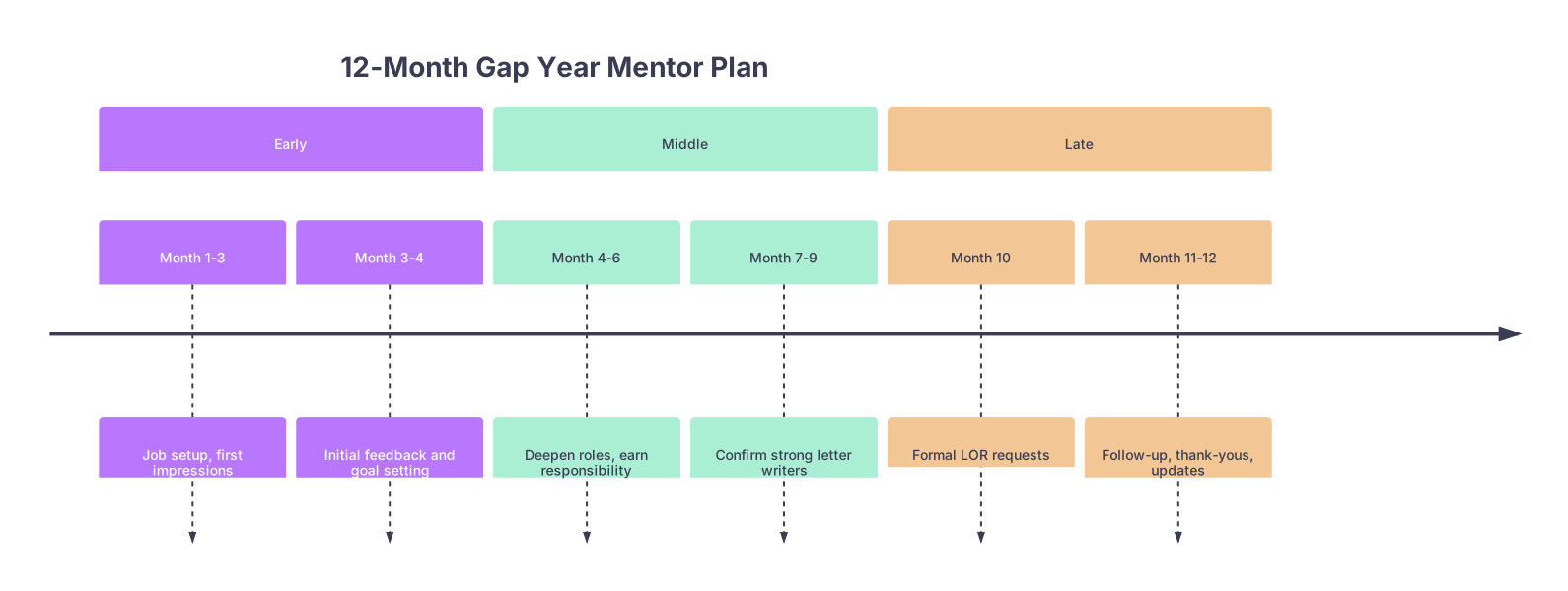
| Period | Event |
|---|---|
| Early - Month 1-3 | Job setup, first impressions |
| Early - Month 3-4 | Initial feedback and goal setting |
| Middle - Month 4-6 | Deepen roles, earn responsibility |
| Middle - Month 7-9 | Confirm strong letter writers |
| Late - Month 10 | Formal LOR requests |
| Late - Month 11-12 | Follow-up, thank-yous, updates |
Month 10: Formal letter requests
At this point you should be 6–8 weeks from when you want letters uploaded.
For each confirmed mentor:
Ask in person or over Zoom if possible:
“I’ll be submitting my primary application around [date]. Would you be willing to write a strong letter of recommendation for me?”
If they agree, follow up with an organized email within 24 hours including:
- Updated CV
- Draft personal statement (even if imperfect)
- A short bullets list:
- How you’ve worked with them
- 3–5 specific things they’ve seen you do that might be useful to mention
- Exact deadlines and upload instructions (AMCAS/Interfolio/etc.)
You’re not writing the letter for them. You’re jogging their memory and making it easy.
Month 11: Gentle follow‑up and continued contact
At this point you should be in “polite nag” mode with anyone who hasn’t submitted.
-
“Just a quick reminder that my letter is due by [date]. Please let me know if there’s anything else I can provide.”
1 week before:
“I’m finalizing my application for submission next week and wanted to check in about the letter. I really appreciate your support.”
Meanwhile, keep giving them substance:
- Brief update on MCAT if done.
- “I submitted my primary this week—thank you again for your support, it genuinely means a lot.”
Month 12: Post‑submission maintenance and next‑level mentoring
You’ve submitted. Some letters might also be reused for secondaries or future opportunities (research positions, scholarships).
At this point you should:
- Close the loop:
- Email: “I submitted my application to [X] schools. Thank you again for writing on my behalf. I’ll keep you updated as I hear back.”
- Actually update them:
- Interview invites
- Big milestones
- Final result (where you matriculate)
This isn’t just politeness. You’re turning “letter writer” into “ongoing career mentor.” Huge difference.
Daily/Weekly Habits That Quietly Build Strong Letters
Now the unglamorous part. What you should be doing week by week to make all this work.
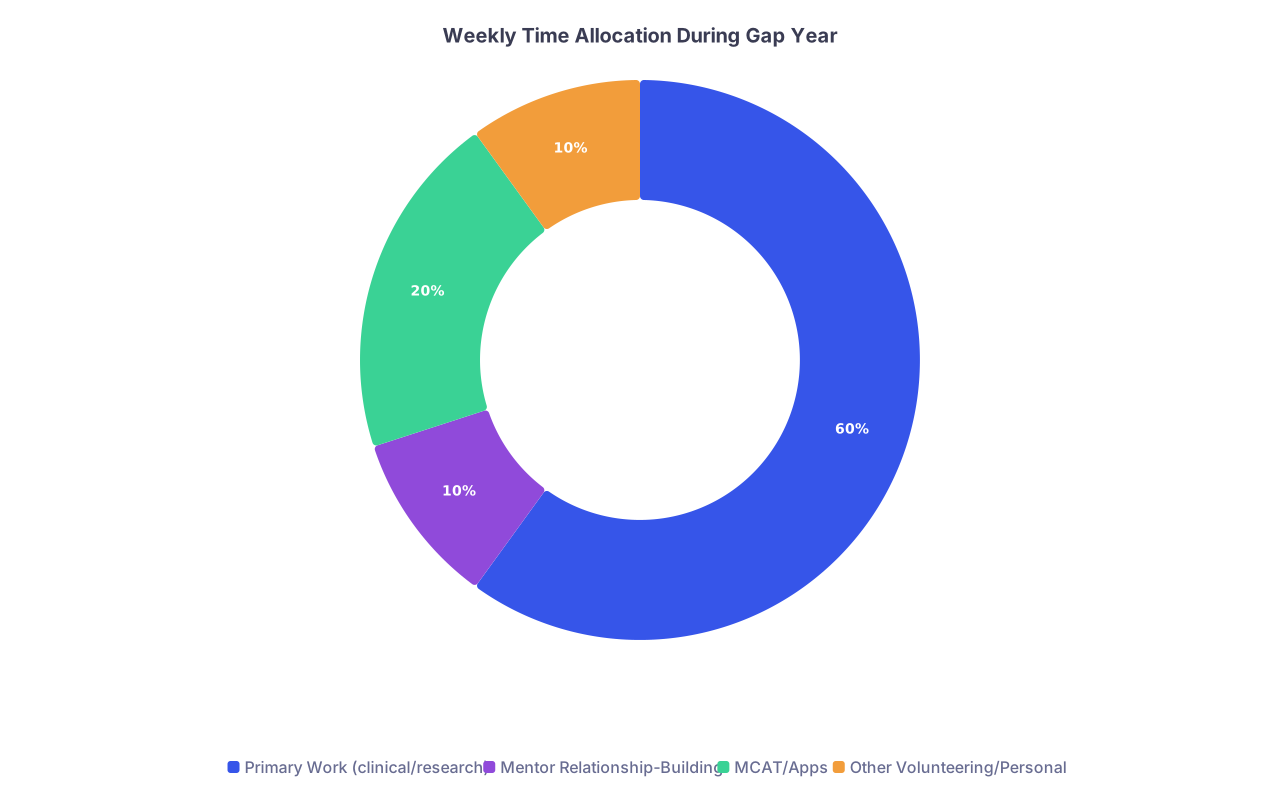
| Category | Value |
|---|---|
| Primary Work (clinical/research) | 60 |
| Mentor Relationship-Building | 10 |
| MCAT/Apps | 20 |
| Other Volunteering/Personal | 10 |
Weekly rhythm (Months 2–10)
At this point you should be living in a simple cycle:
- 4–5 days/week: show up, do excellent work, document your impact.
- 1–2 times/week: have meaningful conversations with potential mentors.
- Doesn’t have to be formal.
- A thoughtful comment after clinic. A smart question in lab. A brief “Can I get your take on something?” moment.
- 10–20 minutes/week: jot down:
- Specific patient stories
- Projects you contributed to
- Feedback you received and acted on
Those notes become:
- Your personal statement
- Secondary essay fuel
- Bullet points you share with letter writers later
Daily micro‑behaviors mentors actually notice
You want to know what turns “generic letter” into “I fought for this applicant in committee”? It’s not your GPA.
It’s stuff like:
- You handle annoying tasks without whining.
- You admit errors quickly and fix them.
- You remember feedback and don’t repeat the same mistake three weeks in a row.
- You treat MAs, receptionists, coordinators, and janitors with the same respect as attendings.
I’ve seen more than one mediocre‑stats student get glowing, door‑opening letters because an attending trusted their judgment with vulnerable patients—and had concrete stories to back that up.
You’re trying to create those stories, deliberately.
Red Flags & Course Corrections (Don’t Waste the Year)
Quick reality check. If, by each point, this is true, you’re fine. If not, adjust.
| Timepoint | Healthy Sign |
|---|---|
| Month 3 | 1–2 people give you specific feedback |
| Month 6 | 2+ people could describe your strengths |
| Month 9 | 3+ people say yes to strong LOR potential |
| Month 12 | 3–4 letters submitted on time |
If by:
- Month 3: Nobody knows your name? You’re invisible. Ask for more responsibility or consider switching sites if that’s impossible.
- Month 6: Everyone still sees you as “the new kid”? You haven’t stepped up. Volunteer for a project.
- Month 9: You don’t have any clear green‑light letter writers? You waited too long to ask or chose the wrong environments. You may need to lean on older mentors from undergrad while salvaging what you can now.
The Three Big Things You Need to Remember
- This year isn’t about “collecting hours.” It’s about leaving 3–4 people absolutely convinced you’ll be an excellent physician—and giving them stories to write about.
- Strong letters take time. Think in 6–12 month relationships, not “I shadowed Dr. X for two days.”
- Every month has a job: early months build reliability, middle months build depth and responsibility, late months lock in letters and convert writers into long‑term mentors.
Use the 12 months with that lens, and your mentor bench—and your letters—won’t be an afterthought. They’ll be your advantage.