Athlete Applicants: Choosing Mentors Who Translate Your Discipline Into Medicine
What do you do when the person who knows you best is your coach, but the people admissions committees respect most are your professors and physicians?
If that’s your situation, you’re the exact person this is for.
You’re an athlete. Your strongest stories are about 5 a.m. lifts, bus rides after away games, competing with an injury, being captain, getting benched and coming back. You know all of that matters for medicine. But LORs are political documents. The wrong letter writer can waste your best asset.
Let’s walk through how to pick mentors and letter writers who don’t just say “you’re hardworking,” but actually translate your athletic discipline into medical language that adcoms care about.
Step 1: Face the Reality of How Committees Read Athlete Letters
Before you pick anyone, understand what you’re up against.
Most committee members have seen hundreds of “He’s the hardest-working player I’ve ever coached” letters. Very few of those move the needle.
What committees actually care about from athlete applicants:
- Can you handle brutal schedules without falling apart?
- Can you take feedback, adjust, and improve?
- Do you function in high-stakes, team-based environments?
- Do you have humility, resilience, and consistency—not just “grit” on posters?
And they trust certain voices more on certain things.
Here’s the unspoken hierarchy I’ve seen play out again and again:
| Letter Writer Type | Typical Credibility for Med School Traits |
|---|---|
| Science faculty (rigorous) | Academic ability, work ethic, reasoning |
| Physician (clinical) | Clinical potential, bedside manner |
| PI / research mentor | Intellectual curiosity, persistence |
| Head coach | Discipline, leadership, team behavior |
| Assistant coach / trainer | Work ethic, daily habits, reliability |
A coach alone cannot carry your file. But a coach plus a professor who “gets” your athletic life and references it correctly? That’s powerful.
Your goal is not “get a coach letter.” Your goal is:
Build a small team of mentors who can each translate different sides of your athlete identity into medicine, in their own domain.
Step 2: Decide What “Version” of You Each Letter Should Prove
Stop thinking “Who likes me enough to write a letter?” and start thinking “What story about me does this letter need to tell?”
You need 3–4 distinct “versions” of yourself backed up by specific mentors:
The academic version
Can you learn complex material, think critically, and perform under pressure in the classroom? That’s usually one or two science faculty.The clinical/service version
Can you work with people in vulnerable situations? That’s usually a physician, NP/PA, or community service supervisor.The athlete-leader version
This is where coaches and athletic staff come in. But this version cannot just be “tries hard.” It has to show leadership, resilience, coachability, and professionalism.The integrator version (optional but gold)
Someone who has seen you combine athletics and academics and premed work—like a professor who knew about your travel schedule and saw you still show up fully, or a PI who watched you time-manage your season and research.
Write these four on a sheet of paper. Under each, list 2–3 potential names. If you only put “coach” under #3, you’re already thinking too small.
Step 3: Pick Coaches Who Actually Understand What You’re Doing
Not every coach is a good letter writer for medicine. Some are flat-out bad choices.
Strong coach or athletic mentor candidates:
Head or assistant coach who:
- Knows your academic goals
- Has seen you across multiple seasons
- Has watched you deal with injury, benching, leadership roles, conflict
Strength and conditioning coach, athletic trainer, or director of operations who:
- Has witnessed your daily habits
- Can talk about reliability, recovery from setbacks, consistency at 6 a.m.
Weak coach letter choices:
- Coach who only knows your stats and position
- New coach who’s only known you one semester
- Coach who has no idea you want to go to medical school
- Coach who’s enthusiastic but vague: “She’s a great kid, I love her”
You want the person who can say things like:
- “She started as a walk-on and became captain by junior year because…”
- “He tore his ACL and spent a year rehabbing, and here’s how he showed up…”
- “We run 20+ hours/week in-season. He never once used that as a reason to miss academic expectations.”
If your head coach does not get it, consider an assistant coach or athletic trainer who does. Title matters, but content matters more.
Step 4: Choose Professors Who Can Translate Your Schedule, Not Just Your Grade
You need professors who don’t just say, “She got an A in my course,” but also:
“I watched her manage full-time varsity athletics and heavy coursework with professionalism.”
Look for:
- Courses you took in-season when your schedule was worst. If you survived Orgo or Biochem during season while traveling every weekend, that professor is valuable.
- Professors who noticed when you had to miss class and saw you coordinate like a responsible adult: emailing ahead, making up work promptly, never making excuses.
- Smaller classes or labs where your behavior was visible, not 400-person lectures where you were just a name on a grade sheet.
The key is alignment. You’re an athlete. Don’t hide it. You want at least one academic letter that explicitly contextualizes your performance given your athletic load.
Script you can use when approaching them:
“I’m applying to medical school and I’d really value a letter from you because I took your course during my [sophomore/junior] season. I was a [sport] athlete and balancing travel and training with your class was a huge growth experience. If you feel you can comment on my performance and professionalism in that context, that would really strengthen my application.”
You’re telling them exactly what to emphasize without being pushy.
Step 5: Line Up at Least One Mentor Who Has Seen You in Both Worlds
The dream scenario: someone who has seen you span athletics and medicine.
That might be:
- A team physician you shadowed
- An orthopedist or PT you saw repeatedly and then later shadowed or worked with
- A professor who also advises premeds and knows your athletic commitments
- A research PI who met with you at 6:30 a.m. because your afternoons were at practice
This person becomes your “translator-in-chief.”
They can write things like:
“I first met Jordan when she was recovering from a shoulder injury. A year later, she reached out to shadow me and I saw the same discipline she put into rehab in how she observed cases, took notes, and asked questions…”
or
“As both her academic advisor and faculty liaison to the athletics department, I’ve watched Nora hold a 3.8 GPA in rigorous science courses while captaining women’s soccer. I’ve seen exactly how she plans, sacrifices, and problem-solves to make that happen.”
That’s gold. It links your athletic discipline to actual behaviors in medical contexts.
Step 6: Help Your Mentors Translate Athlete Traits Into “Med School Language”
Do not assume your coach or even your professor knows what adcoms care about. They don’t live in that world; you do.
You’re not writing their letter, but you should absolutely give them a targeted packet:
- Your CV / resume (with clear sports + premed activities)
- A short paragraph on “What I hope your letter can speak to”
- A bullet list (5–8 bullets) of specific stories they might remember
The key is framing athlete traits in ways that matter to medicine.
Here’s the translation work you should basically hand them:
| Raw Athlete Trait | How It Should Show Up for Med School |
|---|---|
| Plays through pain | Resilience + insight, *not* recklessness |
| Shows up early to lifts | Reliability, professionalism, preparation |
| Captain / team leader | Team leadership, conflict management |
| Accepts being benched | Coachability, ego control, growth mindset |
| Balances season + exams | Time management under pressure |
You might literally include a page that says:
“For medical schools, traits like resilience, professionalism, teamwork, response to feedback, and reliability under pressure are especially important. If you’ve seen me show any of these in an athletic context, specific examples would be very helpful.”
That’s it. You’ve just done 80% of the translation for them.
Step 7: Use a Short, Direct Ask That Signals You Want an Honest Strong Letter
When you ask someone, don’t be weirdly apologetic. But don’t box them into a corner either.
What you say, face-to-face or over Zoom or email, should sound like this:
“I’m applying to medical school this cycle, and I was wondering if you’d feel comfortable writing me a strong letter of recommendation. I think you’ve seen how I handle [X: pressure / leadership / balancing athletics and academics], and that perspective would be valuable for committees.”
Two crucial pieces there:
- “Strong letter” – gives them an exit if they can’t be enthusiastic.
- Naming the angle – you’re clarifying what lane they’re in.
If they hesitate, or say something like “I can write you a letter, but it will mostly comment on your grade” – that’s a no. Politely thank them and move on. A lukewarm letter is worse than no letter.
Step 8: If Your Sport Ate Your Time and Your Non-Athletic Mentors Are Thin
This is very common. You were basically on a full-time job (sport), now someone tells you you need close relationships with three professors and a physician. Right.
If you’re still early (freshman/sophomore):
- Start front-loading:
- Use office hours in 1–2 key science classes per term.
- Tell professors from day one: “I’m a [sport] athlete and premed. My schedule looks like this. I want to make sure I stay ahead.”
- Ask occasionally for advice on med school, not just on homework. They’ll remember that.
If you’re late (junior/senior, already applying):
- Intensify existing relationships rather than chase new ones:
- Go back to professors you did well with. Ask for a meeting to talk about your plans, share your CV, mention 1–2 moments from their class that stuck with you.
- For coaches/athletic staff, do the same. Treat it as: “I’m closing this chapter and could really use your insight going forward.”
If you truly lack a strong physician mentor:
- Look to team physicians and athletic trainers:
- Ask if you can shadow them in clinic or training room.
- Spend a few focused sessions, then ask for a letter that references your dual role as athlete + aspiring physician.
- If that’s not possible, a strong non-physician clinical supervisor (like an MA, RN, PT, or clinic manager) can still be very useful if they’ve watched you with patients. You’d then rely more on professors + coaches for the rest.
Step 9: Coordinate Your Letters So They Don’t All Say the Same Thing
The worst outcome: four letters, all saying, “She’s hardworking, disciplined, and a great teammate.”
You want each letter to occupy a different lane.
Here’s how you subtly orchestrate that without ghostwriting:
Send each writer:
- The same CV/personal statement draft (or a short summary if the PS isn’t ready).
- A different short note on what you hope they will emphasize.
Example breakdown:
- Science professor #1:
- Emphasize: analytical reasoning, exam performance, how you interacted in class or office hours, how you handled one specific challenge.
- Science/non-science professor #2:
- Emphasize: written/oral communication, intellectual curiosity, growth over time, how you balanced athletics with assignments.
- Physician / clinical supervisor:
- Emphasize: manner with patients, willingness to do unglamorous tasks, consistency, observations about how your athlete background shows up in clinic (preparation, focus, composure).
- Coach / athletic mentor:
- Emphasize: leadership, handling adversity (injury, benching, tough season), integrity, daily habits, influence on teammates.
- Science professor #1:
Make it explicit in your note:
- “Professor X is focusing more on my technical performance in Biochem; it would be helpful if you could speak more to [leadership / resilience / whatever].”
You’re not micromanaging; you’re preventing redundancy.
Step 10: Avoid These Common Athlete-Specific Letter Mistakes
You’d be surprised how often I’ve seen these derail otherwise strong applications.
Letting your “best sports letter” replace core academic letters
Don’t do this. You need solid academic letters first. The athlete letter is additive, not a substitute.Having a coach praise your “passion for medicine” when they’ve never seen you in a medical setting
It reads fake. They should keep their lane: discipline, leadership, character. If they mention medicine, it should be about your consistency in pursuing it—like how you scheduled shadowing around practice, not your supposed bedside manner.Letters that glorify unhealthy behaviors
If your coach praises you for playing through concussions or ignoring injuries, that’s a red flag. Ask them, kindly, to frame stories around responsible toughness: you did rehab properly, you communicated symptoms, you didn’t hide injuries.Overly informal coach letters
I’ve seen letters that read like a toast at senior banquet. Those don’t land well. If your coach isn’t used to writing formal letters, give them a template or sample and say, “Schools appreciate formal tone and specifics.”Choosing a “famous” coach over a coach who actually knows you
The assistant who watched you grind for years is better than the big-name head coach who barely interacted with you.
A Quick Visual: How You Want Your Recommender Team to Look

| Step | Description |
|---|---|
| Step 1 | Athlete Premed Applicant |
| Step 2 | Science Prof 1 Rigorous course |
| Step 3 | Science/Non-Science Prof 2 Knows you personally |
| Step 4 | Physician/Clinical Supervisor Saw you with patients |
| Step 5 | Coach/Athletics Mentor Saw leadership & resilience |
| Step 6 | Optional: Research PI Intellectual drive |
That’s the basic structure. Not every box must be filled, but the idea is balance: academics, clinical, and athletics all represented, not lopsided.
What To Do This Week If You’re Serious About This
If you’re nodding and thinking, “Okay, this is me,” here’s what you can actually do right now:
Make a 2-column list:
Left side: all potential letter writers (professors, coaches, physicians, trainers, PIs).
Right side: which “version” of you they can credibly prove (academic, clinical, athlete, integrator).Circle:
- 2 strongest academic options
- 1 strongest clinical option
- 1 strongest athletic/leadership option
For each circled person:
- Draft a short, specific email or script using the “strong letter” phrase and the lane you want them to address.
- Book brief meetings or go to office hours instead of just firing off a cold email, if at all possible.
Pull together your packet:
- CV
- Short personal statement paragraph or summary
- 5–8 bullet list of stories or traits for each writer, tailored to what they’ve actually seen
Ask. Early.
Not two weeks before your deadlines. Months. That gives them time to think, remember specifics, and actually write well.
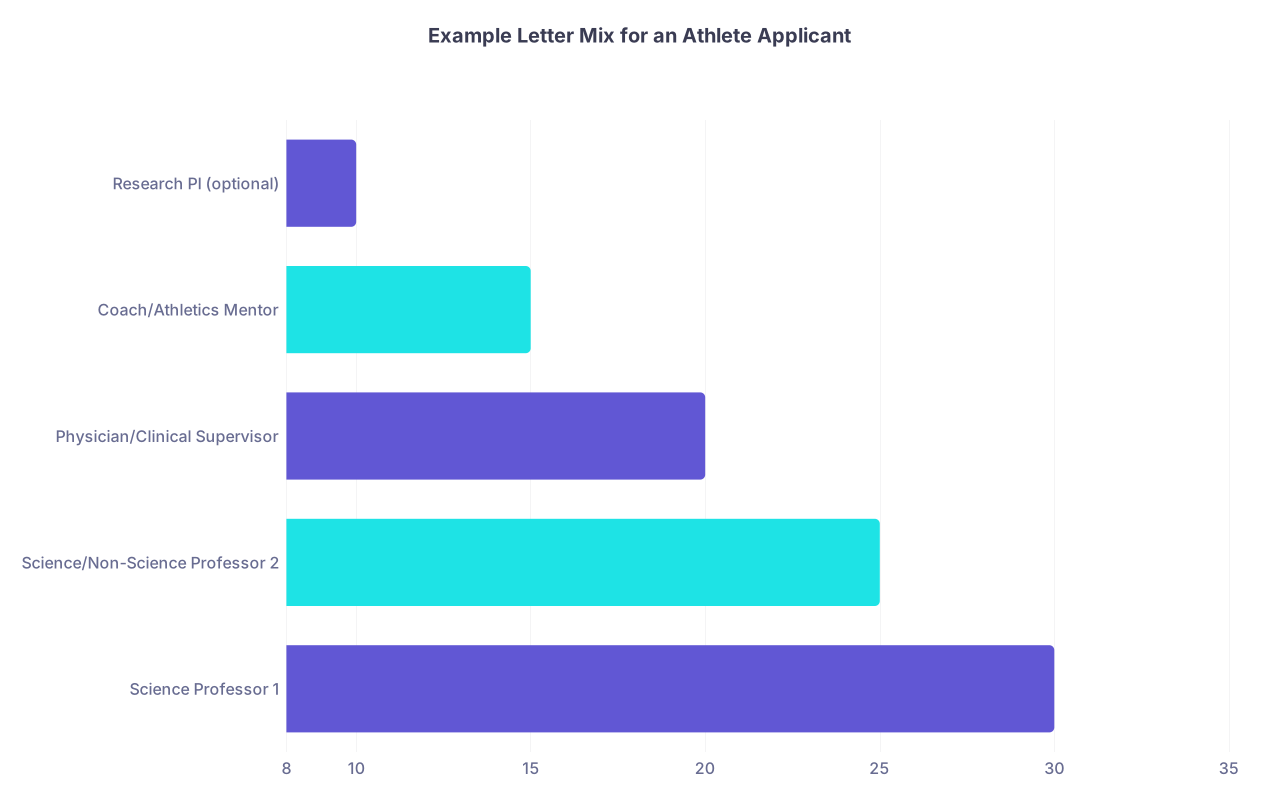
| Category | Value |
|---|---|
| Science Professor 1 | 30 |
| Science/Non-Science Professor 2 | 25 |
| Physician/Clinical Supervisor | 20 |
| Coach/Athletics Mentor | 15 |
| Research PI (optional) | 10 |
(Think of those numbers as “percent of your story” each letter is carrying. You don’t want 60% sitting with athletics alone.)
Key Takeaways
Do not treat your coach as a replacement for strong academic and clinical letters. Treat them as a specialist who proves leadership, resilience, and character in a high-pressure team setting.
Choose mentors who’ve actually seen you balance athletics and academics, then guide them to translate athlete traits into medicine-relevant language: professionalism, teamwork, response to feedback, and reliability under pressure.
Coordinate your letters so each writer covers a different “version” of you—academic, clinical, athlete, and integrator—rather than repeating the same “hardworking athlete” line four times.