
Last month I spoke with a 32‑year‑old software project manager who wants to apply to medical school. She had glowing performance reviews, led multimillion‑dollar projects, and mentored junior engineers. But she’d frozen when AMCAS asked for “letters from science faculty and physicians.” Her best mentors? A tech VP and her direct supervisor. Zero MDs.
If you’re a career‑changer, you already know the game feels rigged for traditional applicants. The good news: non‑medical supervisors can absolutely be credible—sometimes even powerful—mentors and letter writers, if you handle this strategically instead of apologetically.
Let’s go step by step.
1. First, be brutally clear about what schools actually want
You cannot decide how to leverage supervisors until you understand the letter “slots” you’re trying to fill. Different schools phrase this differently, but the buckets are usually the same:
- Academic / science letters
- Clinical / physician or healthcare professional letters
- Character / professional / “other” letters
Here’s how that roughly breaks down:
| Letter Type | Typical Requirement | Who Usually Writes It |
|---|---|---|
| Science Faculty | 1–2 | Bio/Chem/Phys professor |
| Non‑Science Faculty | 0–1 (optional) | Humanities / social science prof |
| Physician / Clinical | 1 (often preferred) | MD/DO or clinical supervisor |
| Committee Letter | 1 (if school offers) | Premed committee |
Where do non‑medical supervisors fit? They live in bucket #3: professional/character letters. The mistake is trying to force them into the physician/clinical bucket or pretending they’re “equivalent” to a science professor.
They are not. And that’s fine.
Here’s the key:
Your non‑medical supervisor letter is there to answer:
- What are you like to work with day‑to‑day?
- Can you handle responsibility, feedback, and stress?
- Do you make teams better or worse?
- Do you actually show up and do the unglamorous work?
Medical schools care deeply about those questions. They just usually get that data from research PIs, clinical supervisors, or academic mentors. You’re going to give them the same insight—but from your prior career.
Before you do anything else, make a list of:
- Schools you’re targeting
- Their LOR requirements and limits (3? 4? 5 letters max?)
- Which “slots” you can realistically cover
Then decide where your supervisor(s) fit:
- Strong traditional science letters already? Supervisor is a bonus “X‑factor” letter.
- Weak academic letters but incredible work history? Supervisor letter becomes one of your anchors, and you explicitly frame your non‑traditional path in your primary and secondaries.
2. Decide which supervisors are actually “med‑school‑worthy”
Not every boss should be anywhere near your file. You’re looking for three things: credibility, proximity, and narrative fit.
Credibility
You want someone whose role inherently carries weight:
- Director, VP, senior manager
- Lead attorney / partner
- Principal engineer / team lead
- School principal or department chair
- Military CO (Commander, OIC, etc.)
This is blunt: “Shift lead at Starbucks” carries less institutional heft than “Regional Manager at Starbucks,” even if the shift lead loved you more. When in doubt, choose the person who can credibly evaluate you at a higher level, as long as they actually know you.
Proximity
Title is useless if they barely interacted with you. You want:
- At least 6–12 months of close work together
- Direct observation of your performance under pressure
- Real knowledge of your growth over time
Red flag phrases I see in mediocre letters: “While I did not work closely with X…” or “Though my contact with X was limited…” That’s a waste of a slot.
Narrative fit
Pick supervisors who can comment on qualities that map directly onto medicine. For example:
- ICU nurse going to med school → charge nurse or nurse manager who saw you with patients and teams
- Sales rep → regional manager who watched you handle rejection, quotas, travel, and ethics
- Teacher → principal or department head who saw your classroom, your families, your data
If you had one toxic job and one job where you absolutely crushed it, only one of those belongs in your application. You know which.
3. Educate your supervisor—quietly and professionally
Your supervisor probably has no idea what a med school letter should look like. Don’t assume they’ll Google it. They won’t. They’ll default to a generic job recommendation.
You’re going to make this easy for them.
Here’s the play:
- Ask in person or on video if possible. Email if you must, but voice is better.
- Use language that gives them a graceful exit if they can’t write a strong letter.
- Follow up with a “letter writer packet” that orients them to what med schools care about.
The ask script (adapt this in your voice):
“I’m applying to medical school this cycle, and I’m putting together my letters of recommendation. I’ve really valued working with you, especially on [specific project], and I think you’ve seen me handle [X, Y, Z responsibilities].
Medical schools are very interested in how applicants function in professional environments—reliability, teamwork, leadership, integrity—so a letter from you would be extremely valuable if you feel you know my work well enough to write a strong, detailed recommendation.
Would you be comfortable doing that?”
The “letter writer packet” should include:
- A 1–2 page summary of:
– Why you’re switching to medicine
– What schools look for (bullet points are fine)
– How they know you and what you did in your role - Your CV or resume
- A brief bullet list: “Some aspects of my work you’ve seen that are particularly relevant to medicine:”
(e.g., crisis management, mentoring, long hours, ethical calls, dealing with angry clients/families)
You’re not writing the letter for them. You’re giving them raw material and context so they can aim correctly.
4. Translate your non‑medical work into medical language
The biggest gap is not credibility—it’s translation. Your VP might say:
“She led migration of a major enterprise client from legacy systems to a new cloud architecture.”
Admissions hears: tech jargon.
You want them to say:
“She led a 9‑month, high‑stakes project with 20+ stakeholders and a 7‑figure budget, where failure would have had significant financial and reputational consequences. She coordinated a cross‑functional team, managed conflict, and kept the project on track under intense time pressure.”
That’s medicine‑adjacent. That sounds like handling a service, not just a server.
So you help them make that leap. In your packet, include a “translation map”—not labeled as such, but functionally that.
Example for a project manager:
- “Stakeholder management” → “coordinating complex teams with competing priorities”
- “Issue escalation” → “knowing when to ask for help and how to communicate risk clearly”
- “Post‑mortem analysis” → “learning from mistakes and system failures without blaming individuals”
For a teacher:
- “Classroom management” → “maintaining composure, fairness, and authority with vulnerable individuals in chaotic environments”
- “Parent communication” → “discussing sensitive topics (performance, behavior, learning challenges) with distressed or defensive adults”
For a military NCO:
- “Squad leader on deployment” → “responsible for the welfare, performance, and safety of X personnel in high‑stress environments with real consequences for error”
If your supervisor is open to it, you can literally say:
“Here are some aspects of my work that map onto what medical schools care about. If any of these resonate with your experience of me, feel free to weave them in.”
They’ll be grateful you did the thinking.
5. Position supervisor letters correctly within your whole application
You can do all of the above and still have your letter land wrong if you don’t frame it for the admissions committee.
You need to do two things:
- Make sure your letter mix covers all required bases.
- Use your primary and secondaries to explain why your professional letters matter.
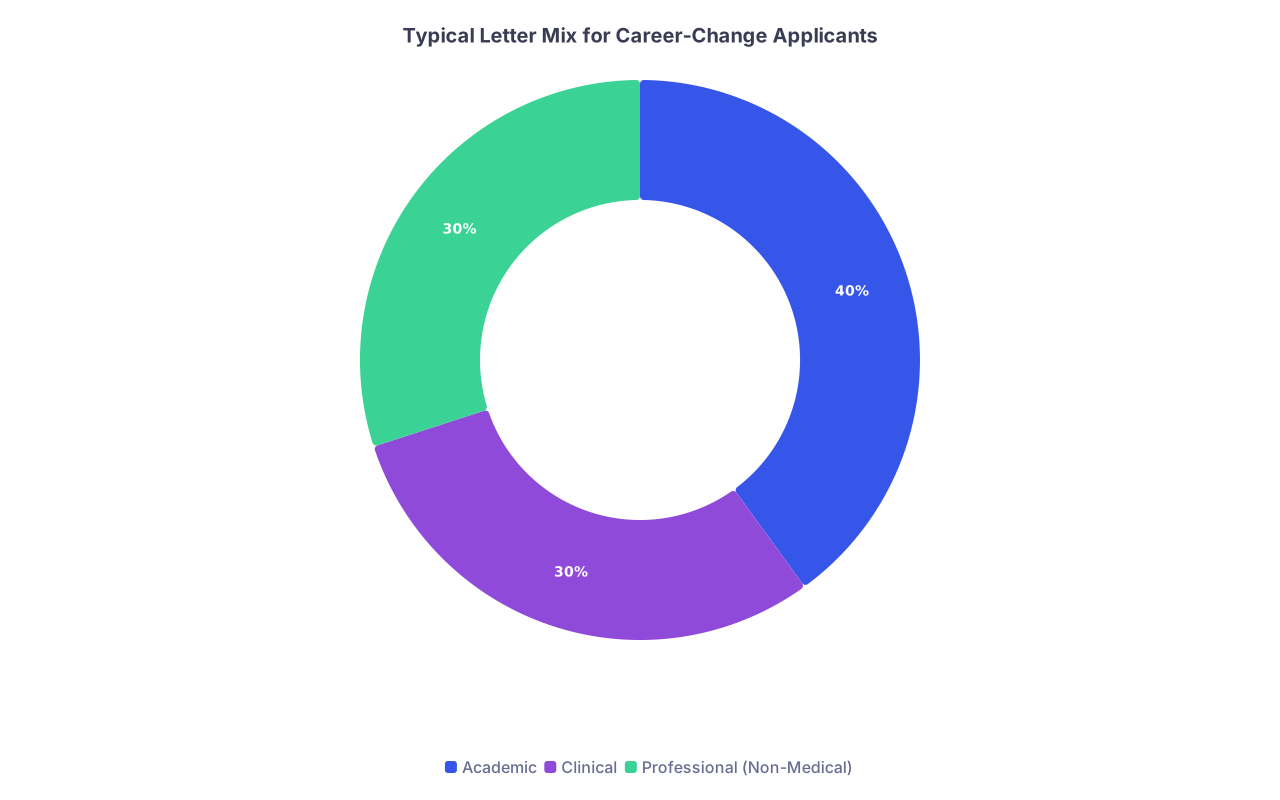
On #1, a typical strong career‑changer mix looks like:
- 1 science professor (recent coursework, even if it’s community college)
- 1 additional academic (science or non‑science)
- 1 clinical supervisor (nurse manager, clinic coordinator, physician, etc.)
- 1–2 professional supervisors from your prior career (the people we’re talking about)
If a school caps letters at 3 or 4, you may have to leave one supervisor out. Prioritize:
- Required academic letters first
- Clinical exposure second
- “Best story about you as a reliable adult” third
On #2, use your application text to teach the reader how to view these letters.
Your personal statement or secondaries can say something like:
“Before returning to complete my science prerequisites, I spent nine years as a [role] at [company]. During that time I led teams, managed crises that affected thousands of customers, and learned how to communicate transparently when things went wrong. The leaders I reported to in that environment saw me grow from an entry‑level analyst to a manager responsible for a global team. Their perspectives in my letters reflect the professional foundation I bring into medicine.”
You’re telling the committee: these are not throwaway “extra” letters. This is how you know I function in adult work environments.
6. Common failure modes—and how to avoid them
I’ve watched a lot of career‑changers misuse supervisor letters. Three patterns come up over and over.
Failure mode 1: The “personality reference”
This letter reads like: “Everyone loves Sarah. She’s nice, always on time, and we will miss her.”
Completely useless.
Fix: Nudge your supervisor to focus on specific, behavior‑based examples:
- Conflicts you resolved
- Responsibilities you owned independently
- Times you made an ethical call that cost money but preserved integrity
- High‑pressure periods (product launch, end of quarter, crisis event) and how you performed
You can literally say in your packet: “Medical schools value specific examples more than general praise.”
Failure mode 2: The “he seemed interested in medicine” letter
If your supervisor never saw you do anything even adjacent to service, teaching, leadership, or crisis, the letter becomes: “He once told me he likes biology and wants to be a doctor.”
Fix: Only use supervisors who can speak to transferable skills. If your best supervisor letter would basically say “good employee, wants med school,” skip it and get a stronger academic or clinical letter.
Failure mode 3: The “overcompensating for lack of doctors” move
Some applicants lean so hard into supervisor letters that their file screams: I didn’t work with a single physician or professor who liked me enough to write a letter.
Fix: You still need at least minimal traditional alignment. That means:
- Taking some recent science coursework and cultivating at least one professor letter
- Doing real clinical work (scribe, MA, CNA, EMT, hospital volunteer, etc.) and securing at least one clinical supervisor letter (not necessarily a physician, but someone who saw you with patients)
Non‑medical supervisors should enhance your story, not cover up the complete absence of medical exposure.
7. Concrete email examples and templates you can steal
You’re probably wondering exactly what to send. Here’s a clean, short follow‑up email you can adapt.
Subject: Letter of recommendation for medical school
Dear [Name],
Thank you again for agreeing to write a letter of recommendation for my medical school applications. I appreciate you taking the time.
I’m including a brief overview of my plans and some context that might be helpful, since medical schools look for slightly different things than typical job references. I’ve also attached my CV and a short summary of the projects we worked on together.
Medical schools are especially interested in examples of:
– Reliability and professionalism
– Ability to work on teams and communicate under stress
– Leadership or initiative
– Integrity and handling of difficult situationsIf any specific situations come to mind where you saw me demonstrate those qualities, stories like that tend to be very helpful in these letters.
The letter will be submitted through [AMCAS/AACOMAS/TMDSAS] using an email link they send you once I list you as a recommender. They usually prefer letters be on company letterhead and signed.
My earliest deadlines are around [month], so submission by [earlier date] would keep everything on track.
Thank you again for your support. Please let me know if there’s any additional information I can provide.
Best,
[Your Name]
And your attached 1–2 page summary can be simple:
Page 1: “Why medicine / my path”
Page 2: “What we did together + examples of my work that are relevant”
Do not send a 10‑page packet. They will not read it.
8. Timing and follow‑through so you do not burn bridges
You’re likely still working for these people. You can’t treat them like line items on your AMCAS checklist.
Basic etiquette:
- Ask at least 6–8 weeks before you need the letter
- Put deadlines in calendar reminders for yourself
- Nudge once, politely, 2 weeks before the deadline if it’s not in
- Always, always send a thank‑you note afterward
And after you get an acceptance?
Email them. Or better, show up with coffee if you’re local.
“I wanted to let you know I’ve been accepted to [School]. Your letter and your support over the years were a big part of making that possible. Thank you.”
You’re not just collecting letters. You’re maintaining real professional relationships you might lean on later—even in residency or beyond.
9. When a non‑medical supervisor letter can be your secret weapon
There are cases where these letters aren’t just “acceptable”—they’re the thing that pushes you over the line.
I’ve seen this in:
- Applicants with rocky early academics but 7–10 years of excellent professional performance. The supervisor letter proves the bad GPA at 19 doesn’t reflect the 33‑year‑old you.
- Applicants from intense fields (military, consulting, startups, education in under‑resourced schools) where resilience and responsibility are baked in.
- Applicants aiming at schools that explicitly like non‑traditional backgrounds (UC Davis, Penn’s program for special services, many DO programs, etc.).
If your supervisor can credibly say:
“I have managed hundreds of employees over 20 years, and [Name] is in the top 5 I would trust with high‑stakes, people‑centered work.”
That hits harder than yet another “A student in my organic chemistry class.”
You just have to set them up to say it.
| Category | Value |
|---|---|
| Academic | 40 |
| Clinical | 30 |
| Professional (Non-Medical) | 30 |

| Step | Description |
|---|---|
| Step 1 | List Target Schools & Requirements |
| Step 2 | Identify Required Academic Letters |
| Step 3 | Secure Clinical Experience & Supervisor |
| Step 4 | Select 1-2 Strong Professional Supervisors |
| Step 5 | Educate Letter Writers with Packets |
| Step 6 | Submit Requests 6-8 Weeks Before Deadlines |
| Step 7 | Reinforce Narrative in Essays & Experiences |
FAQ (Exactly 5 Questions)
1. Can a non‑medical supervisor replace a required science professor letter?
No. If a school explicitly requires a science faculty letter, a supervisor cannot substitute. You still need at least one recent science course and a professor who can write for you. The supervisor letter is a supplement, not a workaround for ignoring requirements.
2. What if my supervisor’s degree or background is in science, but our work wasn’t?
Admissions will view them as a professional supervisor, not as “science faculty,” unless they were teaching you in an academic setting. A PhD in biology who was your corporate manager is still a professional recommender, not an academic one. Use them that way.
3. Is it better to have a mediocre science letter and a great supervisor letter, or vice versa?
You want both to be at least decent, but if forced to choose, you must satisfy formal requirements first—even with a mediocre science letter—then let your supervisor letter carry more of your positive narrative. You can soften the impact of a lukewarm academic letter with strong essays and clear upward trends; you cannot fix missing required letter types.
4. How many non‑medical supervisor letters is too many?
For most applicants, one strong professional supervisor letter is excellent; two is fine if your schools allow four or more letters total and you still have academic and clinical coverage. Three or more starts to look like you avoided getting letters from people who’ve seen you around patients or in the classroom.
5. Should I waive my right to see the letter (FERPA waiver)?
Yes. Schools take letters more seriously when the applicant has waived their right to view them, because they’re presumed to be more candid. If you’re worried a supervisor can’t write a strong letter, the solution is not to keep access—it’s to pick a different writer or have an honest conversation before they agree.
Key points:
- Non‑medical supervisors can be deeply credible mentors and letter writers—but only if they know you well, hold real responsibility, and you help them translate your work into “medical” language.
- They should supplement, not replace, required academic and clinical letters, and you must frame their role clearly in your essays and school selections.
- Your job is to pick the right people, educate them just enough, and let their letters prove what matters most: that you’re already a reliable, mature professional worth betting a medical degree on.