It’s late on a Tuesday night. You’re in a windowless computer lab finishing a problem set for thermodynamics or algorithms or signals and systems. You’ve got a 3.8 in a hardcore STEM major. You’ve TA’d, done research, maybe even published.
But when you open your med school prep spreadsheet and look at “clinical exposure” and “clinical letters,” it’s basically empty. A few shadowing days. Maybe some volunteering where you stocked blankets and never talked to patients. And now you’re wondering:
“How am I supposed to get strong letters that speak to clinical readiness when I barely see patients?”
Good. You’re asking the right question. This is exactly where a lot of serious STEM premeds screw up. They wake up in junior/senior year with incredible technical mentors and zero people who can say, “I’ve seen this person around actual sick humans, and they belong in medicine.”
Let’s fix that.
1. Understand What Your Letters Actually Need To Cover
Before you go chasing mentors, you need to be clear on the gap you’re trying to plug.
You already have (or can easily get) letters that say:
- You’re smart
- You can handle advanced science/math/engineering
- You’re reliable on projects and in the lab
What you don’t have—because you’ve been buried in STEM—is:
- Someone who has seen you around patients
- Someone who can comment on your empathy, communication, bedside manner, or team behavior in a clinical setting
- Someone who can credibly say, “This person understands what medicine actually is, not just academically”
Med schools do not need five people telling them you’re good at differential equations. They need at least one or two people telling them you can handle actual human beings in distress.
So your mission:
Keep your existing academic/research mentors. Add strategic clinical mentors who can write letters that plug your “minimal patient contact” hole.
2. Know Which Mentors You Actually Need (And Why)
You’re not collecting Pokémon cards. You don’t need every possible type of letter. You need coverage across the core dimensions schools care about.
At minimum, you want something like this:
| Mentor Type | Main Purpose |
|---|---|
| Science professor (STEM) | Prove academic ability in hard science |
| Research mentor | Show work ethic, curiosity, teamwork |
| Clinical mentor (MD/DO/PA/NP) | Prove clinical awareness & patient skills |
| Service/volunteer supervisor | Show empathy, reliability with people |
As the “minimal patient contact” STEM person, your weakest two are almost always:
- Clinical mentor
- Service/volunteer supervisor in a patient-facing or human-facing environment
So you’re going to engineer your next 6–12 months to create and deepen exactly those two.
3. If You Have Almost Zero Patient Contact Right Now
You might be here:
- No ongoing clinical volunteering
- Only a couple days of scattered shadowing
- Strong STEM coursework and maybe research
Here’s the blunt truth:
You cannot “letters-of-recommendation” your way out of zero clinical exposure. A physician writing “I met them twice while they shadowed, they seemed nice” is useless. Sometimes worse than useless because it highlights how superficial your exposure is.
So step one is not “find a letter writer.”
Step one is create a role where a clinical mentor can actually get to know you.
Concrete moves you can make in the next 2–4 weeks
Lock in a real clinical role (3–6+ months)
- Hospital volunteer with direct patient interaction (transport, patient liaison, ED volunteer, oncology unit support).
- Free clinic volunteer (check-in, vitals if trained, patient flow).
- Hospice volunteer.
- Scribe role (if you can get one and you’re early enough).
Choose roles where:
- You’ll see the same clinicians repeatedly (important for letters).
- You actually interact with patients or families, not just restocking supplies in a back room.
If you’re emailing volunteer coordinators, say frankly:
- You’re premed
- You’re a STEM major with stronger academic than clinical background
- You’re specifically looking for a role with ongoing patient contact and consistent supervision
That honesty often gets you placed in better roles because coordinators know exactly what you’re trying to accomplish.
4. How To Think About “Clinical Mentors” When You Don’t Have Many
When I say “clinical mentor,” I don’t mean only attending physicians at elite hospitals. Think broader and smarter.
People who can serve as clinical mentors/letter writers:
- Physicians (MD/DO) – obvious, and very good
- Residents/fellows – can mentor you, sometimes co-sign letters with attendings
- PAs and NPs – great for primary care, outpatient settings, free clinics
- Clinical coordinators or lead nurses who supervise volunteers
- Clinic managers at free clinics or community health centers
Ideal letter:
From someone in a clinical setting who has:
- Seen you consistently for months
- Watched you interact with patients, families, and staff
- Seen you handle boring shifts, stressful moments, and the in-between
Your mistake would be chasing a “big name” doctor for a weak letter over a mid-level or coordinator who knows you well and can write a detailed, specific letter.
5. Building Clinical Mentors From Nothing (Step-by-Step)
You’re starting almost from scratch. Here’s how you turn that into actual mentors.
Step 1: Get in the room consistently
For the next semester, you want something like:
- 4–8 hours per week in a single clinical environment
Not 1 hour here, 1 hour there, across four locations. That’s how you end up known by nobody.
When you start:
- Show up early. Every time.
- Learn names. Use them.
- Ask staff how you can actually be useful—not just “What should I do?” but “I noticed the waiting room gets backed up—any way I can help there?”
Step 2: Identify potential mentors
Within the first few weeks, pay attention:
- Who seems to like teaching or explaining things to you?
- Who notices when you’re doing a good job?
- Who talks about patients and care with some passion, not just rushing through tasks?
That’s your shortlist.
Do not ask for letters yet. Just:
- Ask short, thoughtful questions about cases (without being annoying).
- Ask them how they ended up in their role.
- Ask if there’s anything you could do better as a volunteer.
You’re planting seeds.
Step 3: Convert “supervisor” into “mentor”
After 2–3 months of consistent work with someone who clearly knows you:
- Ask if they’d be open to chatting for 20–30 minutes about your path to medicine and what gaps they think you might have.
- Treat it like an informal advising session, not a letter request.
You can say something like:
“I’m a physics major with a lot of lab experience but relatively late to clinical work. You’ve seen me in this role for a few months—are there things you think I should get better at if I want to be a strong medical school applicant?”
People respect that self-awareness. It also gives them language they may later put into a letter: “Initially had limited patient exposure but deliberately sought feedback and grew significantly in…”
Step 4: When and how to ask for a letter
Timing:
Ask after 3–6 months of consistent interaction, or a full cycle (semester/year) if it’s a less-frequent role.
Your wording should:
- Acknowledge your nontraditional clinical path
- Make their job easier
- Give them an easy out if they can’t write a strong letter
Example script by email or in person:
“Dr. Smith,
I’ve really appreciated working in clinic this semester and learning from how you talk with patients and families. As you know, I’m a mechanical engineering major and most of my mentors so far are from research and the engineering department.I’m applying to medical school next year and I’m trying to make sure my letters reflect not just my academics, but also how I work in clinical environments with patients and staff. You’ve seen me in clinic weekly for the last 5 months, and I was wondering if you’d feel comfortable writing a strong letter speaking to my clinical potential and how I’ve worked with patients and the team here. If not, I completely understand and would appreciate your honesty.”
If they hesitate or don’t say “yes” clearly, don’t push. A lukewarm letter hurts you.
6. Leveraging Non-MD Mentors When MDs Are Hard To Access
A lot of STEM-heavy universities have this problem: plenty of labs, not many friendly physicians on campus. That’s fine. You can still build a solid clinical letter package with non-MD supervisors.
Good non-MD clinical letter sources:
- Nurse manager of the unit where you volunteer
- Volunteer coordinator who sees all your evaluations and directly supervises you
- PA or NP in a clinic where you assist regularly
- Director/coordinator of a free clinic where you check in patients, take histories, or manage flow
These people can write phenomenal letters that say:
- You show up and stay late
- You treat patients and families with respect
- You don’t crumble under pressure
- You handle difficult or emotional situations with maturity
If you really want an MD letter but don’t interact directly enough:
- Do not ask an MD who’s barely seen you for a “character letter.”
- Instead, ask your non-MD mentor if they’d be open to co-signing or co-authoring with an overseeing physician who knows you somewhat. Sometimes the coordinator writes the guts of the letter and the MD adds their signature and a short paragraph.
7. Balancing Strong STEM Letters With Clinical Coverage
You’re a STEM major. You should absolutely leverage that.
Your likely academic letter setup:
- Letter from a hard science or math/engineering professor who taught you in an upper-level course
- Letter from your research PI
Those letters should lean hard into:
- Analytical ability
- Independence and initiative
- How you handle failure in long-term projects
- Communication and collaboration on technical teams
Your clinical/service letters should then intentionally complement that:
- “Yes, they’re a strong scientist. I’ve seen that translate into being curious about patient cases and thoughtful in how they ask questions.”
- “Despite their heavy STEM load, they’ve committed X hours per week to patient-facing work and have grown in Y ways.”
To make this easy for your clinical mentors, when you share your CV or letter packet, highlight:
- STEM major rigor
- Clinical gap you recognized
- Concrete actions you took to address it
- How long you’ve been in their setting, and what roles you’ve had
You’re telling a story:
“I realized I was lopsided, and here’s what I did about it.”
8. Avoid Common Traps That Kill Clinical Letters
I’ve watched smart STEM students sabotage themselves in predictable ways.
Don’t do these:
Short-term shadowing letters
- 2–3 days of shadowing → terrible letter.
- The physician can’t say anything meaningful, so you get a generic fluff page. Adcoms roll their eyes.
Big-name but low-contact letter
- “Chief of X” or “Department Chair” who barely knows you.
- Title looks fancy, but the content screams “we met five times and I’m being polite.”
Stacking academic letters only
- Four science/engineering/research letters, no one clinical.
- Adcoms will assume: you like science, not patients.
Ignoring non-traditional clinical supervisors
- Holding out for MD letters and skipping the nurse manager who’s seen you handle 20 tough shifts.
- Huge mistake. The latter is infinitely more valuable.
Not telling mentors your story
- If you don’t say, “I’m a STEM major who came late to clinical exposure, and I’ve been working to balance that,” they won’t frame their letter that way.
- You want them to explicitly address your growth arc.
9. Timeline Strategy If You’re 1–2 Years From Applying
Let’s say you’re a sophomore or early junior with minimal clinical exposure. Good. You have time. Use it strategically.
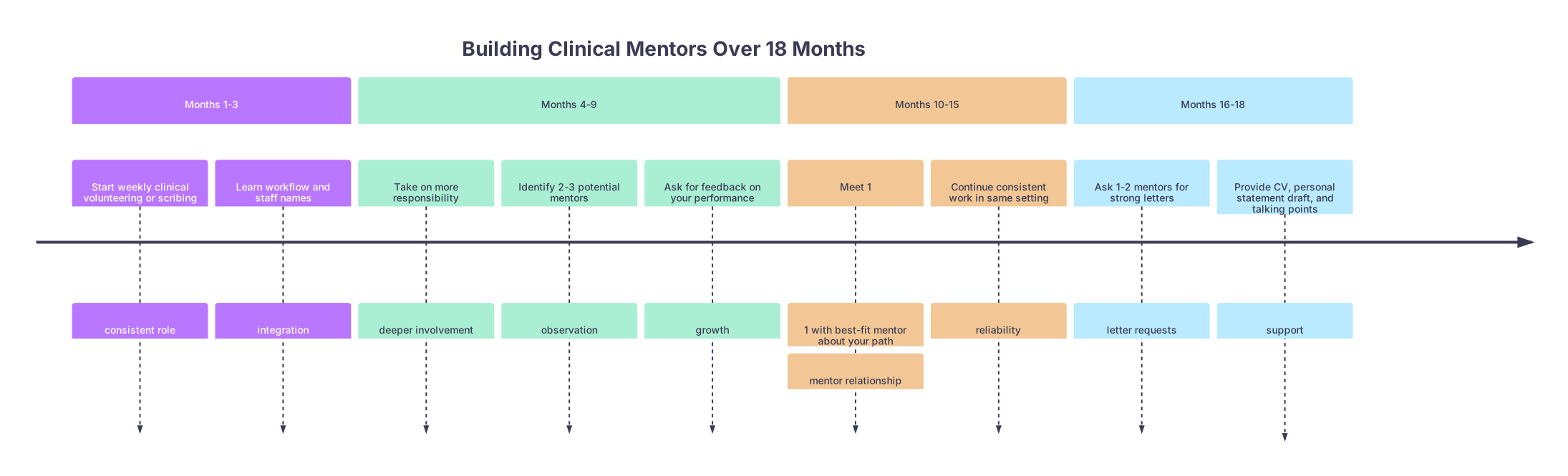
| Period | Event |
|---|---|
| Months 1-3 - Start weekly clinical volunteering or scribing | consistent role |
| Months 1-3 - Learn workflow and staff names | integration |
| Months 4-9 - Take on more responsibility | deeper involvement |
| Months 4-9 - Identify 2-3 potential mentors | observation |
| Months 4-9 - Ask for feedback on your performance | growth |
| Months 10-15 - Meet 1 | 1 with best-fit mentor about your path |
| Months 10-15 - Continue consistent work in same setting | reliability |
| Months 16-18 - Ask 1-2 mentors for strong letters | letter requests |
| Months 16-18 - Provide CV, personal statement draft, and talking points | support |
If you’re closer to applying (0–12 months), you compress this, but the principles don’t change:
- Choose 1–2 settings where you can be seen consistently.
- Prioritize depth over variety.
- Ask for letters from the people who actually know you and have watched you grow.
10. How To Help Your Clinical Mentor Write A Strong Letter
Once someone agrees to write for you, don’t leave them on an island.
Send them:
- Your CV/resume
- A short paragraph about your path: STEM major, realized clinical gap, specific actions taken
- A rough draft of your personal statement (even if it’s ugly)
- Bullet points of 3–5 moments they witnessed that mattered to you (HIPAA-safe, obviously)
You might say:
“Here are a few moments that were meaningful to me:
- The time I stayed late with the elderly patient who was anxious about going home alone.
- Helping manage the waiting room during that really busy flu clinic afternoon.
- When you gave me feedback about talking more directly with patients, and how I’ve tried to improve since then.”
You’re not scripting them. You’re jogging their memory and giving them material that turns into specific, powerful letter content.
11. Example Mentor Mix For a STEM-Heavy Premed
Let me make this concrete. Imagine this setup:
- You’re a computer science major.
- Research in machine learning for radiology.
- Clinical exposure only started junior spring.
Your final letter lineup could look like:
- CS Professor – taught you in advanced algorithms, can speak to rigor, problem-solving, top 5% of class.
- Research PI – ML for medical imaging, can speak to independence, scientific curiosity, collaboration.
- Free Clinic NP – supervised you weekly for a year; can describe your development from quiet, awkward student to someone confidently rooming patients and handling sensitive questions.
- Hospital Volunteer Coordinator – has evaluations from nurses and staff, can speak to reliability, patient rapport, professionalism.
That’s a balanced, believable set that directly addresses your “minimal patient contact” start and shows how you corrected it.
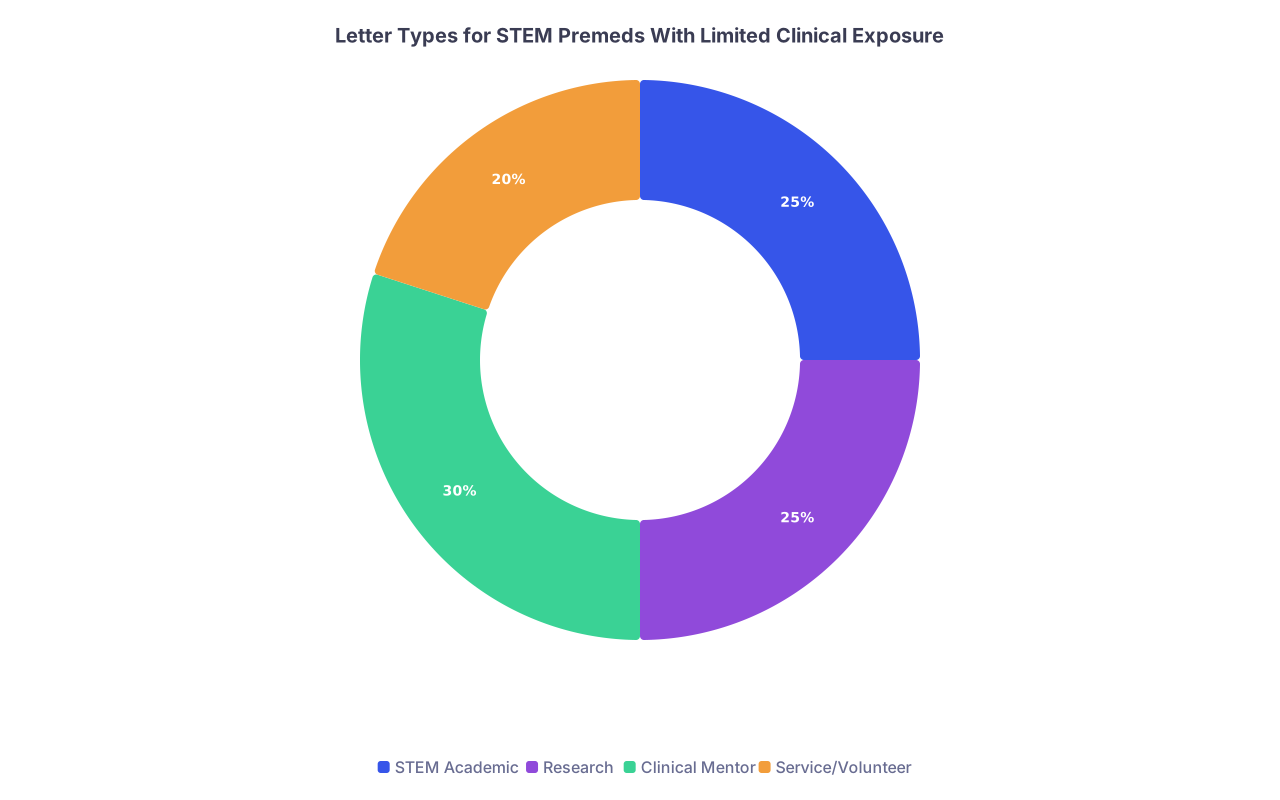
| Category | Value |
|---|---|
| STEM Academic | 25 |
| Research | 25 |
| Clinical Mentor | 30 |
| Service/Volunteer | 20 |

FAQ (Exactly 4 Questions)
1. I only have time for one clinical activity. Is that enough for a good clinical letter?
Yes—if it’s consistent and real. One solid role where you show up every week for 6–12 months beats four scattered, shallow experiences. Choose something where you:
- See the same staff regularly
- Interact with patients directly
- Can gradually take on more responsibility
From that, you can usually get one strong clinical letter and sometimes a second from a different supervisor in the same setting.
2. What if my clinical mentor isn’t an MD—will med schools care?
They care way more about content than letters after a fancy name. A detailed, specific letter from an NP, PA, nurse manager, or clinic director who has seen you for a year is far more valuable than a generic two-paragraph note from an MD who barely knows you. If you can get an MD, great. But do not sacrifice depth of relationship for the title.
3. I’m applying this cycle and only started clinical work 4–5 months ago. Should I still ask for a clinical letter?
If you’ve been there regularly (weekly) and your supervisor clearly knows you and has watched you improve, yes, you should probably ask for one. When you do, be transparent:
- Explain that you came to clinical work later due to heavy STEM coursework and research.
- Emphasize that you’re trying to show schools that you’ve engaged honestly with patient care, even if the timeline is compressed.
- Ask them directly if they feel they’ve seen enough to write a strong letter.
If they’re unsure, don’t force it. Better to rely more heavily on academic/research letters than to include a weak clinical one.
4. How many letters do I actually need that speak to clinical ability?
Assuming applications like AMCAS:
- You generally want at least one clear clinical letter that talks about patient interaction, team behavior, and professionalism in a healthcare setting.
- Two is even better if one is from a physician/NP/PA and another from a coordinator or nurse manager.
- The rest can be academic and research letters—especially from your STEM side—just make sure your total set doesn’t look like you’ve avoided human beings.
Actionable next step for today:
Make a short, brutal list: who currently knows you in any clinical or service setting well enough to comment on how you interact with people? If that list is empty or weak, open your browser and apply to 2–3 clinical volunteer or scribe roles that meet weekly, in one consistent setting. That’s the foundation every good clinical mentor—and letter—will grow from.