Online or Hybrid Programs: How to Create Enough In‑Person Depth for LOR Writers
What do you do when your “professors” mostly know your Wi‑Fi connection better than your face, but you still need strong, specific letters of recommendation for medical school?
If you’re in an online or hybrid program, you’re at an immediate disadvantage for letters. Not fatal. But real. Most med schools don’t care that your program is remote; they care whether any credible adult can write, “I’ve seen this person think, struggle, improve, and show up for others.”
If all anyone can honestly say is, “They always had their camera on and got an A,” that’s weak. You need people who can talk about you like a real colleague, not a username.
Here’s how to fix that—step by step—if you’re stuck in online or hybrid land.
Step 1: Accept the Constraint, Then Design Around It
You’re not going to magically “feel” like an in‑person student. Do not wait for that. You’re going to engineer in‑person depth on purpose.
There are four buckets where med schools like to see letters come from:
- Science faculty
- Non‑science faculty (or another academic instructor)
- Clinical supervisors (physicians, PAs, NPs, etc.)
- Research mentors / longitudinal supervisors (could be community or lab)
Online or hybrid means your “faculty” contact may be shallow. So you compensate by:
- Creating intentional in‑person contact with at least 2–3 professors
- Building long‑term, in‑person relationships in clinical or research environments
- Making sure each recommender has months of real interaction, not a weekend workshop
You’re basically building your own in‑person micro‑environment inside a mostly online degree.
Step 2: Audit Your Current Situation (Brutally)
Before you start adding things, you need to see what you actually have.
Ask yourself:
- How many professors know my name without looking at Zoom tiles?
- Has any instructor seen me solve problems live, ask real questions, or help other students?
- Who has seen me handle stress, confusion, or feedback?
- Who has worked with me for longer than a single semester?
Most online students realize: no one has seen them do anything beyond submit work.
Make a quick chart. Don’t overthink it:
| Category | Name / Role | Mode | Strength (1-5) |
|---|---|---|---|
| Science faculty | Dr. X (Biology) | Online | 2 |
| Non-science | Dr. Y (Psychology) | Hybrid | 3 |
| Clinical | N/A | N/A | 0 |
| Research/Other | N/A | N/A | 0 |
If you have fewer than 2 people at “4” or “5” strength, you need to build more depth. Which you probably do.
Step 3: Turn Hybrid/Online Classes into In‑Person Relationships
Even if the class is online, the relationship doesn’t have to be.
A. Start with one or two target professors
Pick:
- One science instructor
- One other instructor (could be psych, philosophy, stats, whatever)
Criteria: They respond to emails, seem reasonable, and ideally are at your home institution (not random adjunct in another state you’ll never meet).
Then:
Email them early in the term.
Subject line: “[COURSE] – Student hoping to be more involved and meet in person”Body (short, not cringe):
Dear Dr. Smith,
I’m in your online BIOL 220 course this term and am a premed student. Because my program is mostly hybrid, I’m trying to intentionally build more in‑person academic mentorship.
Would you be open to:
– A brief in‑person (or video) meeting to introduce myself and discuss how I can engage more deeply with the course material?
– Occasionally stopping by office hours in person (if you hold them) to review concepts and talk about my preparation for medical school?I don’t want to take up much time, but I’d really appreciate a chance to get to know you beyond the online platform.
Best,
[Name], [ID], [Major]Show up like it’s a job
If they offer in‑person or video office hours, you go. Weekly or every other week. Not to say “hi” but with real questions:- “Can we go through this problem I missed and why my reasoning was off?”
- “How would you recommend I deepen my understanding of [topic] beyond the textbook?”
- “Can I run something by you that confused me in the reading?”
Volunteer for visible things
Even online, you can:- Lead a breakout discussion
- Offer to start a review session for classmates (and invite the professor)
- Do a small optional project / lit review / reading summary and send it to them
The goal: by the end of the semester they can say, “This student always prepared, asked high‑level questions, and took initiative.”
Step 4: Create Actual Face Time (Even in a Mostly Online World)
You need some literal, physical interaction with humans who can write for you. Here are ways I’ve seen students pull this off, even from fully online programs.
Option 1: Local community or state college coursework
If your main program is online, do 1–3 targeted in‑person classes at a local college.
Priorities:
- Upper‑level science if possible: physiology, micro, biochem, etc.
- Smaller classes where the professor will notice effort
- Semesters where you can really engage (not while you’re drowning in 3 jobs and MCAT)
Plan from day one: “I’m going to treat this course not just as content, but as a relationship opportunity.”
What that looks like:
- Sit in the front third of the room
- Ask 1–2 thoughtful questions per week (not performative, but real)
- Visit office hours at least twice before midterm, twice before final
- Email at the end: “Could I keep in touch as I apply to medical school?”
If you do this right in 1–2 courses, you can walk away with 1–2 strong academic letters.
Option 2: On‑ground research or lab work
Research is one of the best ways to generate a detailed LOR because you’re working under someone week after week.
Targets:
- Nearby university labs (even if you’re not a student there)
- Hospital‑based research groups
- Clinical outcomes, epidemiology, or quality improvement projects
You do not need an elite basic science lab. You need:
- A PI or coordinator who sees you regularly
- A project that lasts at least 6 months
- Tasks that aren’t purely data entry in isolation (you want interaction)
A typical path I’ve seen:
- You cold email 10–15 PIs in your city with a short pitch.
- One says yes to having you as a volunteer.
- You show up twice a week, learn the workflow, offer to take on annoying tasks reliably.
- You start attending lab meetings, eventually presenting a small piece.
- After ~9–12 months, that PI can write a killer letter.
Option 3: Clinical roles with real supervision
Shadowing is nice but often too shallow for a strong letter. A job or sustained volunteer role is better.
Think:
- Medical assistant or scribe (urgent care, ED, clinic)
- CNA, EMT, phlebotomist
- Longitudinal volunteer at a free clinic or hospice
You want one person—an MD, DO, PA, NP, or RN leader—who sees you repeatedly, not a rotating cast.
Your script once you’ve proven yourself:
“Dr. Lee, I’ve been working with you here for almost a year, and you’ve seen me interact with patients and the team. I’m planning to apply to medical school this upcoming cycle. If you feel you know my work well enough, I’d be very grateful if you could write a letter focusing on how I function in a clinical environment.”
Do not ask for letters from people who’ve spoken to you twice. That’s how you end up with generic fluff that hurts more than it helps.
Step 5: Structure Your Time So Depth is Even Possible
If you try to do everything halfway, you’ll have ten people who know you a little and no one who knows you well. That is useless.
You want 3–5 people who know you at a deep level.
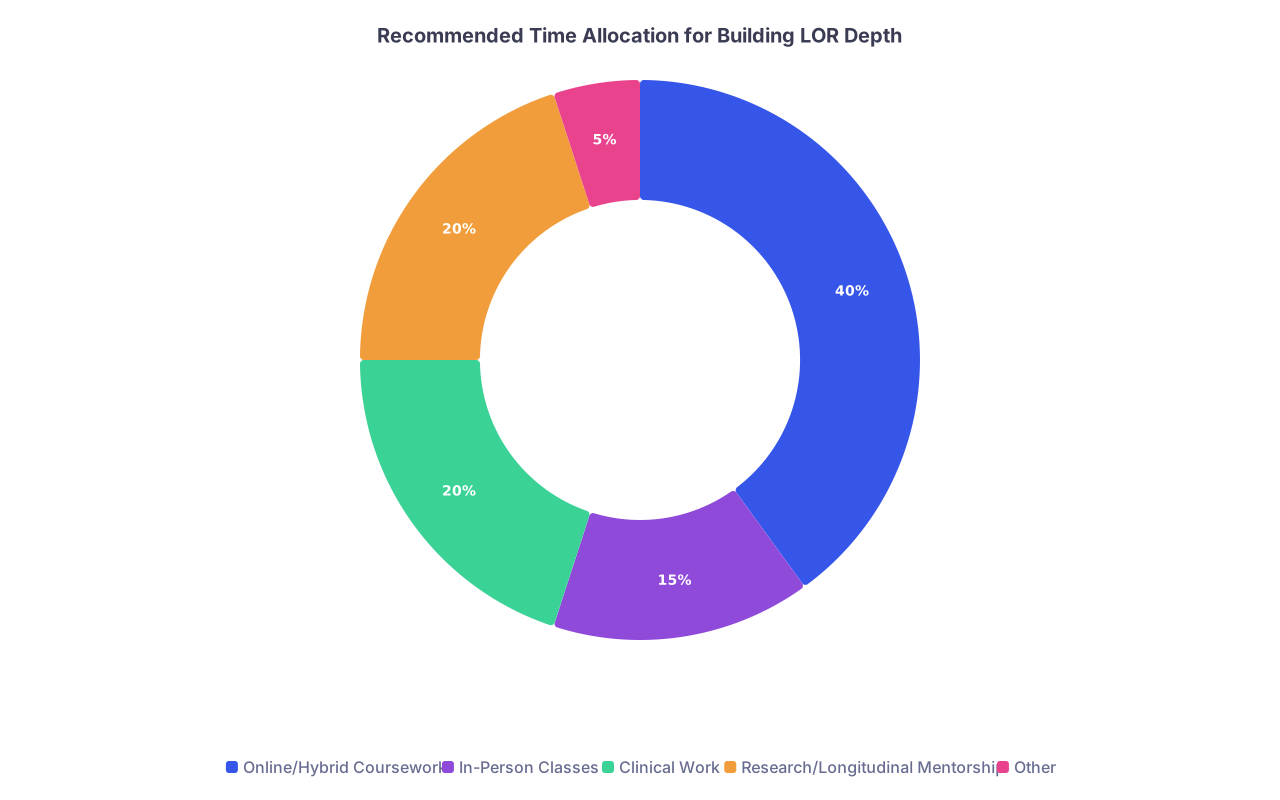
Think of your premed years like this:
| Category | Value |
|---|---|
| Online/Hybrid Coursework | 40 |
| In-Person Classes | 15 |
| Clinical Work | 20 |
| Research/Longitudinal Mentorship | 20 |
| Other | 5 |
Roughly:
- 40%: doing well in your actual (online/hybrid) courses
- 15%: one in‑person class or intense faculty contact per term
- 20%: consistent clinical role under 1–2 supervisors
- 20%: research or other longitudinal mentorship
- 5%: misc (clubs, one‑off volunteering, etc.)
If you’re spending 90% of your energy on isolated, asynchronous work and sporadic volunteering, you’re not building letter‑worthy relationships.
Step 6: Make Your Online Professors Actually Know You
You might still need letters from online‑only faculty. Fine. Then you need to stop being a silent square.
Tactics that work:
Camera on, consistently
Frustrating reality: professors remember faces, not usernames.Speak up regularly
You don’t need to be a show‑off, but you can:- Answer questions in chat
- Volunteer to summarize a reading
- Present briefly in breakout groups, then share back to main room
Use the Learning Management System (LMS) discussion boards like they matter
Post something that isn’t superficial. Respond thoughtfully to others once a week. Show your brain.Email with substance, not noise
Example:I’ve been thinking about what you said about [concept] and how it applies to [example]. Could I get your thoughts on whether this interpretation makes sense?
When, months later, you ask for a letter, attach:
- Your CV
- Your transcript (unofficial is fine)
- A 1‑page “LOR packet” with:
- Your goals (why medicine)
- A short list of projects/assignments you did in their course
- Specific traits/episodes they might remember (“I was the student who presented on X and came to office hours about Y.”)
You’re making it easy for them to say yes and write something concrete.
Step 7: Sequence Your Moves Over 12–24 Months
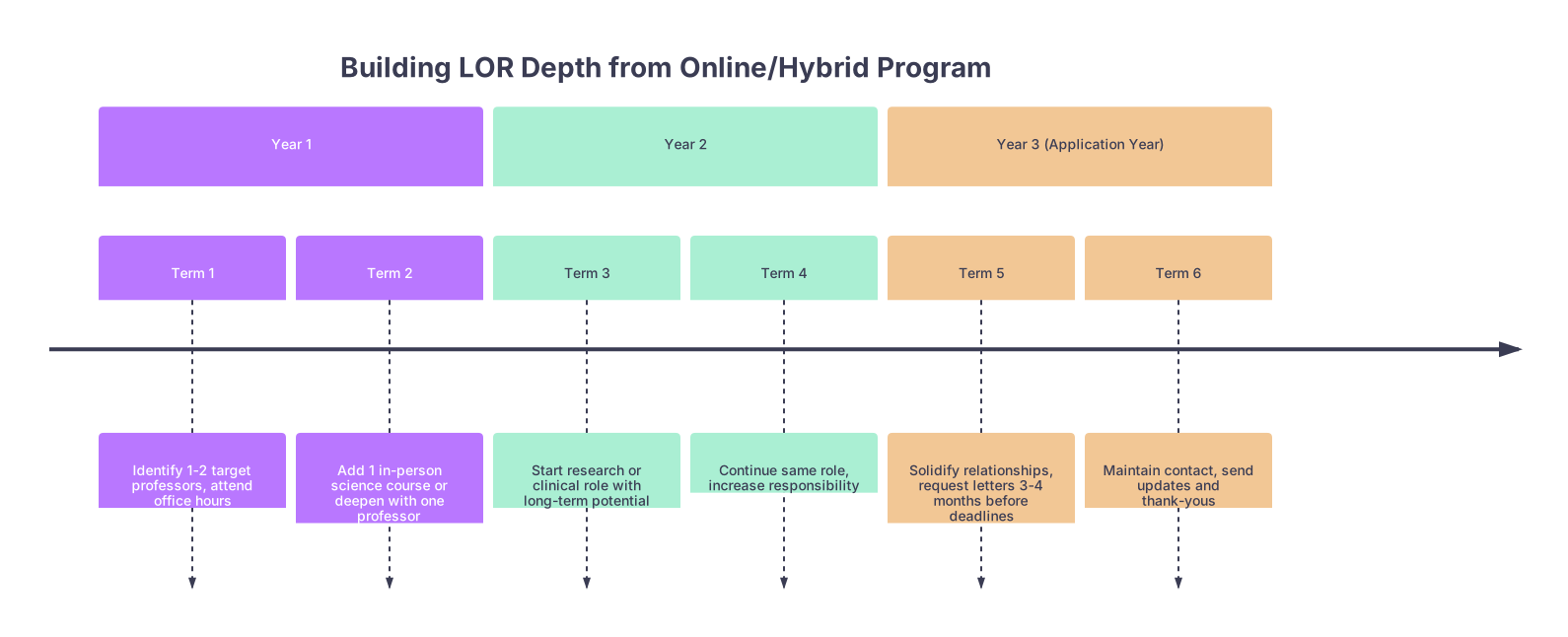
If you’re earlier in the process, plan it. If you’re late, compress it, but still think in phases.
Here’s a pretty standard timeline for someone in a hybrid or online program:
| Period | Event |
|---|---|
| Year 1 - Term 1 | Identify 1-2 target professors, attend office hours |
| Year 1 - Term 2 | Add 1 in-person science course or deepen with one professor |
| Year 2 - Term 3 | Start research or clinical role with long-term potential |
| Year 2 - Term 4 | Continue same role, increase responsibility |
| Year 3 (Application Year) - Term 5 | Solidify relationships, request letters 3-4 months before deadlines |
| Year 3 (Application Year) - Term 6 | Maintain contact, send updates and thank-yous |
If you’re already a year away from applying and you’ve done none of this, your schedule just gets more aggressive:
- Right now: find one in‑person course or local professor
- Within 1–2 months: lock in a clinical or research role
- Next 9–12 months: show up like your life depends on it (because your letters kind of do)
Step 8: Use Non‑Academic Mentors Strategically
Medical schools do not require that every letter be from faculty. They usually want:
- 2 science faculty
- 1 other academic or professional
- Optional: 1–2 clinical / research / supervisor letters
If you’re light on in‑person professors, your non‑academic letters matter more.
Some good sources:
- Clinic manager who saw you handle difficult patients regularly
- Volunteer coordinator who watched you work with vulnerable populations
- Research coordinator who assigned you increasingly complex tasks
Just be clear WHAT each letter is supposed to highlight. You don’t want five letters all saying, “They’re hard‑working and nice.”
Think in roles:
- Professor letter: intellect, curiosity, academic stamina
- Clinical supervisor letter: bedside manner, reliability, teamwork
- Research mentor letter: critical thinking, persistence, responsibility
If you have fewer science faculty letters than ideal, you absolutely need these other letters to be rich and specific.
Step 9: When and How to Ask for Letters (Especially if Your Contact Was Hybrid)
Don’t blindside anyone.
Timeline to request:
- 2–3 months before you need the letters submitted
- After they’ve known you at least one full term, preferably longer
How to phrase it if the course was mostly online/hybrid:
Dear Dr. Patel,
I’ve really appreciated your [Course Name] this past year and the chance to work with you through [office hours / project / labs]. I’m applying to medical school this upcoming cycle and was wondering if you’d feel comfortable writing a strong, detailed letter of recommendation commenting on my abilities as a student and future physician.
I know our course was largely online, but I hope our interactions during [specific examples: office hours, project, group work] gave you a good sense of how I think and engage with material. I’m happy to provide my CV, personal statement draft, and a short summary of my work in your class to make this easier.
If you don’t feel you know me well enough to write a strong letter, I completely understand and would appreciate your honesty.
Best,
[Name]
The key phrase: “strong, detailed letter.” That gives them a polite exit if the answer is “not really.”
Step 10: If Your Online Program Is Weak on Faculty Contact, Patch It Deliberately
Some online programs are simply not designed for mentorship. High enrollment, rotating adjuncts, zero office hours. If that’s you, stop expecting those people to rescue you.
You patch that hole by:
- Cross‑registering for 1–3 in‑person courses elsewhere
- Using local community colleges as faculty‑relationship engines
- Getting deep into research or clinical environments where someone with a degree can speak to your performance
Don’t waste energy being mad at the structure. It’s not going to change in time. Build your own structure around it.
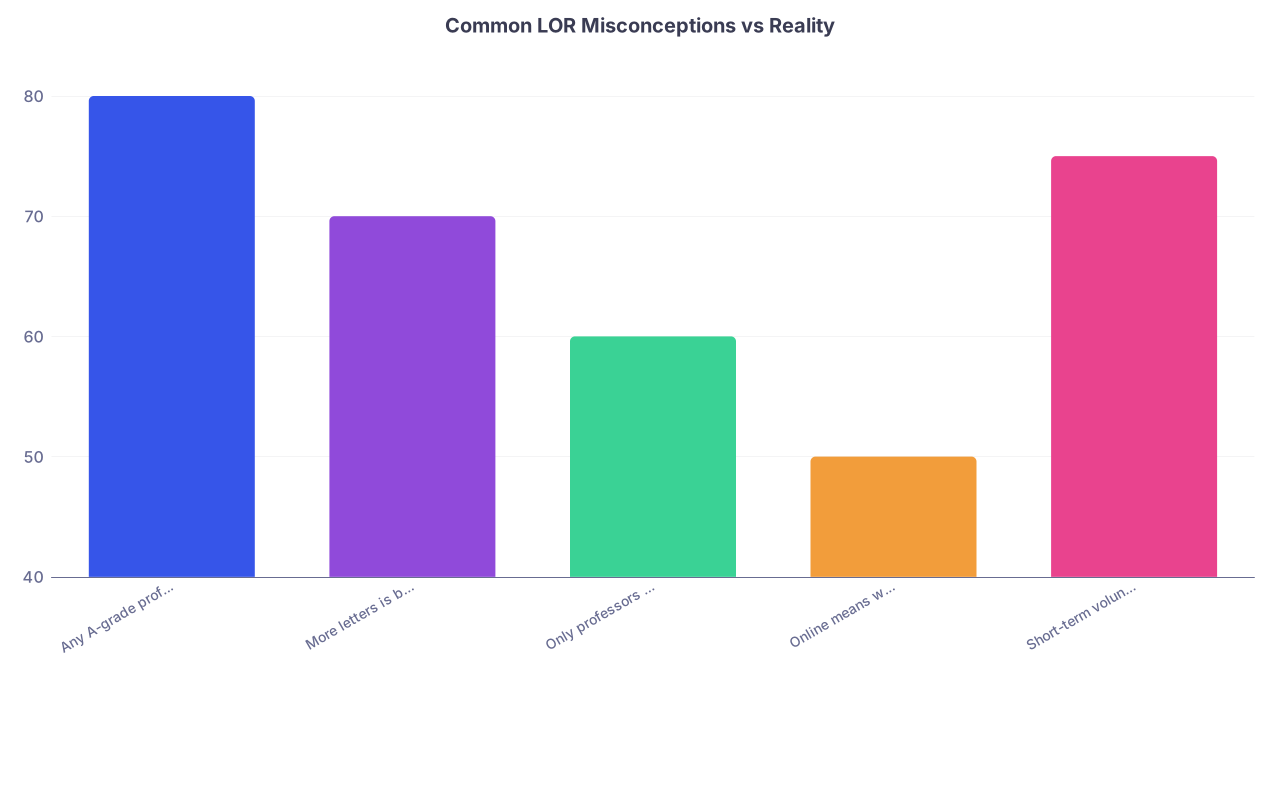
Quick Reality Checks (Common Misconceptions)
| Category | Value |
|---|---|
| Any A-grade prof is enough | 80 |
| More letters is better | 70 |
| Only professors matter | 60 |
| Online means weak letters | 50 |
| Short-term volunteering is enough | 75 |
That bar chart? Think of those numbers as “how common the bad belief is,” not truth.
Reality:
- An A in someone’s class doesn’t automatically mean they can write you a good letter.
- Four strong letters beat eight lukewarm ones.
- Non‑faculty supervisors can sometimes write better letters than professors who barely know you.
- Online does not automatically mean weak letters—only passive behavior does.
- Weekend volunteering rarely generates a decent letter. Depth beats novelty.
FAQs
1. What if I live in a rural area with no nearby university or hospital?
Then you lean harder on what you do have and use remote options smartly. Look for:
- Local clinics, nursing homes, EMS services, or public health departments where you can volunteer or work under supervision.
- Remote research positions that still have weekly Zoom meetings where you present or discuss data.
- One or two professors from your online program who actually do hold regular office hours—milk those for all they’re worth.
You might end up with fewer total in‑person contacts, but if you turn 2–3 of them into deep, long‑term relationships, that’s still viable.
2. My only good mentor isn’t an MD or professor. Can they still be a primary LOR?
Yes, but you can’t dodge the basic requirement: most schools still want at least 1–2 science faculty letters. Your non‑MD/non‑faculty mentor can absolutely be one of your strongest letters, especially for character, resilience, and work habits.
You position it like this on your application: “Letter from [Role], my direct supervisor for [X years] at [clinic/lab/program].” Then you make sure your faculty letters exist, even if they’re from community college or a single great instructor instead of some famous PI.
3. I’m only a year away from applying and have almost no in‑person depth. Is it too late?
It’s late, not too late. But you probably need to slow down your timeline or accept a more intense year.
Your options:
- Take a gap year: Spend it doing one in‑person post‑bacc or upper‑level course and a solid clinical or research role.
- If you refuse to delay: Immediately start an in‑person course and a clinical job/volunteer position, and focus on getting 2–3 people to know you very well in the next 9–12 months.
Rushing forward with only generic online letters will likely lead to weak outcomes and reapplication. Slowing down a year to build real depth usually pays off.
Key points to walk away with:
- You cannot change that your program is online or hybrid. You can intentionally build in‑person depth with a few professors and supervisors.
- Depth beats breadth. Three people who know you extremely well are more valuable than ten who barely remember you.
- Every term you should be asking: “Who actually sees me work closely enough that they could vouch for me to a med school committee?” If the answer is “no one,” your real job this term is to fix that.