
The worst letters of recommendation are written in a rush during your application year. The best ones are quietly built month by month the year before.
You’re not “asking for letters.” You’re running a 12‑month project to make it easy for busy faculty and physicians to write you excellent ones. Here’s how that actually looks on a calendar.
Big Picture: The 12‑Month Letter Game Plan
At this point you should stop thinking, “Who will write my letters?” and start thinking, “What will they have to say about me?”
Your goals over the next year:
- Identify 3–5 strong potential letter writers
- Give each of them multiple real interactions with you
- Provide them with specific material and reminders at the right time
- Avoid last‑minute scrambling that makes your letters generic and weak
Let’s assume you’ll submit in June (AMCAS/AACOMAS/ERAS style timeline). Count backward 12 months.
| Writer Type | Target Number | Priority Level |
|---|---|---|
| Science faculty | 1–2 | Essential |
| Non‑science faculty | 0–1 | Recommended |
| Clinical physician | 1–2 | Essential |
| Research PI | 0–1 | Strong Plus |
Month 12: Audit and Target
At this point you should get brutally honest about who actually knows you.
This month’s targets:
- Make a letter‑writer map
- Plug obvious gaps
- Start one new key relationship if needed
Tasks:
List potential writers
Write down every realistic option:- Professors who know you by name and face
- PIs or research coordinators
- Physicians you’ve shadowed or worked with
- Volunteer supervisors or job managers
Next to each name, rate:
- How well they know your work (not just your personality)
- How recent your interactions are
- How likely they are to say yes and follow through
Identify gaps
Typical problems I see:- Strong in clinical letters, but no science faculty
- One great professor… from two years ago, never kept in touch
- Only TAs know you, not course directors
Start at least one new connection
If you’re missing someone:- Enroll in or audit a course with a potential recommender
- Join a lab with a PI who actually mentors
- Lock in a regular clinical or volunteer role (4–8 hrs/week) with the same supervisor
This month is about positioning. No asks yet. You’re setting up the board.
Month 11: Show Up and Be Seen
At this point you should become visible to the people you might ask letters from.
This month’s targets:
- Establish consistent presence
- Demonstrate reliability early
- Have at least one real conversation with 2 potential writers
Tasks:
For professors
- Sit in the same front‑half area of class
- Go to office hours once, with a real question (not “How do I get an A?” but “I’m curious how X applies in clinical practice.”)
- Introduce yourself briefly: name, major, premed track, one sentence about interest
For research PIs
- Show up on time, every time
- Ask your immediate supervisor what “excellent” looks like in your role
- Request a 10–15 minute intro with the PI: you, your goals, how you can be useful
For clinical/volunteer supervisors
- Learn workflows fast and stop needing to be reminded of basics
- Ask for small extra responsibilities once you’ve proven competent
- Be the person who doesn’t cancel last minute
No talk about letters. Just becoming the student they remember for the right reasons.
Month 10: Give Them Something to Notice
At this point you should deliberately create moments that show who you are, not just that you exist.
This month’s targets:
- Demonstrate initiative
- Get one meaningful interaction with each target writer
- Start a simple “Letter File” for yourself
Tasks:
In class or lab, do one thing above baseline Examples I’ve seen work:
- Volunteering to present a problem solution in discussion
- Asking to draft a short protocol or SOP in lab
- Offering to prepare a brief summary of an article for the team
Short check‑ins With 2–3 targets, do a quick:
- “I’m really enjoying your course because X”
- “I’ve been thinking about the topic from last lecture and looked up Y”
Start your Letter File (do not skip this)
One folder (cloud or local) with:- Updated CV or activities list
- Running document where you log:
- Projects you completed
- Cases/patients that stuck with you
- Specific feedback or compliments you received (“You caught that error I missed,” said by Dr. Lee after clinic)
You’re building the raw material your letter writers will later use. They won’t remember those moments. You will.
Month 9: Quietly Prove Consistency
At this point you should be the person they never have to worry about.
This month’s targets:
- Show reliability over time
- Deepen 1–2 relationships with slightly longer conversations
- Capture concrete stories for future letters
Tasks:
- Maintain perfect or near‑perfect attendance for your key contexts (lab, class, clinic). No no‑shows. Minimal reschedules.
- Ask for feedback once. Something like:
- “I’m trying to grow before I apply next year. Is there anything I could do better as a student/assistant/volunteer?”
When they give you feedback, do two things:
- Thank them, briefly
- Actually fix it within two weeks
Log any specific praise or detailed feedback in your Letter File. Those sentences are gold later.
Month 8: Seed the Future Ask
At this point you should very lightly flag your future application plans.
This month’s targets:
- Let 2–3 people know you’re planning to apply next year
- Get their general support without formally asking for letters yet
- Show them you’re planning ahead (which already makes you look better)
Tasks:
- In a natural moment (office hours, after clinic), say something like:
- “I’m planning to apply to medical school next June, so I’m trying to use this year to grow as much as I can. If there’s anything else I can take on or improve, I’d really appreciate knowing.”
This does three things:
- Signals your timeline
- Shows maturity and openness to feedback
- Plants the idea: “I might be writing a letter for this one”
Still no explicit letter request. Just groundwork.
Month 7: Mid‑Year Position Check
At this point you should evaluate whether each relationship is strong enough to use.
This month’s targets:
- Decide who is “definite,” “maybe,” or “no”
- Strengthen any weak but necessary relationships
- Add one backup option if you’re light in a category
Tasks:
Evaluate each potential writer Ask yourself:
- Do they know specific examples of my work or character?
- Have I had at least 3–4 substantive interactions with them?
- Do they respond to my emails reasonably?
If someone fails all three, they’re probably not a strong letter writer for you.
Patch weak links
- If a professor only knows you on paper: attend office hours 2–3 times this month
- If your PI barely sees you: request a brief progress meeting
- If a clinical supervisor rotates staff constantly: identify who actually sees your work the most and build with them
Identify a backup writer You need redundancy. People get sick, move, go on sabbatical, or simply flake.
Write down your target list:
- 3–4 primary letter writers
- 1–2 backups
Keep this list visible in your calendar or notes.
Month 6: Build the Narrative They’ll Later Write
At this point you should be curating the specific themes you want each person to see.
This month’s targets:
- Match writers to themes (work ethic, curiosity, empathy, leadership, etc.)
- Create at least one situation with each writer that shows “your theme”
- Update your CV/activities list
Tasks:
Assign themes Example mapping:
- Organic Chem Professor → Academic resilience, analytical thinking
- Clinical Supervisor → Bedside manner, teamwork, professionalism
- Research PI → Persistence, scientific curiosity, integrity
Create situations You don’t fake anything. You just lean in:
- If you want your clinical supervisor to talk about your empathy, take the extra 5 minutes to sit with a nervous patient and then debrief that with the supervisor afterward.
- If you want your PI to see your initiative, propose a small, realistic project improvement and trial it.
Update your documents By the end of this month, have:
- Clean 1–2 page CV
- Draft activities list with brief bullet points
- Notes in your Letter File by writer: what they’ve seen you do, themes you hope they can speak to
You’re not scripting their letter. You’re making sure they have something real to write about.
Month 5: Light “Pre‑Ask” and Expectations
At this point you should make it clear that you’ll eventually ask for a letter—and see if anyone subtly balks.
This month’s targets:
- Mention letters indirectly to test the waters
- Clarify each person’s comfort with being a recommender in general
- Spot any potential “lukewarm” writers early
Tasks:
During a check‑in, you might say:
- “I’ll be needing a few letters for my applications later this year, so I’m trying to make sure I work closely enough with people that they really know me. If there are any additional responsibilities I could take on with you, I’d be happy to.”
Watch their response:
- Enthusiastic / supportive → green light
- Vague, noncommittal, or “I don’t really do letters” → yellow/red
Note their tone in your Letter File. This month is about screening as much as building.
Month 4: Draft Your Letter Packet Materials
At this point you should stop relying on memory. You’re about to formalize everything.
This month’s targets:
- Prepare the materials you’ll send with your letter request
- Draft a one‑page “brag sheet” tailored for each writer
- Map your actual application deadlines
Tasks:
Create your master packet For each future writer you’ll eventually need:
- CV
- Draft personal statement or at least a one‑page “why medicine” summary
- List of 5–7 bullet points they might mention—specific, not vague
Tailor the bullet points For example, for your clinical supervisor:
- “Took extra time with confused elderly patient in room 8; helped calm her before procedure”
- “Covered an extra shift when another volunteer cancelled last minute”
- “Frequently stayed 10–15 minutes after shift to finish tasks”
Clarify application logistics
- Confirm whether your schools/programs use centralized letter systems (AMCAS, AACOMAS, Interfolio, etc.)
- Note when those portals open for letter submissions
- Decide your personal target date for all letters to be submitted (usually 2–4 weeks before you submit your application)
By the end of Month 4, your letter packet should be 80% ready to send.
Month 3: The Formal Early Ask
At this point you should actually ask, not “assume they’ll write if needed.”
This month’s targets:
- Secure verbal or emailed commitments from 3–4 writers
- Ask clearly for a strong letter
- Confirm their preferred communication method and timeline
Tasks:
- Ask in person if possible, then follow up by email.
Script you can adapt:- “I’ve really appreciated working with you this past year, and I’m planning to apply to medical school in June. Would you feel comfortable writing me a strong letter of recommendation?”
The word strong matters. It gives them an out if their answer would be lukewarm.
If they say yes:
- Thank them
- Tell them you’ll send a packet with details and deadlines in the next 1–2 weeks
If they hesitate or make excuses:
- Believe them. Pivot to a backup writer.
- Do not push someone into writing a reluctant letter. Those read badly.
Send a very short confirmation email
Bullet their:- Confirmed email address for the portal
- Expected target submission date
- Note that you’ll share your materials soon
Month 2: Deliver the Packet and Set Deadlines
At this point you should make writing your letter as easy as possible.
This month’s targets:
- Send polished, tailored packets to each writer
- Clearly state deadlines and logistics
- Get each writer’s acknowledgment that they received everything
Tasks:
Send a concise email + attachments
Include:- Brief thank‑you (1–2 sentences)
- Your target date for submission (e.g., “It would help me a lot if the letter could be submitted by June 1.”)
- Attach:
- CV
- Personal statement draft or short “Why medicine” doc
- Bullet point list tailored to them
- Any forms or instructions from AMCAS/Interfolio/etc.
Explicitly give them permission to ignore your bullets Add one line:
- “These are just reminders of things you’ve seen me do—please feel free to use whatever you find most accurate or helpful.”
Note each writer’s deadline in your calendar
- Primary deadline (your ideal)
- Absolute last‑chance deadline (for your timeline to still work)
If you haven’t already, now’s when you actually enter their info into the application/letter system so they start getting official requests.
Month 1: Gentle Reminders and Fail‑Safe Plans
At this point you should assume at least one person will be late. Because they will.
This month’s targets:
- Send polite, concrete reminders
- Activate backup writers if needed
- Keep your relationship intact (you may need them later)
Tasks:
2–3 weeks before your target date: Send a brief reminder:
- “I just wanted to check in and see if you needed anything else from me for the letter. My target submission date is June 1, but the system will accept it later if needed.”
If there’s no response after a week:
- Send one more short message
- If still silent, quietly move your backup writer into primary position
If a writer tells you they’re delayed:
- Ask for a realistic date they can submit by
- Decide if that works for your timeline or if you’ll need a backup
Do not spam daily reminders. Two total reminders per writer is enough. Beyond that, you shift to Plan B.
Final 2–3 Weeks Before You Submit: Last Checks and Gratitude
At this point you should be in cleanup mode, not panic mode.
This period’s targets:
- Confirm that required letters are actually submitted
- Thank your writers promptly
- Keep doors open for future letters (residency, scholarships, etc.)
Tasks:
Track letter receipt
- Log into your application portal weekly
- Confirm which letters are in and which are pending
For any still missing that you need:
- One last ping: “I noticed the system doesn’t show your letter yet; they sometimes glitch. Just checking in to see if you’ve had a chance to submit or if I can help with anything.”
- If they still don’t submit and you’re at your hard deadline, use a backup and move on. You cannot let one person sink your timeline.
Send thank‑you messages once each letter is in Keep it simple:
- Thank them
- One sentence about how much their support means to you
- Promise to update them on outcomes
Later, when you get acceptances or match results, send a short update. That’s how you keep mentors for the long haul.
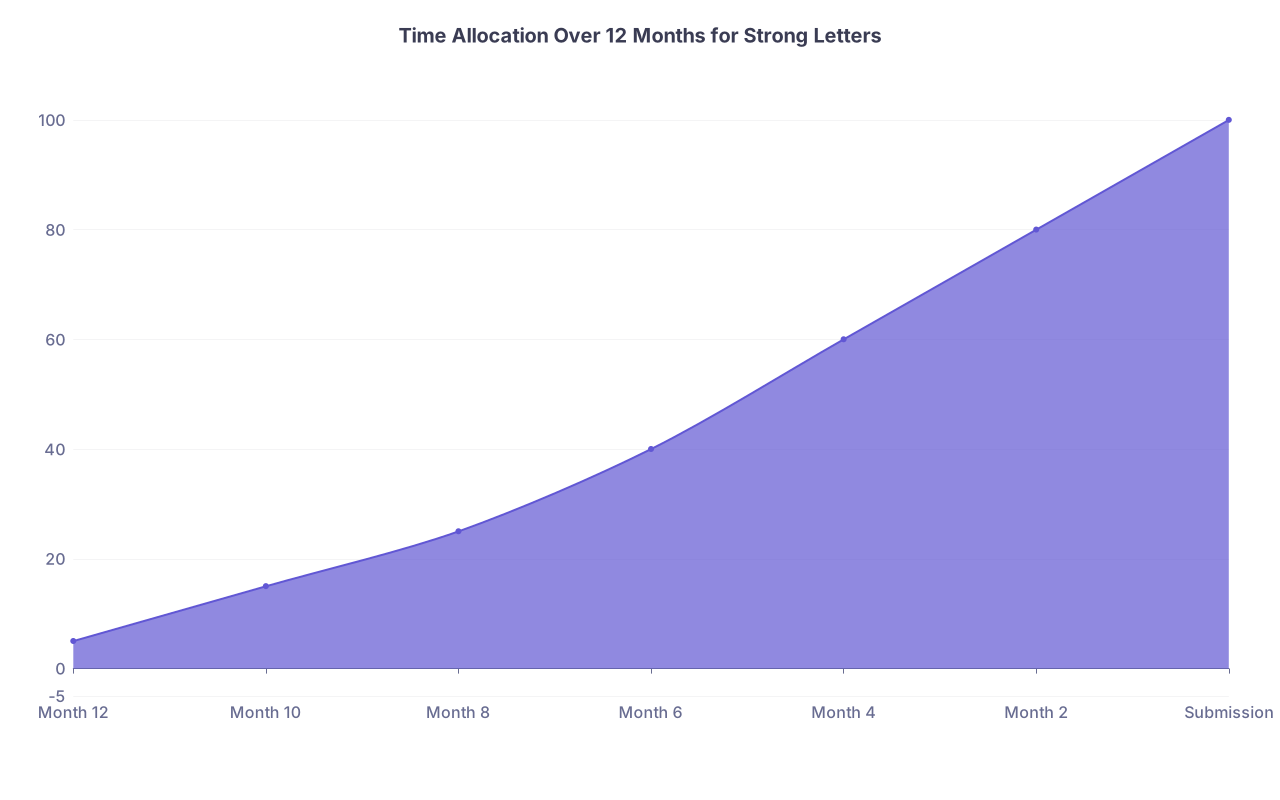
| Category | Value |
|---|---|
| Month 12 | 5 |
| Month 10 | 15 |
| Month 8 | 25 |
| Month 6 | 40 |
| Month 4 | 60 |
| Month 2 | 80 |
| Submission | 100 |
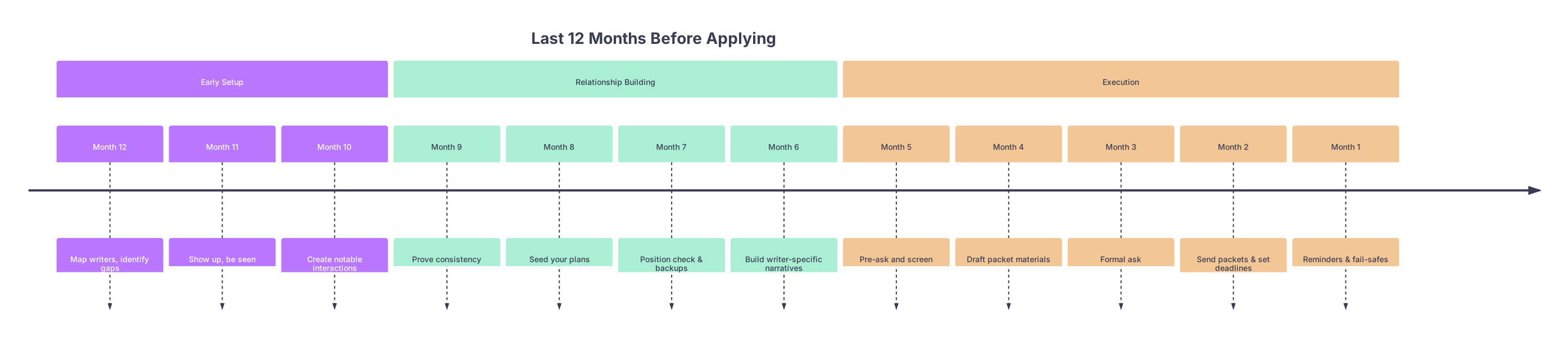
| Period | Event |
|---|---|
| Early Setup - Month 12 | Map writers, identify gaps |
| Early Setup - Month 11 | Show up, be seen |
| Early Setup - Month 10 | Create notable interactions |
| Relationship Building - Month 9 | Prove consistency |
| Relationship Building - Month 8 | Seed your plans |
| Relationship Building - Month 7 | Position check & backups |
| Relationship Building - Month 6 | Build writer-specific narratives |
| Execution - Month 5 | Pre-ask and screen |
| Execution - Month 4 | Draft packet materials |
| Execution - Month 3 | Formal ask |
| Execution - Month 2 | Send packets & set deadlines |
| Execution - Month 1 | Reminders & fail-safes |
Three Things to Remember
- Strong letters are earned, not requested. You build them through a year of consistent, visible work.
- Timing matters. Ask early, provide materials, and set clear but reasonable deadlines.
- Protect yourself. Always have backups, written records, and a personal system—so one busy professor never controls your entire application.