
It’s Tuesday afternoon and you’ve just left Intro Bio at your local community college. Class had 80 students, the professor lectured straight through, and half the room bolted the second the slide deck ended. You want to go premed. You know you’ll need strong letters of recommendation later. But right now? You feel like just another anonymous person in a big room with fluorescent lights.
Here’s the problem you’re quietly aware of: you’re not only competing with students at your college. You’re competing with students at four-year universities where professors run labs, write grants, and are used to sending premeds to med school every year. Those students often get letters from “Dr. Big-Name, MD, PhD, FACP.” You have Dr. Adjunct-who-teaches-three-schools and leaves immediately to beat traffic.
You are not doomed. But you cannot be casual about this.
If you’re at a community college and you want “transfer‑ready mentors” – people who can vouch for you to transfer schools and later to medical school – you need a deliberate plan. Not “I’ll get good grades and hope someone remembers me.” That does not work.
Here’s how to stop being anonymous and start building real mentors who will actually go to bat for you.
Step 1: Accept the Reality of Your Starting Point
Do this first, or you’ll waste time being resentful instead of strategic.
At a community college, you’re often dealing with:
- Larger intro classes where no one knows your name
- Instructors with massive teaching loads, sometimes across multiple campuses
- Limited or no on-site lab research in classic “premed” areas
- Advising that’s often generic: “finish your AA, then transfer”
You need letters for two phases:
- Transfer applications to a four-year university (often junior-level entry)
- Medical school applications down the line
Sometimes the same person can help with both. Often, you’ll build a first wave of mentors now, then a second wave after transfer. The trick is: make the first wave strong enough that they’re still useful even after you leave.
So your goals right now are:
- Stand out in at least 2–3 classes as “one of the best students”
- Convert 1–3 of those instructors into actual mentors who know your story
- Use them as leverage for research, honors programs, and transfer opportunities
If you do that by the end of community college, you’re in very solid shape.
Step 2: Pick the Right Potential Mentors (Not Just Any Professor)
Do not try to turn every instructor into a mentor. You’re looking for 2–3 good fits.
Look for professors who:
- Actually talk to students before/after class
- Run small group activities, office hours, or tutoring
- Show any interest in careers, not just content (“For those thinking of healthcare…” etc.)
- Seem organized and responsive to email (this matters more than their publication record right now)
Prioritize:
- Your core premed sciences: Biology, Chemistry, maybe Anatomy & Physiology
- An English or writing instructor who can comment on your communication skills
- A math or stats instructor if you click with them
If you have a choice of sections, pick the one with:
- Fewer students
- Earlier term reputation for being engaged
- Someone who’s been at the school a while
Ask older students: “Who here writes good letters for transfer or premed?” Word gets around.
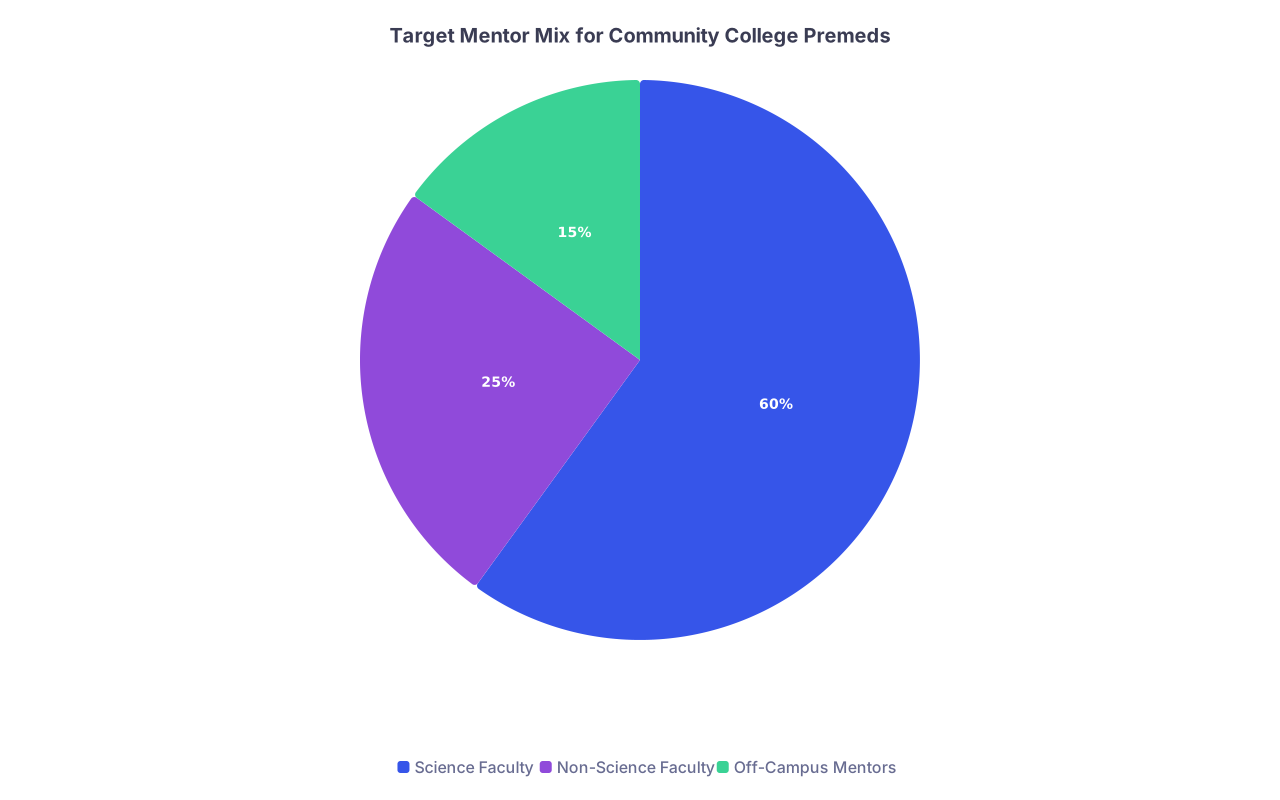
| Category | Value |
|---|---|
| Science Faculty | 60 |
| Non-Science Faculty | 25 |
| Off-Campus Mentors | 15 |
Step 3: Turn Class Performance into Relationship Capital
You do not “earn” a mentor just by getting an A. An A is your ticket into the conversation. That’s it.
Here’s what to actually do in a target class:
Week 1–2: Establish yourself
- Sit in the first couple of rows. Yes, really.
- Introduce yourself after class once:
“Hi Dr. Smith, I’m [Name]. I’m planning to transfer and eventually apply to medical school, so I’m really hoping to build a strong foundation here.” - Follow the syllabus exactly. Turn things in early, not just on time.
Weeks 3–6: Use office hours with a purpose
Stop “popping in to say hi.” Have something real to talk about. For example:- “I tried the practice problems and got stuck on this pattern – can we walk through where I’m going wrong?”
- “I’m trying to get better at reading primary literature. Could you recommend one paper in [topic] I could try, and how you’d approach reading it?”
- “Do you see students from community college successfully transfer to [Local State U] premed track? What do they usually do differently?”
You’re signaling three things: work ethic, curiosity, and long-term goals.
Weeks 7–End: Demonstrate improvement and consistency
- If you do poorly on a quiz, don’t disappear. Go in, show you’ve tried to fix it, ask for feedback.
- Volunteer for any optional projects, presentations, or tutoring opportunities.
- When your instructor sees your name, they should think: “Oh, that’s the student who…”
By the end of the term, your professor should know:
- Your full name
- Your long-term goal (transfer + med school)
- Specific evidence of your growth and reliability
That’s what you’re really building: a memory of you as a real person, not just “A in Bio 101.”
Step 4: Convert an Instructor into an Actual Mentor
A lot of students stall here. They do well in a class, maybe go to office hours once or twice, then vanish and come back a year later begging for a letter.
Do it differently.
As the semester is wrapping up (or right after grades post), you say something like:
“Dr. Lopez, I’ve really appreciated your class, especially [specific aspect – the way you explain X / the extra practice sets / the clinical examples]. I’m planning to apply to [transfer schools] next year and eventually to medical school. Would you be open to staying in touch as I move forward? I’d really value your guidance on how to keep building my preparation.”
You are not asking for a letter yet. You are asking to keep the relationship going. That’s less pressure for them and makes you sound like someone thinking beyond a transactional ask.
Then you actually stay in touch:
- Send occasional updates: “I got into the honors program,” “I started volunteering at the hospital,” “I’m taking Organic next term.”
- Ask for advice a couple times a semester: “I’m deciding between [two paths]. What would you recommend?”
- Show that you listened to prior advice, and tell them what happened.
At that point, they’re not just an instructor you had once. They’re someone who can write, “I have known [Name] for 18 months across courses and in multiple advising conversations…”
That’s mentor territory.
Step 5: Time and Script Your Letter Requests the Right Way
You’ll need letters at two main checkpoints:
- When you apply to transfer (often late in your time at community college)
- When you apply to medical school (after transfer, but community college letters can still be useful in a “committee packet” or as supplemental)
The mechanics matter.
Timing:
- For transfer: ask 4–6 weeks before letters are due
- For med school: if you plan to use a CC letter, reconnect at least 3–4 months before primary submission
How to ask (in person if possible, otherwise email):
“Dr. Patel, I’m applying to transfer to [Schools] for Fall 20XX and I’d be honored if you’d consider writing a strong letter of recommendation for me. I really appreciated [specific memory from class or mentorship], and I think you’ve seen how I [describe strengths: improved, took feedback, handled difficulty].”
The word “strong” is deliberate. It gives them an easy out if they can’t do that:
“If you don’t feel you can write a strong letter, I completely understand and I’d rather you say no.”
If they say yes, immediately follow with:
“I’ll send you a short packet with my resume, a draft of my personal statement, and a bullet list of things we’ve done together to make this easier for you.”
Then you actually send that within 24 hours.
| Item | Purpose |
|---|---|
| Resume/CV | Snapshot of activities and work |
| Draft personal statement | Context for your story and goals |
| Unofficial transcript | Shows academic record and trends |
| Bullet list of interactions | Reminds them what you did with them |
| Deadline & submission info | Prevents last-minute chaos |
Step 6: Build Mentor‑Level Relationships Outside the Classroom Too
Community college often lacks big NIH labs on-site. But that does not mean you’re stuck with only classroom instructors.
Think about mentors in three buckets:
On-campus academic mentors
- Science faculty
- Honors program coordinator
- Pre-health or STEM club advisor
Clinical / community mentors
- Volunteer coordinator at the hospital
- Clinic manager where you scribe or MA
- Physician you shadow regularly
Bridge mentors at four-year institutions
- Faculty who run summer programs or pipelines that accept CC students
- PI at a nearby university who takes you as a volunteer in their lab
Those last two are underrated. I’ve seen community college students land very credible letters from university PIs because they were strategic:
You email:
“Dear Dr. X, I’m a student at [Community College] planning to transfer into a biology program and eventually apply to medical school. I’m especially interested in [their research area]. I know I don’t have extensive lab experience yet, but I’m taking [relevant courses] and I’m eager to learn. Do you ever take on community college students as volunteers or summer students in your lab?”
You’ll get ignored sometimes. You only need one yes.
Once you’re in, treat that experience like grad school lite: be early, be reliable, read papers, ask questions. That PI can become a huge asset for both transfer and med school.
Step 7: Use Programs That Are Designed for Students Like You
You don’t get bonus points for doing this the hard way.
Look for:
- Honors programs at your community college that have “guaranteed” or preferred transfer pathways to state universities
- Formal pre-health or STEM scholars programs that come with built-in advising and letter writers
- Summer research programs that explicitly accept community college students (key phrase: “two-year college students welcome”)
Examples of program types (not exhaustive, just so you know what to Google):
- “UC Davis PREP for community college students”
- “University of X summer research experiences for undergraduates community college”
- “State University Y biomedical research pipeline program community college”
Those programs often expect to write letters. It’s part of their mission. You show up, do good work, you leave with a PI or program director who says, “We specifically recruited [Name] from community college and they were among the strongest participants.”
That looks fantastic to both transfer schools and med schools because it directly answers the unspoken question: “Can a community college student handle advanced work?”

| Step | Description |
|---|---|
| Step 1 | Start at Community College |
| Step 2 | Excel in Key Classes |
| Step 3 | Build Relationships with 2-3 Faculty |
| Step 4 | Join Honors/Pre-health Programs |
| Step 5 | Secure Research/Clinical Roles |
| Step 6 | Ask for Strong Letters for Transfer |
| Step 7 | Transfer to 4-year University |
| Step 8 | Maintain Mentor Relationships |
| Step 9 | Use CC + University Letters for Med School |
Step 8: Manage the “Community College Bias” Head-On
Let me be blunt: some people in admissions still discount community college a bit, especially for heavy science prerequisites. Not always, but it happens.
Your mentors and letters are one of your best tools to counter that.
You want letters that quietly answer:
- “Is this student actually capable at a university-level rigor?”
- “Did they choose community college for financial/family reasons, not because they couldn’t hack it?”
- “Have they done anything beyond the minimum?”
So when you give your letter writers your packet, you can guide them a bit. Not by writing your own letter, but by giving them bullet points that highlight:
- Times you went beyond the syllabus (extra problems, projects, tutoring peers)
- Any family, work, or financial realities you balanced while performing well
- How you improved over time (from average to top of class, for instance)
A professor who writes, “I’ve taught at both community college and State U, and [Name] is in the top 5% of students I’ve seen anywhere,” instantly shuts down the “but community college…” narrative.
You can’t make them say that. But you can give them enough evidence and context that they can say it honestly if it’s true.
Step 9: Keep Your Mentors Warm After You Transfer
A lot of students throw away their best community college advocates by going silent.
Don’t be that person.
You do not need weekly check-ins. But 2–3 times a year, send a genuine update. Example:
“Hi Dr. Nguyen,
I hope you’re doing well. I wanted to share an update since we last talked. I transferred to [New University] this fall and I’m taking Organic Chemistry and Cell Biology. Your General Chemistry class really set me up well – I’m noticing how often I go back to the problem-solving strategies we used in your course.
I’ve also started volunteering at [Hospital/Clinic] and joined the premed club. Still pushing toward medical school.
Thank you again for all your help back at [Community College]. If you ever write letters for current students who are unsure about transferring, I’m happy to talk with them about my experience.
Best,
[Name]”
You’ve done three things there:
- Expressed gratitude without groveling
- Reinforced that you’re progressing on the path you told them about
- Offered to be useful to them in return
That’s how relationships last. Years later, when you ask them to refresh or resend a letter for medical school, they’ll actually remember you.
Step 10: If Your College Is Extra Under-Resourced, Here’s the Workaround
Some community colleges are honestly rough: mostly adjuncts, no office space, everyone commuting in/out. If this is you, you have to be a little more aggressive in engineering access.
A few specific moves:
Use departmental leadership
Find the department chair or full-time faculty in biology/chemistry. Ask if there are any faculty who are particularly supportive of premeds or research-minded students. Chairs often know who “does letters.”Find the one or two “anchor” professors
Every under-resourced school has them. The person who advises the STEM club, runs the one research-like course-based project, organizes transfer nights. Attach yourself to them. Take multiple classes with them if possible.Make yourself easy to advocate for
Be the student who helps set up events, runs review sessions, builds the premed club’s website, whatever. Faculty will remember “the student who actually made my life easier.” That student gets the better letter.Go off-campus early
If your campus just truly cannot offer you mentors at the level you need, start seeking them at nearby four-year schools, hospitals, or labs as soon as you’ve got basic coursework done. Your strongest letters might not be from your college at all, and that’s fine.
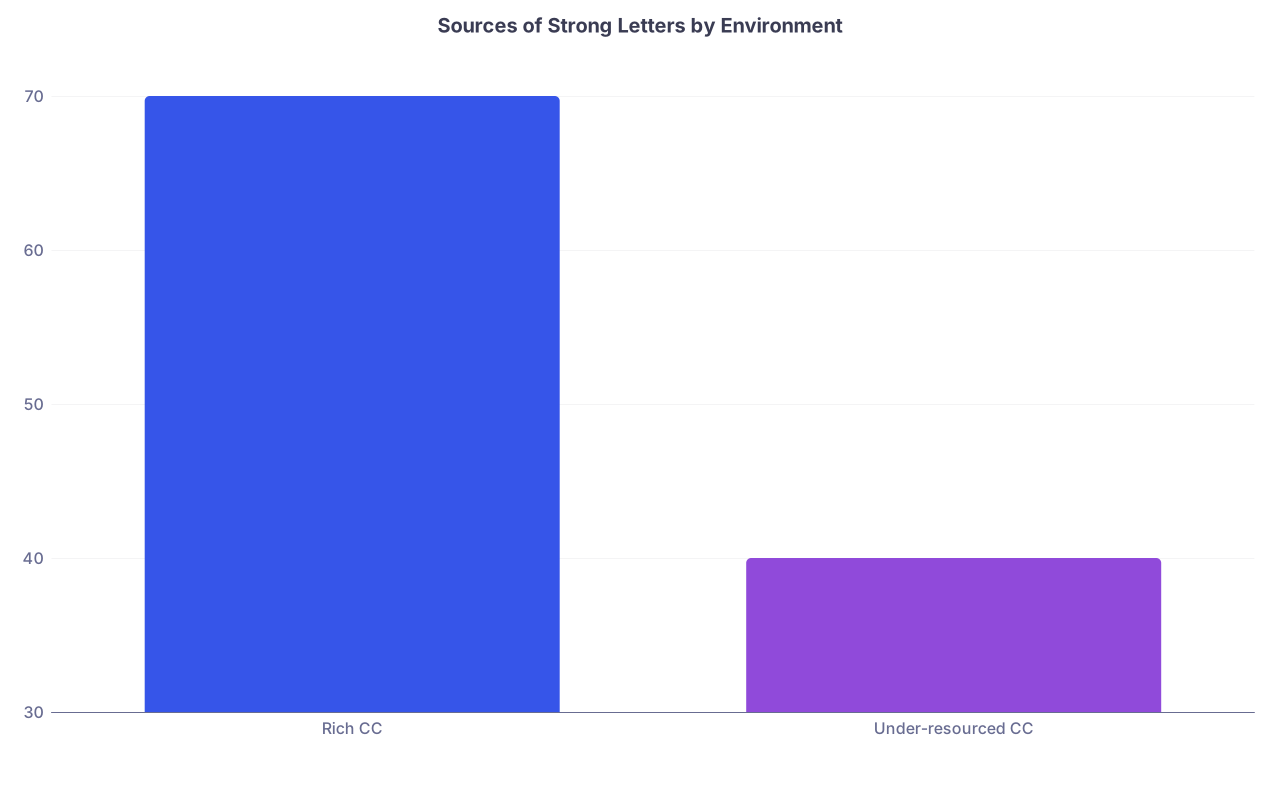
| Category | Value |
|---|---|
| Rich CC | 70 |
| Under-resourced CC | 40 |
Interpretation: in a “rich” community college, most letters can come from on-campus faculty; in a severely under-resourced one, you’ll lean more heavily on off-campus mentors.
Final Thoughts: What Actually Matters Here
If you’re still reading, you’re already ahead of most of your classmates. So let me condense this into what you really need to walk away with:
You cannot be passive. At community college, no one is coming to “discover” you. You have to pick targets, show up, ask good questions, and explicitly invite long-term mentorship.
Letters follow relationships, not just grades. An A in a class is the baseline. Mentorship happens because you deliberately turned that A into conversations, office hours, activities, and ongoing contact.
Think in phases. Phase 1: build 2–3 strong community college mentors for transfer and early credibility. Phase 2: layer on university faculty, research PIs, and clinical supervisors after you transfer. Keep your early mentors warm so they can still vouch for your trajectory.
Do this right, and “I started at community college” becomes part of your strength story, not a liability. You’ll have people – real people – willing to say, in writing, “This student belongs in the room.” That is the whole game.